
The Art of the 'Exit Into': Transforming Your Business into a Lasting Legacy
What if the conclusion of your professional tenure was not a departure, but a deliberate restoration of your own identity? For many founders, the concept of a sale feels like a cold ending; yet, the most visionary leaders understand that a true exit into their next chapter requires the same meticulous craftsmanship they applied to their company’s growth. You have spent decades building a soul into your enterprise. The thought of handing over the keys to a generic broker feels like a betrayal of that heritage. It's natural to feel a profound sense of protective reverence for what you've created.
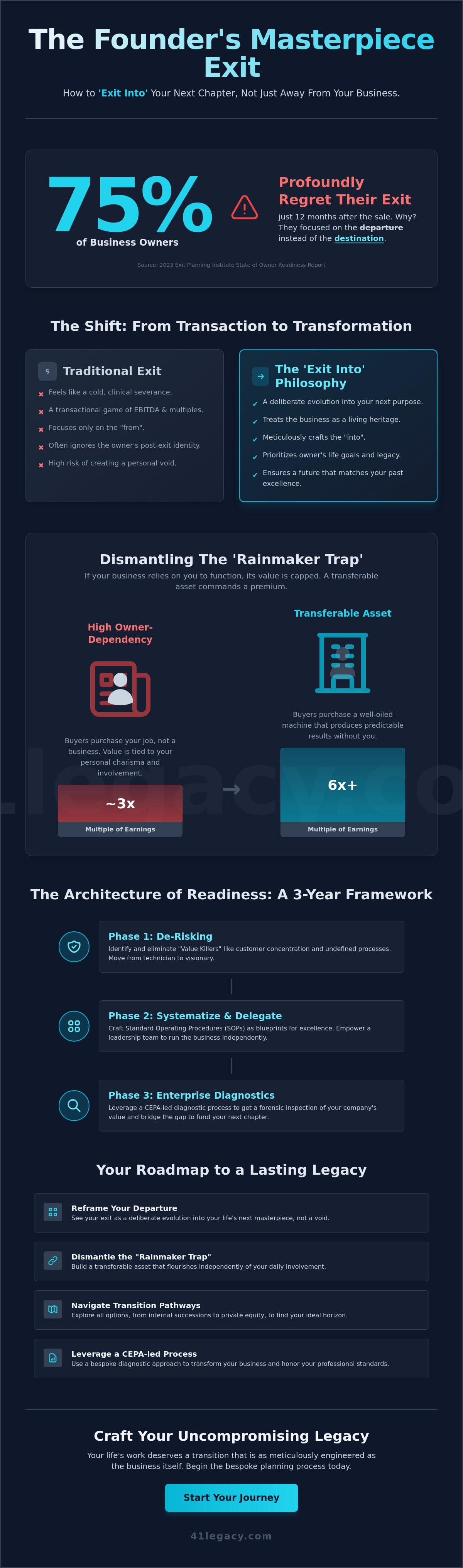
The 2023 Exit Planning Institute State of Owner Readiness Report reveals that 75% of owners experience profound regret only 12 months after a sale because they lacked a meaningful destination. We'll show you how to bridge the value gap and ensure your life's work remains an uncompromising masterpiece. This article provides a bespoke roadmap to elevate your business’s worth while securing a seamless transition into a future defined by purpose rather than just profit.
Key Takeaways
- Reframe your departure as a deliberate evolution, learning how to purposefully exit into your life’s next masterpiece rather than simply leaving a void.
- Discover how to dismantle the "Rainmaker Trap" by building a transferable asset that flourishes independently of its founder’s daily involvement.
- Navigate the diverse spectrum of transition pathways, from internal leadership successions to external private equity acquisitions, to find your ideal horizon.
- Implement a meticulous three-year architecture of readiness to ensure your enterprise is operationally prepared for a seamless and sophisticated handover.
- Leverage a bespoke, CEPA-led diagnostic process to transform your business into a lasting legacy that honors your uncompromising professional standards.
Beyond the Departure: What It Means to 'Exit Into' Your Next Chapter
To many, leaving a business feels like a clinical severance. It's viewed as a finality, a cold conclusion to years of toil. We believe this perspective is flawed. True mastery requires a shift from a clean break to a deliberate evolution. You aren't simply walking away from a company; you're choosing to exit into a purpose that honors everything you've built. This isn't about escaping a burden; it's about the preservation of a soul.
Most entrepreneurs approach their departure through the lens of a standard exit strategy. While these frameworks provide a roadmap for the transaction, they often ignore the owner's post-exit identity. Data from the Exit Planning Institute’s 2023 State of Owner Readiness Report shows that 75% of business owners profoundly regret their exit 12 months after the sale. They fall into a void because they focused on the departure instead of the destination. A Certified Exit Planning Advisor (CEPA) changes this narrative. They act as a master craftsman, meticulously framing the transition to ensure the "into" is as robust as the "from."
The 'Exit Into' Philosophy vs. Traditional M&A
Traditional M&A is a transactional exchange. It's a game of EBITDA and multiples. In contrast, the exit into philosophy treats the business as a living heritage. We prioritize the owner's life goals over mere spreadsheet optimization. This requires a deep reverence for the history of the enterprise. You've spent decades refining your craft; your transition should reflect that same level of uncompromising quality. It's about strategic legacy building, ensuring the brand's DNA survives the change in ownership.
Identifying Your Personal 'Legacy Horizon'
Success looks different when it's no longer measured by a balance sheet. You must assess your emotional readiness for this shift. Does your vision include bespoke philanthropy, the birth of new ventures, or the quiet grace of curated leisure? Defining this horizon is essential. Without a clear vision for your next chapter, even the most lucrative deal will feel hollow. We help you build a bridge to a future that matches the excellence of your past, ensuring your personal evolution is as meticulously engineered as the business itself.
Building the Vessel: Why Transferability is the Foundation of Your Exit
To exit into a legacy requires more than a profitable balance sheet. It demands a transferable asset. In the world of high-end restoration, a vehicle's value lies in its provenance and its ability to perform for any driver. Your business must function with the same independent grace. If your presence is the only spark plug that fires the engine, the enterprise remains a personal project rather than a commercial masterpiece. A transferable asset is a firm that thrives, scales, and breathes without the constant intervention of its founder.
Many founders fall into the Rainmaker Trap. When the owner generates 75% or more of the revenue, the business's value plummets. This happens because the intellectual property walks out the door at the end of every day. Buyers don't want to purchase your personal charisma; they want to buy a machine that produces predictable results. Meticulous documentation serves as the automotive-grade engineering for your firm. It ensures that every process is repeatable and every outcome is precise. This level of craftsmanship directly impacts the multiple. A company with high owner-dependency might trade at a 3x multiple of earnings, while a fully transferable firm can often command 6x or higher. Precision pays.
The Architecture of De-Risking
De-risking is the process of identifying and removing Value Killers. These are structural flaws, such as having a single client account for 30% of your income, that stall a transition. Sophisticated delegation moves the owner from the role of lead technician to that of a visionary curator. Standard Operating Procedures act as the blueprints for excellence. They ensure that your brand's soul remains intact even when you aren't there to oversee the work. You can explore how a bespoke strategy can help you build this foundation of independence.
Enterprise Diagnostics and the Value Gap
Enterprise diagnostics serve as the forensic inspection of your organization. They reveal the delta between your current valuation and the capital required to fund your next chapter. The Value Growth Roadmap acts as a tool for uncompromising improvement, providing a step-by-step guide to bridge this divide. It's a disciplined approach to evolution that turns a standard business into a high-performance legacy. The Value Gap is the distance between current reality and legacy goals.
Choosing Your Horizon: Comparing Internal and External Exit Pathways
The architect of a business faces a choice similar to a master restorer deciding whether to keep a rare vehicle in a private collection or offer it to the global market. This decision defines the very nature of what you will exit into, shifting your role from the active creator to the silent guardian of a legacy. The spectrum of options isn't merely a financial calculation; it's a curation of the future. You must choose between the intimate stewardship of internal transitions and the high-octane environment of external acquisitions.
Internal Transitions: Keeping it in the Family or Firm
Internal pathways, such as Employee Stock Ownership Plans (ESOPs) or management buyouts, function as a meticulous preservation of the company's DNA. According to 2023 data from the National Center for Employee Ownership, ESOP companies demonstrate a 2.5% higher annual growth rate than firms without employee ownership. This route prioritizes cultural continuity. You're entrusting the "soul" of the firm to those who've already spent years mastering its rhythm. It's a bespoke solution for the owner who views their staff as fellow artisans.
- Mechanics: ESOPs allow for a gradual transfer of equity, often providing tax advantages for the seller.
- Culture: The existing leadership maintains the brand's core values without interference from outside interests.
- Financials: These deals often utilize long-term internal notes; your final payout depends on the firm's enduring performance.
External Sales: The Pursuit of Maximum Enterprise Value
External sales represent the pursuit of peak enterprise value. These transactions involve intense scrutiny from institutional buyers who analyze the business with clinical precision. Strategic buyers, those looking to integrate your unique capabilities into their own operations, often pay a premium of 20% to 30% over purely financial buyers. However, this capital comes with a trade-off. The higher the valuation, the less control you retain over the brand's future evolution. You must decide if the buyer respects the craftsmanship or merely the cash flow generated by the engine.
Preparing for this path requires an uncompromising audit of your systems. Institutional buyers look for "turnkey" excellence. If the business relies too heavily on your personal touch, the valuation will drop. You're effectively deciding what you exit into: a clean break with a significant capital event, or a structured transition where you might remain as a consultant for 12 to 24 months. For the connoisseur owner, the challenge is finding a buyer who recognizes that the company's value lies in its heritage, not just its balance sheet.
The Architecture of Readiness: Preparing Your Enterprise for a Seamless Transition
True excellence isn't rushed; it's curated. We believe the three-year rule is the gold standard for business preparation. This window allows for the meticulous refinement of every operational component, ensuring that your exit into the next chapter of your life is as smooth as a perfectly tuned engine. You wouldn't enter a premier concours event with a vehicle assembled in a week. Your business deserves the same reverence and time to achieve peak performance. This duration provides the runway needed to identify inefficiencies and replace them with bespoke systems that stand the test of scrutiny.
Coordination is the soul of a successful transition. Your advisory team, consisting of CPAs, attorneys, and strategic advisors, must operate under a Quarterback model. One lead visionary ensures every expert moves in harmony toward your singular legacy goal. Without this central alignment, the transition risks becoming a collection of disjointed efforts rather than a unified masterpiece. This structural integrity protects your enterprise value during the due diligence phase, preventing potential buyers from finding flaws in the mechanical or financial health of the organization.
The Value Growth Roadmap Implementation
Success requires the monthly execution of strategic improvements. We don't settle for "good enough" when perfection is attainable. Financial forecasting acts as your compass, establishing a level of credibility that attracts the most discerning buyers. You're not just selling a company; you're offering a proven trajectory. Talent development serves as the engine's displacement, driving enterprise value by proving the business thrives beyond your daily involvement. A legacy that depends on one person is a liability; a legacy that depends on a team is an asset.
The Role of Financial Precision
Pro forma statements are more than numbers on a page. They're a narrative of potential, illustrating what the enterprise can achieve under new stewardship. There's a vital distinction between tax-ready and exit-ready financials. While tax-ready books focus on minimization, exit-ready books focus on transparency and growth. Impeccably clean books are the polished chrome of a business sale, reflecting the true quality and care invested in the machine beneath the surface. When a buyer looks at your records, they should see a reflection of an uncompromising commitment to clarity.
To ensure your business is prepared for its ultimate showcase, you must begin the refinement process today. Learn how to secure your professional legacy through our master-crafted transition strategies.
Crafting Your 41 Legacy: A Bespoke Approach to Exit Planning
At 41 Legacy, we don't view a company as a mere collection of balance sheets and spreadsheets. We see it as a living entity, a masterpiece of engineering that's been refined over decades of effort. Our role is that of the guardian. We protect the automotive and business history you've built, ensuring that your transition isn't a disappearance but an evolution. To exit into a life of significance requires more than a simple transaction; it demands the steady hand of a master craftsman who understands the weight of heritage.
Our process is led by the Certified Exit Planning Advisor (CEPA) framework, utilizing the Value Acceleration Methodology. This isn't a standard consulting service. It's a rigorous, three-act play designed to synchronize your personal, financial, and business goals. We treat your company's final evolution with the same reverence a restorer brings to a rare 1960s prototype. Every adjustment is intentional. Every decision serves the long-term integrity of the machine.
The 41 Legacy Diagnostic Process
The journey begins with an exhaustive diagnostic phase. We don't believe in surface-level observations. We look deep into the chassis of your enterprise to identify the specific levers that drive value. This initial assessment evaluates the "Four Capitals": human, structural, customer, and social. Research from the Exit Planning Institute suggests that up to 80% of a business owner's wealth is tied up in their company. Our diagnostic ensures that wealth isn't just theoretical; it's protected and optimized through an uncompromising standard of excellence.
- Value Discovery: A baseline valuation to understand where the enterprise stands today.
- Gap Analysis: Identifying the distance between your current value and your ultimate potential.
- Actionable Roadmaps: Prioritizing the 3 to 5 key initiatives that will have the greatest impact on your EBITDA multiple.
Securing Your Life's Work
True peace of mind comes from knowing your business is a transferable, high-performance asset. It's a sobering reality that only 20% to 30% of businesses that go to market actually sell. We work to place you in that elite percentage by creating a coordinated strategy that removes the owner from the center of the engine. When the business can thrive without your daily intervention, it becomes a legacy. It becomes something that can endure for generations.
This is the moment to decide how your story continues. You've spent years building something remarkable; don't leave its final chapter to chance. The path to a meaningful exit into your next great endeavor starts with a single, deliberate choice. We invite you to join us in this pursuit of perfection. Begin your Legacy Assessment with 41 Legacy today and ensure your life's work receives the stewardship it deserves.
Securing Your Place in History
The transition from founder to steward is a deliberate evolution of your life's work. It demands a shift from the daily mechanics of operation to the high-altitude vision of a true curator. True enterprise value isn't a byproduct of chance. It's the result of building a transferable vessel that thrives long after your hands leave the wheel. Research from the Exit Planning Institute indicates that roughly 70% of private businesses fail to sell, often because they lack the structural readiness required for a successful handoff. By refining your enterprise architecture now, you ensure that your eventual departure becomes a seamless exit into a future defined by new purpose and absolute freedom.
Our team, led by a Certified Exit Planning Advisor (CEPA), applies the same meticulous craftsmanship to your business value as a master restorer applies to a rare vintage chassis. We don't believe in generic templates or hurried departures. We develop bespoke value growth roadmaps with an uncompromising focus on the soul of your company and its long-term health. Your business is more than a series of transactions; it's a living heritage waiting for its next chapter. Begin your journey toward a transferable legacy with 41 Legacy. The road ahead is open, and your masterpiece is ready for its final, most important refinement.
Frequently Asked Questions
What does it mean to 'exit into' a new chapter?
It's a strategic transition where an owner moves toward a purposeful future rather than away from a past burden. To exit into a new chapter means treating the business as a masterpiece ready for its next curator while the founder pursues a pre-defined legacy. According to the Exit Planning Institute, 75% of owners regret selling within 12 months because they lacked a personal vision for what follows the sale.
How long does it take to prepare for a business exit?
A meticulous transition requires a minimum of 3 to 5 years to maximize value and ensure operational stability. This timeline allows for the systematic removal of owner-dependency and the refinement of financial systems. Data from the 2023 State of Owner Readiness Report indicates that 49% of business owners have done no planning. This neglect often results in rushed sales that sacrifice up to 30% of potential value.
Why is my business worth less than I think it is?
Market value often diverges from emotional value because buyers prioritize transferable cash flow and risk mitigation over historical sentiment. If your business lacks documented processes or diversified revenue, it carries a higher risk profile. Industry benchmarks show that companies with a "key person" dependency often see valuation multiples decrease by 20% compared to peers with autonomous management teams. This reality reflects the cold, meticulous precision of investment math.
What is the difference between an exit planner and an M&A broker?
An exit planner serves as the architect of your long-term strategy, while an M&A broker acts as the agent for the final transaction. The planner begins work years in advance to cultivate value and align personal goals. In contrast, the broker enters the narrative when the asset is ready for market. Statistics suggest that businesses utilizing comprehensive planning are 2 times more likely to close a deal successfully through professional channels.
Can I exit my business if it still depends on me for daily operations?
You cannot successfully exit into a legacy if the machinery of the business ceases to function in your absence. A business tethered to its founder is a job, not a transferable asset. To secure a premium valuation, you must transition from the primary driver to the visionary architect. Investors typically discount businesses where the founder handles more than 20% of client-facing or technical tasks, as this creates unacceptable operational risk.
How does a Value Growth Roadmap actually increase enterprise value?
A Value Growth Roadmap identifies specific structural weaknesses and applies engineering precision to repair them. By focusing on the "Four Capitals" of Human, Customer, Social, and Structural assets, this process builds a foundation of institutional knowledge. Research from the Value Builder System shows that companies achieving a score of 80 or higher out of 100 receive offers 71% higher than the average business. It's a blueprint for uncompromising excellence.
What is the role of a 'Quarterback' in the exit planning process?
The Quarterback is the lead advisor who synchronizes the efforts of your CPA, attorney, and wealth manager into a single, harmonious movement. This role ensures that every technical detail serves the overarching vision of the legacy. Without this central coordination, 50% of business transitions fail due to conflicting advice or overlooked tax implications. They maintain the rhythm of the project from inception to the final signature, protecting your uncompromising standards.