
The Art of the Exit: Crafting a Business Strategy for Lasting Legacy
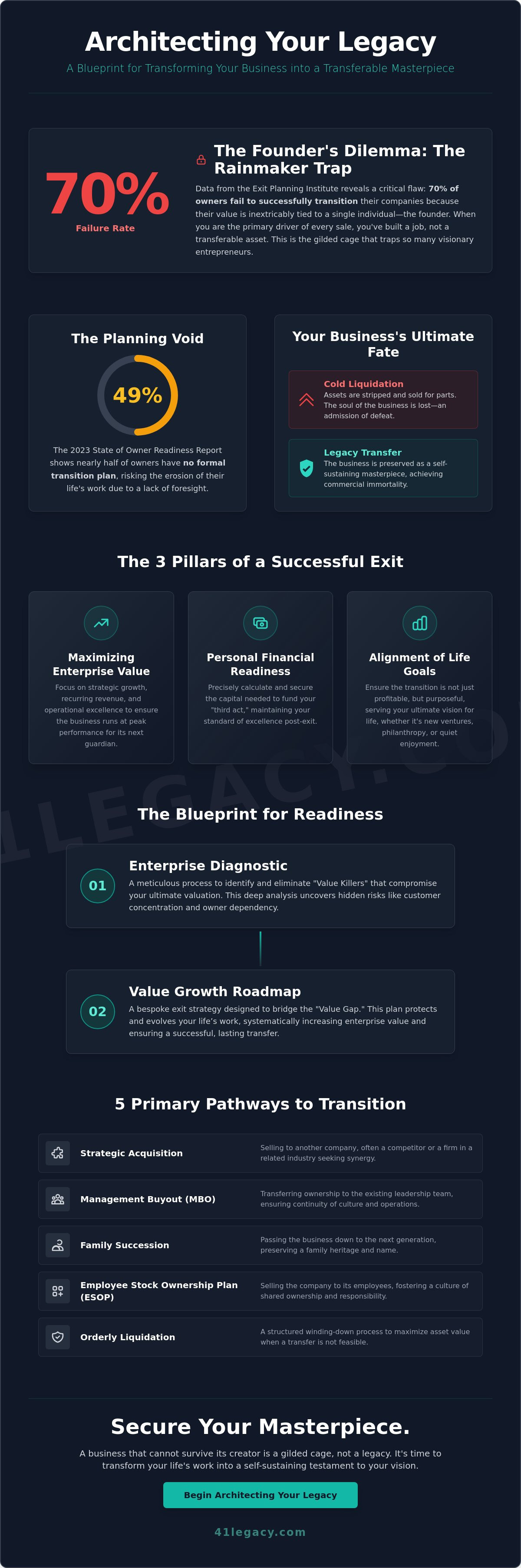
A business that cannot survive the departure of its creator is not a legacy; it is a gilded cage. You've poured your soul into every detail, yet data from the Exit Planning Institute suggests that 70% of owners fail to successfully transition their companies because they remain the primary driver of every sale. This Rainmaker Trap creates a fragile enterprise where value is tied to a single pulse rather than a repeatable system. To truly honor your craftsmanship, you must architect a sophisticated exit strategy that transforms your daily operations into a transferable masterpiece.
You likely believe that your personal involvement is the only thing maintaining the uncompromising standards your clients expect. We'll show you how to transcend this limitation to secure your financial freedom while ensuring the business thrives in your absence. This article provides a clear roadmap to maximizing your final enterprise value through meticulous preparation and strategic evolution. We'll explore the essential steps to decouple your soul from the machinery, allowing your life's work to endure as a self-sustaining testament to your vision.
Key Takeaways
- Transform your business from a personal occupation into a transferable masterpiece by distinguishing between mere liquidation and a legacy-driven transfer.
- Learn to dismantle the "Rainmaker Trap" to ensure your organization possesses the structural integrity to thrive independently of its founder.
- Evaluate the five primary pathways to transition—including strategic acquisitions and management buyouts—to ensure the soul of your company remains intact.
- Master the meticulous process of the Enterprise Diagnostic to identify and eliminate "Value Killers" that compromise your ultimate valuation.
- Implement a bespoke exit strategy through a Value Growth Roadmap designed to protect and evolve your life’s work into a lasting heritage.
What is an Exit Strategy? Beyond the Financial Transaction
An exit strategy isn't merely a final act. It's a meticulous blueprint designed to transition the stewardship of a living enterprise from one guardian to the next. While many conflate the term with a simple sale, a true exit strategy is a comprehensive plan that ensures a brand’s soul survives the departure of its founder. It's the essential difference between a cold liquidation, where assets are stripped and sold for parts, and a legacy-driven transfer, where the business is preserved as a functioning masterpiece. To liquidate is to admit defeat; to transfer a legacy is to achieve a form of commercial immortality.
Precision in planning should begin the moment the first brick is laid. Waiting for the horizon of retirement often leads to rushed decisions and compromised value. Data from the 2023 State of Owner Readiness Report indicates that 49% of business owners haven't engaged in any formal transition planning. This lack of foresight often results in the erosion of what was once a proud heritage. To avoid this, an owner must view their company as a bespoke product to be perfected for a future buyer. It's no longer just a place to work; it's a high-performance machine that must be tuned to run without its original creator at the controls.
The Philosophical Shift: From Owner to Steward
The evolution of a founder requires moving from being the "soul" of the machine to becoming its meticulous curator. When an owner is the sole driver of every process, the business lacks the independence to survive without them. By building systems that mirror the harmony of a high-end engine, the owner ensures the brand’s heritage is preserved long after they step away. This stewardship focuses on the evolution of the brand rather than the ego of the individual. An exit strategy is the ultimate manifestation of business maturity.
The Three Pillars of a Successful Exit
A sophisticated transition rests on three uncompromising supports that define the strength of the eventual handoff:
- Maximizing Enterprise Value: This involves strategic growth that focuses on recurring revenue and operational excellence. It ensures the machine runs at peak performance for the next guardian, commanding a premium price based on its inherent quality.
- Personal Financial Readiness: Preparing for the "third act" of life requires a precise understanding of the capital needed to maintain one's standard of excellence post-exit. It's about securing the resources to fund a future of continued refinement and passion.
- Alignment of Life Goals: The transition shouldn't just be profitable; it must be purposeful. This pillar ensures that the exit strategy serves the owner’s ultimate vision for their life, whether that involves philanthropy, new ventures, or the quiet enjoyment of a collection well-earned.
The Architecture of Value: Why Most Exit Strategies Fail
Constructing a business is an act of high-end engineering, yet many founders inadvertently build a gilded cage rather than a transferable masterpiece. The most common point of failure is the "Rainmaker Trap," where the owner remains the primary architect of every significant sale. When a firm's success is tethered to a single individual's charisma or specialized knowledge, its market value evaporates the moment that individual steps away. A buyer isn't seeking to purchase a job; they're looking for a self-sustaining engine. True exit strategy planning requires a shift from being the performer to being the conductor of a finely tuned orchestra.
Value growth is fundamentally distinct from simple revenue expansion. While a 15% increase in annual turnover looks impressive on a balance sheet, it doesn't always translate to a higher sale multiple. Enterprise diagnostics often reveal hidden risks, such as customer concentration where a single client represents more than 20% of revenue, that devalue the firm in the eyes of sophisticated investors. We must look beyond the surface to ensure the business can breathe independently, possessing a soul that survives the transition of its creator.
Mind the Gap: Identifying the Value Gap
The "Value Gap" is the silent chasm between what your business is worth today and what it could be worth with meticulous optimization. To bridge this, one must first calculate the "Wealth Gap," which is the difference between your current net worth and the specific capital required to sustain your lifestyle after the transition. A 2023 study by the Exit Planning Institute found that 76% of owners who sold their businesses later regretted the decision, often because they hadn't performed a diagnostic to align their financial needs with the various types of business exit strategies available to them. This process isn't merely accounting; it's an uncompromising audit of the firm's potential.
The Devaluation of Owner-Dependency
Buyers discount companies where the founder holds all key relationships. If the institutional knowledge isn't codified, the asset is fragile. Standard Operating Procedures (SOPs) act as the blueprint for this mechanical harmony, ensuring that every process, from procurement to client delivery, is executed with bespoke precision by the team rather than the leader. This creates a legacy that stands independent of its creator. When your firm operates with this level of autonomy, it transforms from a personal service into a high-performance asset. For those seeking to refine their internal systems, engaging with a steward of operational excellence can reveal the path toward true transferability.
Evaluating Your Path: 5 Primary Business Exit Strategies
Choosing an exit strategy isn't merely a financial decision; it's the final stroke on a masterpiece. Just as a meticulously restored 1960s grand tourer requires a specific environment to shine, your business demands a transition that honors its mechanical soul. We view these five paths as distinct avenues of evolution, each requiring a different level of technical precision and emotional preparation.
- Strategic Acquisition: This involves selling to a competitor or a larger firm to capture a maximum premium. It's the pursuit of the "Maximum Multiple," where a buyer pays for the synergy your craftsmanship adds to their existing portfolio.
- Management Buyout (MBO): This path transitions the soul of the company to the existing team. It ensures the engine keeps running with the same precision by placing the keys in the hands of those who helped build the legacy.
- Family Succession: The delicate art of passing the torch to the next generation. It requires a balance of emotional heritage and technical competence to ensure the brand's story continues uninterrupted.
- Employee Stock Ownership Plan (ESOP): This builds a legacy of shared ownership. It transforms your workforce into a collective of stewards, ensuring the company’s values remain anchored in the community.
- Initial Public Offering (IPO): The rarest and most complex path to the public markets. While it offers immense liquidity, it subjects the brand to the uncompromising scrutiny of global investors.
Internal vs. External Transitions
An external sale often yields a higher liquid value, yet it frequently demands a sacrifice of control. The buyer might choose to dismantle the heritage you've spent decades building. Conversely, an internal transfer focuses on the "Heritage" and "Soul" of the enterprise. It prioritizes the preservation of a "Bespoke" vision over a quick exit. Research from the Exit Planning Institute shows that roughly 70% of private businesses fail to sell when they go to market; often because the owner failed to choose a path that aligned with the company's underlying identity.
The Role of the M&A Advisor vs. the Exit Planner
Distinguishing between these roles is vital for a seamless transition. A broker or M&A advisor is a specialist in the transaction; they focus on the "deal." An exit planner focuses on "Exit Readiness Assessments" to ensure the business can thrive without its founder. Statistics indicate that 80% of a business owner’s wealth is typically locked within their company. 41 Legacy acts as the "Quarterback" for this entire advisory team. We ensure that every legal, financial, and emotional gear is synchronized long before a broker is engaged. Your exit strategy must be as refined and intentional as the craftsmanship that defined your career.
The Blueprint for Readiness: Preparing for a Meticulous Transition
True excellence requires preparation. Much like the restoration of a 1964 Porsche 911, a sophisticated exit strategy is not a single event but a series of precise, intentional movements. It begins with a deep Enterprise Diagnostic. This forensic audit establishes a baseline valuation, stripping away assumptions to reveal the raw mechanical truth of the organization. We then identify and mitigate "Value Killers." These are the structural flaws, such as a 25% customer concentration or an over-reliance on the founder, that erode the premium a buyer is willing to pay.
Closing the Value Gap requires a bespoke Value Growth Roadmap. This document serves as the technical manual for the company’s evolution, detailing exactly how to enhance the 12-month trailing EBITDA. Once the foundation is secure, we align the professional advisory team. This group typically includes your CPA, Attorney, and Wealth Manager. Finally, we execute the transition with a focus on preserving the company’s soul. The goal isn't just a transaction; it's the preservation of a heritage as it passes to new hands.
The Timeline of Excellence
A world-class exit isn't rushed. It demands a horizon of 3 to 5 years. This window allows for a complete evolution of the business, shifting it from owner-centric to system-driven. During these 36 to 60 months, monthly advisory support keeps the roadmap uncompromising. It ensures every decision reinforces the legacy you’ve built. Without this lead time, you're merely selling a job; with it, you're transferring a masterpiece. This period is where the business matures into its most valuable form.
Coordinating the Advisory Team
Success relies on the "Quarterback" model. Without a central lead, advisors often operate in silos. This leads to conflicting decisions that can stall a deal or create unforeseen tax liabilities. A Certified Exit Planning Advisor (CEPA) brings harmony to this group. They ensure the CPA’s tax strategy aligns perfectly with the Attorney’s contract language and the Wealth Manager’s post-exit requirements. It’s a choreographed performance where every professional pulls in the same direction, protecting the integrity of your exit strategy.
Securing the Legacy: The 41 Legacy Strategic Advisory Approach
At 41 Legacy, we don't view a business as a mere collection of balance sheets. It's a living organism. It's a masterpiece that requires a dedicated guardian to reach its full potential. Our mission centers on the preservation and elevation of your life’s work. We recognize that your enterprise is more than a source of income; it's a testament to your dedication and skill. Our Value Growth Roadmap serves as the definitive blueprint for this evolution. It's a bespoke implementation plan designed to bring your business to full maturity before you ever consider a transition. By focusing on intrinsic value, we ensure your exit strategy isn't just a departure, but a coronation.
Excellence is never an accident. It's the result of high intention and sincere effort. Our Monthly Implementation Support provides the rigorous accountability required to transform vision into reality. We act as the master mechanics of your corporate structure, fine-tuning every department to ensure peak performance. This consistent oversight prevents the drift that often stalls progress in less disciplined environments. We don't simply provide advice; we walk the floor with you, ensuring every adjustment aligns with the overarching vision of a timeless enterprise.
The 41 Legacy Difference
We approach the boardroom with the same reverence a restorer brings to a 1964 Ferrari 250 GTO. We honor the Art of Business and the Craft of Leadership. Most advisors focus on a quick sale. We focus on transferable assets. This distinction is vital. A sales transaction is a moment in time; a transferable asset is a legacy that endures. Every advisory engagement is bespoke, honoring your specific history while engineering a future that remains uncompromising in its quality. We believe leadership is a craft to be perfected, ensuring the soul of the company remains intact long after the keys change hands.
Your Next Step Toward a Timeless Legacy
The path to a graceful exit begins with clarity. According to the Exit Planning Institute’s 2023 State of Owner Readiness Report, 75% of owners who sold their businesses later regretted the decision because they lacked a personal plan. Don't leave your legacy to chance. A meticulously planned exit offers more than financial gain; it provides the profound peace of mind that comes from knowing your work will continue to thrive. Your journey toward a timeless transition begins with an Exit Readiness Assessment. It's time to ensure your exit strategy reflects the excellence of your career. This diagnostic reveals hidden vulnerabilities and highlights opportunities for significant value appreciation.
Curating the Final Act of Your Professional Masterpiece
Your business is a masterpiece of personal engineering. Moving toward a transition requires the same surgical precision as tuning a high-performance engine for its next century of service. You've seen that a sophisticated exit strategy is not a mere departure; it's the final, vital stage of value architecture. By evaluating the 5 primary paths of transition, you ensure the soul of your enterprise endures while maximizing the financial harvest of your labor. Success isn't accidental; it's the result of meticulous readiness.
41 Legacy operates as the master craftsman of this transition. Our firm is led by a Certified Exit Planning Advisor (CEPA), a designation representing the elite standard in global planning. We utilize a bespoke Value Growth Roadmap and a comprehensive Quarterback advisory model to synchronize your financial and personal goals. This disciplined approach removes the friction of uncertainty, replacing it with the steady rhythm of a well-timed handoff. You've spent decades building a heritage of excellence; we're here to ensure that excellence remains untarnished. Your vision deserves a finish that is as flawless as its inception.
Begin your journey toward a transferable legacy with 41 Legacy.
Frequently Asked Questions
What is the difference between an exit plan and an exit strategy?
An exit strategy is the overarching vision for your departure, while an exit plan is the meticulous roadmap of tactical steps required to execute it. Your strategy identifies the ultimate destination, such as an IPO or a private sale to a competitor. In contrast, the plan details the 12 to 24 months of operational adjustments needed to reach that goal. It's the difference between a master's vision and the artisan's specific blueprints.
How far in advance should I start planning my business exit?
You should begin crafting your exit strategy at least 3 to 5 years before your intended departure date. This timeframe allows you to increase business value and address structural weaknesses that could deter buyers. According to the Exit Planning Institute, 75% of owners regret their exit within one year due to poor preparation. Starting early ensures your legacy remains intact and your financial goals are met with surgical precision.
Why is owner-dependency a major risk for my exit strategy?
Owner-dependency is a risk because it suggests the business cannot function without your personal intervention, which devalues the asset. If you're responsible for 80% of client relationships or technical decisions, a buyer sees a high-risk investment rather than a self-sustaining entity. Meticulous documentation and a robust management team are essential. Transitioning these responsibilities ensures the soul of the enterprise survives your absence and maintains its premium market position.
Can I still have an exit strategy if I do not want to retire yet?
You can absolutely implement a transition plan without immediate retirement goals to ensure your business is always market-ready. This proactive approach treats the company as a masterpiece in progress, ready for a transition should an unsolicited offer or a lifestyle change occur. Approximately 50% of business exits are forced by unforeseen circumstances like health issues or market shifts. Maintaining a state of readiness preserves your control over the narrative of your legacy.
What is a Value Gap and how does it affect my business sale?
The Value Gap is the difference between the current value of your business and the amount you need to fund your post-exit lifestyle. If your current valuation is $5 million but your wealth goals require $8 million, you face a $3 million deficit. Closing this gap requires a disciplined focus on increasing EBITDA and reducing operational risks. Identifying this number early prevents the heartbreak of a failed transition and ensures your financial future is uncompromising.
What role does a Certified Exit Planning Advisor (CEPA) play?
A Certified Exit Planning Advisor acts as the lead architect who coordinates your financial, legal, and operational advisors into a unified team. They use the Value Acceleration Methodology to align your personal, financial, and business goals. By focusing on the Three Pillars of Excellence, a CEPA ensures your transition isn't just a transaction but a curated evolution of your life's work. They provide the technical precision needed for a flawless execution.
How much does a professional exit readiness assessment cost?
A professional exit readiness assessment typically costs between $5,000 and $25,000 depending on the complexity of your enterprise. This investment provides a comprehensive audit of your human, structural, customer, and social capital. Industry data from the Exit Planning Institute suggests these assessments uncover hidden risks that could otherwise lead to a 20% to 30% discount on your sale price. It's a necessary step for those who demand perfection.
What happens if I do not have a formal exit strategy in place?
Failing to establish a formal roadmap often leads to a fire sale or a liquidation that erodes the value of your craftsmanship. Without a plan, you're 50% more likely to leave money on the table or face a failed deal during the due diligence phase. Your legacy becomes vulnerable to market whims rather than being a controlled, elegant transition. Protecting your life's work requires the same dedication you applied to building it.