The Art of the Archive: Preparing a Data Room for Strategic Due Diligence
The most profound evidence of a business’s value isn't found in its daily operations, but in the clarity of its records. While many owners view preparing a data room for due diligence as a heavy administrative burden, this process is actually the final act of curating a masterpiece. You likely feel the weight of the "Value Gap" or the uncertainty of which documents truly prove your enterprise's worth. It's a common anxiety that a lifetime of work could be undermined by the chaos of a disorganized digital drawer.
We understand that your business is more than a collection of contracts; it's a living entity with a story to tell. As the quarterback of your advisory team, we'll show you how to transform your records into a sophisticated archive that verifies your business as a truly transferable asset. By following a structured Value Growth Roadmap, you can accelerate deal speed and significantly reduce post-closing liability through transparency. This guide explores the meticulous steps required to refine your data room into a professional repository that speaks the language of strategic excellence.
Key Takeaways
- Reframe the data room from a simple transaction tool into a curated gallery that showcases your enterprise's history and future potential.
- Discover the principles of Transferability Engineering when preparing a data room for due diligence to highlight recurring revenue and market attractiveness.
- Learn how to curate evidence that your management team operates autonomously, effectively mitigating "Rainmaker" risk in the eyes of a sophisticated buyer.
- Understand the role of an Enterprise Diagnostic in identifying documentation gaps while a strategic quarterback aligns your professional advisory team.
- Adopt a mindset of continuous readiness to position your business as a premium, low-risk asset that thrives independently of its founder.
The Strategic Essence of a Due Diligence Data Room
A business is a living legacy, a collection of decisions and triumphs that deserve a dignified presentation. When an owner begins the process of preparing a data room for due diligence, they aren't simply uploading files. They're curating a definitive gallery of their enterprise’s history and future potential. Historically, a data room was a physical space secured with locks and keys, but the digital transition hasn't changed the fundamental requirement for strategic clarity. It remains a pillar of exit readiness and a testament to the owner's stewardship.
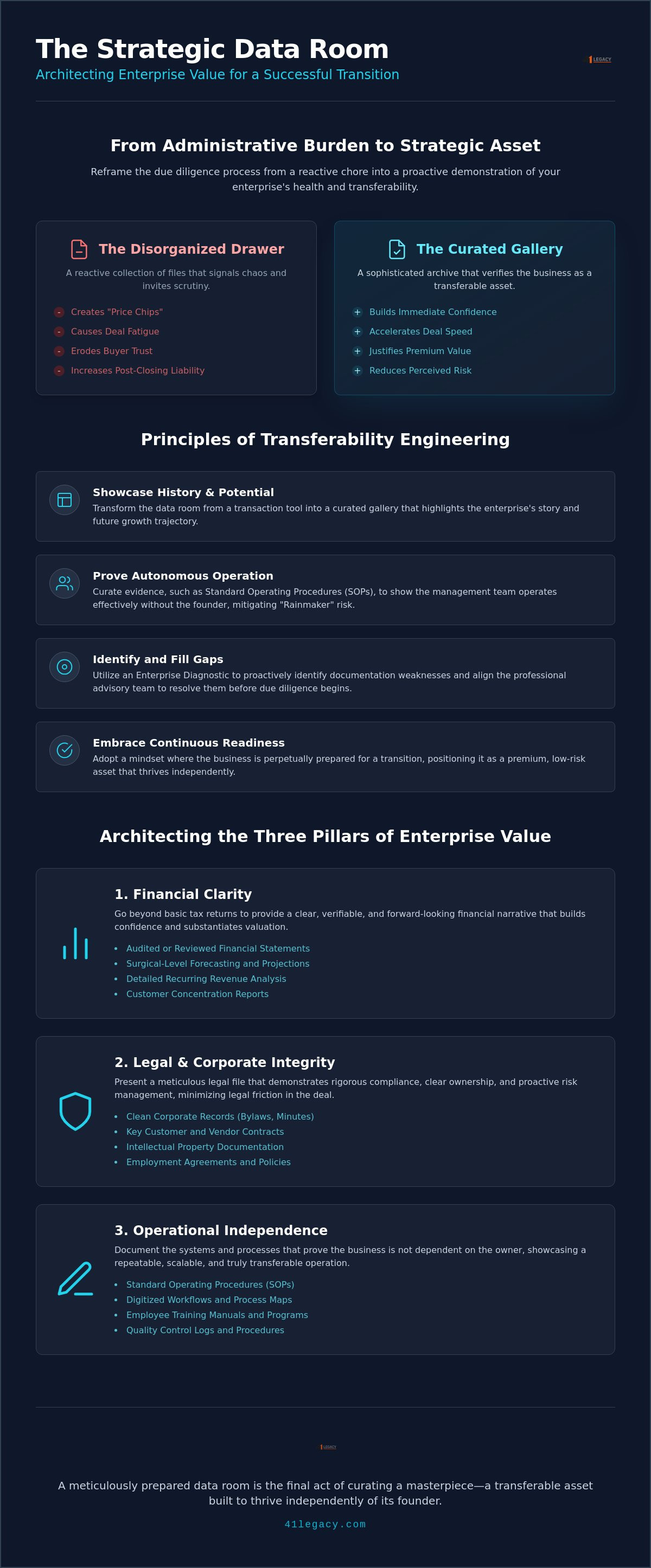
The psychological weight of this archive cannot be overstated. A meticulous repository signals to a buyer that the company is managed with surgical precision. This builds immediate confidence and reduces the perceived risk that often haunts mid-market transactions. Conversely, disorganization is a silent value killer. Messy or incomplete data invites intense scrutiny and leads to "price chips," where a buyer justifies a lower offer based on the uncertainty they find. Deal fatigue often sets in when information is difficult to locate, causing momentum to stall and trust to erode before the finish line is even in sight.
Beyond the Repository: A Reflection of Enterprise Health
Documentation is a living asset. It reflects the inner essence of your operations and the strength of your systems. The act of preparing a data room for due diligence often reveals the "Value Gap," which is the distance between what you believe your business is worth and what the evidence actually supports. By shifting from reactive document gathering to proactive stewardship, you transition from a business owner to a master artisan of enterprise value. This process is a core component of our Enterprise Diagnostics, ensuring that the health of the organization is visible in every folder and every contract.
Protecting Your Value Through Sophisticated Transparency
There is a direct correlation between information accessibility and final enterprise valuation. When a buyer can verify every claim with ease, their confidence increases and their risk profile drops. This sophisticated transparency isn't just a courtesy; it's your ultimate defense against post-closing litigation and liability. By crafting a narrative of excellence through your records, you establish the business as a truly transferable asset. We act as the quarterback for your advisory team, ensuring that legal and financial records are polished to a high sheen, reflecting a standard where compromise simply does not exist.
Architecting the Data Room for Maximum Transferability
Structure dictates value. When you begin the process of preparing a data room for due diligence, you are essentially designing a blueprint that proves your business is a functional, independent asset. This is where Transferability Engineering becomes visible. It's not enough to simply provide a digital vault; the organization must reflect a hierarchy of evidence that prioritizes recurring revenue and market attractiveness. A well-architected room speaks a universal language to CPAs, attorneys, and strategic buyers alike, presenting a narrative of stability and growth.
Effective curation involves more than just collecting files. It requires a deep understanding of what a sophisticated buyer seeks: a machine that runs without its inventor. By preparing the online data room with this level of intentionality, you provide the clarity needed to sustain deal momentum. Each document should act as a brick in a foundation of trust, demonstrating that the enterprise’s success is systemic rather than personality-driven.
Documenting SOPs as Transferable Assets
Standard Operating Procedures are the most valuable files in the room. They represent the "connective tissue" of your architecture, proving that your success is repeatable and documented. We look for evidence of consistency: training manuals, digitized workflows, and quality control logs. These documents are the ultimate antidote to buyer anxiety, as they demonstrate a significant reduction in operational risk. When a buyer sees a business governed by clear SOPs, they see an asset they can actually manage on day one.
Categorizing the Pillars of Enterprise Value
A sophisticated data room is built upon three distinct pillars that define the strength of the asset:
- Financial Clarity: Moving beyond basic tax returns to include pro forma statements and surgical-level forecasting.
- Legal Integrity: A meticulously organized collection of IP filings, corporate governance records, and transferable contracts.
- Operational Excellence: Evidence of supply chain resilience and a diversified customer base that reduces concentration risk.
Strengthening these pillars is a fundamental part of your Value Growth Roadmap, ensuring the business is positioned as a premium, low-risk acquisition that can thrive independently of its founder.
Proving Independence: Auditing Owner Dependency via Data
A masterpiece must eventually outgrow the shadow of its creator to be considered a lasting legacy. In the strategic endeavor of preparing a data room for due diligence, every document serves as a witness to either the enterprise’s autonomy or its fragility. The most significant risk we uncover during our Enterprise Diagnostics is the "Rainmaker" Risk. This occurs when the data inadvertently reveals that the founder is the primary driver of value, involved in every critical decision and key relationship. If your records show your signature on every minor purchase order or customer contract, you are documenting a dependency that diminishes the transferable value of the asset.
The most critical question a strategic buyer will ask is, "What happens to this company when you leave?" To answer this with confidence, the data room must act as an archive of independence. We guide our clients to include empirical proof of a self-sustaining entity, such as leadership meeting minutes where the founder was absent or decision logs managed entirely by the management team. These records prove that the business possesses the internal systems to thrive without the founder’s constant intervention. It shifts the narrative from a business that is owned to one that is truly engineered for transferability.
Evidence of a Self-Sustaining Management Team
A sophisticated data room goes beyond simple organizational charts to demonstrate depth and succession planning. We emphasize the inclusion of human capital documentation that highlights high employee retention rates and structured talent development initiatives. This provides a clear view of your "Strategic Capacity," showing that the leadership team has the skill and authority to execute the company’s vision. By documenting these internal strengths, you alleviate buyer anxiety and present a management team that is already operating with surgical precision and autonomy.
The Founder Independence Audit
We conduct a rigorous audit of your records to ensure that the business’s essence is rooted in the entity, not the individual. This involves reviewing customer contracts to verify that relationships are legally tied to the company and auditing internal approval processes to ensure they function independently of the owner. When preparing a data room for due diligence, using these findings to showcase a business built as a transferable asset is essential. It transforms your documentation into a narrative of resilience, proving that the enterprise is a polished, professional machine capable of sustained performance under new stewardship.
The Meticulous Mechanics of Data Room Preparation
The transition from strategic vision to tactical execution requires a steady hand and an eye for granular detail. When preparing a data room for due diligence, the process must follow a logical progression that preserves the integrity of the asset while respecting the timeline of the transaction. This isn't a task of simple file management, but one of mechanical excellence. It begins with a comprehensive Enterprise Diagnostic to identify any missing documentation that could invite unwanted scrutiny during the review phase. Finding these gaps early is the difference between a smooth transition and a stalled deal.
Once the gaps are identified, the following steps ensure a polished presentation:
- Coordinate with your Quarterback: Align legal and financial records through a central advisor who understands the broader strategic goals.
- Phased Upload Schedule: Release documents in stages to maintain momentum and prevent overwhelming the buyer’s team.
- Rigorous Permission Structures: Protect sensitive intellectual property by controlling who sees what, and when.
- The Buyer-Eye Audit: Perform a final review to anticipate and address potential red flags before the room is opened to external parties.
The Role of the Advisory Quarterback
We act as the guardian of your process, coordinating with your existing CPAs and attorneys to ensure every record is accurate and aligned. This structured approach reduces your administrative burden, allowing you to focus on leading the enterprise while we handle the intricacies of implementation. By linking the data room to your Value Growth Roadmap, we ensure that every file uploaded serves to strengthen the narrative of a transferable, high-value asset. It's about building a repository that stands as evidence of your enterprise's transferable value.
Permissions and Information Flow
A sophisticated data room utilizes a "Need-to-Know" hierarchy, ensuring that sensitive employee or customer data is only released at the appropriate stage of the deal. Digital rights management and watermarking act as the guardians of your legacy, preventing the unauthorized distribution of your most valuable secrets. Tracking buyer engagement provides a window into their intent. Modern systems now utilize AI to predict bidder engagement, identifying which parties are most serious based on their interaction patterns. By monitoring which folders receive the most attention, we can anticipate their questions and prepare your team for the next phase of the conversation with surgical precision.
Transforming Exit Readiness into a Strategic Advantage
True mastery is not found in the final performance, but in the relentless preparation that precedes it. Adopting a mindset of "Continuous Readiness" transforms the act of preparing a data room for due diligence from a frantic scramble into a strategic victory. When your records are maintained with surgical precision long before a transaction is on the horizon, you position your business as a premium, low-risk asset. This level of organization signals to the market that the enterprise is a polished machine, capable of sustaining its essence and performance under new stewardship. The data room becomes the final, tangible deliverable of a successful Value Growth journey, protecting your life’s work through the power of evidence.
The Difference Between a Deal Room and a Value Room
Most owners approach documentation as a defensive necessity, a task of "compliance" to satisfy a buyer’s checklist. We invite you to shift your perspective toward an offensive "value demonstration." This is the fundamental difference between a standard deal room and a true Value Room. A deal room merely answers questions; a Value Room proactively tells the story of an enterprise’s strength, transferability, and future potential. When a buyer encounters this level of strategic clarity, their perceived risk drops significantly. This confidence often translates directly into the final multiple of your sale, as the buyer is willing to pay a premium for a business that is transparent, organized, and ready for a seamless transition. Beyond the financial gain, this clarity provides a profound psychological peace of mind, knowing that your enterprise stands on a foundation that cannot be shaken by scrutiny.
Establishing a Culture of Meticulous Stewardship
Meticulous stewardship is not a one-time event, but a culture integrated into the rhythm of your leadership. We ensure this standard is upheld by incorporating data room updates into our Monthly Implementation Support. By treating every contract, workflow, and financial statement as a brick in the foundation of your legacy, you build an asset that thrives independently of your presence. This ongoing refinement ensures that you are always prepared for the unexpected, whether it is an internal transition or an external strategic offer. The next step in your journey is moving from the initial Enterprise Diagnostic to the active implementation of your Value Growth Roadmap. Together, we will curate an archive that doesn't just store history, but secures your future impact with the reverence and precision your life’s work deserves.
Securing the Lasting Impact of Your Enterprise
The transition from founder to steward is a profound evolution. Preparing a data room for due diligence is the final, meticulous refinement of a business designed for longevity. It serves as much more than a digital vault; it's the definitive evidence of the transferability engineering that allows your enterprise to thrive beyond your tenure. By documenting autonomous management and operational precision, you transform a transaction into a showcase of premium value. This archive stands as the sophisticated biography of your stewardship, revealing an asset that functions with surgical consistency.
Our team provides national advisory coverage and the specialized expertise of Certified Exit Planning Advisor (CEPA) leadership. We guide you through a structured Value Growth Roadmap process, acting as the quarterback for your professional team to ensure every record reflects the true essence of your work. This level of clarity honors the impact you've built over a lifetime while reducing the friction of transition. Your legacy deserves a presentation that matches the height of your achievement.
Begin your journey toward strategic clarity with an Exit Readiness Assessment
Frequently Asked Questions
What is the most common mistake owners make when preparing a data room?
The most frequent error is approaching the archive as a reactive task rather than a proactive discipline. Many owners wait until a letter of intent is signed to begin gathering records, which often exposes significant documentation gaps. This delay creates deal fatigue and invites buyers to devalue the asset based on perceived risk. A reactionary approach suggests a lack of stewardship and can lead to costly price adjustments during the final stages of a transaction.
How far in advance should I start preparing my due diligence documents?
You should begin the process of preparing a data room for due diligence at least 12 to 24 months before a planned transition. This timeframe allows you to identify and resolve "Value Gaps" discovered during an initial diagnostic. Establishing a culture of continuous readiness ensures that your enterprise is always positioned as a transferable asset. It gives you the necessary space to polish every record and ensure the business is ready for scrutiny at any moment.
Does every business need a Virtual Data Room (VDR), or is a shared drive enough?
A dedicated Virtual Data Room is essential for any mid-market transaction where security and professional optics are paramount. Shared drives lack the granular permission structures, watermarking, and audit trails required to protect your intellectual property. A VDR serves as a curated gallery, signaling to sophisticated buyers that your organization operates with a high degree of technical precision. It provides the sophisticated transparency needed to build trust while maintaining absolute control over your sensitive information.
How do I handle sensitive customer information in a data room?
Sensitive data should be managed through a tiered disclosure hierarchy and surgical redaction. You don't release specific customer identities or detailed employee contracts in the initial phase. Instead, you provide anonymized data and only reveal the inner essence of these relationships once a buyer has demonstrated serious intent. This phased approach protects your competitive advantage and ensures that your most valuable secrets are only shared with parties who have reached the final stages of review.
What documents are most important for proving owner-dependency reduction?
The most persuasive evidence includes leadership meeting minutes where the owner was absent and internal decision logs managed entirely by the management team. Standard Operating Procedures (SOPs) and digitized training manuals also prove that the business thrives on systems rather than the founder's personality. These documents serve as the connective tissue that demonstrates the enterprise is a truly independent and transferable asset. They provide the empirical proof a buyer needs to feel confident in the business's future.
How does 41 Legacy help with the data room if they aren’t M&A brokers?
We act as the quarterback for your advisory team, ensuring all documentation aligns with a broader Value Growth Roadmap. While we don't represent you in a sale, we provide the Enterprise Diagnostics and Transferability Engineering necessary to maximize your enterprise value. Our role is to assist you in preparing a data room for due diligence that reflects a polished, professional machine. We coordinate with your CPAs and attorneys to ensure every file serves the narrative of strategic excellence.
Can a poorly organized data room actually kill a business sale?
A disorganized archive is a frequent cause of deal failure. When a buyer encounters chaos, they lose confidence in the underlying health of the business and the accuracy of its financial claims. This erosion of trust leads to stalled momentum and deal fatigue, often causing the most sophisticated investors to walk away. Precision in your records is a direct reflection of precision in your operations; if one is lacking, the buyer will assume the other is as well.

Article by
Mike Laskowski
Mike Laskowski is a Business Value Growth Strategist who helps business owners uncover the truths that drive their performance, risk, and readiness. Blending forensic interviewing from a 26‑year federal career with Strategic Capacity analysis and CEPA methodology, he works upstream to reduce owner dependency, increase transferability, and strengthen enterprise value. Mike guides founders through clarity, operational evolution, and transition readiness so their companies become transferable, owner‑independent assets that endure beyond the founder.
Disclaimer
This article is for educational and informational purposes only and does not provide legal, tax, investment, or business brokerage advice. 41 Legacy does not offer M&A brokerage services, legal document drafting, tax preparation, or investment advisory services. Business owners should consult licensed professionals in those disciplines before making decisions related to business transactions, legal matters, tax strategy, or financial planning. All examples are illustrative and may not apply to your specific situation.