
The Art of Identifying Ideal Buyer Profiles for Your Business Legacy
What if the clients who currently sustain your revenue are the very reason your enterprise remains untransferable? It's a sobering realization for many dedicated owners that there's a profound difference between a profitable marketing target and a strategic acquirer. You've poured years into building your reputation, yet understanding what makes a business attractive to buyers requires shifting your perspective from daily operations to the architectural precision of a legacy asset. If your business relies on a few key relationships or your personal involvement, it isn't yet a transferable masterpiece; it's a collection of tasks waiting for a leader.
We believe every founder deserves to see their life's work endure as a lasting contribution to their industry. This guide provides the strategic clarity needed to define and attract buyers who'll honor your history while maximizing your enterprise value. You'll discover how to utilize enterprise diagnostics to identify high-value customer profiles and follow a value growth roadmap that reduces owner dependency. By the end of this article, you'll have a clear framework to transform your business into a resilient, independent entity that thrives long after your transition is complete.
Key Takeaways
- Distinguish between the customers who fuel your current revenue and the strategic acquirers who will eventually inherit the essence of your enterprise.
- Understand that what makes a business attractive to buyers is the deliberate engineering of a transferable asset that thrives independently of its founder.
- Recognize the "Rainmaker Trap" and learn how to mitigate customer concentration risks that can silently erode your hard-earned enterprise value.
- Utilize Enterprise Diagnostics to evaluate your most profitable relationships, ensuring your business is structured for maximum strategic alignment.
- Transition from a daily operator to a dedicated steward of legacy by following a Value Growth Roadmap that prioritizes transferability and professional precision.
The Dual Nature of the Ideal Buyer: Beyond Customer Acquisition
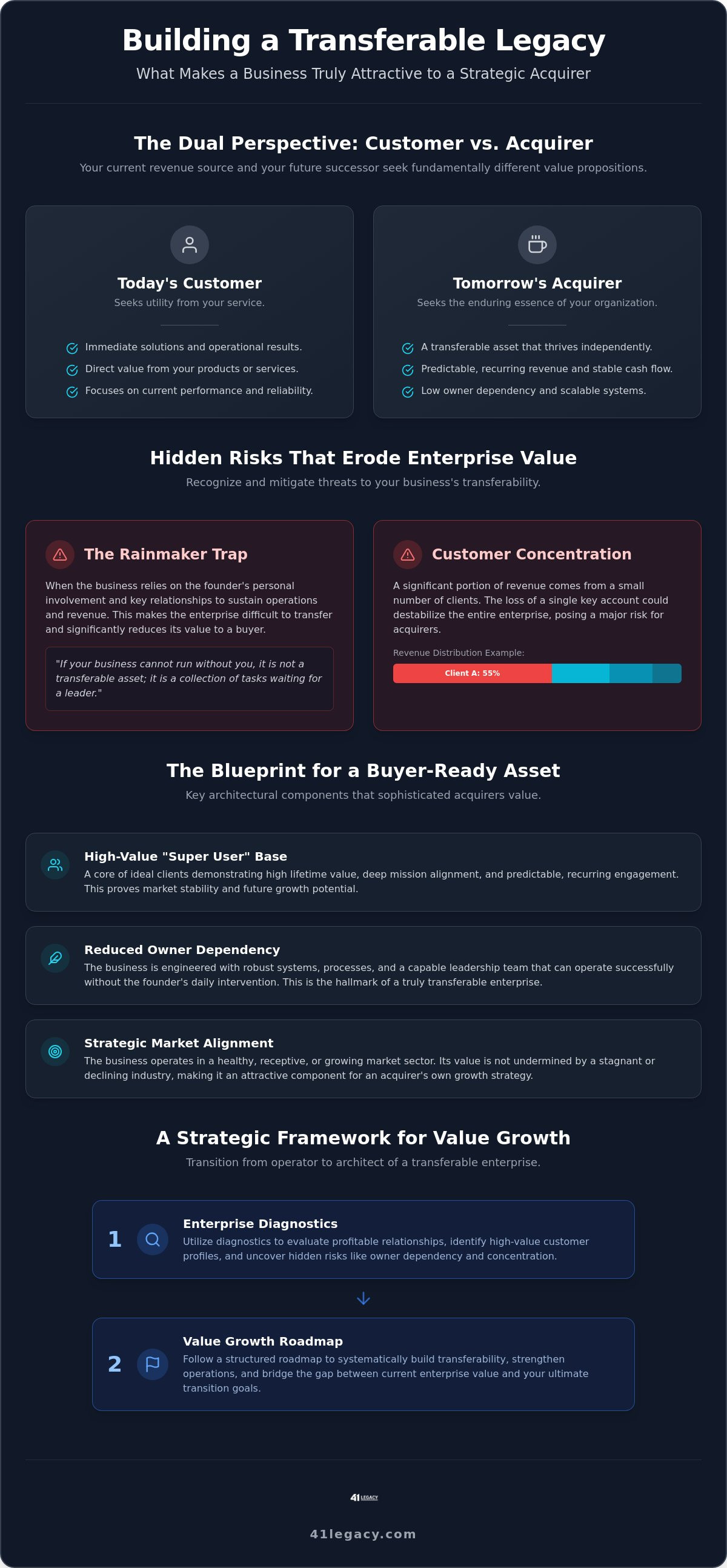
The distinction between a client and a successor is often blurred by the daily demands of the marketplace. While a customer seeks the utility of your service, an acquirer seeks the enduring essence of your organization. This is the core of stewardship. You aren't merely running a company; you're refining a vessel that must eventually sail under a different flag. True transferability begins when you stop building for yourself and start engineering for the person who will lead after you. This intentionality reduces the friction that often plagues transitions. It transforms a chaotic collection of tasks into a polished, transferable asset. A clear profile of your successor is a primary driver of what makes a business attractive to buyers who value precision and strategic alignment.
The Customer-Acquirer Connection
Market health is best signaled by the "Super User," the client who embodies your ideal demographic. These high-value relationships serve as a blueprint for future growth. When a business demonstrates a consistent ability to attract and retain these profiles, its market attractiveness rises. A "Super User" typically exhibits three specific traits:
- High lifetime value with minimal demand on the founder's personal time.
- A deep alignment with the core mission and unique culture of the enterprise.
- Predictable, recurring engagement that stabilizes the long-term balance sheet.
Buyers look for stability. Nothing provides a more secure foundation than recurring revenue. This predictable flow of capital allows for various Business valuation approaches to reflect a premium on your hard work. A healthy customer base isn't just a source of cash; it's the evidence that your business model is sustainable without your constant intervention.
Defining the 'Ultimate Buyer'
Identifying the right successor requires a nuanced understanding of the market. Strategic acquirers often value your unique market position or specialized intellectual property. Financial acquirers may focus more on the efficiency of your operations and the strength of your cash flow. Both types seek an alignment of values to ensure the business doesn't lose its soul post-transition. Understanding these motivations is central to knowing what makes a business attractive to buyers in a competitive landscape. This clarity allows you to position your legacy as a rare opportunity rather than a common commodity. The Ultimate Buyer is the entity that views your business as a vital component of their own future success.
Architectural Components: Defining the Profile of a Transferable Asset
Constructing a legacy requires more than a robust balance sheet; it demands a structural integrity that withstands the scrutiny of sophisticated acquirers. While foundational metrics are essential, the true measure of what makes a business attractive to buyers lies in the alignment between your current operations and the strategic capacity of your target market. You must analyze the "Value Gap." This is the distance between your current enterprise value and the financial milestones required for your ultimate transition. Bridging this gap isn't a matter of chance. It's an engineering feat that involves selecting the right sectors and the most resilient buyer profiles.
A business that lacks strategic capacity is a business at risk. If your ideal buyer operates in a stagnant or declining sector, your enterprise value will inevitably suffer from the weight of its surroundings. You're building a magnet, and magnets only work when the surrounding environment is receptive. By evaluating the market's attractiveness today, you ensure that your professional life's work remains a sought-after asset tomorrow.
Firmographics with a Strategic Lens
Revenue thresholds serve as more than mere benchmarks of size. They signal a level of professional maturity and operational stability that a novice enterprise lacks. A business with consistent revenue above specific industry markers demonstrates that its systems can support a larger organization. Geographic reach also plays a vital role. A concentrated local footprint may offer intimacy, but a diversified reach often enhances transferability by reducing regional economic risks. You should also evaluate the maturity of your industry. Entering a shifting market without a plan introduces a risk of obsolescence that internal efficiency cannot fully mitigate. Successful owners view their market position through the lens of Transferability Engineering to ensure their asset remains relevant.
Psychographics and Behavioral Alignment
Beyond the data, you must understand the soul of the acquirer. Identifying buyers who value precision and established excellence is paramount. These entities aren't just looking for cash flow; they're looking for a heritage they can steward into the future. This requires a deep dive into Decision-Maker Personas. In complex strategic sales, the person signing the document is often driven by emotional and philosophical motivations. They seek a business that reflects their own dedication to craftsmanship and long-term impact. When your organizational values mirror the high standards of your ideal buyer, the transition moves from a cold transaction to a purposeful passing of the torch. This alignment reduces friction and preserves the essence of what you've built, which is ultimately what makes a business attractive to buyers who care about legacy.
The Risk of the Wrong Buyer: Customer Concentration and Value Erosion
The "Rainmaker Trap" is a subtle but destructive force that tethers an enterprise to its founder. It begins when an owner pursues every lead with equal fervor, mistakenly believing that all revenue carries the same weight. This creates an environment where every success requires your personal intervention, effectively turning your life's work into a high-stakes job rather than a transferable asset. A sophisticated acquirer isn't looking to purchase your personal magic; they're looking for a machine that runs with surgical precision. This operational independence is a primary driver of what makes a business attractive to buyers. When revenue is concentrated in a few key accounts, you aren't just facing a financial risk; you're signaling that the business cannot yet stand on its own.
Servicing buyers who don't fit your core mastery is an expensive distraction. It forces your team to customize every delivery, which prevents the development of repeatable excellence. A few perfect customers are worth more than a hundred decent ones because they allow for the focus that defines a premium brand. Every misaligned client carries a hidden cost, draining the strategic energy required to maintain your market position and erode the very essence of what you've built.
Identifying Value-Eroding Customers
High-maintenance, low-margin buyers act as a weight on your Value Growth Roadmap. These relationships demand excessive attention while offering minimal contribution to your long-term enterprise health. They distract your leadership team and force you to solve problems that don't align with your vision for a transferable legacy. Preserving the integrity of your asset requires the courage to say no. By refusing misaligned clients, you protect the profitability and strategic focus that sophisticated buyers expect from a top-tier acquisition.
Reducing Owner Dependency through Profile Precision
Standardizing your service delivery begins with a ruthless focus on a specific, repeatable buyer type. This niche focus is the foundation of successful Transferability Engineering. It allows your organization to develop robust, written procedures that don't require your constant oversight or "founder's intuition." When the business functions with rhythmic consistency in your absence, its value increases exponentially. A precise buyer profile is central to what makes a business attractive to buyers who seek a resilient, independent organization that can flourish under new stewardship.
Engineering for the Ultimate Transaction: A Strategic Framework
Transitioning from an operator to a steward requires a shift from passive observation to active, intentional construction. It's no longer enough to merely grow; you must grow with the precision of an artisan. This phase of the journey moves beyond identifying risks like the "Rainmaker Trap" and into the realm of architectural alignment. By performing a rigorous Enterprise Diagnostic, you begin to uncover the patterns of excellence that define your most harmonious relationships. This isn't just about revenue. It's about identifying the top 10% of your clients who provide both high profitability and, more importantly, high transferability. Understanding these dynamics is a fundamental component of what makes a business attractive to buyers who prioritize long-term stability over short-term gains.
Drafting the "Ultimate Buyer" profile is the final act of this engineering process. This profile shouldn't be a generic target but a specific entity that recognizes the unique essence and professional heritage of your firm. Once this profile is established, every aspect of your organization, from Monthly Implementation Support to daily service delivery, must be refined to cater exclusively to this ideal. This level of focus ensures that when the time comes for transition, the business is already operating in perfect harmony with its future owner's expectations.
The Diagnostic Phase
The diagnostic process involves a deep dive into historical data to find where your operations and market demand intersect most gracefully. We look for operational harmony, where the team's expertise meets the client's needs without the founder's constant intervention. Interviewing internal stakeholders often reveals the "essence" of these successful relationships, providing a narrative that numbers alone cannot capture. These diagnostics also serve as a protective measure. They allow you to uncover hidden risks in your current buyer pool, such as subtle customer concentration or misaligned expectations, before they have the chance to devalue the firm in a future transaction.
The Roadmap to Alignment
Aligning your business with the ideal buyer requires a disciplined approach to change. You must set clear milestones for transitioning your customer base, moving away from high-maintenance outliers and toward those who fit your strategic vision. This coordination extends to your wider advisory team. Working alongside your CPA and Attorney ensures that your financial structures and legal agreements are perfectly positioned to support the profile of your successor. A Value Growth Roadmap is the bridge between today's customer and tomorrow's successful exit. To begin this process of refinement, we invite you to explore our Enterprise Diagnostics to see where your current value truly lies.
Fortifying Your Legacy: The 41 Legacy Approach to Buyer-Ready Enterprises
The ultimate aim of stewardship is the creation of a vessel that thrives long after the builder has departed. As an owner, your most vital role is that of the Quarterback. You must coordinate a sophisticated, multidisciplinary advisory team with the same precision a curator uses to manage a private collection. This coordinated effort is precisely what makes a business attractive to buyers who seek a turnkey legacy rather than a chaotic rescue mission. By positioning yourself as the strategic leader rather than the primary engine of production, you signal that the organization's heartbeat is independent of your own. 41 Legacy acts as the guardian of this enterprise value, ensuring that every operational adjustment serves the long-term integrity of your professional history.
Strategic clarity is not a static destination; it's a discipline maintained through rhythmic oversight. Our Monthly Implementation Support provides the framework for this consistency, ensuring that your team remains aligned with the Value Growth Roadmap. This structured accountability prevents the drift that often occurs in the heat of daily operations. You aren't merely leaving a job you own. You are delivering a transferable asset that carries your essence into a new era while providing the financial security you've earned through years of dedication. This level of preparation is what makes a business attractive to buyers who value stability and professional excellence above all else.
The 41 Legacy Structured Process
Our methodology begins with an Exit Readiness Assessment that acts as a high-resolution lens. It identifies your ideal buyer profile with extreme precision, ensuring that your growth efforts aren't wasted on misaligned targets. We then employ Enterprise Diagnostics to protect your life's work from market volatility, uncovering hidden risks before they can devalue the firm. Through Transferability Engineering, we help you build a legacy that thrives independently of its creator. This process ensures that the systems, culture, and profitability of your enterprise are woven into the fabric of the organization itself, making it a resilient entity capable of flourishing under new leadership.
Your Next Steps Toward Strategic Clarity
Waiting until the moment of transition to define your buyer is a risk that few can afford to take. Strategic positioning requires time, thought, and a refusal to settle for less than perfection. The most successful transitions are those that were engineered years in advance, allowing the owner to exit on their own terms with their legacy intact. We invite you to a deeper conversation about the future of your company and the preservation of its unique impact. It's time to move beyond the daily grind and toward the intentional construction of a transferable masterpiece. Explore how we help you understand and grow your enterprise value to ensure your transition is as seamless as it is rewarding.
Securing the Essence of Your Enterprise
Defining your ideal buyer profile is more than a strategic exercise; it's a commitment to the preservation of your professional history. You've learned that reducing owner dependency and neutralizing customer concentration are not just operational goals, they are essential acts of stewardship. Understanding what makes a business attractive to buyers allows you to shift your focus from the friction of daily tasks to the rhythmic precision of a transferable asset. By identifying the strategic acquirers who value your unique market position, you ensure that your life's work continues to thrive long after your transition.
At 41 Legacy, we serve as the guardian of your enterprise value. Led by a Certified Exit Planning Advisor (CEPA), our team employs a structured "Quarterback" approach to coordinate your advisory team with surgical precision. We don't operate as a brokerage; we focus on the engineering of transferability and the growth of your company's core worth. You've built something remarkable. It's time to ensure it endures.
Begin your journey toward a transferable legacy with an Exit Readiness Assessment. Your future as a successful steward starts with the clarity of a well-defined plan.
Frequently Asked Questions
What is the difference between an Ideal Customer Profile and a Buyer Persona?
An Ideal Customer Profile (ICP) defines the specific type of company that derives the most value from your service, while a Buyer Persona focuses on the individual human beings within that organization. The ICP addresses firmographics like revenue and industry; the persona explores the motivations and behaviors of the decision-makers. Both are essential for strategic clarity, ensuring your team targets the right entities and speaks the right language to the leaders who authorize the partnership.
How does my customer profile affect my business valuation?
Your customer profile is a primary determinant of what makes a business attractive to buyers because it signals the quality and predictability of future earnings. A base of diversified, high-margin clients in growing sectors commands a higher valuation multiple. Conversely, a profile dominated by low-margin or high-maintenance accounts introduces risk and operational strain. Sophisticated acquirers pay a premium for a client list that represents a stable, transferable asset rather than a collection of volatile relationships.
Can I have more than one Ideal Buyer Profile?
You can certainly identify multiple profiles, though maintaining a narrow focus is often more conducive to building a transferable asset. Each profile requires its own standardized systems and delivery models to ensure operational excellence. Having too many disparate profiles can lead to the "Rainmaker Trap," where the founder's personal intervention is required to manage the complexity. We recommend focusing on two or three high-alignment profiles that share common operational requirements and strategic goals.
How often should I update my business’s ideal buyer profile?
We recommend reviewing your profile annually or whenever a significant shift occurs in your market or industry maturity. As your enterprise evolves, the type of client that best supports your Value Growth Roadmap may change. Regular refinement ensures your team remains focused on the relationships that maximize enterprise value. This proactive approach prevents your organization from becoming stagnant or over-reliant on sectors that no longer offer the strategic capacity required for a successful future transition.
Does every business need an Exit Readiness Assessment to define their buyer?
While not strictly mandatory, an Exit Readiness Assessment is the most precise tool for identifying the acquirers who will truly value your professional legacy. It moves beyond guesswork to provide a data-driven view of your firm's current market position and transferability. Without this diagnostic, you risk building a business that serves your current needs but fails to meet the criteria of a strategic successor. This assessment serves as the architectural foundation for your entire transition strategy.
What are the most common mistakes when identifying ideal buyers?
The most frequent error is prioritizing top-line revenue over net margin and operational harmony. Owners often chase large accounts that actually erode enterprise value because they require excessive customization or founder involvement. Another mistake is failing to consider the strategic alignment between the buyer's future goals and your firm's core mastery. Identifying what makes a business attractive to buyers requires looking past the immediate transaction to the long-term health and independence of the organization.
How do I communicate a shift in target buyer profile to my team?
Communicate the shift by framing it as an elevation of the firm's standards and a commitment to long-term stability. Share the Value Growth Roadmap with your leadership team to illustrate how the new profile reduces friction and enhances the quality of their work. When the team understands that a more precise profile leads to repeatable excellence and less daily chaos, they'll embrace the transition. This clarity transforms the shift from a management directive into a shared pursuit of craftsmanship.
What role does my CPA play in identifying ideal buyer profiles?
Your CPA provides the financial technical precision required to validate the profitability of your target profiles. They help analyze historical data to uncover which client segments contribute most to your bottom line and which ones are a drain on resources. This financial diagnostic is a critical component of our "Quarterback" approach, ensuring that your strategic vision is supported by hard data. Their insights allow us to engineer a profile that is both philosophically aligned and financially robust.

Article by
Mike Laskowski
Mike Laskowski is a Business Value Growth Strategist who helps business owners uncover the truths that drive their performance, risk, and readiness. Blending forensic interviewing from a 26‑year federal career with Strategic Capacity analysis and CEPA methodology, he works upstream to reduce owner dependency, increase transferability, and strengthen enterprise value. Mike guides founders through clarity, operational evolution, and transition readiness so their companies become transferable, owner‑independent assets that endure beyond the founder.
Disclaimer
This article is for educational and informational purposes only and does not provide legal, tax, investment, or business brokerage advice. 41 Legacy does not offer M&A brokerage services, legal document drafting, tax preparation, or investment advisory services. Business owners should consult licensed professionals in those disciplines before making decisions related to business transactions, legal matters, tax strategy, or financial planning. All examples are illustrative and may not apply to your specific situation.