
Transferability & Owner Dependency
The Architecture of Value: Making Your Business Attractive to Private Equity Buyers in 2026
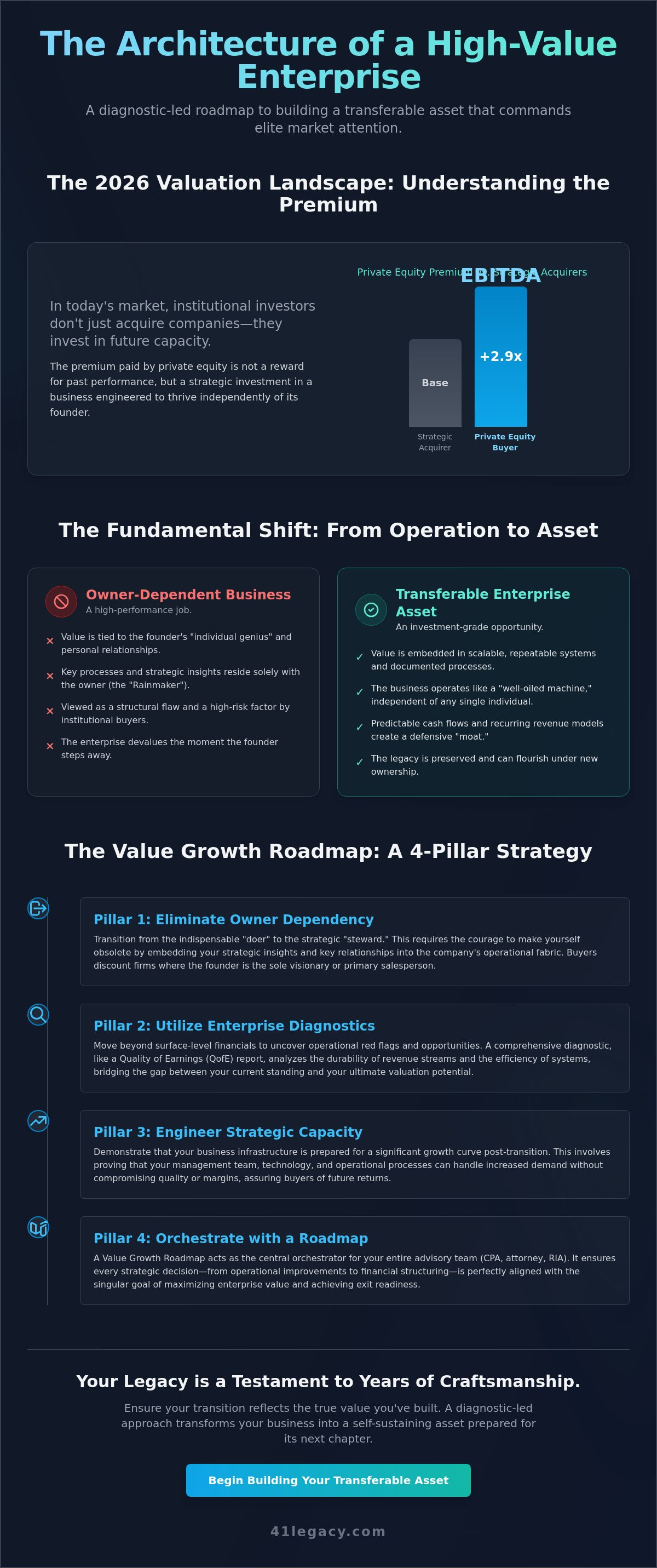
In the 2026 landscape, private equity buyers are paying approximately 2.9 turns of EBITDA more than strategic acquirers for the right opportunities. This significant premium is rarely a reward for historical success. Instead, it's a purposeful investment in the future capacity of an enterprise to flourish independently of its founder. Achieving this level of interest requires a shift in perspective, moving from mere operations to the intentional work of building a transferable business asset.
You likely recognize the weight of being the primary engine of your company's growth. It's a common challenge to face the uncertainty of whether your business can sustain its value, or protect your employees, once you step away. We understand that your legacy is not just a financial figure but a testament to years of dedicated craftsmanship. You deserve a transition that reflects the true essence of what you've built.
This guide provides a clear, diagnostic-led roadmap to exit readiness. You'll learn how to transition from a founder-led operation into a high-value, self-sustaining asset that commands elite market attention. We'll explore the strategic pillars of owner-dependency reduction and capacity evaluation, ensuring your transition is both a personal victory and a professional masterpiece.
Key Takeaways
- Understand why institutional buyers in 2026 prioritize scalable, repeatable systems over individual genius to ensure long-term stability.
- Master the art of building a transferable business asset by implementing transferability engineering that allows your company to flourish without your daily involvement.
- Utilize enterprise diagnostics to uncover operational red flags and bridge the value gap between your current standing and your ultimate financial legacy.
- Develop strategic capacity to demonstrate that your business infrastructure is prepared to handle a significant growth curve after the transition.
- Learn how a value growth roadmap serves as a central orchestrator for your advisory team, ensuring every strategic move aligns with your exit readiness.
The Architecture of Attractiveness: What Private Equity Buyers Truly Seek
Excellence in business is often mistaken for the brilliance of its creator. For an institutional buyer, however, individual genius is a risk factor, not an asset. They seek the quiet hum of a machine, a masterpiece of order where every process is documented and every outcome is repeatable. This is the core of building a transferable business asset. While a lifestyle business provides for the owner, a transferable enterprise asset provides for the future. It's the difference between a single performance and a written score; one ends when the artist leaves, while the other can be played by any master who follows.
In 2026, the marketplace rewards strategic clarity with unprecedented intensity. With private equity accounting for roughly 40% of global M&A activity by value, the competition for "Investment Grade" businesses has matured. These aren't just profitable companies. They're entities that have achieved a state of risk-adjusted value, where the "essence" of the brand is preserved through systems rather than individuals. To understand the foundational mechanics of these firms, one might ask, What is Private Equity? At its heart, it is a disciplined search for companies that can thrive independently of their founders. The transition from owner-led to asset-driven is the fundamental shift required for building a transferable business asset that survives the test of time.
Financial Buyers vs. Strategic Buyers: Understanding the Nuance
Financial buyers evaluate risk through the lens of a "Quality of Earnings" (QofE) report. They aren't just looking at the bottom line. They're looking at the durability of those numbers, much like a curator examines the provenance of a rare artifact. A clean balance sheet is merely the entry price for a serious conversation. They want to see that your margins are protected by operational excellence. While a strategic buyer looks for a piece that fits their existing collection, a financial buyer seeks a standalone masterpiece that generates its own momentum.
The Premium of Predictability
Predictability is the highest form of business art. Institutional buyers pay for the certainty of future cash flows, not historical anomalies or one-time wins. This is why recurring revenue models and long-term contracts act as significant value multipliers in 2026. A well-positioned company creates a "moat" around its enterprise essence. This ensures the legacy you've built remains unassailable long after you've stepped away. We help owners achieve this at 41 Legacy by refining the internal architecture of the firm. It's about ensuring the work survives the worker.
Eliminating Owner Dependency: The Foundation of a Transferable Asset
The most seductive trap for any founder is the role of the "Rainmaker." It's a position born of necessity but maintained through a misplaced sense of identity. When the owner is the most important person in the room, the enterprise is often little more than a high-performance job. Institutional buyers view this dependency as a structural flaw. They don't just look at the bottom line; they scrutinize the key performance metrics for private equity to see if success is tied to a person or a process. If your key relationships and strategic insights reside solely in your head, the asset devalues the moment you step away. Building a transferable business asset requires the quiet courage to become obsolete.
This transition demands a profound psychological shift. You must move from being the "doer" who orchestrates every detail to the "steward" who protects the enterprise's future. It's an act of preservation. By removing yourself as the central pillar, you allow the business to breathe independently. Buyers discount firms where the founder is the primary salesperson or the sole visionary. They seek a machine that hums with its own energy, fueled by systems that ensure the legacy remains intact long after the transition. We often guide owners through this delicate process of owner dependency reduction to ensure the company's essence is truly transferable.
The "Vacation Test" for Enterprise Value
A simple but brutal diagnostic for any leader is the thirty-day absence. If your business cannot grow, or even sustain its current momentum, for a full month without your direct intervention, you haven't yet built an asset. You've built a cage. Identifying "Single Point of Failure" risks is the first step in engineering resilience. It requires empowering a second-tier management team to handle high-level operational decision-making. This isn't just delegation; it's the intentional distribution of authority to ensure the enterprise functions as a self-sustaining entity.
Institutionalizing Tribal Knowledge
Excellence shouldn't be a secret held by a few. It must be institutionalized through documented Standard Operating Procedures (SOPs) that capture the "how" of your success. Technology plays a vital role here, automating workflows and reducing human error during the vulnerable period of a transition. Transferability Engineering is the strategic bridge that transforms a demanding job into a resilient, high-yield investment. By codifying tribal knowledge into a repeatable system, you ensure that building a transferable business asset is a matter of precision engineering rather than luck.
Utilizing Enterprise Diagnostics to Bridge the Value Gap
The Value Gap represents a silent, often painful discrepancy between an owner's perceived legacy and the market's clinical assessment. While a founder may view their company through the lens of decades of sacrifice, an institutional buyer views it through the lens of risk and future yield. In the 2025 middle market, where average EBITDA multiples stood between 7.2x and 7.5x, many owners discovered that their expected retirement goals were unreachable without a significant shift in strategy. Closing this gap requires moving beyond emotional valuation into a market-verified diagnostic reality. It is the first disciplined step in building a transferable business asset that commands the premium it truly deserves.
At 41 Legacy, we utilize Enterprise Diagnostics to quantify two critical metrics: Attractiveness and Readiness. Attractiveness measures how much a buyer wants the company, while Readiness measures how prepared the company is to be transitioned. A business can be highly attractive but entirely unready, leading to a collapsed deal during the final stages of scrutiny. By identifying red flags long before a buyer arrives, we transform the exit process from a game of chance into a scripted orchestration of value. This diagnostic clarity allows a steward to see their business as a professional investor would, revealing the precise adjustments needed to elevate the enterprise essence.
Identifying the Five Pillars of Risk
Institutional buyers rarely walk away from a deal because of the purchase price; they walk away because of unmitigated risk. We evaluate every firm through five strategic pillars: financial, operational, market, human capital, and legal risks. Hidden vulnerabilities in these areas are the primary reason deals stall during due diligence. Once these risks are surfaced, we use a Value Growth Roadmap to systematically eliminate them over a 12 to 36 month period. This proactive approach ensures that the foundation of the business is as polished as its performance, removing the obstacles that would otherwise devalue the asset.
The Power of the Diagnostic Fee
There is a profound integrity in a project-based assessment. Unlike a casual estimate from a broker, which may overpromise to secure a listing, a formal enterprise diagnostic provides an unvarnished look at the company's health. This investment in clarity serves as a dress rehearsal for the ultimate due diligence process. It allows you to address structural weaknesses on your own terms and timeline. Building a transferable business asset is a process of refinement, and the diagnostic fee is the entry price for the strategic depth required to protect your life's work. By the time a buyer sits at the table, the difficult questions have already been answered, and the path to transition is clear.
Engineering Strategic Capacity: Moving Beyond Financial Statements
Financial statements are a record of what was. Strategic capacity, however, is a blueprint for what can be. In 2026, institutional buyers aren't just paying for existing cash flow; they're paying a premium for the latent potential within the organization. This capacity represents the operational infrastructure required to absorb a 2x or 5x growth curve immediately following an acquisition. For those dedicated to building a transferable business asset, this means looking past the balance sheet to ensure the engine is built for a higher gear. It's a shift from maintaining a steady state to preparing for a massive influx of capital and scale.
One of the most critical, yet overlooked, factors in this engineering process is the reduction of customer concentration. If a single client represents more than 15% of your revenue, the enterprise essence is compromised. Buyers view such concentration as a structural fragility that could crumble the moment the founder exits. Diversifying your client base isn't just about safety; it's about proving that your value proposition is universal and your systems are robust enough to serve a broad market. This level of operational maturity is what makes a company an "Acquisition of Choice." To see where your organization stands, consider our Strategic Capacity Evaluation to identify the bottlenecks currently throttling your future value.
The Infrastructure of Scalability
A buyer looks for a technology stack and supply chain that can support rapid, institutional expansion without breaking. If your systems require constant human intervention or "workarounds," they aren't scalable; they're merely functional. Supply chain resilience is equally vital, ensuring that external dependencies don't act as a throttle on your growth. Strategic Capacity is the intentional empty space in your business that a buyer can fill with their capital. By building this room for growth now, you invite the premium multiples that only the most prepared enterprises command.
Human Capital as a Transferable Asset
The true strength of an asset is found in a culture of accountability that persists even when the founder isn't in the room. Institutional deal structures often utilize stay bonuses and management incentives to ensure that the "tribal knowledge" remains with the firm post-transition. Buyers are searching for a "Bench" of talent, a group of capable leaders ready to step into larger roles. Building a transferable business asset requires investing in this human architecture. When the management team is incentivized to treat the company as their own, the risk of a post-exit talent drain evaporates, protecting the long-term health of the legacy.
The Value Growth Roadmap: Orchestrating Your Legacy for Transition
A successful transition is a symphony of moving parts, requiring a level of coordination that few business owners ever experience. While you may have a trusted CPA, a dedicated attorney, and a seasoned wealth manager, these professionals often operate in silos. Without a central coordinator, their advice can become fragmented or even contradictory. We act as the "Quarterback" in this professional room, ensuring that every legal, tax, and strategic decision is filtered through a single lens: the preservation of your enterprise essence. This orchestration is the final, vital step in building a transferable business asset that stands as a testament to your life's work.
True exit readiness is a multi-year discipline, not a sudden transaction. It requires a steady, unhurried cadence of improvement that transforms the business into a self-sustaining masterpiece. By aligning your personal legacy goals with corporate transition strategies, we ensure the impact of your work continues long after your departure. Monthly implementation support keeps your growth roadmap alive, moving beyond theoretical plans into granular, technical excellence. This long-term perspective protects your employees and your brand, ensuring the transition is a graceful handoff rather than a disruptive break.
Coordinating the Professional Room
Conflicting advice is the primary friction point that slows down a value growth trajectory. When an attorney focuses solely on risk and a CPA focuses only on tax mitigation, the strategic growth of the asset can suffer. Our role at 41 Legacy is to align these specialists toward an uncompromising vision of perfection. We facilitate a collaborative environment where every decision increases enterprise value. By harmonizing these disparate voices, we create a clear path forward, allowing you to focus on your role as a steward of a high-value, transferable asset.
Your Next Steps Toward Exit Readiness
The journey toward a premium transition begins with clarity. You cannot bridge a gap you haven't yet measured. We invite you to take the first step by engaging in a comprehensive Exit Readiness Assessment. This diagnostic provides the baseline for your future roadmap, identifying the precise areas where transferability engineering can yield the highest impact. Following the assessment, we establish a cadence of accountability through structured advisory support. This process offers more than just financial upside; it provides the profound peace of mind that comes from knowing your business is a "Built to Sell" masterpiece, ready to thrive independently of its founder.
- Establish a clear baseline through enterprise diagnostics.
- Identify and eliminate owner-dependency risks within the first 12 months.
- Coordinate with your existing advisory team to ensure strategic alignment.
- Implement monthly growth initiatives that build long-term strategic capacity.
Securing Your Enterprise Essence
Excellence in the 2026 market is not an accident; it's a deliberate architectural choice. We've explored how the shift from a founder-led operation to a self-sustaining entity creates the predictability that institutional buyers crave. By eliminating owner dependency and expanding your strategic capacity, you transform your life's work into a masterpiece of order and impact. The path to a premium exit is paved with the disciplined work of building a transferable business asset that functions with precision and grace long after your departure.
Led by a Certified Exit Planning Advisor (CEPA), our team provides national strategic advisory expertise designed for the sophisticated business owner. We utilize a proprietary Enterprise Diagnostics process to uncover the hidden value within your organization and bridge the gap between your current reality and your ultimate legacy goals. This isn't merely a transaction; it's the preservation of an essence that deserves to endure. You've spent years crafting your company's story, and we're here to ensure its next chapter is one of strength and independence.
Begin your journey toward a transferable legacy with a 41 Legacy Diagnostic.
Your dedication has built a significant foundation. It's time to ensure that foundation is resilient enough to support a lasting and prosperous future.
Frequently Asked Questions
How long does it take to make a business attractive to private equity?
Transforming a company into an institutional-grade asset typically requires a disciplined commitment of 12 to 36 months. This timeframe allows for the rigorous identification of structural weaknesses and the implementation of systems that ensure the enterprise thrives independently. It is a multi-year journey of refinement, moving from owner-led momentum to a state of operational excellence that commands a premium multiple.
What is the minimum EBITDA private equity firms look for in 2026?
While requirements vary by sector, many private equity firms look for a minimum EBITDA of $3 million for standalone platform investments. Smaller entities may still attract interest as add-on acquisitions if they possess unique strategic capacity or specialized technology. The size of the business remains a critical driver of valuation, as firms with higher EBITDA often command significantly higher multiples.
Does private equity always want to fire the founder immediately?
Institutional buyers rarely seek an immediate departure; they often prefer the founder to remain for a transition period of 12 to 24 months. This period ensures the preservation of the brand's essence while tribal knowledge is institutionalized into repeatable systems. Their ultimate objective, however, is a self-sustaining asset that no longer requires the founder's daily intervention to maintain its growth trajectory.
What is the difference between enterprise value and market value?
Enterprise value is the clinical measure of a company's total operational worth, accounting for both equity and debt. Market value often refers more specifically to the equity value alone. In the context of building a transferable business asset, we focus on enterprise value because it reflects the true health and yield of the business machine, independent of its capital structure.
How does owner dependency specifically impact my company valuation?
Owner dependency acts as a direct discount on your valuation multiple because it represents a structural fragility. If the founder is the primary "Rainmaker," the buyer sees a high risk that the business will devalue once that individual exits. Reducing this dependency through transferability engineering can increase a multiple significantly, as it moves the firm from a lifestyle business to an investment-grade asset.
Can I still grow my business while preparing for an exit?
Preparing for a transition and pursuing growth are complementary disciplines. The same systems that make an enterprise transferable also provide the infrastructure for rapid, institutional expansion. By building a transferable business asset, you create the strategic capacity required to handle a 5x growth curve, which is precisely what sophisticated buyers are looking to purchase and fund.
Why do I need an advisor if I already have a CPA and an Attorney?
A strategic advisor acts as the "Quarterback" who aligns your siloed professionals toward a single, uncompromising vision of perfection. While CPAs and attorneys provide essential technical expertise, they often lack the operational focus required for value growth. An advisor ensures that every legal and financial decision is filtered through the strategic lens of increasing the long-term health of the enterprise.
What are the most common deal killers during private equity due diligence?
The most frequent deal killers include high customer concentration and undocumented operational processes. If a single client represents more than 15% of revenue, or if the "how" of the business exists only in the founder's head, institutional buyers see unmitigated risk. These red flags often lead to collapsed deals or significant price reductions during the final stages of the Quality of Earnings review.
Disclaimer
This article is for educational and informational purposes only and does not provide legal, tax, investment, or business brokerage advice. 41 Legacy does not offer M&A brokerage services, legal document drafting, tax preparation, or investment advisory services. Business owners should consult licensed professionals in those disciplines before making decisions related to business transactions, legal matters, tax strategy, or financial planning. All examples are illustrative and may not apply to your specific situation.