
Transferability & Owner Dependency
The Architecture of Transferability: Strengthening Supplier Contracts for Business Sale
What if the very relationships that sustain your daily operations are the silent cracks in your company’s foundation? Many visionary owners believe a long-standing handshake agreement is a sign of strength, yet in the eyes of a sophisticated buyer, it represents a fragile point of failure. You've spent years curating these partnerships with precision, but without formal structure, their value remains tethered to your personal presence. This owner-dependency creates a significant risk, especially as the annual inflation rate reached 3.8% in April 2026, making stable, predictable supply chains more valuable than ever.
We understand that your business is a legacy worth protecting. We'll show you how to begin strengthening supplier contracts for business sale, transforming these invisible threads into ironclad, transferable assets that endure long after your departure. By treating your supply chain as a masterwork of engineering, you ensure it survives the scrutiny of rigorous due diligence and rising economic pressures. This article examines the strategic steps required to build a supply chain that functions independently, protecting your enterprise value and ensuring a seamless transition for the next steward of your work.
Key Takeaways
- View supplier agreements as essential infrastructure that supports the weight of the enterprise rather than mere administrative burdens.
- Learn the critical role of assignment and change of control clauses in strengthening supplier contracts for business sale to prevent value leakage during due diligence.
- Transition from personal handshake relationships to institutional excellence by documenting supplier knowledge through rigorous standard operating procedures.
- Identify and prioritize high-impact vendor relationships through a strategic audit to ensure your most vital assets are hardened for transition.
- Discover how structured diagnostics and transferability engineering can transform a founder-dependent supply chain into a self-sustaining asset.
The Structural Sinews: Why Supplier Contracts Define Exit Readiness
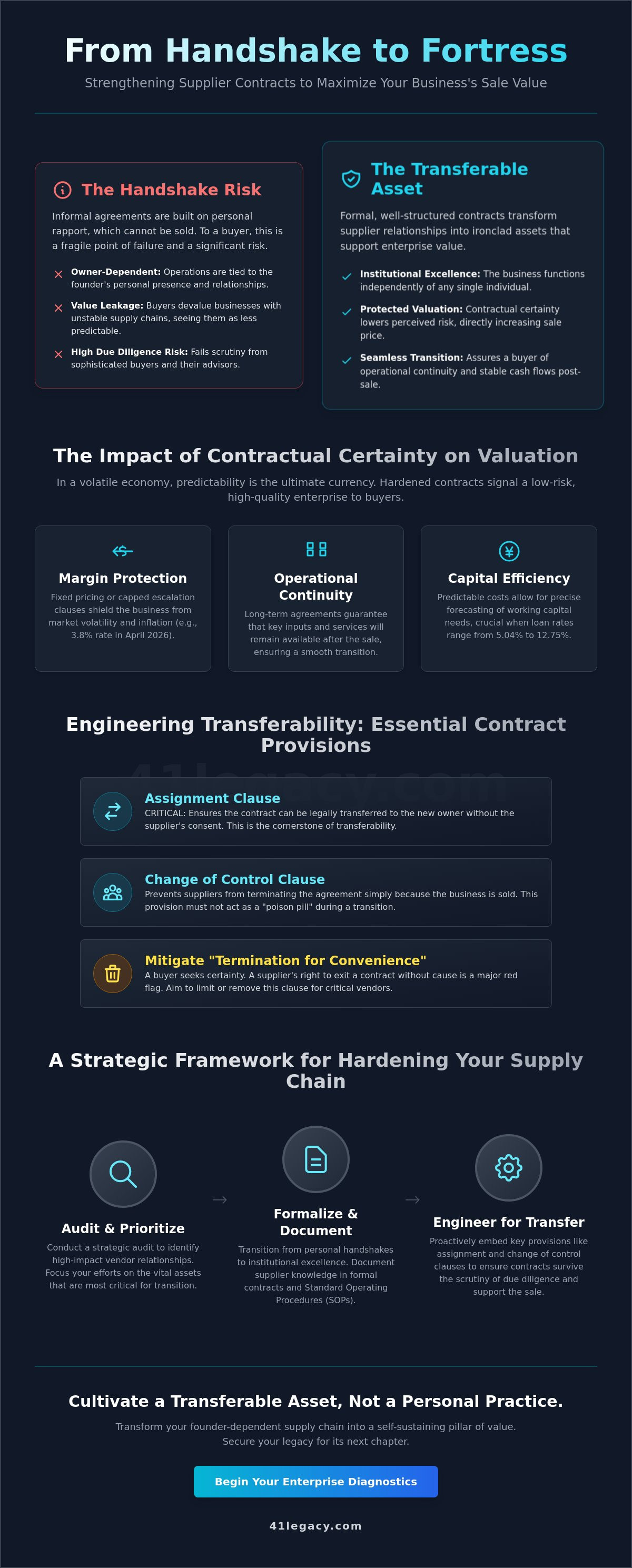
A business is more than the sum of its inventory or the brilliance of its founder. It is a living architecture held together by vital connective tissues. In our work at 41 Legacy, we view supplier contracts as the structural sinews of an organization. They provide the stability required for an entity to stand on its own, independent of the hands that originally built it. For the sophisticated buyer, a supplier agreement is not a mere administrative detail; it is a pillar of enterprise transferability. When you begin the process of strengthening supplier contracts for business sale, you are essentially hardening the infrastructure of your legacy.
The psychological shift from owner-led deals to enterprise-driven agreements is profound. Many founders pride themselves on handshake relationships built over decades of personal rapport. While these connections are admirable, they are often fragile. A buyer cannot purchase your personal history or your unique charisma. If the supply chain relies on your presence to function, the enterprise is not yet a transferable asset. It remains a personal practice. Transitioning these relationships into formal, documented agreements ensures that the essence of the business remains intact during a change of stewardship.
The Concept of the Transferable Asset
True value lies in the ability of a business to thrive without the founder's intervention. During our Enterprise Diagnostics, we often identify handshake risks as significant points of value leakage. These informal arrangements signal high risk to professional advisors and potential successors. By grounding these relationships in the legal framework of sales contracts, you reframe supplier management as a form of stewardship. You are no longer just buying goods; you are securing the future capacity of the organization. This discipline transforms a volatile dependency into a resilient, institutionalized asset.
The Impact of Contractual Certainty on Valuation
Predictability is the ultimate currency in any transition. With the annual inflation rate reaching 3.8% in April 2026, the ability to demonstrate locked-in pricing or clear adjustment mechanisms is invaluable. Strengthening supplier contracts for business sale directly correlates to lower discount rates in a valuation. When cash flows are protected by certain terms, the perceived risk of the investment drops. This creates a narrative of excellence that appeals to the most discerning buyers.
- Margin Protection: Fixed pricing or capped escalations shield the business from market volatility.
- Operational Continuity: Long-term agreements assure a buyer that key inputs will remain available after the sale.
- Capital Efficiency: Certainty allows for more precise forecasting of working capital needs.
In an era where commercial loan rates range from 5.04% to 12.75%, buyers are meticulously scrutinizing every line item for stability. A hardened contract portfolio acts as a beacon of quality. It signals that the enterprise is prepared for its next chapter of growth, functioning with surgical precision regardless of who holds the keys.
Engineering Transferability: Essential Provisions for the Sophisticated Exit
If the supplier contract is the sinew of the business, its specific provisions are the architectural blueprints that dictate whether that structure can be moved. A buyer's due diligence team will scrutinize these documents with surgical precision. They look for "poison pills" that could dissolve the partnership upon a change of ownership. Proactively strengthening supplier contracts for business sale involves identifying these vulnerabilities years before a transition occurs. It's about ensuring the continuity of the enterprise's lifeblood under new stewardship.
One of the most overlooked risks is the "Termination for Convenience" clause. While flexibility is often desired, a supplier's right to exit a contract without cause can destabilize future cash flow projections. A sophisticated buyer seeks certainty. They want to know that the essential inputs required to maintain margins are secure, especially as the annual inflation rate reached 3.8% in April 2026. Aligning your Service Level Agreements (SLAs) with future expectations is equally vital. Your current standards must match the rigorous demands of a larger, perhaps more institutional, successor.
Assignability: The Key to a Seamless Transition
The distinction between "silent" consent and express anti-assignment language is where many owners stumble. If a contract is silent on assignment, it is generally transferable; however, many modern vendor agreements include explicit "Change of Control" triggers. These clauses can give a supplier the right to renegotiate terms or terminate the relationship if the owner changes. We recommend a thorough Transferability Engineering review to audit your portfolio. This allows you to renegotiate these rights while your relationship with the vendor is strong, rather than under the pressure of a looming transaction. It's a strategic move that preserves value and prevents eleventh-hour surprises.
Protecting the Inner Essence: IP and Confidentiality
A business's unique essence often resides in custom solutions developed alongside vendors. Without clear intellectual property (IP) provisions, you might find that the "secret sauce" powering your operations actually belongs to a third party. This creates a catastrophic "founder trap" where the business cannot be sold because it doesn't own its core processes. Hardening your confidentiality agreements is equally critical. As you prepare for an exit, your trade secrets must be protected by more than just trust. Ensuring that your contracts explicitly secure IP ownership and data security standards signals to a buyer that they are acquiring a hardened, self-contained asset.
Transitioning from Personal Rapport to Institutional Excellence
The founder's charisma is often the enterprise's greatest invisible risk. While personal loyalty with vendors feels like a testament to your history, it creates a "Founder Trap" that can devalue the organization during a transition. A buyer isn't purchasing your friendships; they're purchasing a machine that must run without you. When the lifeblood of your supply chain depends on personal rapport, the business lacks the institutional excellence required for a premium exit. Proactively strengthening supplier contracts for business sale means moving beyond the personal to the professional.
Institutionalizing these relationships requires more than just a signature. It involves creating a culture of post-contract accountability and governance. We believe that true stewardship means building a legacy that survives your departure. This is achieved by empowering a management team to lead vendor relations. When a buyer sees that the supply chain is managed by a capable team using documented protocols, the risk profile of the company shifts from volatile to stable. This transition is essential in a market where commercial loan rates remain between 5.04% and 12.75%, making buyers hyper-sensitive to any operational instability.
The Fragility of the Handshake Deal
Buyers view "best friend" supplier relationships as high-risk variables. If terms exist only in your head or a casual email, they aren't transferable assets. Formalizing these legacy agreements into binding enterprise assets is a meticulous process of balancing relational trust with contractual precision. It's about translating decades of mutual respect into a document that protects the essence of the work. This clarity ensures that the vendor remains committed to the entity, regardless of who sits in the owner's chair.
Building the Management Buffer
Delegating supplier oversight is a core pillar of our Value Growth Roadmap. We use Enterprise Diagnostics to identify where an owner is too deeply embedded in vendor mechanics. By training leadership in contract stewardship, you create a management buffer. This allows you to step back while the enterprise functions with precision. It signals that the business thrives under new leadership, reducing owner-dependency and maximizing the final valuation.
To ensure this transition is successful, consider these operational shifts:
- Documented SOPs: Standardize the process for vendor selection and performance reviews.
- Shared Communication: Move vendor correspondence from personal accounts to institutional channels.
- Performance Metrics: Establish clear KPIs for suppliers that are tracked by the management team.
A Strategic Framework for Strengthening Supplier Agreements
Excellence is never an accident; it's the result of high intention and sincere effort. Strengthening supplier contracts for business sale requires a structured approach that moves beyond reactive management. You must view your vendor portfolio as a curated collection of assets, each requiring specific maintenance to ensure its longevity and value. This framework serves as a blueprint for transforming these relationships into hardened, transferable components of your enterprise.
A successful transition relies on your ability to demonstrate that the business is a well-oiled machine. This involves aligning every contract term with your overall Value Growth Roadmap. By coordinating with a "quarterback" advisor, you can synchronize your strategic goals with the technical precision required by your legal and tax professionals. This unified front ensures that your supply chain isn't just functional, but optimized for the highest possible market attractiveness. Implementing a regular review cycle keeps your business in a state of constant exit readiness, protecting your legacy against unforeseen market shifts.
The Audit: Identifying the Value Gap
The first step in our engineering process is a comprehensive audit. We categorize suppliers by their strategic importance and the difficulty of their replacement. It's vital to flag any contracts set to expire within your typical 3-5 year exit window. During this phase, we identify missing protections that could lead to value leakage. For instance, with the annual inflation rate at 3.8% in April 2026, contracts lacking clear price adjustment mechanisms are significant liabilities. We look for these gaps to ensure your margins remain protected under new ownership.
Synchronization with Professional Advisors
Your advisor acts as the guardian of your vision, ensuring that all professional partners are working toward the same objective. We use an Exit Readiness Assessment to provide your attorney with the strategic context they need for contract refinement. It's equally important that your CPAs understand the margin protections embedded in your supplier deals. This collaboration maintains a "professional-room altitude" during negotiations, focusing on long-term enterprise health rather than short-term transactional wins. This level of coordination is especially critical when commercial loan rates range from 5.04% to 12.75%, as buyers will demand absolute financial clarity.
To begin identifying the vulnerabilities in your current vendor relationships, schedule your Enterprise Diagnostics review today. By taking these steps now, you ensure that your supply chain stands as a testament to your stewardship and a cornerstone of your company's future value.
Cultivating the Transferable Asset: The 41 Legacy Perspective
At 41 Legacy, we don't view a business transition as an ending. It's the ultimate validation of your craftsmanship. We approach the task of strengthening supplier contracts for business sale as a form of curation, ensuring that every vital relationship is prepared to endure under new stewardship. Our collective vision is to transform the volatility of founder dependency into the stability of a hardened, institutionalized asset. We believe that your life's work deserves a future that isn't tethered to your daily presence, but rather powered by the systems you've meticulously refined. In an environment where commercial loan rates reach up to 12.75%, the certainty provided by these systems is your most valuable currency.
Our Enterprise Diagnostics process serves as the foundational lens through which we evaluate the health of your supply chain. We don't merely look for legal compliance; we look for the structural integrity that allows the business to breathe on its own. As your strategic advisory partner, we "quarterback" the complex interplay between your internal team and external professionals. We ensure that the technical precision of your legal counsel and the financial rigor of your CPA are perfectly synchronized with your long-term legacy goals. This unified approach protects the enterprise from value leakage during the sensitive periods of due diligence.
Beyond the Transaction: The Steward’s Mindset
True stewardship requires a shift in perspective. You aren't just selling a company; you're facilitating the successful transfer of a living entity. This requires an uncompromising devotion to detail. Every clause in a supplier agreement, every documented SOP, and every institutionalized rapport serves as a safeguard for the essence of what you've built. We act as the guardians of this history, ensuring that the transition is seamless and that the value you've created remains intact. It's about moving from owner-dependency to enterprise excellence with surgical precision.
Next Steps on the Journey to Readiness
The path to transferability is a deliberate journey. It begins with identifying vulnerabilities and continues through the steady implementation of a Value Growth Roadmap. We provide monthly implementation support to ensure these strategic goals are met with the highest standards of excellence. This unhurried, thoughtful process reflects the time-intensive nature of high-end craftsmanship. It's about building a legacy that commands respect and stands the test of time. We invite you to begin this process by exploring our Exit Readiness Assessments. Together, we can ensure that your enterprise stands as a timeless testament to your vision.
Securing the Architectural Integrity of Your Transition
The transition of a business is a rare intersection of creative artistry and technical engineering. By moving beyond the fragility of personal rapport and formalizing the structural sinews of your supply chain, you ensure the essence of your work remains intact for the next generation of stewardship. We have explored the necessity of hardening assignment rights and securing intellectual property to eliminate value leakage during due diligence. Proactively strengthening supplier contracts for business sale transforms a collection of relationships into a resilient, transferable asset that thrives independently of its founder.
As a national strategic advisory firm for high-value enterprises, we specialize in the meticulous discipline of Transferability Engineering. Our team, led by a Certified Exit Planning Advisor (CEPA), is dedicated to protecting the impact of your life's work through structured diagnostics and strategic clarity. The health of your enterprise depends on the precision of these foundational details. We invite you to Begin Your Exit Readiness Assessment with 41 Legacy today. Your commitment to excellence has built this legacy; our commitment will ensure it endures.
Frequently Asked Questions
What is an assignment clause and why is it vital for a business sale?
An assignment clause determines whether a contract can be transferred to a new owner without the supplier's explicit consent. It's vital because it ensures operational continuity during a transition. Without clear assignability, a buyer faces the risk of key vendors renegotiating terms or exiting the relationship entirely at the moment of sale, which creates significant value leakage and uncertainty.
Can I strengthen my supplier contracts if I plan to sell in less than a year?
Yes, you can initiate refinements even on a condensed timeline, although a longer horizon is ideal for strengthening supplier contracts for business sale. Focus on your most critical vendors first to secure the highest impact. Even short term amendments that clarify assignability or lock in pricing for twelve months can provide the institutional certainty a buyer requires during due diligence.
How do handshake agreements with suppliers affect my business valuation?
Handshake agreements generally depress valuation because they represent a high risk of owner dependency. A buyer cannot verify the terms of a verbal deal, nor can they be certain the relationship will survive your departure. Sophisticated buyers often apply a higher discount rate to cash flows that aren't protected by formal, documented contracts, viewing them as volatile rather than institutional assets.
What happens if a key supplier refuses to sign a transferable contract?
If a supplier refuses to formalize terms, you must develop a strategic contingency plan to reduce that specific dependency. This might involve identifying alternative vendors or adjusting your internal processes to mitigate the risk. Demonstrating to a buyer that you have a viable "Plan B" protects your credibility and ensures the enterprise remains attractive despite the lack of a formal agreement.
Should I involve my attorney or my exit planning advisor first in contract reviews?
Involve your exit planning advisor first to establish the strategic context and "professional-room altitude" for the review. While attorneys handle the legal mechanics, an advisor ensures the contracts align with your overall Value Growth Roadmap. This sequence allows the legal work to be guided by a clear vision of transferability and long term enterprise health rather than just technical compliance.
How does owner-dependency in supplier relations impact the due diligence process?
Owner dependency creates a friction point that can stall or derail the due diligence process. When supplier relationships are tethered to your personal rapport, a buyer sees a "Founder Trap" rather than a self-sustaining asset. Strengthening supplier contracts for business sale involves institutionalizing these links so the business functions with surgical precision regardless of who holds the title of owner.
What are the most common "red flag" clauses in supplier agreements for buyers?
Common red flags include "Change of Control" triggers that allow suppliers to terminate upon a sale and "Termination for Convenience" clauses that lack adequate notice periods. Buyers also scrutinize contracts that lack clear intellectual property protections or have pricing that fluctuates wildly. These provisions signal instability and can lead to aggressive price negotiations or requests for substantial holdbacks during the transition.
Does strengthening supplier contracts really increase the final sale price?
It increases the probability of a premium valuation by significantly reducing the perceived risk of the investment. While contracts don't always dictate the price, the certainty they provide allows a buyer to pay a higher multiple for your earnings. Hardened contracts ensure that the projected future cash flows are secure, which is the ultimate driver of enterprise value in any market.
Disclaimer
This article is for educational and informational purposes only and does not provide legal, tax, investment, or business brokerage advice. 41 Legacy does not offer M&A brokerage services, legal document drafting, tax preparation, or investment advisory services. Business owners should consult licensed professionals in those disciplines before making decisions related to business transactions, legal matters, tax strategy, or financial planning. All examples are illustrative and may not apply to your specific situation.