
Transferability & Owner Dependency
The Architecture of Transferability: Key Value Drivers in a Business Sale
A business that cannot breathe without its founder isn't an asset; it's a beautifully gilded cage. For the sophisticated owner, the ultimate expression of craftsmanship isn't just in the daily operation, but in the deliberate engineering of a legacy that endures through a transition of stewardship. Understanding the key value drivers in a business sale is the first step in evolving from a primary operator to a true architect of enterprise value. It's about moving beyond the fear of leaving money on the table and toward a state of complete exit readiness.
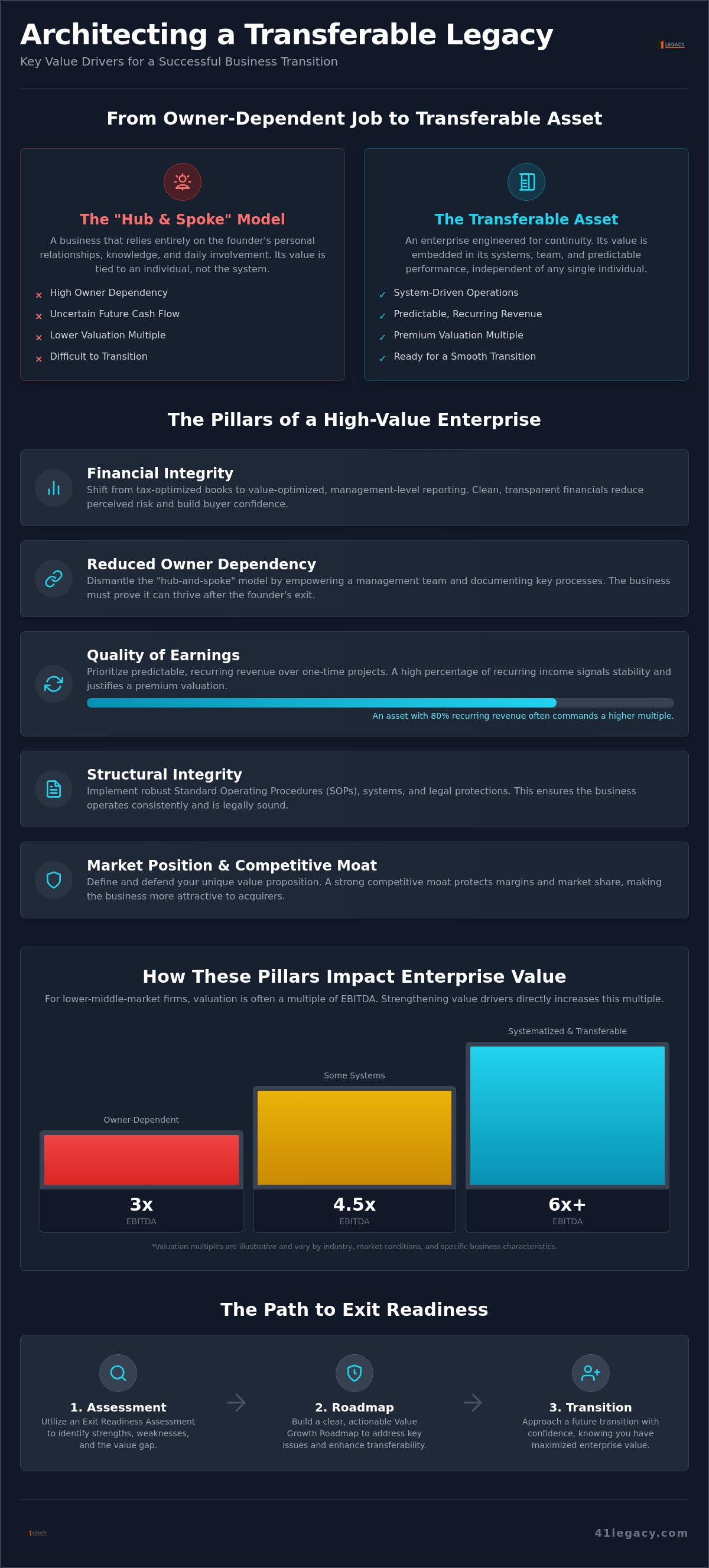
We understand the weight of your life's work and the desire to see its essence preserved. You've likely felt the stress of a business that demands your presence to function, creating a ceiling on what a buyer is willing to pay. This guide will illuminate the strategic pillars that transform a successful company into a high-value, transferable asset. We'll examine the specific operational frameworks and risk-reduction strategies that justify premium multiples in the 2026 market, where lower-middle-market firms often command between 3 and 6 times EBITDA. You'll discover a clear path to increasing your enterprise value while finally reducing the daily weight of operational dependency.
Key Takeaways
- Distinguish between a personal income stream and a transferable asset by aligning your current operations with the certainty of future cash flow.
- Master the financial pillars of transparency and forecasting to reduce perceived risk and illustrate the long-term potential of your enterprise.
- Identify the key value drivers in a business sale that allow you to dismantle the hub-and-spoke management model and eliminate owner dependency.
- Implement Standard Operating Procedures and robust legal protections to ensure your business maintains its structural integrity in your absence.
- Utilize an Exit Readiness Assessment to bridge the value gap and build a clear roadmap toward a successful, high-value transition.
Defining Enterprise Value: The Distinction Between a Job and an Asset
True enterprise value isn't a trophy awarded for years of labor; it's a calculated assessment of the future. We believe that Business valuation represents the precise intersection of financial performance and the probability of its continuation. Many owners find themselves trapped by the "Value Gap," which is the chasm between their personal financial needs and the price a sophisticated buyer is actually willing to pay. This discrepancy usually arises because the owner has built a lifestyle business—essentially a high-paying job—rather than a transferable asset that breathes on its own.
We define Transferable Value as the price a buyer pays for a business that operates without the seller. When we analyze the key value drivers in a business sale, we're searching for the structural integrity that remains once the founder departs. If the organization's success is tied exclusively to your personal relationships or technical brilliance, you haven't built a company; you've built a pedestal. A true asset is a machine that produces results regardless of who sits in the captain's chair.
The Shift from Revenue to Quality of Earnings
Top-line growth often acts as a veil, masking underlying value erosion that can devastate a sale price. Buyers in 2026 are increasingly clinical, looking past gross revenue to scrutinize the "stickiness" of your customer base. They prioritize recurring revenue over one-time project fees because it provides a predictable narrative of future cash flow. We've seen that a smaller, highly efficient company with 80% recurring revenue often commands a higher multiple than a larger competitor reliant on constant, manual hunting for new contracts. This focus on quality over quantity is what separates the artisan from the amateur.
Market Attractiveness and Competitive Moats
Your industry's current environment dictates the ceiling of your valuation. For instance, while professional services might see multiples between 4 and 7 times EBITDA, technology-driven platforms often reach much higher. We use Enterprise Diagnostics to evaluate your current standing against these benchmarks. Identifying your "competitive moat," the unique essence of your work that cannot be easily replicated, is vital. This moat isn't just a marketing claim. It's a structural defense that protects your margins and ensures your legacy remains untouchable by the tide of competition.
The Financial Pillars: Performance, Transparency, and Forecasting
Financial integrity is the bedrock upon which all trust is built. It transforms a ledger from a mere historical record into a testament of future reliability. When evaluating the key value drivers in a business sale, sophisticated acquirers look for the absence of friction. They seek a narrative that is clear, verifiable, and devoid of the "founder's math" that often complicates smaller enterprises. Clean books aren't just an administrative requirement; they're the foundation of any successful transferability engineering effort.
Many owners operate with tax-optimized books, structured to minimize immediate liabilities. While efficient for the short term, this approach often masks the true earning power of the company. To build a transferable asset, you must transition toward value-optimized reporting. This involves management-level financial statements that move beyond the basic tax return to reveal the rhythmic heartbeat of your operations. It allows a buyer to see the business as a standalone entity, capable of generating wealth without your personal intervention.
The Role of Financial Transparency
Transparency is the ultimate currency in a high-value sale. Detailed reporting eliminates the "buyer's remorse" that frequently stalls deals during due diligence. When every dollar is accounted for and every margin is explained, the perceived risk of the acquisition drops precipitously. In the current 2026 market, where lower-middle-market businesses are valued between 3 and 6 times EBITDA, the difference between a "clean" business and a "cloudy" one can represent millions in enterprise value. Transparency ensures that the value you've built is seen and respected, rather than questioned.
Forecasting as a Strategic Roadmap
A buyer isn't paying for where you've been; they're paying for where the business is going. Pro forma statements and financial forecasting serve as the blueprints for this future potential. By illustrating the scalability of the enterprise, you provide a roadmap that justifies a premium multiple. We use Enterprise Diagnostics to uncover hidden financial opportunities, ensuring your current operational decisions align with long-term growth. With the Prime Rate holding at 6.75% as of July 2026, buyers are more discerning than ever. They require data-driven proof that your company can thrive in a shifting economic landscape. Forecasting provides that proof, turning abstract potential into a tangible, high-value asset.
Escaping the Rainmaker Trap: Reducing Owner Dependency
The most profound paradox of entrepreneurship lies in the founder's own brilliance. When an owner becomes the sole engine of growth, they inadvertently diminish the enterprise's ultimate worth. We often see businesses that sparkle under the founder's gaze but wither the moment that attention is diverted. In the context of key value drivers in a business sale, owner dependency is perhaps the most significant discount factor. If you are the business, the business has no value to anyone but you.
A buyer is purchasing your systems, not your personal charisma. This fundamental truth requires a shift in perspective. Many organizations suffer from a "hub-and-spoke" management model, where every decision, no matter how granular, spirals back to the center. This creates a fragile architecture. It suggests that the company is not a living entity but merely a reflection of a single personality. To build a lasting legacy, you must transition from being the primary actor to the chief architect of the system.
Building Management Depth
The evolution of leadership requires a deliberate shift from doing to leading, and finally, to stewarding. Empowering a second-tier management team isn't merely a delegation of tasks; it's a transfer of ownership over key results. When an acquirer observes a team that operates with autonomy, their confidence in the continuity of future cash flow increases. Talent development is a direct investment in the multiple a buyer is willing to pay. We focus on Owner Dependency Reduction to ensure the essence of the work continues without your constant touch.
Strategic Capacity Evaluation
We must also consider the bandwidth of the remaining team. A Strategic Capacity Evaluation determines if your specialists have the mental and operational space to scale the company after a transition. Reducing "Key Person Risk" involves a meticulous process of cross-training and knowledge sharing. This ensures that the collective wisdom of the organization isn't stored in a single mind. By positioning yourself as the architect of the system rather than the engine of the work, you create an asset that is truly transferable. This clarity of structure is what sophisticated connoisseurs of business value seek above all else. It's the difference between a company that survives and one that thrives independently of its creator.
Structural Integrity: Systems, SOPs, and Legal Protection
Structural integrity is the silent guardian of enterprise value. While management depth addresses the human soul of the company, systems and legal frameworks provide the skeletal strength required for a successful transition. Among the most critical key value drivers in a business sale is the presence of documented, replicable processes. These ensure the work remains excellent long after the founder has departed. This is the essence of transferability engineering. It transforms a collection of individual efforts into a plug-and-play acquisition target that a buyer can operate with confidence from day one.
Ensuring your legal and compliance frameworks are exit-ready is a process that should begin years before a potential sale. Sophisticated acquirers don't just buy your past performance; they buy the certainty that your performance will continue. Any ambiguity in your systems or legal standing creates friction. Friction is the enemy of a premium valuation. By fortifying these structures early, you position yourself as a steward of a lasting asset rather than an operator of a temporary venture.
Documenting the 'Secret Sauce'
Undocumented processes are viewed as high-risk liabilities by the clinical eye of a sophisticated buyer. They represent a knowledge leak where the core value of the company resides only in the minds of a few individuals. We believe that Standard Operating Procedures (SOPs) are the blueprints of your enterprise. They allow for consistent execution and predictable results. This ensures that the company's unique essence is captured and preserved. Creating a culture of documentation ensures the business survives personnel changes and maintains its operational standards without compromise.
Contractual and Legal Fortification
The strength of your enterprise is often found in the fine print of your agreements. It's vital to ensure that customer and vendor contracts are fully assignable. This allows for a seamless transition of ownership. The inclusion of non-compete and non-solicitation agreements for key staff protects the integrity of your talent pool. In the stable tax environment of 2026, buyers are looking for long-term security. Reducing legal friction through meticulous preparation accelerates the closing of a transaction and preserves your hard-earned value. To begin fortifying your business's foundation, consider our Transferability Engineering services to ensure your legacy is built on solid ground.
The Path to Exit Readiness: Implementing a Value Growth Roadmap
Transitioning a legacy is perhaps the most significant event in an owner's life. It requires more than just high-level intent; it demands a clinical, structured approach to key value drivers in a business sale. We begin with a baseline of truth. An Exit Readiness Assessment establishes where the enterprise stands today, identifying the specific gaps that prevent it from reaching its full valuation potential. This isn't merely a checklist. It's the first step in a sophisticated process of value engineering that prepares the organization for its next chapter of stewardship.
Success in this arena is rarely a solo endeavor. It requires the synchronized effort of a "Team of Five": your CPA, attorney, RIA, and other strategic specialists. Even the most brilliant advisors can struggle if their efforts aren't coordinated toward a singular vision of enterprise value. We act as the "Quarterback" in this process. Our role is to ensure that every strategic move, from tax optimization to legal fortification, is perfectly aligned with your long-term goals. We provide the connective tissue that turns individual expert advice into a cohesive strategy for growth.
Enterprise Diagnostics and the Value Gap
Identifying the levers that will move the needle on your valuation is a matter of technical precision. We use Enterprise Diagnostics to uncover the specific risks that may be eroding your company's worth. This prioritized action plan allows us to address the "Value Gap" directly. By treating the business as a living entity that requires constant refinement, we prevent the "value decay" that often occurs when an owner takes their eye off the horizon. In a market where buyers are increasingly discerning, maintaining this edge is vital to preserving your impact.
Monthly Implementation Support
A one-time plan is a static artifact; a Value Growth Roadmap is a rhythmic execution. The difference lies in our Monthly Implementation Support. We maintain a "professional-room altitude," keeping the focus on high-level strategy while ensuring that granular improvements are executed with surgical accuracy. This recurring rhythm provides the accountability needed to transform a lifestyle business into a transferable asset. You don't have to navigate this complexity alone. Learn how an Exit Readiness Assessment can illuminate your path to a successful transition and ensure your life's work reaches its ultimate potential.
Architecting the Future of Your Legacy
The evolution from founder to steward is a deliberate act of creation. It requires a clinical focus on the key value drivers in a business sale to ensure that the essence of your work remains intact long after you've moved on. By fortifying your financial pillars and dismantling the trap of owner dependency, you transform a successful operation into an enduring institution. This structural clarity isn't just a strategy; it's a commitment to the longevity of your impact and the preservation of your life's work.
We operate as a national strategic advisory firm dedicated to this meticulous level of craftsmanship. Led by a Certified Exit Planning Advisor (CEPA), our specialists provide the Enterprise Diagnostics and Value Growth Roadmaps necessary to bridge the gap between your current standing and your ultimate financial goals. We invite you to begin your journey toward a transferable legacy with an Exit Readiness Assessment. You've spent a lifetime building your business with precision. Now is the time to ensure it thrives as a standalone asset, capable of flourishing for generations to come.
Frequently Asked Questions
What are the most important value drivers for a small to mid-sized business?
Financial performance, management depth, and operational systems are the foundational pillars of enterprise value. Sophisticated buyers seek a "transferable" entity where the probability of future cash flow remains high regardless of who is in charge. By focusing on these key value drivers in a business sale, an owner moves from merely running a job to stewarding an enduring asset that commands a premium multiple.
How can I increase my business valuation without significantly increasing revenue?
You can increase your valuation by focusing on multiple expansion, which involves reducing the perceived risk of your organization. Buyers pay more for businesses with high-margin recurring revenue, documented processes, and a diversified customer base. These structural improvements lower the risk profile, allowing the business to command a higher multiple of its existing earnings even if the top-line revenue remains stagnant for a period.
Why do buyers care so much about owner dependency?
Buyers prioritize owner-independent businesses because they represent a lower risk of operational collapse after a transition of stewardship. If the company's success relies on your personal relationships or technical brilliance, the asset is considered fragile. Reducing owner dependency proves that the enterprise's unique essence is baked into its systems and team rather than residing solely in the mind of the founder.
How long does it take to prepare a business for a successful transition?
Preparing a business for a successful transition typically requires 24 to 36 months of deliberate effort. This timeframe allows for the implementation of structural changes, such as building a second-tier management team and refining financial reporting. While a transfer can happen faster, a multi-year lead time ensures you can address the key value drivers in a business sale with the technical precision required to maximize enterprise value.
What is the difference between a business broker and an exit readiness advisor?
A business broker focuses on the transaction itself, while an exit readiness advisor focuses on the structural health and value growth of the enterprise before it ever reaches the market. Our work involves Strategic Advisory and Transferability Engineering to ensure the business is ready for a transition at any time. We build the intrinsic value that eventually makes a transaction successful, focusing on the long-term integrity of the asset.
Can a business be too dependent on a single customer?
Customer concentration is a significant risk that can depress your valuation. If a single client accounts for more than 10% or 15% of your total revenue, buyers see a precarious foundation. Diversifying your client base ensures that the loss of one relationship doesn't jeopardize the survival of the entire enterprise. This makes the business much more attractive to clinical acquirers who value stability and predictable cash flow.
How do standard operating procedures (SOPs) impact the sale price?
Standard Operating Procedures act as the blueprints of your organization, directly increasing the certainty of future performance. They transform tribal knowledge into a replicable system, which reduces the learning curve for a new steward. Well-documented systems often lead to a premium price because they prove the business can maintain its standards of excellence and operational precision without the founder's daily intervention or oversight.
What role does my CPA play in the exit planning process?
Your CPA ensures the financial integrity of your books, which is the baseline for any successful valuation. They provide the historical data and management-level reporting needed to survive the intense scrutiny of due diligence. While they handle the technical accounting and tax mitigation, we work alongside them to ensure those financial truths are translated into a broader, strategic narrative of enterprise value growth and transferability.
Disclaimer
This article is for educational and informational purposes only and does not provide legal, tax, investment, or business brokerage advice. 41 Legacy does not offer M&A brokerage services, legal document drafting, tax preparation, or investment advisory services. Business owners should consult licensed professionals in those disciplines before making decisions related to business transactions, legal matters, tax strategy, or financial planning. All examples are illustrative and may not apply to your specific situation.