
The Architecture of Transferability: How to Assess Business Exit Readiness
If your business were to lose its architect tomorrow, would the structure stand as a monument to your vision, or would it crumble under its own weight? For many founders, the enterprise is less a transferable asset and more a reflection of their personal presence, a phenomenon known as the Rainmaker Trap. Learning how to assess business exit readiness is not merely a financial exercise; it's a diagnostic of your legacy's structural integrity. It requires a shift in perspective, moving from the role of a daily operator to that of a steward building a masterpiece that can thrive independently.
We understand that your company is more than a series of balance sheets; it's the culmination of years of meticulous craftsmanship. You likely feel the weight of uncertainty regarding the actual market attractiveness of your enterprise and the lack of coordination among your various advisors. Discover the sophisticated framework for evaluating your company’s value, reducing owner dependency, and transforming your life’s work into a transferable legacy. This guide provides a clear diagnostic of current enterprise value and a roadmap to bridge the gap between your present reality and your long-term financial goals.
Key Takeaways
- Discover how to assess business exit readiness by distinguishing between your personal financial requirements and the structural independence of the enterprise itself.
- Utilize Enterprise Diagnostics to identify the "Value Gap," revealing the critical distance between your current asset value and your ultimate financial aspirations.
- Implement Transferability Engineering to reduce owner dependency, ensuring the business retains its essence and performance without your constant intervention.
- Align your existing professional advisors through a coordinated "quarterback" strategy to eliminate fragmented guidance and maximize the health of the enterprise.
- Move from a passive assessment to a proactive Value Growth Roadmap, utilizing structured monthly support to bridge the gap toward a successful transition.
Defining the Essence of Exit Readiness
Exit readiness isn't a fixed point on a calendar or a reaction to a market peak. It's the measure of an enterprise's structural integrity and its allure to the outside world. To truly understand how to assess business exit readiness, you must distinguish between your personal financial requirements and the business’s independent functionality. Financial readiness is a calculation of what you need to sustain your lifestyle. Structural readiness, however, is a surgical evaluation of whether the business can survive the departure of its creator. It's the difference between owning a high-paying job and stewarding a transferable masterpiece.
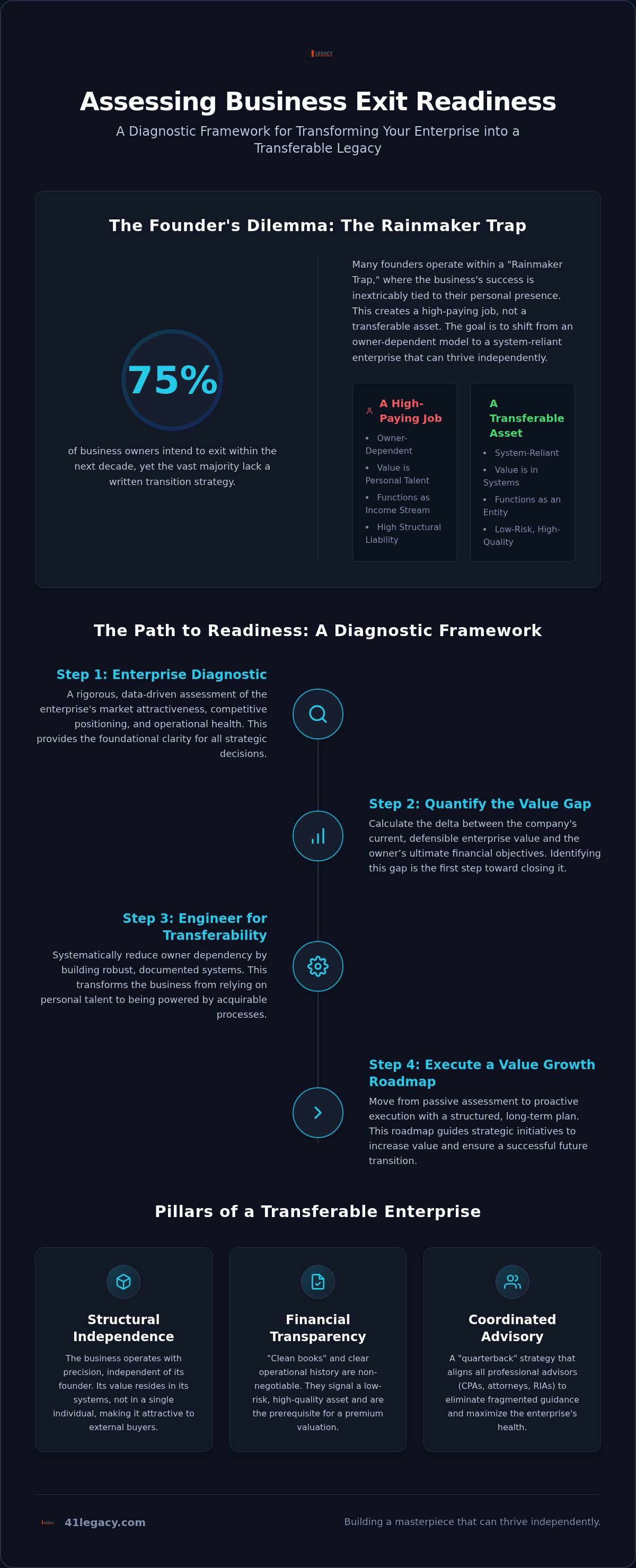
According to data from Maus Software published in September 2025, more than 75% of business owners intend to exit their companies within the next decade, yet the vast majority lack a written strategy. This lack of foresight often results in a business that functions as a personal income stream rather than a transferable asset. True strategic clarity comes from viewing the enterprise as a separate, living entity. Assessing this readiness years before a planned transition allows you to identify the "Value Gap" early, ensuring the asset's health is preserved and its value is maximized through meticulous engineering.
The Distinction Between a Job and an Asset
Many founders fall into the "Rainmaker Trap." They're the primary salesperson, the chief problem solver, and the sole keeper of critical relationships. While this feels like a badge of honor, it's a structural liability that devalues the enterprise. A buyer doesn't want to purchase your personal talent; they want to acquire your systems. If you're the inner essence of the work, the value evaporates the moment you walk out the door. The master artisan's ultimate achievement is building a machine that operates with surgical precision without the master’s hand.
Why Timing is Secondary to Preparation
External market conditions are volatile and beyond your control. However, internal readiness is a variable you can govern with absolute precision. Exit planning is often mistaken for a transaction event, but it's actually the pursuit of perpetual sellability. Unforeseen life events often dictate the timing of a transition. If the business is structurally sound, you have options and leverage. If it isn't, you face a crisis of value. Preparation allows you to act as a guardian of your company's history, protecting the impact you've built regardless of when the transition occurs.
The Diagnostic Framework: Assessing Enterprise Attractiveness
The journey toward a successful transition begins with a rigorous, cold-eyed look at the current state of the enterprise. The first step in understanding how to assess business exit readiness is the deployment of a comprehensive Enterprise Diagnostic. This foundational tool serves as a high-precision lens, bringing the "Value Gap" into sharp focus. It evaluates the enterprise’s market attractiveness, looking beyond simple balance sheets to examine industry trends, competitive positioning, and the clarity of operational history. Premium buyers are not merely looking for cash flow; they seek the assurance of financial transparency. "Clean" books are the prerequisite for a premium valuation, representing a level of meticulous stewardship that signals a low-risk, high-quality asset. Without this diagnostic clarity, an owner is navigating by intuition rather than data.
Quantifying the Value Gap
The Value Gap is the delta between a company’s current worth and its owner’s ultimate financial objective. Determining enterprise value provides the essential baseline for this calculation, offering a sobering but necessary reality check. For many owners, realizing that their "number" is unsupported by the business’s current structural state can be a profound psychological challenge. It requires moving from the emotional attachment of a creator to the analytical detachment of a curator. This shift ensures the legacy you've built is actually capable of supporting your future aspirations. Identifying this gap early is the only way to begin the work of closing it through strategic growth and risk reduction.
Market Attractiveness vs. Internal Readiness
A business may exist within a high-growth sector with attractive industry multiples, yet remain fundamentally unsellable if its internal diagnostics are poor. Market attractiveness is an external force, but readiness is an internal achievement. High multiples can't compensate for a lack of documented systems or a team that relies solely on the founder’s intuition. We utilize a Strategic Capacity Evaluation to measure growth potential and operational maturity. This evaluation ensures that the internal infrastructure matches the external opportunity, bridging the gap between being a participant in a market and being a leader within it. Learning how to assess business exit readiness requires a commitment to this internal engineering. Engaging in a formal Exit Readiness Assessment is the only way to ensure these internal drivers are prepared for the scrutiny of the marketplace.
Engineering Transferability: Reducing the Founder’s Shadow
The most profound challenge in mastering how to assess business exit readiness lies in the mirror. For many founders, the fact that a business cannot function without their daily intervention is viewed as a badge of honor. Within a professional valuation framework, however, this indispensability is a critical point of failure. It represents a "Key Person Risk" that signals instability to any potential successor. To transform a life's work into a transferable asset, one must engage in Transferability Engineering. This is the technical process of extracting the founder’s "inner essence" from the mechanical operations of the company, ensuring that the legacy remains intact long after the creator has departed.
Transferability is not achieved through a single event but through the meticulous decoupling of the owner from the brand, the sales process, and the technical execution. When an owner is the primary driver of value, the business is merely a high-performance job. By engineering a structure that thrives independently, you elevate the company from a personal income stream to a durable institution. This shift in perspective is the hallmark of a steward who values the preservation of impact as much as the performance of the present moment.
The Role of Standard Operating Procedures (SOPs)
Standard Operating Procedures are the architectural drawings of your business legacy. They provide the repeatable blueprint that allows a successor to execute with the same surgical precision as the founder. Understanding what is sop in business is essential for any owner seeking to build a transferable asset. These documented processes reduce the perceived risk of a transition, serving as a signature thematic anchor for operational excellence. Clear, high-value documentation is one of the most effective ways to learn how to increase enterprise value, as it proves the business's success is systemic rather than accidental.
Leadership Continuity and Strategic Capacity
A truly ready business possesses a leadership team capable of executing the "Value Growth Roadmap" without founder oversight. During a Strategic Capacity Evaluation, we look for the presence of a professional-led management layer that can sustain growth and manage operational risks. Buyers in the current 2026 market apply stricter standards to leadership structures, seeking teams that demonstrate both technical skill and an artistic devotion to the company’s standards. If the team cannot function as a self-sustaining entity, the enterprise remains shadowed by the founder, limiting its strategic options and devaluing the ultimate transfer.
The Coordinated Diagnostic: Aligning the Advisory Team
Strategic clarity is often lost in the noise of fragmented advice. When you begin the process of how to assess business exit readiness, you likely encounter a common frustration: your professional advisors are operating in silos. Your CPA focuses on tax mitigation, your attorney on risk protection, and your wealth manager on liquid assets. While each provides technical excellence, they often lack a unified vision for the enterprise itself. Fragmented advice is the primary enemy of exit readiness, as a decision made in one area can inadvertently devalue the business in another.
The "Quarterback" philosophy addresses this by providing a central point of coordination. It ensures that every professional is reading from the same architectural blueprint. A certified exit planning advisor acts as this strategic lead, aligning tax planning, estate planning, and business growth into one cohesive roadmap. This coordination transforms a group of disparate specialists into a unified force dedicated to the preservation of your legacy and the maximization of your enterprise's transferable value.
Why Your CPA is Not an Exit Planner
Tax preparation is fundamentally historical. It looks backward at what has already occurred to ensure compliance and efficiency. In contrast, exit planning is future-focused and strategic. To truly understand the health of the enterprise, you need a specialist who understands "Enterprise Value" beyond the simple figures on a balance sheet. The Quarterback creates a collaborative environment where the CPA’s technical data informs the long-term growth strategy. This ensures that tax decisions don't just save money today, but actually strengthen the asset's attractiveness for tomorrow.
The Coordinated Advisory Team (CAT) Framework
The Coordinated Advisory Team is a group of specialists unified by your specific legacy goals. Without this framework, siloed decisions often lead to missed opportunities or structural weaknesses that surface during due diligence. Regular coordination meetings prevent these conflicts, ensuring that every move increases the structural integrity of the business. We don't replace your existing advisors. Instead, we empower them by providing the strategic clarity they need to perform at their highest level. To begin aligning your team for a successful transition, we invite you to schedule a Strategic Advisory consultation today.
From Assessment to Action: The Value Growth Roadmap
The diagnostic phase reveals the architectural flaws, but the Value Growth Roadmap is where the meticulous restoration of the enterprise begins. Understanding how to assess business exit readiness is a continuous discipline rather than a static event. Once the Value Gap is quantified, the focus shifts to a structured implementation phase. This isn't a generic, automated plan. It's a deliberate, human-led process of engineering value. We track progress through recurring enterprise diagnostics, ensuring that every strategic move actively closes the gap between your current reality and your legacy aspirations. By treating the business as a transferable asset, you move from the chaos of daily operation to the clarity of strategic stewardship.
Implementing the Strategic Roadmap
The transition to action is governed by a steady monthly rhythm of advisory support and accountability. This cadence ensures the strategy doesn't sit on a shelf but lives within the daily operations of the company. We begin by prioritizing the specific operational risks that provide immediate value protection. This often involves reducing owner dependency or clarifying financial records to meet the stricter buyer scrutiny documented in the 2026 market. Building enterprise value is a marathon of precision, not a sprint. It requires a commitment to the details, from refining leadership structures to perfecting the inner essence of your workflows. Each month, we move closer to a state of perpetual sellability, treating the business as a living entity that deserves meticulous care and constant refinement.
The Culmination of Readiness: A Transferable Legacy
The ultimate end state is an enterprise that is ready for a transition at any time, purely on your own terms. By mastering how to assess business exit readiness, you ensure that the impact you've built will endure through the progression of time. A business that is structurally ready to be transferred is, by definition, a more profitable and enjoyable business to lead today. It operates with a surgical efficiency that allows you to step back into the role of a visionary curator rather than a daily operator. You aren't just preparing for a final event; you're elevating the health and performance of your life's work. To begin your Enterprise Diagnostic journey with 41 Legacy is to take the first step toward transforming your business into a transferable masterpiece that thrives independently of your presence.
The Path to a Transferable Masterpiece
The architecture of your life’s work deserves a structure that outlasts its creator. True enterprise value isn't found in a single transaction; it's engineered through the relentless pursuit of transferability and the reduction of owner dependency. By understanding how to assess business exit readiness, you shift from the role of a daily operator to that of a visionary curator. This process requires a sophisticated alignment of your existing advisory team, led by the surgical precision of a Certified Exit Planning Advisor (CEPA).
Our "quarterback" approach provides the coordination necessary to ensure your CPA, attorney, and wealth manager are unified by a singular strategic vision. Through the structured Value Growth Roadmap, we help you systematically close the Value Gap and transform your company into a self-sustaining asset. Your business is a living testament to your dedication. It's our privilege to help you preserve its inner essence. Move beyond uncertainty toward a future defined by strategic clarity and perpetual sellability. Your legacy is waiting to be secured.
Secure Your Legacy with a Professional Exit Readiness Assessment
Frequently Asked Questions
What is the difference between a business valuation and an exit readiness assessment?
A business valuation provides a historical snapshot of what a company is worth today based on past financial performance. An Exit Readiness Assessment is a forward looking diagnostic that evaluates the structural integrity and transferability of the asset. It identifies the Value Gap and operational risks that might prevent a successful transition. While a valuation tells you the price, the assessment tells you if the business is actually sellable without you.
How long does it typically take to bridge a significant Value Gap?
Bridging a significant Value Gap is a multi year strategic endeavor rather than a quick fix. Depending on the complexity of the enterprise and the depth of owner dependency, the process typically requires twenty four to thirty six months of consistent implementation. This time allows for the engineering of new systems, the development of a leadership team, and the stabilization of financial records to meet the scrutiny of sophisticated buyers.
Can I assess my business readiness if I don't plan to sell for ten years?
You should begin the process now because the most valuable businesses are those that are perpetually ready for a transition. Learning how to assess business exit readiness a decade in advance gives you the luxury of time to refine your Value Growth Roadmap without the pressure of a looming deadline. A ready business is simply a better run company that provides more profit and freedom for the owner today.
What is the 'Rainmaker Trap' and how does it impact my company's value?
The Rainmaker Trap occurs when the founder remains the primary driver of sales, relationships, and technical execution. This creates a significant structural liability because the company’s inner essence is tied to a single person. Buyers view this as extreme risk and will often devalue the enterprise or walk away entirely. Reducing this dependency through Transferability Engineering is essential to transform your life's work into a transferable asset that thrives independently.
Does an exit readiness assessment require me to share confidential data with my employees?
A professional assessment does not require you to disclose sensitive financial data or your intent to exit to your entire staff. The diagnostic focuses on high level operational systems, leadership capacity, and structural risks. While key members of your management team may eventually be involved in executing the Value Growth Roadmap, the initial evaluation is a confidential strategic exercise conducted between the owner and their coordinated advisory team to protect the enterprise stability.
Why do I need an exit planning advisor if I already have a great CPA and attorney?
While CPAs and attorneys provide essential technical excellence, they often operate in silos without a unified strategic vision. A Certified Exit Planning Advisor (CEPA) acts as the quarterback for your advisory team, ensuring that tax, legal, and growth strategies are perfectly aligned. This coordination prevents fragmented advice that can inadvertently devalue the business. We empower your existing advisors by providing the strategic clarity needed to maximize the health of the enterprise.
What are the first steps in reducing owner dependency in a professional service firm?
The first steps involve documenting your unique processes into Standard Operating Procedures (SOPs) to create a repeatable blueprint for success. You must transition from being the master craftsman to the curator of the system. This includes identifying Key Person Risk and delegating critical client relationships to a capable leadership team. By utilizing a Strategic Capacity Evaluation, you can measure the team’s ability to execute the mission with surgical precision without your intervention.
Is exit readiness only for owners looking for an external sale to a third party?
Exit readiness is essential for any form of transition, whether it is an external sale, a family succession, or a management buyout. Every successor requires a business that is structurally sound and independent of the founder's presence. Mastering how to assess business exit readiness ensures that the enterprise remains a viable, transferable asset. Building a ready business protects your impact and provides the flexibility to choose the transition path that best honors your history.

Article by
Mike Laskowski
Mike Laskowski is a Business Value Growth Strategist who helps business owners uncover the truths that drive their performance, risk, and readiness. Blending forensic interviewing from a 26‑year federal career with Strategic Capacity analysis and CEPA methodology, he works upstream to reduce owner dependency, increase transferability, and strengthen enterprise value. Mike guides founders through clarity, operational evolution, and transition readiness so their companies become transferable, owner‑independent assets that endure beyond the founder.
Disclaimer
This article is for educational and informational purposes only and does not provide legal, tax, investment, or business brokerage advice. 41 Legacy does not offer M&A brokerage services, legal document drafting, tax preparation, or investment advisory services. Business owners should consult licensed professionals in those disciplines before making decisions related to business transactions, legal matters, tax strategy, or financial planning. All examples are illustrative and may not apply to your specific situation.