
The Architecture of Legacy: Understanding the Key Drivers of Enterprise Value
Most founders eventually realize that their greatest achievement is also their primary constraint. The business simply cannot breathe without their daily presence, leaving their personal wealth inextricably tied to their desk. While 72.6% of M&A advisors expect deal flow to increase in 2026, many owners will find their wealth remains trapped because they haven't addressed the key drivers of enterprise value that sophisticated partners demand. You've acted as a devoted steward for your vision, and you deserve to see that work treated as a masterpiece of engineering rather than a mere transaction.
It's natural to feel a sense of uncertainty regarding how a buyer might perceive your company's internal risks or your own heavy involvement in its success. We'll show you how to identify the strategic levers that transform a successful operation into a transferable asset that flourishes long after you step away. This article provides a clear roadmap to bridge the Value Gap and secure the strategic clarity necessary for a graceful, high-value exit.
Key Takeaways
- Distinguish between simple profit and the quality of earnings to understand how sophisticated observers evaluate the future certainty of your organization.
- Identify and refine the key drivers of enterprise value by systematically reducing owner-dependency and engineering a business that functions as a self-sustaining entity.
- Shift your perspective from that of a daily operator to a steward of a transferable asset, ensuring your legacy thrives independently of your personal involvement.
- Utilize enterprise diagnostics and a structured value growth roadmap to identify hidden risks and purposefully bridge the gap between your current and potential value.
Defining the Essence: What Truly Drives Enterprise Value?
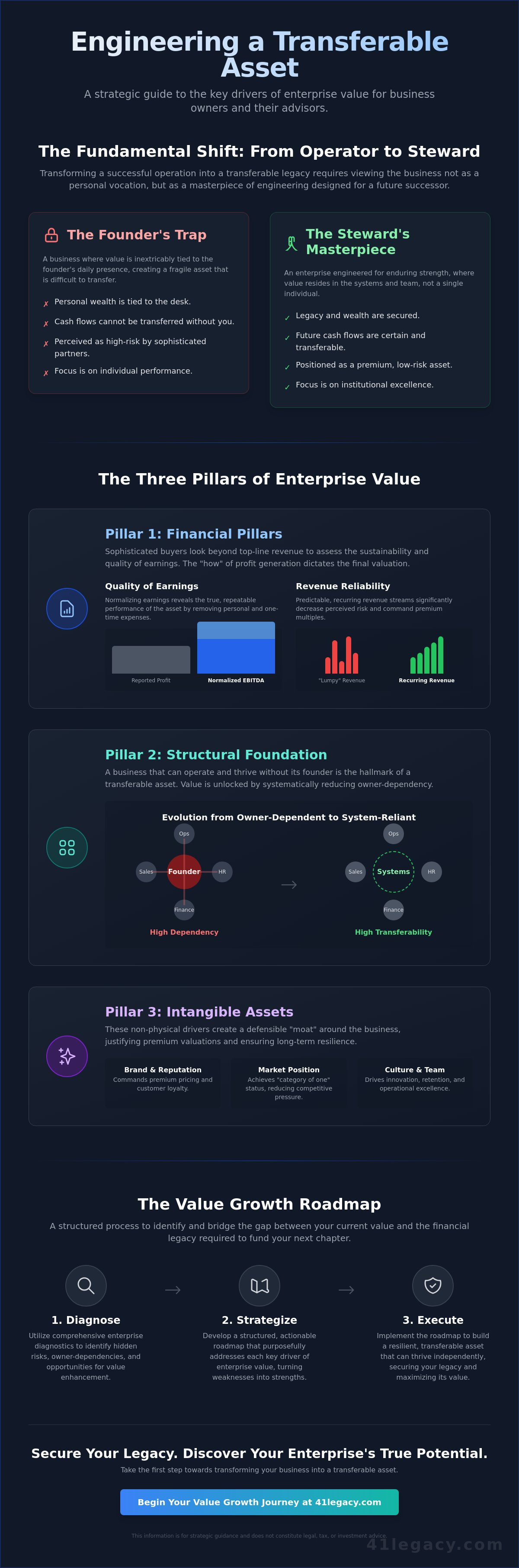
Building a business is an act of creative will, but refining its value is an act of stewardship. For the sophisticated owner, the true measure of success isn't found in a single year's tax return. It's found in the enduring strength of the asset itself. To achieve this, one must undergo a fundamental philosophical shift: viewing the business not as a personal vocation, but as a product designed for a future successor. This perspective transforms the enterprise into a masterpiece of engineering, where every system and process serves to enhance the key drivers of enterprise value.
Understanding the technical nuances of valuation is the first step toward this transformation. While many focus on equity value, the sophisticated leader looks at Enterprise Value to assess the total economic worth of the entity, independent of its capital structure. This figure serves as the ultimate scorecard for business health and stewardship. It reveals the Value Gap, which is the distance between what your business is worth today and the financial legacy required to fund your next chapter. Identifying this gap through structured advisory support is the primary work of strategic growth.
The Distinction Between Profit and Transferable Value
A company can generate significant annual profit yet remain a fragile asset to a potential buyer if that profit is tied too closely to the founder's daily presence. Being Investment Ready is a higher standard than merely being Profitable. It requires a shift from individual performance to institutional excellence. Enterprise value is the present value of future transferable cash flows. If those cash flows cannot be transferred without your genius, the value remains locked within you rather than the business.
The Role of Market Attractiveness in Valuation
External forces also shape the landscape of your legacy. Industry trends and economic cycles act as powerful external value drivers that you must navigate with precision. Positioning your company within a high-multiple sector requires more than just luck; it demands a strategic lens on your Total Addressable Market. By aligning your internal key drivers of enterprise value with these external tailwinds, you ensure the business is perceived as a premium asset. This alignment allows a company to transcend commodity status and enter a category of one, commanding respect from even the most discerning partners.
The Financial Pillars: Beyond EBITDA and Revenue
Financial statements are the technical drawings of a business legacy. They reveal the integrity of the structure and the precision of its assembly. While top-line revenue often captures the imagination of the casual observer, the true value of an enterprise resides in the consistency and quality of its bottom line. It's not enough to simply be profitable. A sophisticated steward asks how those profits are generated, as the "how" often dictates the eventual exit price. This inquiry leads us to the Quality of Earnings, a critical lens through which we examine the sustainability of your success. By focusing on the key drivers of enterprise value, you ensure that your financial health is a reflection of operational excellence rather than mere market timing.
Revenue reliability serves as a primary indicator of institutional health. Transactional income, while useful for cash flow, lacks the structural permanence that buyers crave. When income is predictable and recurring, the perceived risk of the asset decreases. Profit margins also act as a proxy for competitive advantage. High margins suggest a company has achieved a "category of one" status, where the brand commands a premium because it lacks a direct substitute. For those seeking a deeper technical foundation on how these elements coalesce, this comprehensive guide to valuation methods details the cash flow discounting techniques that underpin modern appraisal.
EBITDA Quality and Normalization
True earning power is often obscured by the complexities of owner-operated accounting. Normalization is the process of stripping away personal expenses and one-time events to reveal the "core" performance of the asset. Add-backs are not just accounting adjustments; they are declarations of the business's true capacity. However, financial transparency is a non-negotiable prerequisite for a premium valuation. "Lumpy" revenue, characterized by erratic spikes and troughs, creates a narrative of instability. Smoothing these cycles through better contract structures is one of the most impactful key drivers of enterprise value.
Growth Prospects and Scalability
A successor isn't just paying for your historical performance; they're investing in the future potential of the entity. This is often reflected in the "Growth Multiple." To capture this premium, you must demonstrate "Strategic Capacity." Can your organization double its output without a corresponding collapse in quality or culture? Proving the future to a skeptical audience requires more than optimism. It requires rigorous financial forecasting and a clear value growth roadmap that outlines the path ahead. When you can mathematically demonstrate scalability, you move from selling a job to offering a high-performance vehicle for wealth creation.
The Structural Foundation: Transferability and Owner-Dependency
Enterprise value is more than a financial calculation; it's a structural reality. A business that relies on the founder’s daily intervention is not an asset, but a high-pressure job. Structural independence is among the most vital key drivers of enterprise value, as it ensures the organization can flourish without its creator. We view this as "Transferability Engineering." It’s the process of transforming a company from a centralized hub where the owner makes every decision into a decentralized machine powered by an empowered leadership team.
Founders often fall into the "Rainmaker Trap," believing their personal ability to close deals is their greatest contribution. In reality, being the primary salesperson devalues the company. A sophisticated successor seeks a revenue engine that operates predictably regardless of who sits in the corner office. By shifting from a "Hub and Spoke" model to a structure defined by shared authority, you elevate the business from a personal practice to an institutional legacy. This evolution is the hallmark of true stewardship.
The Power of Standard Operating Procedures (SOPs)
Documentation is the blueprint of a transferable asset. Without clear, written processes, a business’s collective knowledge exists only in the minds of its employees. This creates immense risk. Precision in documentation justifies higher multiples because it provides a successor with a manual for success. We recommend starting with Enterprise Diagnostics to identify the critical process gaps that currently tether the owner to the business. When excellence is codified, it becomes a permanent feature of the organization rather than a fleeting trait of the individual.
Human Capital and Management Depth
A resilient legacy requires an interdependent team that owns its outcomes. The presence of "Key Person Risk" is a significant drag on value. If the loss of a single individual, whether the founder or a top manager, threatens the continuity of service, the business's foundation is flawed. Talent development is more than a human resources initiative; it’s a long-term value growth strategy. By cultivating a deep bench of leadership, you address one of the most critical key drivers of enterprise value, ensuring the essence of the company remains intact through any transition.
The Intangible Assets: Brand, Culture, and Market Position
While financial metrics and structural engineering provide the skeleton of a business, the intangible assets provide its soul. These elements are often the most potent key drivers of enterprise value because they're nearly impossible for a competitor to replicate with precision. A sophisticated successor isn't just looking for a cash flow machine; they're seeking a "category of one" brand that commands respect and loyalty in its market. This brand equity transforms a business from a mere commodity into a lasting institution, ensuring that its essence remains intact long after the founder’s departure.
Corporate culture serves as a formidable moat, protecting the organization from the volatility of the talent market. A high-performance culture isn't just a pleasant environment; it’s a proprietary system for delivering excellence. When your team is united by a shared vision and disciplined processes, the business gains a level of resilience that financial engineering alone cannot provide. Intellectual property and proprietary systems act as the "secret sauce" that justifies a premium multiple, signaling to the market that your value is protected by more than just hard work.
Customer Base Diversity and Loyalty
Diversity in your client base is a vital safety net for your enterprise's value. We often advocate for the "10% Rule," where no single customer represents more than 10% of your total revenue. This prevents the organization from being held hostage by the whims of a single entity. To increase transferability, you must "institutionalize" these relationships. This means moving from a personal bond between the founder and the client to a professional partnership between the client and the brand. Measuring customer retention and the cost of acquisition provides the data necessary to prove this loyalty to an outsider.
Market Differentiation and Proprietary Technology
True differentiation requires moving beyond "me-too" services and embracing unique, high-margin offerings. A compelling unique selling proposition acts as a strategic multiplier on financial performance, transforming standard profits into premium valuations by eliminating the need for price-based competition. Technology also plays a critical role in this evolution by automating value delivery and ensuring consistency. By integrating proprietary tech into your workflow, you create a barrier to entry for others. To understand where your organization stands in this competitive landscape, consider a Strategic Capacity Evaluation to identify your most potent levers for growth.
Engineering Your Exit: The Value Growth Roadmap
The final assembly of a legacy is not a transaction; it's the culmination of intentional engineering. While previous sections explored the structural and intangible elements of a business, this phase focuses on the integration of those parts into a cohesive, high-value asset. Realizing the full potential of your life's work requires more than just a desire to transition. It demands an Enterprise Diagnostic to identify "Value Killers" before they ever reach the eyes of a potential successor. By systematically addressing these weaknesses, you strengthen the key drivers of enterprise value and ensure the business is positioned as a masterpiece of operational excellence.
Closing the Value Gap is a disciplined process that moves from high-level vision to granular execution. A Value Growth Roadmap provides the necessary structure, turning strategic intentions into a series of actionable milestones. This roadmap serves as your guide, ensuring that every refinement to the business increases its transferability and reduces its reliance on your daily presence. Without this structured approach, many founders find their wealth remains theoretical, locked within an entity that cannot survive their absence.
The Importance of an Exit Readiness Assessment
Waiting until you feel "ready to sell" is often the most expensive mistake an owner can make. There's a profound difference between a business being sellable and an owner being ready for the transition. A sellable asset is one where the key drivers of enterprise value are already optimized and the systems are self-sustaining. Achieving this state takes time, often years of deliberate preparation. We invite you to explore 41 Legacy’s home page for details on how an Exit Readiness Assessment can provide the clarity you need to begin this journey with confidence.
Coordinating the Professional Advisory Team
Sophisticated business owners often possess a talented circle of advisors, including CPAs, attorneys, and RIAs. However, these professionals frequently operate in silos, focusing on their specific disciplines without a unified strategy. We utilize a "Quarterback" model to align these tax, legal, and strategic goals through a single, cohesive roadmap. In this role, we act as the Guardian of the Vision, ensuring that every technical decision serves the long-term health and transferability of the enterprise. Monthly implementation support provides the steady rhythm necessary to maintain momentum, ensuring that the strategic vision becomes a permanent operational reality. This collaborative effort transforms the transition process from a fragmented series of tasks into a well-orchestrated symphony of stewardship.
Securing the Future of Your Masterpiece
The transition from a successful business to a transferable legacy is a journey of refinement. It requires a relentless focus on the key drivers of enterprise value, moving beyond simple profit toward a structure defined by institutional excellence. We've explored how financial transparency, structural independence, and the cultivation of intangible moats create an asset that thrives on its own. This isn't a task to be left to chance or the final hour of your career. It's a deliberate act of stewardship that preserves the essence of what you've built.
Our team, led by a Certified Exit Planning Advisor (CEPA), provides the strategic clarity required for this transformation. Through our structured Enterprise Diagnostic process and a proven "Quarterback" advisory model, we ensure your professional team remains aligned with your long-term vision. You've spent years building a business of substance; now is the time to engineer its permanence. Begin your journey toward a transferable legacy with 41 Legacy. Your commitment to excellence deserves a finish that is as remarkable as the foundation you've laid.
Strategic Insights: Frequently Asked Questions
What is the difference between revenue and enterprise value?
Revenue measures the total volume of financial activity within a specific period, representing the top line of your income statement. Enterprise value reflects the total economic worth of the entity as a self-sustaining asset. While revenue is a historical marker of scale, enterprise value is a forward-looking assessment of the company's ability to generate transferable cash flow under new ownership.
How does owner dependency affect my business valuation?
High owner dependency acts as a primary risk factor that significantly devalues your organization. If the business cannot function without your daily technical or sales intervention, a buyer views the acquisition as a high-risk investment. Reducing this dependency is one of the most effective key drivers of enterprise value, as it transforms the company from a personal practice into a transferable asset.
What are the most common "value killers" in a mid-market company?
The most frequent "value killers" include heavy customer concentration, the absence of a second-tier management team, and undocumented operational processes. These weaknesses signal to a successor that the current success is fragile or tied to specific individuals. Addressing these flaws through enterprise diagnostics allows you to protect your legacy and justify a premium valuation multiple during a transition.
Can a business with declining revenue still have high enterprise value?
A business with declining revenue can maintain a high enterprise value if it demonstrates expanding profit margins and possesses proprietary systems. Sophisticated partners often prioritize the quality of earnings and the sustainability of the "moat" over sheer top-line growth. If the organization has institutionalized its value delivery and secured its market position, it remains a highly attractive and valuable asset.
How long does it take to significantly increase enterprise value?
Meaningful growth in value typically requires a deliberate effort spanning twenty-four to thirty-six months. This duration allows for the implementation of a structured value growth roadmap and the stabilization of new, decentralized leadership teams. It also provides the necessary time to document a consistent track record of performance under refined, more efficient operational systems.
Why do I need an exit planning advisor if I already have a CPA?
A CPA focuses on historical financial accuracy and tax compliance, while an exit planning advisor coordinates your entire professional team toward a future transition. We act as the "Quarterback," ensuring that tax, legal, and strategic goals are aligned. By focusing on the key drivers of enterprise value, an advisor prepares the business for a successful internal or external transfer that a CPA's historical focus doesn't address.
What is a "transferable asset" in the context of business ownership?
A transferable asset is a business entity that functions as a standalone machine, completely independent of its founder's presence. It's characterized by documented standard operating procedures, a diverse customer base, and a leadership team that owns the outcomes. This structural integrity ensures that the essence of the company and its cash flow remain intact when the ownership changes hands.
How much does customer concentration impact the sale price of a business?
Heavy customer concentration is a significant deterrent that often leads to lower valuation multiples or structured earn-outs. If a single client represents more than 10% of your revenue, the buyer perceives a catastrophic risk if that relationship ends. Diversifying your client base creates a safety net that stabilizes the enterprise and ensures you command a premium price for the business's resilience.

Article by
Mike Laskowski
Mike Laskowski is a Business Value Growth Strategist who helps business owners uncover the truths that drive their performance, risk, and readiness. Blending forensic interviewing from a 26‑year federal career with Strategic Capacity analysis and CEPA methodology, he works upstream to reduce owner dependency, increase transferability, and strengthen enterprise value. Mike guides founders through clarity, operational evolution, and transition readiness so their companies become transferable, owner‑independent assets that endure beyond the founder.
Disclaimer
This article is for educational and informational purposes only and does not provide legal, tax, investment, or business brokerage advice. 41 Legacy does not offer M&A brokerage services, legal document drafting, tax preparation, or investment advisory services. Business owners should consult licensed professionals in those disciplines before making decisions related to business transactions, legal matters, tax strategy, or financial planning. All examples are illustrative and may not apply to your specific situation.