
Transferability & Owner Dependency
The Architecture of Legacy: Building Your Business Exit Team for Strategic Transferability
The true masterpiece of a founder is not the business they built, but the enterprise that possesses the strength to thrive without them. For the dedicated steward, the transition from active leadership to a lasting legacy is the final, most delicate phase of craftsmanship. It requires a shift from daily operations to the high-altitude perspective of strategic transferability. Building your business exit team serves as the foundational architecture for this evolution. It's the process of selecting a coordinated ensemble that understands your history as much as your financial goals.
You likely recognize the frustration of working with advisors who remain in silos, leaving you to manage the friction between disparate legal and financial perspectives. It's a heavy burden that creates uncertainty regarding your true enterprise value, especially as the 2026 tax landscape introduces new complexities. This article explores how to unify these voices into a singular, strategic force. You'll discover how to utilize enterprise diagnostics and value growth roadmaps to bridge the value gap. We'll examine the specific steps to minimize risk and ensure your business remains a vibrant, independent entity that endures for generations.
Key Takeaways
- Understand the philosophy of stewardship by viewing your exit as a strategic transition rather than a mere transaction.
- Learn the necessity of building your business exit team as a coordinated ensemble to eliminate advisor silos and conflicting guidance.
- Identify how Transferability Engineering reduces owner dependency to protect and enhance the true enterprise value of your organization.
- Discover how Enterprise Diagnostics provide the essential baseline for creating a customized Value Growth Roadmap.
- Recognize the critical roles of specialized CPAs and attorneys in moving from simple compliance to high-level strategic planning.
The Philosophy of the Exit Team: Stewardship Over Transaction
The transition of a business is often mistaken for a single, transactional event. In reality, a successful transfer is the culmination of years of intentional refinement. At this level of enterprise management, we view the exit not as a departure, but as a deliberate act of stewardship. This philosophy dictates that the owner’s primary responsibility is to ensure the business remains a vibrant, living entity that can endure long after their personal involvement concludes. Building your business exit team is the first step in moving from a solitary operator to a visionary guardian of a lasting legacy.
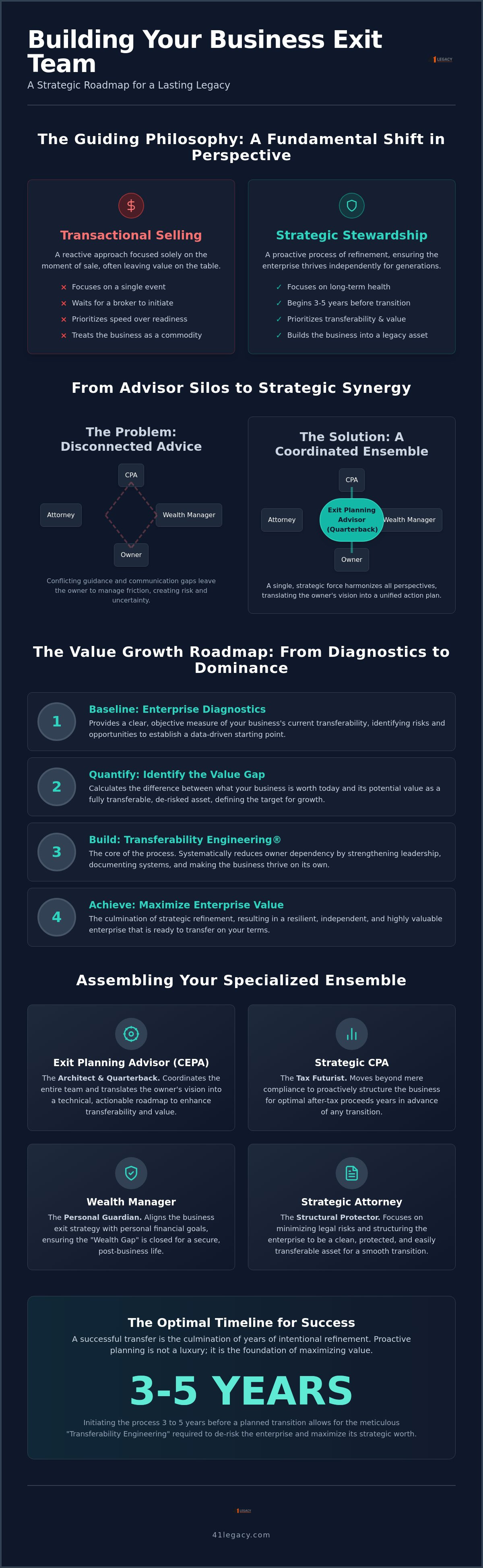
A strategic ensemble differs fundamentally from a collection of vendors. While a vendor performs a task, an ensemble collaborates to protect the inner essence of the organization. This team works in harmony to identify and close the Value Gap, which is the difference between what the business is worth today and its potential value as a fully transferable asset. To achieve this, the process must begin early. We recommend initiating this structural alignment three to five years before a planned transition. This timeframe allows for the meticulous "Transferability Engineering" required to de-risk the enterprise and maximize its strategic worth.
The Difference Between Exit Planning and Transactional Selling
Waiting for a broker to arrive is often too late to influence the true value of an enterprise. Transactional selling focuses on the moment of sale; exit planning focuses on the health and independence of the asset. There is a profound philosophical shift when moving from being "ready to sell" to being "ready to transfer." A business that is ready to sell might have high revenue, but a business that is ready to transfer has documented systems, a strong leadership layer, and minimal owner dependency. It's a continuous improvement process that turns a job into a transferable legacy.
The Role of the Owner as a Visionary Steward
The most difficult phase of building your business exit team is often the internal shift the owner must make. You must transition from being the primary operator to becoming an owner-investor. This requires detaching your personal identity from the daily rhythms of the company. Our specialists support this evolution by providing the strategic clarity needed to step back without losing control of the vision. By treating the business as a masterpiece to be preserved rather than a tool to be used, you ensure its story continues with strength and precision.
- Strategic Clarity: Aligning personal goals with the long term health of the enterprise.
- Risk Mitigation: Identifying structural weaknesses that could impede a smooth transition.
- Value Growth: Utilizing diagnostics to create a roadmap for sustainable, independent success.
Assembling the Specialized Ensemble: Core Advisory Roles
To build a legacy, one must first curate the artisans capable of preserving it. Building your business exit team is akin to assembling a chamber orchestra; every member must be a master of their specific instrument, yet all must play from the same score. The process of refining an enterprise for transfer requires a departure from the generalist approach. You need specialists who possess the technical precision to handle complex valuations and the sophisticated vision to see the business as a transferable asset rather than just a source of annual income.
At the center of this ensemble sits the Exit Planning Advisor, often a Certified Exit Planning Advisor (CEPA). This individual acts as the primary architect of the readiness strategy. Their role isn't to replace your existing advisors, but to provide the high-altitude coordination necessary to ensure every move strengthens the enterprise. They translate the owner's vision into a technical roadmap, ensuring that the reduction of owner dependency remains the guiding principle of every tactical decision.
The Financial Guardians: CPAs and Wealth Managers
Your current CPA may be exceptional at annual compliance, but strategic exit planning requires a different lens. Strategic tax planning for a transition involves looking years into the future to optimize the business structure for maximum after-tax proceeds. With the federal estate tax exemption set to rise to approximately $15 million per individual in 2026, the stakes for proactive wealth preservation have never been higher. A wealth manager complements this by aligning your personal financial needs with the projected net proceeds. They ensure that the "Wealth Gap" is closed, providing the confidence that your life after the business is as secure as the legacy you've built.
The Legal Architects: Protecting the Essence
Legal architects ensure the structural integrity of the legacy. They identify "legal landmines" such as ambiguous intellectual property ownership or loose employment agreements that could devalue the enterprise during due diligence. Clean contracts and standardized operating procedures (SOPs) are the fine details of a business masterpiece. These elements ensure that the essence of the company is legally protected and easily transferable to a new steward. Conducting Enterprise Diagnostics is a critical first step in identifying which of these legal or financial areas require the most immediate attention to protect your enterprise value.
- The CPA: Moves beyond the past to engineer a future-focused tax strategy.
- The Attorney: Codifies the business's value through ironclad contracts and IP protection.
- The Wealth Advisor: Bridges the distance between business value and personal freedom.
- The Exit Planning Advisor: Harmonizes the team to ensure a singular focus on transferability.
The Advisory Quarterback: Harmonizing the Silos
The most significant obstacle to a seamless transition isn't a lack of talent, but a lack of harmony. Even when an owner is successful at building your business exit team with elite specialists, these professionals often operate within strict silos. A CPA focuses on tax mitigation, an attorney on liability, and a wealth manager on portfolio stability. Without a central architect to unify these perspectives, the owner is forced to act as the interpreter for conflicting advice. This "Advisory Noise" creates a heavy cognitive burden, often leading to strategic paralysis or fragmented execution that devalues the enterprise.
The Advisory Quarterback serves as the singular point of strategic contact, ensuring that every specialist is working toward the same objective: the long term transferability of the business. This role is not about replacing your existing trusted advisors. Instead, it's about providing the high-altitude coordination needed to manage timelines and establish clear accountability. By aligning the ensemble, the Quarterback ensures that the technical precision of each advisor contributes to a unified masterpiece rather than a collection of disjointed parts.
Eliminating Friction Between Professional Silos
Friction often arises when a recommendation from one specialist inadvertently compromises the goals of another. For instance, aggressive tax planning might reduce the reported earnings of a company, which could then negatively impact the business's valuation during a transition phase. The Quarterback identifies these contradictions before they become costly errors. Through Monthly Implementation Support, the Quarterback facilitates regular communication between all parties. This structured rhythm keeps the team focused on the Value Growth Roadmap, allowing the owner to step back from the exhausting role of mediator and return to the position of visionary steward.
The CEPA Designation: A Standard for Coordination
Working with a Certified Exit Planning Advisor (CEPA) introduces a rigorous, proven framework to the process. Unlike a traditional business consultant who might focus on a single operational vertical, a CEPA utilizes the "Value Acceleration Methodology." This approach treats the business, the owner's personal financial goals, and their life after the transition as three interconnected pillars. By building your business exit team around this standard, you ensure that the process remains focused on building a transferable asset that can thrive independently of your daily presence. It is a commitment to excellence that elevates exit planning from a transactional necessity to a philosophical endeavor of legacy preservation.
- Strategic Alignment: Ensuring all advisors play from the same sheet of music.
- Accountability: Managing the implementation of the value growth roadmap.
- Clarity: Reducing the overwhelm of conflicting professional advice.
The Mandate of Transferability: Reducing Owner Dependency
The ultimate test of any masterpiece is its ability to endure once the artist has set down the brush. In the world of enterprise, the most significant risk to a legacy is the founder themselves. While your intuition and drive fueled the initial ascent, a business that remains tethered to a single individual is a fragile asset. Owner dependency is the primary factor that devalues mid-market companies; it signals to any future steward that the success of the organization is a personality trait rather than a structural reality. Building your business exit team allows you to move beyond this vulnerability through the disciplined application of Transferability Engineering.
This process is not merely about delegation. It's a technical refinement of the organization's architecture. Your team utilizes Enterprise Diagnostics to pinpoint exactly where the business is too founder-centric. By conducting a Strategic Capacity Evaluation, the ensemble identifies the talent and systems required to replace the owner's daily input. This transformation ensures the enterprise's essence is preserved in its operations, allowing the business to thrive independently while you shift into a role of high-level oversight. It's about building an asset that is ready for any transition, whether internal or external, by making the founder's presence optional rather than essential.
Building Systems That Thrive Independently
A business becomes a turnkey asset when its success is predictable and repeatable. Standardized operating procedures (SOPs) are the blueprints that allow a new leader to maintain the standard of excellence you've established. Your advisory ensemble supports your management team in assuming key decision-making responsibilities, effectively dismantling the "Rainmaker Trap." If you're the primary salesperson or the sole keeper of client relationships, your valuation suffers. To protect your impact, you must implement Owner Dependency Reduction strategies that transfer your unique brilliance into scalable systems.
Risk Mitigation Through Diversification
Strategic transferability also requires a cold, clinical look at concentration risks. A business that relies on a single customer or a solitary vendor for a large portion of its revenue is an inherently risky investment. Your advisors work to diversify these relationships, enhancing the market attractiveness and competitive positioning of the enterprise. This work ensures that the business is not just a collection of contracts, but a robust entity with a sustainable future. By focusing on these granular details, the team preserves the historical significance of the brand while engineering it for modern growth.
- Systemic Redundancy: Creating a leadership layer that operates without the founder’s intervention.
- Operational Precision: Codifying tribal knowledge into accessible, high-standard SOPs.
- Concentration Risk: Protecting the legacy by diversifying the revenue base and supply chain.
Executing the Value Growth Roadmap
The transition from conceptual planning to tangible execution marks the moment when a business begins its transformation into a legacy asset. While the initial stages of this journey focus on philosophy and personnel, the final phase is defined by the relentless pursuit of measurable progress. Building your business exit team is not a static achievement; it's the commencement of a dynamic, multi-year engagement. The first 90 days are critical, as they set the cadence for the entire transition process. During this window, we move from observation to the implementation of the Value Growth Roadmap. This document is a living blueprint, detailing the specific milestones and KPIs required to bridge the gap between current operations and a fully transferable masterpiece.
Success in this phase depends on the framework provided by 41 Legacy. We don't settle for surface-level adjustments. Instead, we guide your advisory ensemble through a structured process that prioritizes long term health over short term convenience. By establishing clear accountability and a steady rhythm of implementation, we ensure that the strategic clarity gained in the planning phase is never lost in the noise of daily operations. This is where the engineering of transferability meets the artistry of leadership, resulting in a business that stands as a testament to your dedication.
The Diagnostic Phase: Establishing the Baseline
Every architectural marvel begins with a survey of the land. In the context of your enterprise, this survey is the Enterprise Diagnostics phase. We utilize a comprehensive Exit Readiness Assessment to establish an undeniable baseline of your current standing. This diagnostic identifies the Value Gap, which is the distance between your present enterprise value and the financial resources required to fund your next chapter. Knowing this number provides a profound psychological benefit. It replaces the fog of uncertainty with the clarity of a defined target. You no longer have to guess if your business is transferable; you have the data to prove its strength.
Monthly Implementation: The Pulse of Progress
Annual planning sessions are often too infrequent to capture the shifting tides of the market or the internal evolution of a growing company. For a legacy to endure, it requires a steady, unhurried rhythm of refinement. Monthly Implementation Support serves as the heartbeat of the process, ensuring that the team of specialists remains accountable to your singular vision. These regular touchpoints allow the Advisory Quarterback to verify that every legal, financial, and operational adjustment aligns with the overarching roadmap. This structured approach transforms exit planning from a daunting future event into a manageable series of strategic victories. To begin this journey and discover your readiness with 41 Legacy, you must first commit to the discipline of the roadmap.
- 90-Day Sprint: Establishing momentum through immediate, high-impact refinements to the business structure.
- KPI Alignment: Monitoring the specific indicators that drive transferability and reduce founder dependency.
- Ongoing Stewardship: Maintaining a relentless focus on the business’s health, ensuring it thrives as an independent entity.
Securing the Future of Your Masterpiece
The transition of your enterprise is the final refinement of a life’s work. By shifting from a transactional mindset to one of deliberate stewardship, you ensure the essence of your business remains intact for the next generation. We've explored how building your business exit team creates the architectural integrity needed to reduce owner dependency and maximize enterprise value. This process isn't merely about planning for an end. It's about engineering a beginning that doesn't require your daily presence to sustain its excellence.
Our approach at 41 Legacy, led by a Certified Exit Planning Advisor (CEPA), utilizes the "Quarterback" model to harmonize your advisory ensemble. Through Enterprise Diagnostics and a customized Value Growth Roadmap, we provide the strategic clarity required to bridge the value gap. This is the path to a business that thrives as a standalone asset, protected by the precision of a coordinated team. Your legacy is a story still being written, and it deserves a conclusion defined by strength and confidence.
Begin Your Journey Toward a Transferable Asset with 41 Legacy and discover the clarity that comes from a perfectly orchestrated transition.
Common Inquiries Regarding Strategic Transitions
What is the difference between an exit planner and a business broker?
An exit planner acts as a strategic architect who prepares the enterprise for transferability long before a sale is contemplated. Their work focuses on enhancing the internal health and value of the business through structural refinements. Conversely, a business broker is primarily concerned with the transaction itself, operating at the point of sale to facilitate a deal. The planner builds the value; the broker realizes it.
When is the ideal time to start building my business exit team?
Initiating the process three to five years before your anticipated departure is the standard for high-level stewardship. This duration provides the necessary window for Transferability Engineering and the meticulous reduction of owner dependency. Starting early ensures that building your business exit team becomes a proactive strategy rather than a reactive necessity. It allows the ensemble to identify and rectify structural weaknesses before they impact your valuation.
Why can’t my current CPA handle the entire exit planning process?
Most CPAs are dedicated to historical compliance and annual tax mitigation, which are essential but distinct from strategic transition planning. Exit planning requires a forward-looking perspective that optimizes the business structure for a future transfer. A specialized tax strategist on your team ensures the enterprise is positioned for maximum after-tax proceeds. They look beyond the current year to engineer a long term financial legacy.
What does an Exit Readiness Assessment actually measure?
This diagnostic measures the structural integrity and attractiveness of your business as a transferable asset. It evaluates owner dependency, financial transparency, and operational systems to identify risks that could devalue the company. By quantifying these factors, the assessment provides a clinical baseline for your Value Growth Roadmap. It ensures you have a clear understanding of the business's strengths and its readiness for a new steward.
How much does it cost to build a coordinated exit team?
The investment required depends on the complexity of the enterprise and the specific specialists needed to preserve its legacy. Rather than a simple expense, these costs represent a reinvestment into the business’s enterprise value and transferability. Professionals in this field generally operate on project-based or monthly advisory structures tailored to the scope of the work. Every dollar spent on coordination helps minimize the risk of a failed transition.
What happens if my advisors don’t agree on the best exit strategy?
Conflicting advice is a common symptom of advisors working in silos without a central point of coordination. This is why the "Quarterback" model is vital for building your business exit team. A Certified Exit Planning Advisor harmonizes these disparate voices, ensuring that every recommendation serves your overarching legacy goals. This coordination eliminates the "Advisory Noise" that often leads to strategic paralysis for the business owner.
Can I build an exit team if I plan to transition the business to my children?
An exit team is arguably more important for internal transitions to ensure the next generation inherits a thriving, independent entity. The team focuses on making the business a "turnkey" asset so that family members aren't overwhelmed by founder-centric systems. This professional oversight helps preserve both family harmony and the brand's heritage. It ensures the business remains a source of wealth rather than a burden for your heirs.
What is the "Value Gap" and why does my team need to know it?
The Value Gap is the difference between the current net value of your business and the financial resources required to support your life after the transition. Your team must identify this gap early to implement effective value growth strategies. Closing this gap ensures your exit provides the personal freedom you've earned through years of craftsmanship. It serves as the primary metric for the success of your long term transition strategy.
Disclaimer
This article is for educational and informational purposes only and does not provide legal, tax, investment, or business brokerage advice. 41 Legacy does not offer M&A brokerage services, legal document drafting, tax preparation, or investment advisory services. Business owners should consult licensed professionals in those disciplines before making decisions related to business transactions, legal matters, tax strategy, or financial planning. All examples are illustrative and may not apply to your specific situation.