
The Architecture of Attractiveness: How to Build a Transferable Business Asset
Your most profitable year could be your most significant liability if the success of the enterprise rests entirely on your personal touch. You've spent decades as a dedicated steward of your company, yet you likely feel the weight of its daily demands. It's a common paradox in the world of private enterprise: the more vital you are to the operation, the less valuable the entity becomes to a successor. Mastering how to make your business more attractive to buyers requires a shift in perspective from managing a company to engineering a transferable asset.
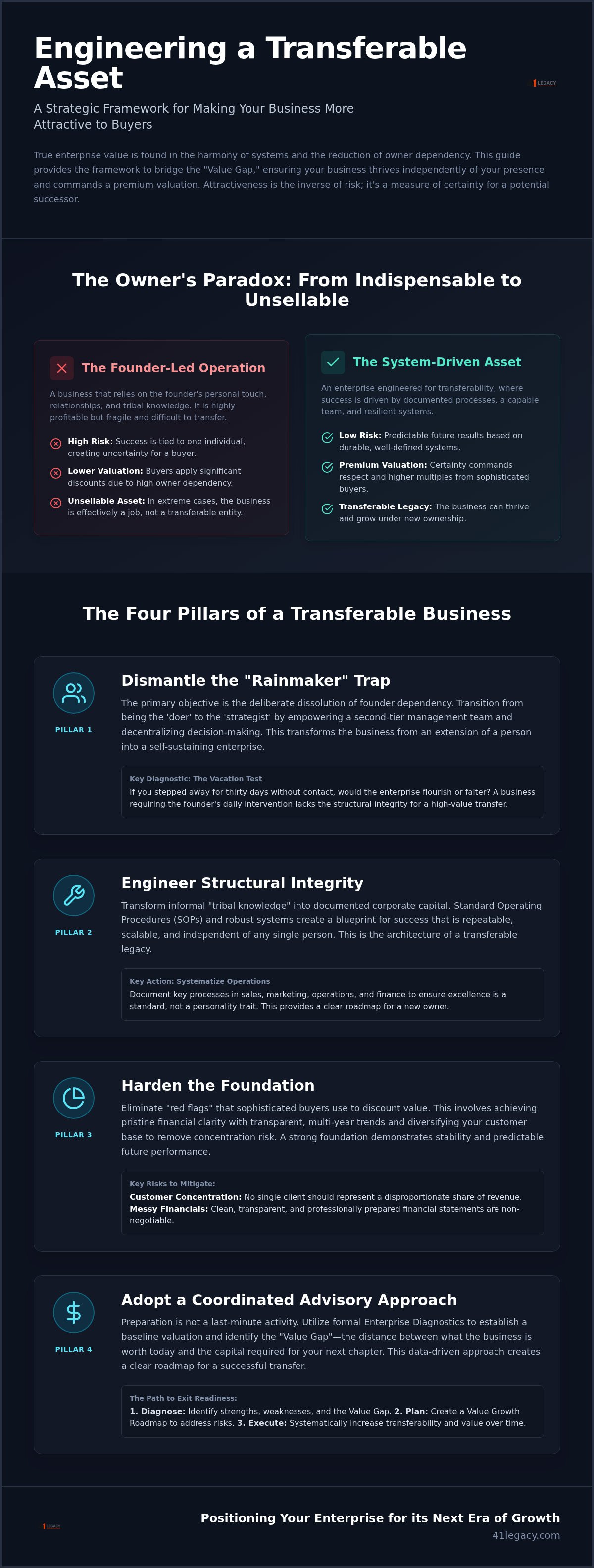
We believe that true enterprise value is found in the harmony of systems and the reduction of owner dependency. You deserve to see your life's work transition from a founder-led operation into a high-value legacy that commands respect and premium multiples. This guide provides the strategic framework to bridge the "Value Gap" and solidify your company's future. We'll examine the diagnostic process and the implementation of a Value Growth Roadmap to ensure your business thrives independently of your presence.
Key Takeaways
- View attractiveness as the inverse of risk, ensuring that the certainty of future performance is built into the very fabric of your enterprise.
- Discover how to make your business more attractive to buyers by reducing owner dependency and transitioning from a founder-led operation to a system-driven asset.
- Transform tribal knowledge into lasting corporate capital through the engineering of standard operating procedures that serve as the blueprint for your legacy.
- Secure the foundation of your company by prioritizing financial clarity and customer diversification to eliminate the high-risk discounts associated with concentration.
- Utilize a coordinated advisory approach and formal Enterprise Diagnostics to identify your Value Gap and create a clear roadmap for a successful transfer.
Defining Attractiveness: The Lens of the Sophisticated Buyer
Attractiveness is a measure of certainty. To a sophisticated buyer, a business isn't just a collection of assets or a stream of cash flow; it's a living entity that must prove its ability to survive the departure of its creator. When you consider how to make your business more attractive to buyers, you must view your enterprise through the lens of risk. The more predictable the future results, the more valuable the asset becomes. Buyers aren't just purchasing what you've done; they're purchasing the confidence that they can replicate your success without your presence.
Many owners find themselves facing a "Value Gap." This is the cold distance between what the business is worth today and the capital required to fund the owner's next chapter. Closing this gap isn't a matter of aggressive marketing or surface-level aesthetics. It requires the meticulous engineering of transferability. You are moving from being the "rainmaker" who drives every sale to being the architect of a self-sustaining system. This shift in mindset from "selling out" to "stewarding a legacy" ensures the essence of the company remains intact long after the keys are handed over.
The Transferability Quotient
Buyers evaluate the inner essence of a company to see if it possesses structural integrity. A business can be highly profitable yet entirely unsellable if its success is tied to the founder's personal relationships or specialized knowledge. This is the difference between owning a job and owning a transferable asset. Establishing a baseline through determining enterprise value allows you to see the business as a third party would. It reveals where the foundation is strong and where it's cracked by owner dependency. Professional-grade preparation turns tribal knowledge into corporate capital, making the momentum of the business independent of any single person.
Risk Mitigation as Value Creation
Value isn't just added; it's preserved through the elimination of uncertainty. Sophisticated investors spend more time looking for reasons to walk away than reasons to stay. They look for "red flags" such as customer concentration, messy financials, or informal agreements that suggest the current success is fragile. Utilizing standardized Business valuation methods helps you understand how buyers discount for these risks. Instead of "window dressing" your books for a single year, you must demonstrate transparent, multi-year financial trends that tell a story of stability. Positioning yourself as the architect of a self-sustaining enterprise signals that the business is ready for its next era of growth.
Dismantling the Rainmaker Trap: Reducing Owner Dependency
The Rainmaker Trap is a silent architecture of limitation. When a founder serves as the primary driver for sales, strategy, and culture, the company isn't truly an asset; it's an extension of a person. Sophisticated buyers recognize this as a profound risk. High owner dependency inevitably leads to discounted valuation multiples because the mechanical essence of the company ceases to function once the operator departs. If you're exploring how to make your business more attractive to buyers, your primary objective must be the deliberate dissolution of this dependency.
Consider the "Vacation Test." If you stepped away for thirty days without contact, would the enterprise flourish or falter? A business that requires the founder's daily intervention is fragile and lacks the structural integrity required for a high-value transfer. To build a transferable asset, you must decentralize decision-making and empower a second-tier management team to hold the mantle of leadership. It's about ensuring the momentum of the work is preserved through systems rather than individual effort.
The Strategic Capacity Evaluation
Building a legacy requires a rigorous audit of your own time. We use a Strategic Capacity Evaluation to identify where the owner has become a bottleneck rather than a visionary. Transitioning from "Doer" to "Strategist" isn't merely about delegating tasks; it's about shifting the weight of responsibility to those you've trained. By establishing a culture of accountability, you ensure that excellence is a standard, not a personality trait. This process is essential for anyone seeking Owner Dependency Reduction to ensure the company's long-term health and growth.
Protecting the Enterprise through Talent Development
A turnkey management team is one of the most valuable components of a transferable asset. Buyers pay a premium when they see a dedicated group of specialists who are already managing the intricacies of the work with precision. This is a critical factor in making a business attractive for sale or internal transition. You must reduce key person risk by documenting tribal knowledge and incentivizing key employees to remain through the transition period. When the team is united by an uncompromising vision of perfection, the story of the business continues long after the founder's final chapter. This is how to make your business more attractive to buyers who value long-term stability over short-term gains.
Engineering Structural Integrity: The Role of SOPs and Systems
Systems are the silent guardians of an enterprise's future. While the founder provides the initial spark of creativity, it is the underlying architecture of Standard Operating Procedures (SOPs) that preserves that spark through the friction of growth and transition. Determining how to make your business more attractive to buyers often begins with the translation of invisible expertise into visible, repeatable processes. By codifying tribal knowledge into corporate capital, you transform a fragile operation into a resilient asset. Documented systems are the primary tool for increasing enterprise value, as they provide the operational consistency that sophisticated investors demand.
The Blueprint for Transferability
A transferable system is distinct from a personal habit. Habits reside in the mind of the owner; systems reside in the manual of the company. The role of SOPs is to act as the blueprint for your legacy, ensuring that quality control remains uncompromising under new ownership. When a buyer evaluates your company, they look for an "Engine of Growth" that is already tuned and ready for fuel. If the engine requires your constant mechanical intervention to run, it lacks the structural integrity required for a high-multiple transfer. We focus on engineering these processes so the business functions as a self-sustaining entity, moving with a rhythm that is independent of any single person's daily effort.
Technology as a Value Multiplier
A modern tech stack serves as a powerful signal of a forward-thinking and ready-to-scale operation. Beyond simple efficiency, leveraging automation removes the variable of human error and reduces long-term labor costs, directly impacting the bottom line. Buyers prioritize data integrity; they value centralized reporting systems that provide a clear, unvarnished view of the company's health. Precision in your digital infrastructure mirrors the precision of your craftsmanship. It suggests that the business is not merely surviving the present but is actively engineered for the future. This technological maturity is a cornerstone of how to make your business more attractive to buyers who seek to acquire a platform for expansion rather than a project for repair.
Through the use of Enterprise Diagnostics, we identify the gaps where systems are missing or technology is underutilized. Our goal is to ensure that your business is recognized as a masterpiece of operational engineering, capable of thriving for generations to come.
Hardening the Foundation: Financial Clarity and Diversification
The financial ledger is more than a record of transactions; it is the definitive narrative of an enterprise's health. Many owners prioritize tax-minimization accounting to preserve immediate cash, yet this often erodes the very valuation they've worked decades to build. To understand how to make your business more attractive to buyers, you must prioritize financial "cleanliness" over short-term tax savings. This requires a shift from viewing the company through "book value," which merely accounts for tangible assets, to "enterprise value," which captures the true economic power and future potential of the entity.
Financial Transparency vs. Obfuscation
Sanitizing your financials involves a meticulous recasting of the books to reveal the true Owner's Discretionary Earnings. This process identifies "add-backs," such as personal expenses or one-time costs that don't represent the ongoing operational requirements of the business. EBITDA serves as the universal language of business valuation. By presenting audited or reviewed statements, you signal a level of professional-grade integrity that eliminates the friction of uncertainty. Transparency is not just about honesty; it's about providing a buyer with the confidence to pay a premium for an asset that has been scrutinized and verified by independent experts.
Diversifying the Revenue Stream
A business with high customer concentration carries a fragile risk profile that sophisticated investors will quickly identify. If a single client or product line accounts for a majority of your profit, the momentum of the entire organization is vulnerable to a single point of failure. Diversification is the shield that protects your legacy. By expanding into new verticals or securing recurring, contractual revenue, you demonstrate "Strategic Capacity." This proves the business has the structural strength to thrive in various market conditions. Reducing this concentration risk is a vital component in how to make your business more attractive to buyers who seek long-term stability and predictable growth.
Identifying these financial vulnerabilities and correcting them before a transition is the core focus of our Enterprise Diagnostics process. We help you build a foundation that is not only clear but also resilient enough to support the next era of the company's history.
The Path to Exit Readiness: The Coordinated Advisory Approach
A successful transition is not a solitary event; it's a meticulously conducted symphony. Most owners maintain relationships with a CPA, an attorney, and a wealth advisor, yet these specialists often operate in isolation. To truly understand how to make your business more attractive to buyers, you must introduce a "Quarterback" to the team. This role ensures that every professional contribution is aligned with the singular goal of maximizing transferability and securing your legacy. The Certified Exit Planning Advisor serves as the architect of this process, bridging the gap between historical accounting and future value growth.
The Enterprise Diagnostics Process
We begin with a 360-degree view of the business through our Enterprise Diagnostics process. This rigorous evaluation uncovers the "Value Gap," revealing the hidden liabilities that could devalue your life's work during a transition. Moving from theoretical planning to Monthly Implementation Support is where the transformation occurs. Implementing a Value Growth Roadmap provides the monthly accountability needed to turn strategic intent into tangible results. By aligning your personal financial goals with a structured growth strategy, we ensure the business is prepared to thrive without your constant oversight. This level of preparation is the definitive answer to how to make your business more attractive to buyers who prioritize low-risk, high-integrity assets.
Building a Legacy, Not Just a Transaction
The most sophisticated owners recognize that the best time to prepare for a transfer is years before the intended departure. This "Always Ready" posture ensures that if an unsolicited offer arrives, the business is already engineered to command a premium multiple. It's about being a steward of an asset that is perpetually in its prime. Building a legacy requires more than a simple exit strategy; it requires a commitment to excellence that permeates every level of the organization. You aren't just preparing for an end; you're ensuring a new beginning for the entity you've built.
Begin your journey with an Exit Readiness Assessment at 41 Legacy.
The Masterwork of Transferable Value
Building a transferable asset is a deliberate act of craftsmanship. It requires an intentional transition from founder-led momentum to a self-sustaining engine of growth. By dismantling the rainmaker trap and hardening your financial foundation, you ensure the company's essence remains intact for the next generation. This journey of refinement is not merely about a future transfer; it's about the present health and resilience of your enterprise.
Mastering how to make your business more attractive to buyers demands a coordinated effort between your professional advisors. Our team, led by a Certified Exit Planning Advisor, provides the Strategic Advisory needed to bridge the Value Gap. Through our structured Enterprise Diagnostics Framework, we identify liabilities and engineer transferability into the very fabric of your work. The legacy you've built deserves to be preserved with the same precision used to create it.
Secure Your Legacy with a Professional Exit Readiness Assessment. Your masterpiece is ready for its next era.
Frequently Asked Questions
What makes a business most attractive to a buyer?
A sophisticated buyer prioritizes the certainty of future performance over past achievements. Attractiveness is found in the inverse of risk. When an enterprise demonstrates predictable cash flow, diversified revenue streams, and a robust management team, it becomes a premium asset. Buyers seek a turnkey operation where the systems and culture are strong enough to thrive independently. This structural integrity allows the next steward to step in with total confidence.
How can I reduce owner dependency in my business?
Reducing dependency requires a deliberate shift from being the central rainmaker to becoming the architect of systems. You must empower a second-tier management team with the authority to make critical decisions. This process involves documenting your tribal knowledge into corporate capital. By utilizing a Strategic Capacity Evaluation, we identify bottlenecks and create a culture of accountability. This ensures the business functions with a rhythm that doesn't require your daily presence.
What is the 'Value Gap' in exit planning?
The Value Gap represents the distance between your current enterprise value and the financial resources required to fulfill your long-term legacy. It's a critical metric identified through our Enterprise Diagnostics process. Many owners are surprised to find their business isn't yet worth what they need for a successful transition. Closing this gap requires a Value Growth Roadmap focused on improving transferability and increasing the efficiency of the operation.
Why are SOPs important for selling a business?
Standard Operating Procedures serve as the blueprint for a transferable legacy. They turn individual habits into repeatable corporate processes, ensuring that quality control remains uncompromising under new ownership. Without documented systems, a buyer is essentially purchasing your personal expertise, which is not a transferable asset. SOPs provide the operational consistency that builds buyer trust and justifies a higher valuation multiple by reducing the perceived risk of the transition.
How does customer concentration affect my business valuation?
High customer concentration creates a significant risk profile that directly impacts your multiple. If a single client accounts for more than a small percentage of your profit, the enterprise is vulnerable to a single point of failure. Buyers apply a risk discount to businesses with this vulnerability. Diversifying your revenue stream proves that your value proposition is broad and resilient, making the entire organization more stable and attractive for a long-term transfer.
What is the role of a Certified Exit Planning Advisor (CEPA)?
A Certified Exit Planning Advisor acts as the strategic architect of your transition. They serve as a quarterback for your professional advisory team, ensuring your CPA, attorney, and wealth advisor are unified by a single vision. By focusing on the three pillars of exit planning, they help you build a transferable asset while aligning your personal and financial goals. Their expertise ensures that the process is focused on long-term value growth.
How long does it take to make a business attractive for sale?
Engineering a high-value, transferable asset typically requires a window of two to five years. This timeframe allows you to implement a Value Growth Roadmap and demonstrate the resulting multi-year financial trends. It's about proving that your systems and management team can sustain excellence over time. While some diagnostic work happens immediately, the most significant increases in valuation come from the deliberate and consistent application of transferability engineering.
Can I sell my business if I am the primary salesperson?
Selling a business when you are the primary salesperson is possible, but it often results in a lower valuation. Learning how to make your business more attractive to buyers involves decentralizing your personal influence over revenue. You must transition your key relationships to a professional sales team and document the sales process. This proves to a successor that the company's momentum is tied to a system rather than your personal charisma.

Article by
Mike Laskowski
Mike Laskowski is a Business Value Growth Strategist who helps business owners uncover the truths that drive their performance, risk, and readiness. Blending forensic interviewing from a 26‑year federal career with Strategic Capacity analysis and CEPA methodology, he works upstream to reduce owner dependency, increase transferability, and strengthen enterprise value. Mike guides founders through clarity, operational evolution, and transition readiness so their companies become transferable, owner‑independent assets that endure beyond the founder.
Disclaimer
This article is for educational and informational purposes only and does not provide legal, tax, investment, or business brokerage advice. 41 Legacy does not offer M&A brokerage services, legal document drafting, tax preparation, or investment advisory services. Business owners should consult licensed professionals in those disciplines before making decisions related to business transactions, legal matters, tax strategy, or financial planning. All examples are illustrative and may not apply to your specific situation.