
The Architecture of Alignment: How to Prepare Your Leadership Team for a Successful Exit
What if the true measure of your legacy isn't what you've built, but how well it breathes without you? Many founders view their senior leadership as a support system, yet the reality of a transition is far more demanding. You likely feel the weight of owner-dependency or fear that revealing your intentions might trigger a departure of key talent. Understanding how to get your leadership team aligned for an exit is not about managing a transaction; it's about the deliberate engineering of a business to thrive independently of its creator.
We agree that your business is a work of precision that deserves to endure. This guide provides an elevated strategic framework to transform your leadership team into a self-sustaining engine of transferability and enterprise value. You'll learn how to harmonize founder goals with leadership incentives to reduce risk and elevate the worth of your organization. We'll examine the specific diagnostics and roadmaps required to transition your role from active operator to the steward of a lasting, transferable asset. By the end, you'll possess the clarity needed to turn your team into your company's most valuable, independent feature.
Key Takeaways
- Understand how leadership cohesion directly bridges the "Value Gap," transforming your team from a support system into a primary driver of enterprise value.
- Discover how an Exit Readiness Assessment serves as the foundational diagnostic to evaluate the strategic capacity of your senior leaders.
- Learn how to get your leadership team aligned for an exit by implementing a Value Growth Roadmap that shifts daily operations from the founder to the curators of the firm’s future.
- Identify the role of a Strategic Quarterback in harmonizing the efforts of CPAs and attorneys toward a singular, transferable legacy.
- Master the art of communicating your vision to ensure a seamless transition that honors the company’s history while reducing owner dependency.
The Gravity of Alignment: Why Cohesion Dictates Enterprise Value
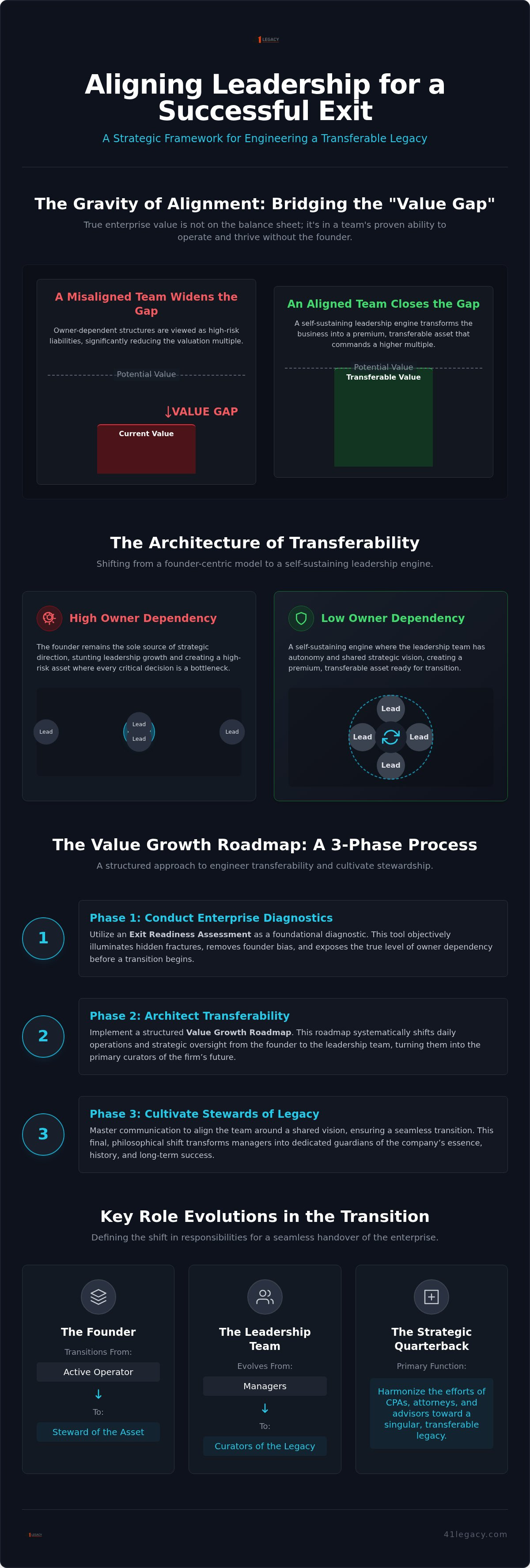
True enterprise value isn't found in the balance sheet alone. It resides in the collective capability of a team to operate without the founder's constant intervention. Alignment is the precise synchronization of leadership behavior with the goal of transferability. This Strategic Alignment ensures that every decision made at the executive level contributes to the firm's independent viability. Without this cohesion, a significant "Value Gap" emerges. This gap represents the difference between what the business is worth today and its potential value if it were truly transferable. A misaligned team widens this chasm. Buyers view owner-dependent structures as high-risk liabilities rather than premium assets. They seek a self-sustaining engine, not a job.
The Cost of the Silent Silo
Founders often fear that transparency regarding an exit will cause panic. This "expensive silence" actually breeds the very instability you wish to avoid. When a team lacks clarity, operational friction increases and key talent begins to drift. Enterprise alignment serves as the bridge between current operations and future transferability. If you are wondering how to get your leadership team aligned for an exit, the process begins by recognizing that silence is a cost, not a safeguard. A team operating in a vacuum cannot build for a future they don't see. This lack of shared vision leads to missed opportunities and a slow erosion of the culture you've meticulously built.
Preserving the Essence of the Enterprise
We view a business as a living history, a collection of values and successes that require a dedicated guardian. Your leadership team must evolve from mere managers into curators of this legacy. Their role is to maintain brand integrity and operational excellence long after the founder has stepped away. This philosophical shift from "managing employees" to "cultivating stewards" is what creates a lasting impact. True alignment cannot be manufactured in a final-hour meeting. It must be engineered years before the transition occurs to ensure the essence of the enterprise remains intact. By positioning your leaders as the architects of the company's next chapter, you transform the business into a transferable asset that commands respect and a premium valuation. This preparation honors the past while securing the future.
Conducting Enterprise Diagnostics: Uncovering Misalignment
Before any meaningful transition can occur, we must first confront the current reality of the organization with surgical precision. The Exit Readiness Assessment serves as our foundational diagnostic tool, illuminating the hidden fractures within a leadership structure. It isn't enough to simply assume your team is prepared; you must verify their readiness through an objective lens. This process removes the emotional bias that often clouds a founder's perspective, allowing for a clear view of where the business truly stands. By identifying these misalignments early, we can begin the work of strengthening your company's transferability through structured advisory support. This ensures that every component of the enterprise is polished to its highest standard before it ever reaches the gaze of a potential successor.
A primary focus of this diagnostic is exposing owner dependency. This is the phenomenon where a founder's shadow inadvertently obscures the team's ability to lead. When the owner remains the sole source of strategic direction, the leadership team's growth is stunted. To understand how to get your leadership team aligned for an exit, we must first measure the degree to which the company can function in your absence. If every critical decision still routes through your desk, the enterprise remains a high-risk asset in the eyes of any sophisticated buyer. True value is found in the silence of the founder, where the leadership team's voice is most resonant.
Identifying the Value Gap
The "Value Gap" is the distance between your current enterprise value and the financial requirements of your next chapter. This gap is often widened by leadership performance, which directly impacts the valuation multiple applied to your business. A team that lacks cohesion acts as a drag on growth, while a unified team creates a premium. Understanding How to Increase Enterprise Value requires a deep dive into how your leaders currently contribute to or detract from the firm's bottom line. When leadership behavior is synchronized with transferability, the gap begins to close naturally, turning potential risk into realized wealth.
The Strategic Capacity Evaluation
We must also gauge whether your current team possesses the "altitude" required to manage the firm under new ownership. This Strategic Capacity Evaluation identifies key person risk within the leadership tier itself. If the departure of a single executive would destabilize operations, the asset is fragile. Closing the Alignment Gap involves ensuring that every leader shares a deep understanding of the company's transferable assets. This shared clarity allows the team to operate as a singular, cohesive unit. It transforms them from individual contributors into curators of a legacy that can thrive independently of any one person. The result is a leadership engine that doesn't just maintain the status quo but actively drives future growth.
The Architecture of Transferability: Reducing Founder Dependency
Alignment is often mistaken for a mere communication exercise, yet in the context of a legacy, it is a structural engineering challenge. To understand how to get your leadership team aligned for an exit, one must view the organization as a complex machine where every part must function with autonomous precision. This phase of the transition requires a shift from the founder as the primary engine to a system where the leadership team serves as the collective operator. We begin this process by documenting the "Master Blueprint," ensuring that the wisdom once held solely by the founder is distilled into a permanent institutional asset. This transformation creates a business that is not just successful, but transferable.
SOPs as the Blueprint for Legacy
Documented processes are the DNA of a sustainable enterprise. When you formalize your operations, you transform individual knowledge into a tangible asset that adds immediate value to the firm. What is an SOP in Business? It is the definitive guide that ensures your company’s essence remains intact regardless of who holds the keys. Your leadership team must own this documentation process. By tasking them with the creation and refinement of these standards, you empower them to become the guardians of the company’s operational excellence. This ownership fosters a deep sense of accountability and ensures that the "right way" of doing things is never lost to time.
Engineering Out the Founder
Reducing dependency requires the deliberate dismantling of the "hub-and-spoke" model, where all decisions lead back to the center. Transferability engineering is the surgical removal of owner-dependency from core operations. This involves establishing decision-making frameworks that allow mid-level and senior management to act with confidence without your intervention. It’s a transition toward a collaborative leadership circle where strategic clarity is shared by all. To support this, we implement a Value Growth Roadmap that rewards the creation of long-term enterprise value rather than short-term gains. This aligns the team's incentives with the eventual goal of a successful transition, ensuring everyone is pulling in the same direction.
The final test of this architecture is the founder's sabbatical. We recommend a planned absence, starting with two weeks and eventually extending to a full month. This serves as a live diagnostic for readiness. If the business flourishes in your absence, the engineering is sound. If friction arises, it illuminates exactly where the alignment remains incomplete. Testing the system in this manner provides the ultimate proof of a transferable asset, giving you the confidence that your legacy is secure and your team is prepared to lead.
Navigating the Transition: A Value Growth Roadmap for Leaders
A transition is not a single event, but a carefully choreographed progression. The Value Growth Roadmap serves as the living document that provides collective strategic clarity, ensuring every member of the executive circle understands the path ahead. When considering how to get your leadership team aligned for an exit, the roadmap acts as a stabilizing force. It translates the founder's vision into actionable milestones. This clarity is essential to communicate the exit vision without triggering organizational anxiety. By framing the transition as an evolution of stewardship rather than an ending, you preserve the company's culture and maintain operational momentum. This approach ensures the essence of the business remains intact during the shift in ownership.
The Discipline of Implementation
Strategic alignment often falters not during the planning phase, but in the quiet months of execution. Without a structured rhythm, the daily demands of the business quickly eclipse long-term goals. We emphasize a monthly implementation support model to maintain a steady cadence of progress. This discipline ensures that the work of reducing owner dependency remains a priority rather than a secondary thought. For a deeper understanding of this process, review our guide on Exit Planning for Business Owners. Consistent strategic review transforms the roadmap from a static plan into a dynamic engine of value growth, allowing the team to adjust to real-time challenges without losing sight of the ultimate objective.
Incentivizing the Future
To secure the commitment of your key talent, you must align their personal success with the firm's transferability. This involves structuring incentives, such as stay bonuses or equity-like rewards, that vest upon the successful completion of the transition. When leaders are rewarded for the enterprise value they help create, their focus shifts from short-term performance to the long-term health of the organization. Discussion of these sensitive financial matters requires a professional-room altitude, maintaining respect for the history of the firm while looking toward its future. If you're ready to begin this process, our team can help you develop a custom Value Growth Roadmap tailored to your unique legacy.
The emotional transition is perhaps the most delicate aspect of the journey. For the founder, it's a letting go of a life's work; for the executive team, it's the weight of new responsibility. Acknowledging this weight is a sign of sophisticated leadership. By addressing the psychological shifts alongside the technical requirements, you ensure a transition that's both seamless and respectful. This holistic approach honors the past while providing the team with the confidence to lead the organization into its next chapter. It's this balance of precision and empathy that defines a truly successful exit.
The Strategic Quarterback: Coordinating the Path to Exit
The transition of a business is a complex undertaking that requires more than just legal documents and tax strategies; it's a symphony of moving parts that demands a conductor. We refer to this role as the Strategic Quarterback. This individual doesn't replace your existing advisors; they harmonize them. While your CPA and Attorney are essential for technical precision, they aren't inherently trained in the holistic discipline of exit planning. The Certified Exit Planning Advisor acts as the architect who ensures that the efforts of every specialist are synchronized with your ultimate goal of transferability.
A primary challenge for any founder is understanding how to get your leadership team aligned for an exit while simultaneously managing these technical demands. Without a central point of coordination, advice often becomes siloed and conflicting. The Quarterback bridges these gaps, ensuring that the Value Growth Roadmap we discussed earlier is executed with precision. This coordination reduces the risk of missteps and ensures that the leadership team remains focused on their role as curators of the future. By maintaining this professional-room altitude, we ensure the transition remains a strategic endeavor rather than a chaotic transaction.
The Master Artisan's Approach
At 41 Legacy, we approach exit planning with the same reverence a master artisan brings to a lifelong work. We refuse to settle for a transactional approach that treats your company as a mere commodity. Instead, we prioritize the "essence" of the firm, ensuring that its history and values are preserved through the transition. This requires a level of detail that transcends simple brokerage. We coordinate with your advisors to ensure that every structural change supports the long-term health of the enterprise. To begin this journey, you can discover your current exit readiness with a diagnostic assessment.
Bridging the Past and Future
We view the exit not as a conclusion, but as the ultimate validation of everything you've built. It's the moment where the enterprise proves it can stand on its own, thriving as a living legacy. This process is unhurried and thoughtful, reflecting the meticulous nature of high-end craftsmanship. By the time the transition occurs, the leadership team should be so well-aligned that the change feels like a natural progression rather than a disruption. This is the highest form of stewardship. A legacy is not what you leave for people, but what you leave in them through a transferable business.
The Stewardship of a Lasting Legacy
Achieving a successful transition requires more than a simple handoff; it demands the intentional engineering of your leadership team into a self-sustaining engine of value. By conducting rigorous diagnostics and implementing a structured roadmap, you reduce owner-dependency and elevate the firm's transferability. Understanding how to get your leadership team aligned for an exit is the definitive step in transforming your business from a personal achievement into a permanent institutional asset.
This process is most effective when guided by a Strategic Quarterback who harmonizes the technical precision of your CPAs and attorneys with your long-term vision. Led by a Certified Exit Planning Advisor (CEPA), our team provides the coordination and custom Value Growth Roadmaps necessary to bridge the gap between today's operations and your future legacy. You've spent years refining the intricacies of your business; now's the time to ensure those efforts endure. Every detail of your transition deserves the same level of craftsmanship you applied to building the enterprise itself.
Secure your legacy with a comprehensive Exit Readiness Assessment from 41 Legacy
Your dedication to excellence has built a remarkable enterprise. We invite you to take this final, sophisticated step to ensure your company flourishes long after your own chapter concludes. The future of your firm is a masterpiece waiting to be realized.
Frequently Asked Questions
How do I tell my leadership team I'm planning to exit without them quitting?
Transparency should be framed as an invitation to stewardship rather than a notice of departure. By presenting the transition as a structured evolution, you provide your leaders with a sense of security and future purpose. We utilize a Value Growth Roadmap to define their roles as the curators of the firm's next chapter. This clarity reduces organizational anxiety and ensures that their personal success is naturally synchronized with the long-term transferability of the enterprise.
What is the difference between a business broker and an exit planning advisor?
A business broker is primarily concerned with the transaction, while an exit planning advisor focuses on the structural health and transferability of the asset. 41 Legacy provides Strategic Advisory and Enterprise Diagnostics to build value years before a transition occurs. We act as a "quarterback" for your professional team, ensuring that every decision made by your CPA or attorney contributes to a cohesive, high-value legacy that functions independently of the founder.
How long does it typically take to get a leadership team aligned for an exit?
Authentic alignment is a meticulous process that typically requires 12 to 36 months of unhurried effort. This timeframe allows for the surgical removal of owner-dependency and the implementation of robust Standard Operating Procedures. It provides the space needed to test the leadership team's strategic capacity through founder sabbaticals. Rushing this engineering often creates operational friction, whereas a thoughtful, steady pace ensures the business remains a polished, transferable asset for the future.
Can a business be sold if the owner is still making all the major decisions?
While such a business can be sold, it will likely suffer a diminished valuation because buyers view owner-dependency as a significant risk. Sophisticated acquirers seek a self-sustaining engine, not a role they must fill themselves. Learning how to get your leadership team aligned for an exit is essential to prove the company can flourish in your absence. Reducing your daily intervention is the ultimate validation of the firm's maturity and its inherent enterprise value.
What are the most common risks that devalue a business during a leadership transition?
The most frequent risks include key person dependency, the loss of institutional knowledge, and a lack of shared strategic clarity. When a team operates in silos without documented processes, the business becomes fragile. This fragility widens the "Value Gap," as buyers discount the price to account for the uncertainty of the transition. True value is preserved when the leadership team is unified in their behavior and dedicated to maintaining the essence of the firm.
How does an Exit Readiness Assessment help my senior management team?
The Exit Readiness Assessment serves as a foundational diagnostic that illuminates the hidden fractures within a leadership structure. It provides your senior management with an objective view of the firm's "Strategic Capacity," identifying where growth is needed to achieve transferability. By removing emotional bias, this assessment allows the team to focus on the technical precision required for a successful transition. It positions them as the architects of a business that thrives beyond the founder.
What role does a CPA play in the leadership alignment process?
A CPA provides the surgical financial precision necessary to measure the company's performance and identify tax risks. Their role is critical, yet they represent only one facet of a successful transition. 41 Legacy acts as the Strategic Quarterback, coordinating your CPA's insights with your broader goals. This ensures that financial data supports the Value Growth Roadmap, creating a harmonious narrative of stability and high enterprise value that appeals directly to sophisticated successors.
Why is owner dependency considered a 'value killer' by potential buyers?
Owner dependency is a value killer because it signals that the business's success is tied to an individual rather than a system. If the founder is the primary engine, the asset is not truly transferable. Buyers prioritize organizations that function as independent entities with a dedicated guardian team. Reducing this dependency through Transferability Engineering is the most effective way to lower risk and command a premium valuation during a transition, honoring the company's history.

Article by
Mike Laskowski
Mike Laskowski is a Business Value Growth Strategist who helps business owners uncover the truths that drive their performance, risk, and readiness. Blending forensic interviewing from a 26‑year federal career with Strategic Capacity analysis and CEPA methodology, he works upstream to reduce owner dependency, increase transferability, and strengthen enterprise value. Mike guides founders through clarity, operational evolution, and transition readiness so their companies become transferable, owner‑independent assets that endure beyond the founder.
Disclaimer
This article is for educational and informational purposes only and does not provide legal, tax, investment, or business brokerage advice. 41 Legacy does not offer M&A brokerage services, legal document drafting, tax preparation, or investment advisory services. Business owners should consult licensed professionals in those disciplines before making decisions related to business transactions, legal matters, tax strategy, or financial planning. All examples are illustrative and may not apply to your specific situation.

