
The Architect’s Dilemma: How Personal Goodwill Affects Business Value
A masterpiece cannot be sold if the artist's hand must remain on the canvas to maintain its form. For the sophisticated owner, understanding how personal goodwill affects business value is not merely a tax consideration; it's a fundamental inquiry into the permanence of their creation. You've spent years refining your craft and building a reputation that commands respect in the marketplace. It's natural to feel that your personal involvement is the cornerstone of the firm's success. However, that same influence can create an unintended ceiling on your exit potential and marketability.
We'll explore how to distill that personal essence into enterprise equity, ensuring your business becomes a transferable asset rather than a temporary reflection of your presence. Discover the strategic framework required to bridge the value gap and engineer a legacy that thrives independently of its founder. This article provides a clear path to convert personal influence into institutional strength, allowing you to secure higher multiples and ensure the continuity of your work. By the end, you'll understand the precise mechanics of owner dependency reduction and how to position your firm as a self-sustaining asset.
Key Takeaways
- Learn to distinguish between the intangible value of your personal reputation and the durable equity residing within your company’s systems and brand.
- Discover how personal goodwill affects business value by creating a "value ceiling" that often deters institutional buyers and limits your exit options.
- Explore the "With and Without" valuation logic to determine if your business can maintain its performance and financial health in your absence.
- Master the process of "institutionalizing" client relationships to ensure your company operates as a self-sustaining asset rather than a reflection of your daily presence.
- Use an Exit Readiness Assessment to identify owner-dependency risks and begin engineering a legacy that remains transferable and valuable for the long term.
Defining the Essence: Personal vs. Enterprise Goodwill
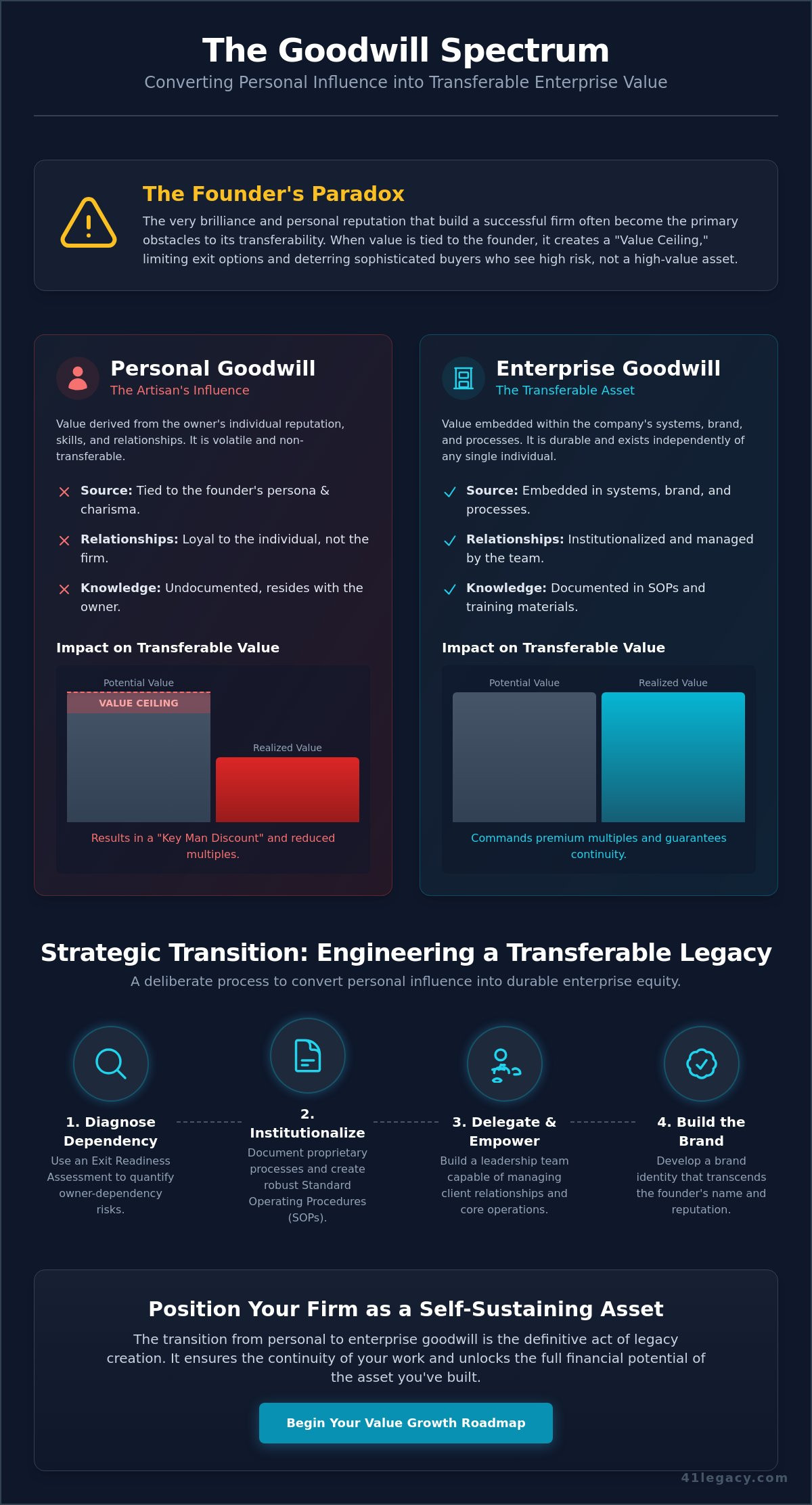
To understand the soul of a business, one must first distinguish between the influence of the individual and the resilience of the institution. At its core, personal goodwill is the intangible value born from your specific technical mastery, your refined reputation, and the trust you've cultivated over decades. It's the essence of the artisan. In contrast, enterprise goodwill represents the value that resides within the systems, the brand identity, and the collective institutional knowledge of the firm. While the former is a tribute to your past, the latter is a testament to the business's future.
The distinction is not merely philosophical; it's a structural reality recognized by the IRS and the broader financial community. In 2026, the distinction remains a cornerstone of strategic exit planning. For owners of C-corporations, properly identifying personal goodwill can mitigate the burden of double taxation during an asset sale, as personal goodwill is held by the individual rather than the entity. However, from a legacy perspective, understanding how personal goodwill affects business value is about more than tax efficiency. It's about determining whether the business is a self-sustaining masterpiece or a temporary reflection of its creator. Much of what owners consider "Relationship Capital" often resides solely in their own Rolodex, making the business fragile and difficult to transfer to a successor.
The technical definition of Goodwill (accounting) provides the foundation for this analysis. It separates the purchase price of a business from its tangible assets. If that residual value is tied to your persona, the asset's worth is inherently volatile. At 41 Legacy, we view the transition from personal to enterprise value as a deliberate act of Transferability Engineering.
The Components of Individual Influence
Individual influence is often characterized by the "Rainmaker" effect, where charisma and personal history drive the majority of revenue. This includes the specialized trade secrets and technical mastery that only you possess. When customer loyalty is pledged to the person rather than the firm, the business lacks a life of its own. Without your daily involvement, the vital spark of the enterprise begins to dim.
The Anatomy of Enterprise Equity
Enterprise equity is built upon the solid foundation of proprietary processes and documented standard operating procedures. It's the beauty of a well-oiled machine. This equity thrives through brand recognition that exists independently of the founder's name. When relationships are institutionalized and managed by a professional team, the business becomes a durable asset. It's no longer a job you own; it's a legacy that can endure for generations.
The Founder’s Paradox: How Personal Goodwill Erodes Transferable Value
The founder's paradox is a quiet tragedy. You've built a firm through sheer will and technical brilliance, yet that very excellence often becomes the anchor preventing the business from sailing toward a successful transition. While many advisors focus on the tax implications of personal goodwill, few address its role as a "transferability killer." Sophisticated institutional buyers view high personal goodwill as a signal of systemic fragility. They don't see a masterpiece; they see a "Key Man Risk" that threatens the stability of their investment the moment you step away.
This reality creates a "Value Ceiling." When a business is tethered to the founder’s daily involvement, the pool of potential successors shrinks. Strategic buyers and private equity firms prioritize predictable, institutionalized cash flow over the fleeting spark of personal charisma. Understanding how personal goodwill affects business value requires a cold assessment of what remains when you are gone. Transferable systems and documented processes command premium multiples because they offer a guarantee of continuity that personal talent simply cannot match. There is a profound emotional weight in realizing that your creation might not survive its architect without a deliberate shift toward Owner Dependency Reduction.
The Key Man Discount
Banks and private equity firms are inherently risk-averse. They fear "The Walkaway Risk," which is the possibility that the business's soul departs with the founder. High levels of personal goodwill complicate due diligence, as buyers struggle to verify if client loyalty is tied to the brand or the individual. To mitigate this, buyers often insist on long-term earn-outs, forcing you to remain tethered to the company for years post-sale to prove the value is real. This discount is the price you pay for being indispensable.
The Transferability Trap
It's vital to evaluate if you own an asset or a high-paying job. Market attractiveness is often high for profitable firms, but internal readiness is what determines if a sale actually closes. In a transferable asset, "Rainmaking" is a liability. If revenue depends on your personal Rolodex, the business is not yet a standalone entity. True value is engineered when the founder’s influence is replaced by a professional team and institutionalized relationships. You must build a business that works, not a business that needs you to work.
The Valuation Mechanics: Quantifying the Intangible
The artistry of building a business eventually meets the cold precision of the balance sheet. Quantifying the intangible requires a blend of surgical technical skill and a deep understanding of human influence. To understand how personal goodwill affects business value, one must look beyond standard financial statements. Valuation experts use specific frameworks to isolate the owner's individual contribution from the company's institutional strength. This isn't just an accounting exercise; it's a diagnostic of the firm's structural integrity.
Sophisticated advisors don't view value as a static number. They see it as a reflection of risk and resilience. When a business is overly dependent on its founder, the risk profile rises, and the market value inevitably contracts. By applying rigorous valuation mechanics, we can move from subjective feeling to objective data. This clarity is the first step in transforming a personal masterpiece into a transferable legacy.
Common Valuation Methodologies
The "With and Without" method is perhaps the most visceral approach. It asks a singular, haunting question: what is the business worth if you disappear tomorrow? Analysts project the expected cash flows under your continued leadership and contrast them against a scenario where you are absent. The resulting delta represents the financial weight of your personal goodwill. It's a stark quantification of the revenue drop-off that a successor might face during a transition.
For a more nuanced perspective, the Multi-Attribute Utility Model (MUM) provides a sophisticated scoring framework. This model evaluates specific attributes such as personal reputation, technical expertise, and the depth of individual client relationships. Unlike static accounting entries, these scores reflect the economic reality of the firm's dependency. While many treat these scores as fixed outcomes, they're actually variables that can be proactively improved through structured Enterprise Diagnostics. By identifying low-scoring attributes early, you can systematically transfer that influence to the organization and improve how personal goodwill affects business value over time.
Documentation and Evidence
The burden of proof rests on the ability to demonstrate that the business can operate as a self-sustaining asset. This is where technical engineering meets legal strategy. Non-compete agreements and employment contracts serve as the bridges that "lock in" personal goodwill, effectively converting it into a corporate asset that a buyer can rely upon. These documents provide the necessary assurance that your departure won't result in a mass exodus of clients or talent.
Preparing these records is a meticulous process that requires the guidance of a Certified Exit Planning Advisor. It's not enough to have a profitable business; you must have a documented business. Formal evidence of the firm's independence, such as team-led client reviews and autonomous operational cycles, provides the empirical data required to justify higher multiples. This documentation transforms the intangible essence of your leadership into a tangible, transferable asset.
Strategic Transition: Converting Personal Influence into Enterprise Equity
The evolution from a founder-led firm to a transferable institution is a multi-year project requiring surgical precision. It's a deliberate act of stewardship. You've spent years as the primary architect of your firm's success, but true legacy is built when the masterpiece can endure without the artist's constant touch. This transition redefines how personal goodwill affects business value by shifting the focus from individual performance to systemic reliability. You aren't just stepping back; you're elevating the organization to a level of institutional maturity that commands premium multiples.
This process, which we define as Transferability Engineering, requires a fundamental shift in your identity. You must transition from the "Founding Father" who holds every key to the "Chairman of the Board" who oversees the strategic vision. It's a move from being the source of value to being the guardian of the asset. By systematically replacing personal influence with enterprise equity, you dismantle the dependency that keeps you captive to daily operations. To begin this journey, a structured Value Growth Roadmap provides the necessary architecture to ensure every step builds lasting, transferable worth.
Steps to Institutionalize Value
Institutionalizing value happens in distinct, intentional phases. First, you must document the "Secret Sauce." This involves translating your intuitive technical mastery into scalable standard operating procedures (SOPs) that a professional team can execute with extreme precision. The second phase involves the thoughtful transition of primary client contacts to your senior leadership. This ensures that loyalty is pledged to the firm's standards rather than your personal charisma. Finally, you must build a brand narrative that transcends your own biography. The firm's story should be about its collective impact and history, not just the founder's resume.
Talent Development as Value Growth
Your team is the vessel for the firm's relationship capital. Empowering the next generation of leaders is a critical component of owner-dependency reduction. You must provide them with the autonomy to manage high-stakes engagements while aligning their incentives to ensure long-term retention. When your staff is viewed as the primary drivers of value, the "Key Man Risk" dissipates. Your role eventually settles into high-level strategic oversight, where your wisdom guides the firm without requiring your presence in every meeting. This creates a self-sustaining asset that thrives on its own merit.
The 41 Legacy Approach: Engineering a Transferable Legacy
The journey from an owner-dependent firm to a self-sustaining asset requires more than just intent; it demands a disciplined framework. At 41 Legacy, we believe your business is a masterpiece intended for a new gallery. Just as a curator ensures the provenance and structural integrity of a fine work before it changes hands, we guide you through the meticulous process of Transferability Engineering. Understanding how personal goodwill affects business value is the first step in this curation. We help you identify where your personal influence ends and where the firm’s institutional strength begins, ensuring the legacy you’ve built can survive the transition to its next steward.
Our role is that of a strategic architect, or more precisely, the "Quarterback." We don't replace your trusted advisors; we harmonize their efforts. By coordinating with your CPAs and attorneys, we ensure that tax strategies and legal structures are perfectly aligned with the goal of maximizing transferability. This collaborative approach ensures that the technical precision of your exit plan matches the artistic vision of your legacy. We provide the strategic oversight necessary to move from theory to implementation, ensuring that the essence of your business is preserved while its dependency on your daily presence is dissolved.
The Diagnostic Phase
Every masterpiece begins with a thorough examination. Our Exit Readiness Assessment serves as the primary diagnostic tool for identifying the hidden risks of personal goodwill. We uncover the "Value Gap," which is the distance between your firm's current market worth and the financial goals required for your future. Through deep Enterprise Diagnostics, we reveal how your daily involvement might be suppressing the firm's multiples. This phase provides a baseline of clarity, allowing us to see the business as a buyer would. We identify the specific areas where how personal goodwill affects business value is most pronounced, setting the stage for a systematic transition toward enterprise equity.
Ongoing Implementation Support
Strategic clarity is only valuable if it leads to tangible results. Once the diagnostic phase is complete, we provide a Value Growth Roadmap that serves as your blueprint for the future. This isn't a static document; it's a living guide supported by Monthly Implementation Support. We maintain a "professional-room altitude," keeping you focused on high-level strategic oversight while we help you navigate the complexities of owner-dependency reduction. This disciplined advisory ensures that the roadmap is followed with the same precision used in the firm's founding. Ready to begin the process of securing your firm's future? Explore our Exit Readiness Assessment to discover the true potential of your transferable legacy.
From Personal Influence to Permanent Impact
The transition from a founder-led masterpiece to a self-sustaining institution is the final, most significant phase of your stewardship. We've examined the vital distinction between individual reputation and institutional equity, emphasizing that true value lies in the systems and talent that endure after your departure. By mastering how personal goodwill affects business value, you move beyond the limitations of "Key Man Risk" and toward the creation of a durable asset. This process ensures that the essence of your creation is preserved while its marketability is enhanced through deliberate, strategic engineering.
Our firm provides national strategic advisory expertise led by a Certified Exit Planning Advisor (CEPA) to guide you through this delicate evolution. Through our structured Value Growth Roadmap process, we bring technical precision to the art of legacy building, ensuring your firm operates with surgical excellence and institutional strength. Begin your journey toward a transferable legacy with an Exit Readiness Assessment. Your business has been your life's work; now is the time to ensure it lives on as a permanent testament to your vision and a thriving asset for the next generation.
Frequently Asked Questions
Can personal goodwill be sold separately from the business assets?
Yes, personal goodwill is an asset owned by the individual shareholder rather than the corporate entity itself. It represents the value of your specific reputation, technical mastery, and relationships that exist outside of any employment contract. In a transition, this is often treated as a separate transaction between the individual and the buyer, distinct from the sale of the company's tangible assets.
How does the IRS distinguish between personal and corporate goodwill?
The IRS evaluates whether the firm's value is derived from the individual's unique skills and reputation or from the company’s brand, systems, and institutionalized processes. Courts often look for the absence of a non-compete agreement between the owner and the corporation as evidence that the goodwill remains personal. This distinction is vital for C-corporation owners seeking to avoid double taxation on the sale of their life's work.
Why do buyers prefer to allocate value to personal goodwill?
Buyers often favor this allocation because it allows them to amortize the purchased goodwill over a 15-year period under Section 197 of the Internal Revenue Code. This creates a significant tax shield for the successor, effectively reducing their after-tax cost of acquisition. While this can be a point of negotiation, it requires meticulous documentation to ensure the allocation reflects the economic reality of the founder's influence.
What happens to personal goodwill if I don’t have a non-compete agreement?
The absence of a non-compete agreement is a primary indicator that the goodwill belongs to you personally rather than the corporation. If you haven't legally transferred your "right to compete" to the entity, the value of your relationships and expertise remains your own. While this supports a favorable tax strategy, it also highlights the "Key Man Risk" that can lower your overall marketability to institutional buyers.
Can a business have zero personal goodwill?
Yes, a business achieves zero personal goodwill when it operates as a self-sustaining asset where every process is institutionalized and the brand stands independent of the founder. This is the hallmark of a truly transferable legacy. In such cases, the value resides entirely within the enterprise equity, which typically commands the highest multiples because the risk of a performance drop-off post-transition is virtually eliminated.
How long does it take to convert personal goodwill into enterprise value?
Converting personal influence into enterprise equity is a meticulous process that typically requires 24 to 36 months of disciplined implementation. This time is necessary to transition primary client relationships and document technical mastery into scalable systems. It's an unhurried evolution that ensures the firm's excellence is preserved while the founder's daily involvement is systematically reduced through a structured roadmap.
Is personal goodwill taxable at capital gains rates in 2026?
Personal goodwill is generally taxed at long-term capital gains rates of 0%, 15%, or 20% in 2026, depending on your total taxable income. For high-income sellers, a 3.8% Net Investment Income Tax (NIIT) also applies if modified adjusted gross income exceeds $250,000 for joint filers. This single layer of taxation is significantly more favorable than the double taxation often encountered in corporate asset sales.
How does owner dependency affect my business’s valuation multiple?
Owner dependency acts as a significant drag on valuation multiples by increasing the perceived risk for a successor. When exploring how personal goodwill affects business value, it's clear that buyers pay a premium for predictability and resilience. A business that requires the architect's constant touch is viewed as a fragile asset, leading to lower offers and more restrictive earn-out requirements during a transition.

Article by
Mike Laskowski
Mike Laskowski is a Business Value Growth Strategist who helps business owners uncover the truths that drive their performance, risk, and readiness. Blending forensic interviewing from a 26‑year federal career with Strategic Capacity analysis and CEPA methodology, he works upstream to reduce owner dependency, increase transferability, and strengthen enterprise value. Mike guides founders through clarity, operational evolution, and transition readiness so their companies become transferable, owner‑independent assets that endure beyond the founder.
Disclaimer
This article is for educational and informational purposes only and does not provide legal, tax, investment, or business brokerage advice. 41 Legacy does not offer M&A brokerage services, legal document drafting, tax preparation, or investment advisory services. Business owners should consult licensed professionals in those disciplines before making decisions related to business transactions, legal matters, tax strategy, or financial planning. All examples are illustrative and may not apply to your specific situation.