
The Architect of Legacy: Navigating the Strategic Challenges of Family Business Succession
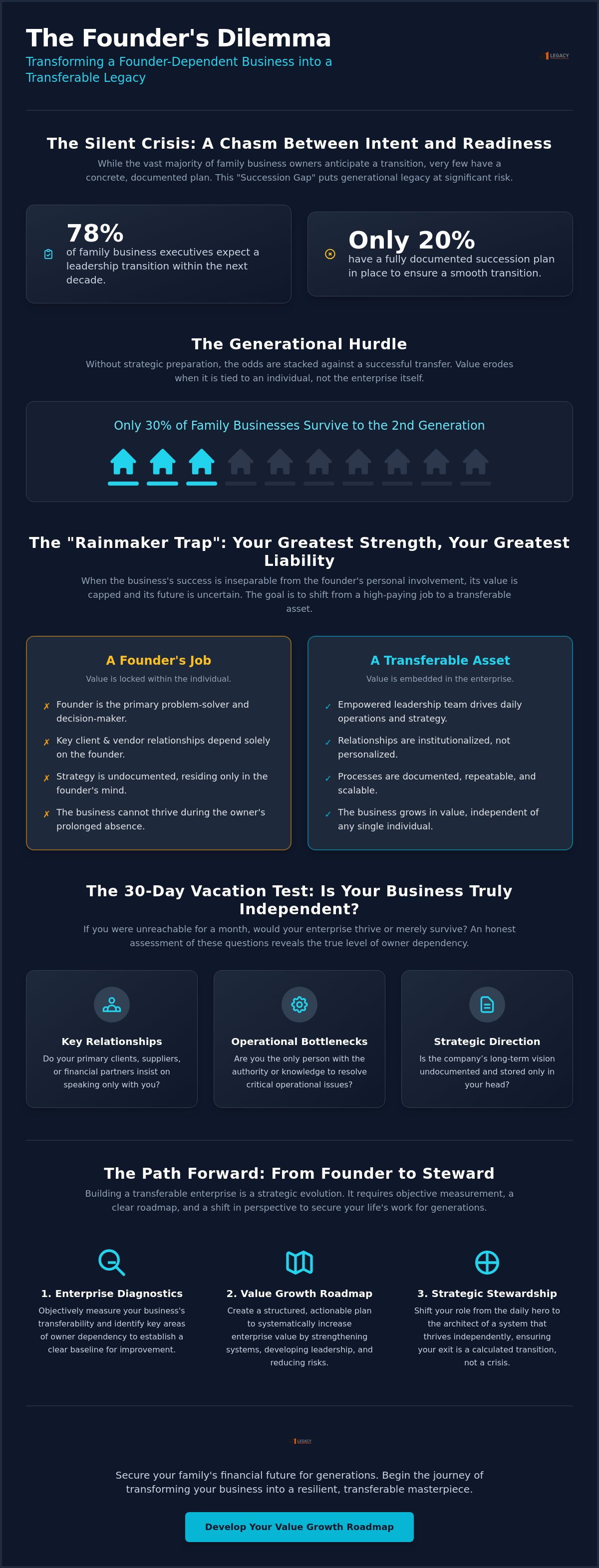
What if the very strength that built your enterprise is the precise structural flaw that ensures its eventual collapse? For many founders, the business is a living reflection of their personal drive, yet this deep integration often creates a "Rainmaker Trap" where value remains locked within the individual rather than the institution. You've likely felt the weight of this dependency, realizing that the strategic challenges of family business succession are rarely about the lack of an heir; they're about the absence of a truly transferable asset. While 78% of family business executives expect a leadership transition within the next decade, a Bank of America study reveals that only 20% have a fully documented plan in place.
We believe your life’s work deserves a more permanent composition. You've navigated the complexities of growth. Now, you must master the art of stewardship to protect what you’ve built. This guide explores how to transform a founder-dependent operation into a resilient, transferable masterpiece that thrives independently of its creator. We'll examine the strategic diagnostics required to reduce owner dependency, navigate conflicting visions among heirs, and leverage the $15 million federal estate tax exemption to secure your family's financial future for generations.
Key Takeaways
- Bridge the gap between your personal intent and the enterprise’s structural readiness by treating succession as a strategic evolution rather than a singular event.
- Identify the symptoms of owner dependency to dismantle the "Rainmaker Trap" and ensure your business retains its value without your daily presence.
- Resolve the strategic challenges of family business succession by navigating the delicate balance between active family operators and passive shareholders.
- Utilize Enterprise Diagnostics to objectively measure transferability and create a clear roadmap for increasing the health and value of the organization.
- Shift your perspective from founder to steward, positioning your eventual exit as a calculated transition that preserves the essence of your legacy.
The Silent Crisis: Why Family Business Succession Often Fails
Succession is far more than a mere departure; it's the intentional orchestration of a transition in both leadership and ownership. It's the final, most complex movement in a founder’s professional symphony. Yet, a silent crisis persists. We often see a profound "Succession Gap," which is the structural distance between a founder’s intent to retire and the enterprise’s actual readiness to survive that exit. The challenges of family business succession aren't found in the lack of desire to continue, but in the failure to build an organization that functions independently of its creator.
The emotional weight of stewardship is heavy. You aren't just managing a company; you're guarding a history and a name. This pressure to preserve a multi-generational legacy can lead to paralysis. When a business is treated as a personal job rather than a transferable asset, the founder becomes the primary value driver. If you're the only one who can solve the "unsolvable" problems, the business doesn't truly belong to the next generation yet. It still belongs to you. Creating a legacy requires shifting your perspective from being the hero of the story to being the architect of a system that no longer needs a hero.
The Statistical Reality of Generational Transitions
The numbers are sobering. Research indicates that only 30% of family businesses successfully navigate the transition to the second generation. To understand what is a family business in its most resilient form, one must look past the heritage to the underlying mechanics. Most failures occur because of friction points like a lack of formal strategic planning or an absence of an objective valuation. We believe that Enterprise Value is the only metric that matters. If the value of the business drops the moment you walk out the door, you haven't built an enterprise; you've built a high-paying role for yourself. Success is measured by the stability of the asset during your absence.
The Difference Between Succession and a Simple Sale
An internal family transfer is fundamentally different from a third-party M&A transaction. While a sale to a competitor is often a clean break, a family transition requires a higher level of Transferability Engineering. You're balancing the need for the retiring founder’s financial security with the successor’s need for operational cash flow. This often reveals a "Value Gap," where the current worth of the business doesn't meet the founder's retirement requirements. We bridge this through a Value Growth Roadmap. This structured path ensures the business grows in value specifically where it counts, making it a robust, standalone asset that can support the family for decades to come.
Structural Owner Dependency: The Invisible Ceiling on Legacy
Many founders view themselves as the indispensable engine of their enterprise. While this individual drive is vital during the early stages of growth, it eventually becomes a barrier to a successful transition. If the business relies on your specific intuition, personal relationships, or daily decision-making to survive, it isn't a transferable asset yet; it's a job you happen to own. This structural reliance is one of the most significant challenges of family business succession. When the "secret sauce" of the company resides exclusively in the founder’s mind, the firm faces a steep "Transferability Discount" from potential successors or external investors. They aren't looking for a star; they're looking for a system. Reducing this dependency isn't an admission of obsolescence. It's an act of deep reverence for the business’s future architectural integrity.
Identifying the Rainmaker Trap
The Rainmaker Trap is the paradox where the founder’s individual excellence becomes the company’s greatest structural liability. To determine if you've fallen into this trap, we often suggest the 30-day vacation test. If you were to vanish for a month without access to a phone or email, would the enterprise thrive or merely survive? Consider these indicators of high dependency:
- Do your primary clients or vendors insist on speaking only with you?
- Are you the only person with the authority to resolve operational bottlenecks?
- Is the company’s long-term strategy undocumented and stored only in your head?
If these scenarios resonate, your Enterprise Diagnostic score will likely reveal a high risk profile. An asset that cannot function without its creator is inherently fragile and difficult to transition. Addressing these challenges of family business succession requires a deliberate shift from personal performance to institutional excellence.
Building Strategic Capacity Within the Next Generation
Preparing a successor involves more than a simple title change. It requires a fundamental evolution from "Doing" to "Leading." For the next generation to step into their roles with confidence, they need a foundation of institutional knowledge. Standard Operating Procedures (SOPs) act as the technical blueprints of the organization, capturing the essence of your process so it can be replicated with precision. We use Strategic Capacity Evaluation to ensure family heirs possess the specific leadership skills required for the enterprise's next chapter. This process ensures the successor isn't just filling a seat but is equipped to manage the complex machinery of the business with the same dedication to perfection that you've maintained for years.
Navigating the Intersection of Family Dynamics and Enterprise Value
Family dynamics are often dismissed as emotional static, but in the context of enterprise health, they represent a significant financial risk. Unresolved conflict acts as a silent "Value Killer" during the high-stakes scrutiny of due diligence. If siblings or cousins cannot agree on the strategic direction of the firm, potential buyers or successors perceive a fractured foundation that threatens future cash flows. As a steward of your life's work, your role is to construct a Value Growth Roadmap that addresses these human complexities with the same technical precision you apply to your capital expenditures. You aren't just managing personalities; you're engineering the stability of a multi-generational asset.
The "Fair vs. Equal" debate is one of the most persistent challenges of family business succession. Distributing ownership equally among children might feel fair at the dinner table, but it can be catastrophic for the boardroom. True fairness often requires a structured approach that prioritizes the long-term vitality of the asset over simple mathematical equality. Consider these common friction points that emerge when ownership is not strategically aligned:
- Active operators feeling undervalued by passive siblings who share equal equity but don't carry the daily burden of leadership.
- Passive shareholders prioritizing immediate dividends over the long-term capital reinvestment necessary for growth.
- Voting deadlocks that prevent the firm from pivoting quickly during significant market shifts.
Active vs. Passive Shareholder Alignment
Passive family members holding significant veto power over operational decisions can inadvertently stifle growth. For the enterprise to flourish, shareholder agreements must clearly define roles and prioritize the health of the institution. We recommend beginning with an Exit Readiness Assessment to align expectations across the entire family. This diagnostic process brings clarity to the distance between family desires and the business’s current structural reality, ensuring everyone understands what is required to preserve the legacy. It's about moving the conversation from individual entitlement to collective stewardship.
The Role of the Professional Advisory Team
Most owners rely on a trusted CPA or attorney, yet these professionals often operate in specialized silos. Your tax professional focuses on liability reduction, while your attorney focuses on risk mitigation and legal compliance. Without a "Quarterback" to align these distinct perspectives, you may end up with a collection of disjointed plans that fail to address the overarching strategy of transferability. A strategic advisor serves this essential function, coordinating the efforts of your RIA, attorney, and CPA to ensure harmony. This unified approach prevents siloed decisions from eroding enterprise value and ensures that every technical move supports the ultimate goal of a successful, multi-generational transition. Coordinated advisory is the hallmark of a sophisticated exit, transforming a chaotic process into a disciplined progression toward your next act.
The Exit Readiness Framework: Building a Transferable Asset
Building a legacy is an act of structural engineering. While the emotional and legal facets of a transition are vital, the core of a successful handoff rests on the business’s integrity as a standalone asset. At 41 Legacy, we view this as a meticulous refinement process. We address the challenges of family business succession by applying a disciplined framework designed to de-risk the enterprise and amplify its market attractiveness. This isn't a matter of hope; it's a matter of engineering readiness through technical precision and strategic clarity.
Step 1: The Enterprise Diagnostic
The journey begins with a clinical assessment of the organization’s current state. Our Enterprise Diagnostics process assigns a "transferability" score to the firm, moving beyond simple balance sheets to examine the underlying health of the operation. This diagnostic phase is essential because it identifies "Value Killers," those structural weaknesses or hidden risks that would lead a buyer or successor to heavily discount the firm’s worth. You cannot grow what you have not measured. By quantifying these risks early, we establish a baseline that allows for a targeted, high-impact refinement of the business’s core systems.
Step 2: Closing the Value Gap
Most owners face a "Value Gap," which is the distance between the business’s current worth and the financial resources required to fund the owner’s next act. We bridge this gap by focusing on the Three Pillars of Value: Growth, Risk, and Transferability. While many firms focus solely on top-line growth, a sophisticated transition requires equal attention to de-risking the operation and ensuring its systems are easily handed over. A business is only truly valuable when it can be sold to a stranger for the same price it would cost a family member. Achieving this level of excellence ensures that the founder’s financial objectives are met without compromising the successor’s ability to thrive.
Step 3: Monthly Implementation and Accountability
A strategy is only as effective as its execution. To ensure the Value Growth Roadmap remains a living document rather than a shelf-bound theory, we provide Monthly Implementation Support. This structured advisory retainer creates a rhythm of accountability, preventing the owner from reverting to old habits of micromanagement or "Rainmaking." We act as the strategic "Quarterback" for your entire professional team, ensuring that your CPA, attorney, and wealth advisor are all moving in harmony toward the same objective. This coordinated effort preserves the essence of the enterprise while building the strategic capacity necessary for it to flourish under new leadership. To begin this transformation, we invite you to schedule your Exit Readiness Assessment today.
Stewardship and Strategy: Securing the Legacy with 41 Legacy
The final movement of a founder’s career shouldn't be a retreat. It's the commencement of a "Next Act." At 41 Legacy, we don't view ourselves as mere service providers; we are guardians of the essence you've spent a lifetime cultivating. Protecting this essence requires a blend of creative vision and technical precision. By treating the enterprise as a living entity with its own story to tell, we help you master the challenges of family business succession through rigorous Transferability Engineering and strategic alignment. You've built the foundation. Now, we ensure the structure can stand for centuries. True stewardship means building an asset that no longer requires your daily presence to sustain its excellence.
The CEPA Difference
Working with a Certified Exit Planning Advisor (CEPA) provides a depth that general consulting cannot reach. We operate at the intersection of Business, Personal, and Financial readiness. This holistic approach ensures that while the business is being optimized through Enterprise Diagnostics, your personal and financial objectives are equally prioritized. We take the role of the "Quarterback," leading your existing team of CPAs, attorneys, and RIAs to ensure every technical detail serves the larger strategic vision. This coordinated leadership prevents the fragmentation that often destroys enterprise value during a transition. We ensure that your wealth advisors and legal teams aren't working in silos, but are instead contributing to a singular, polished masterpiece of a transition.
Your Next Act Starts with a Roadmap
The first step toward a secure future is clarity. We invite you to view your transition not as an ending, but as the ultimate test of your stewardship. A Value Growth Roadmap provides the technical blueprints for this evolution, ensuring every decision increases the health and independence of the firm. It’s a comprehensive health check for the business’s future, de-risking the operation while maximizing its attractiveness to the next generation or potential successors. Your legacy is too important to leave to chance. It deserves the same meticulous attention to detail that you applied to your very first day of operation. Take the first step toward Exit Readiness today. By beginning this process now, you ensure your business remains a masterpiece of independence and a source of lasting pride. Schedule your Enterprise Diagnostic with 41 Legacy to define the path forward and secure your life's work for the generations to come.
Architecting Your Next Act
Your business is the culmination of years of meticulous effort and unyielding vision. To ensure it survives your eventual departure, you must move beyond the role of the primary value driver and become the architect of a self-sustaining system. We've explored how reducing owner dependency and aligning family dynamics are essential steps in protecting the enterprise’s structural integrity. These aren't just operational adjustments; they're the technical requirements for a masterpiece that endures for generations.
Navigating the complex challenges of family business succession requires a disciplined, professional-grade approach. Led by a Certified Exit Planning Advisor (CEPA), our team utilizes a proprietary Enterprise Diagnostics process to identify "Value Killers" and create a clear Value Growth Roadmap. By focusing on transferability engineering and owner dependency reduction, we help you transform your firm into a resilient asset that thrives independently. This is the ultimate expression of stewardship. Begin your journey toward a transferable legacy with an Exit Readiness Assessment. You've built a remarkable history. It's time to ensure its future is just as certain.
Frequently Asked Questions
What is the biggest challenge in family business succession?
The most significant obstacle is the "Rainmaker Trap," where the founder’s personal identity and decision-making are so deeply woven into the firm that it cannot function independently. This structural dependency creates one of the primary challenges of family business succession, as it devalues the enterprise in the eyes of successors or buyers who require a system rather than a star performer. Transitioning from a founder-dependent operation to a transferable asset is the ultimate test of stewardship.
When should a family business start succession planning?
You should ideally begin the transition process three to five years before your anticipated departure date. A Deloitte survey found that 78% of family business executives expect a CEO transition within the next decade, yet many wait until a crisis occurs to begin the work. Starting early allows for the technical refinement of transferability and the gradual reduction of owner dependency without disrupting the operational harmony of the enterprise.
How do I tell my children they aren’t ready to take over the business?
Use objective data rather than personal opinion to guide this delicate conversation. By implementing a Strategic Capacity Evaluation, you can identify specific leadership gaps and provide a developmental roadmap for your heirs based on technical requirements. This professionalizes the process, shifting the focus from family hierarchy to the objective needs of the enterprise’s future success and the preservation of its essence.
What is the difference between a business exit plan and a succession plan?
A business exit plan focuses on the founder’s personal and financial readiness to depart, while a succession plan addresses the intentional transfer of leadership and ownership within the organization. While they're distinct, they must be harmonized to ensure the owner’s financial security and the business’s long-term operational stability. Coordinated advisory ensures these two paths never diverge, protecting the enterprise's value during the transition.
How does owner dependency affect the value of my family business?
Owner dependency acts as a "Value Killer" that triggers a significant discount on the firm’s worth during any transition or assessment. Investors and successors apply this discount because high dependency represents high risk; if the business relies on your personal relationships or intuition, it's not a truly transferable asset. Reducing this dependency through Enterprise Diagnostics is the most effective way to amplify your firm's market attractiveness and secure its legacy.
What role does a CPA play in family business succession?
Your CPA provides essential technical precision regarding tax implications, financial reporting, and the structural health of the balance sheet. However, they should work as part of a coordinated team led by a strategic advisor who acts as a "Quarterback." This ensures that tax-saving strategies don't inadvertently compromise the overarching goal of enterprise value growth or the operational transferability of the business.
Can I stay involved in the business after a succession transfer?
It's possible to maintain a presence, but your role must evolve from an operational leader to a strategic mentor or board chair. Successful transitions often include a defined period where the founder provides advisory support without retaining veto power over daily decisions. This allows the next generation to establish their authority while the business continues to benefit from your historical perspective and technical wisdom.
What happens if I don’t have a formal succession plan in place?
Without a formal plan, the enterprise faces a "Succession Gap" that often leads to family conflict and a rapid loss of enterprise value. A Bank of America study reveals that while 78% of owners believe planning is important, only 20% have a documented strategy. This lack of clarity often results in an unplanned sale or operational collapse, jeopardizing the legacy you've spent a lifetime building with such meticulous care.

Article by
Mike Laskowski
Mike Laskowski is a Business Value Growth Strategist who helps business owners uncover the truths that drive their performance, risk, and readiness. Blending forensic interviewing from a 26‑year federal career with Strategic Capacity analysis and CEPA methodology, he works upstream to reduce owner dependency, increase transferability, and strengthen enterprise value. Mike guides founders through clarity, operational evolution, and transition readiness so their companies become transferable, owner‑independent assets that endure beyond the founder.
Disclaimer
This article is for educational and informational purposes only and does not provide legal, tax, investment, or business brokerage advice. 41 Legacy does not offer M&A brokerage services, legal document drafting, tax preparation, or investment advisory services. Business owners should consult licensed professionals in those disciplines before making decisions related to business transactions, legal matters, tax strategy, or financial planning. All examples are illustrative and may not apply to your specific situation.