
Talent Development as a Pillar of Enterprise Value and Exit Readiness
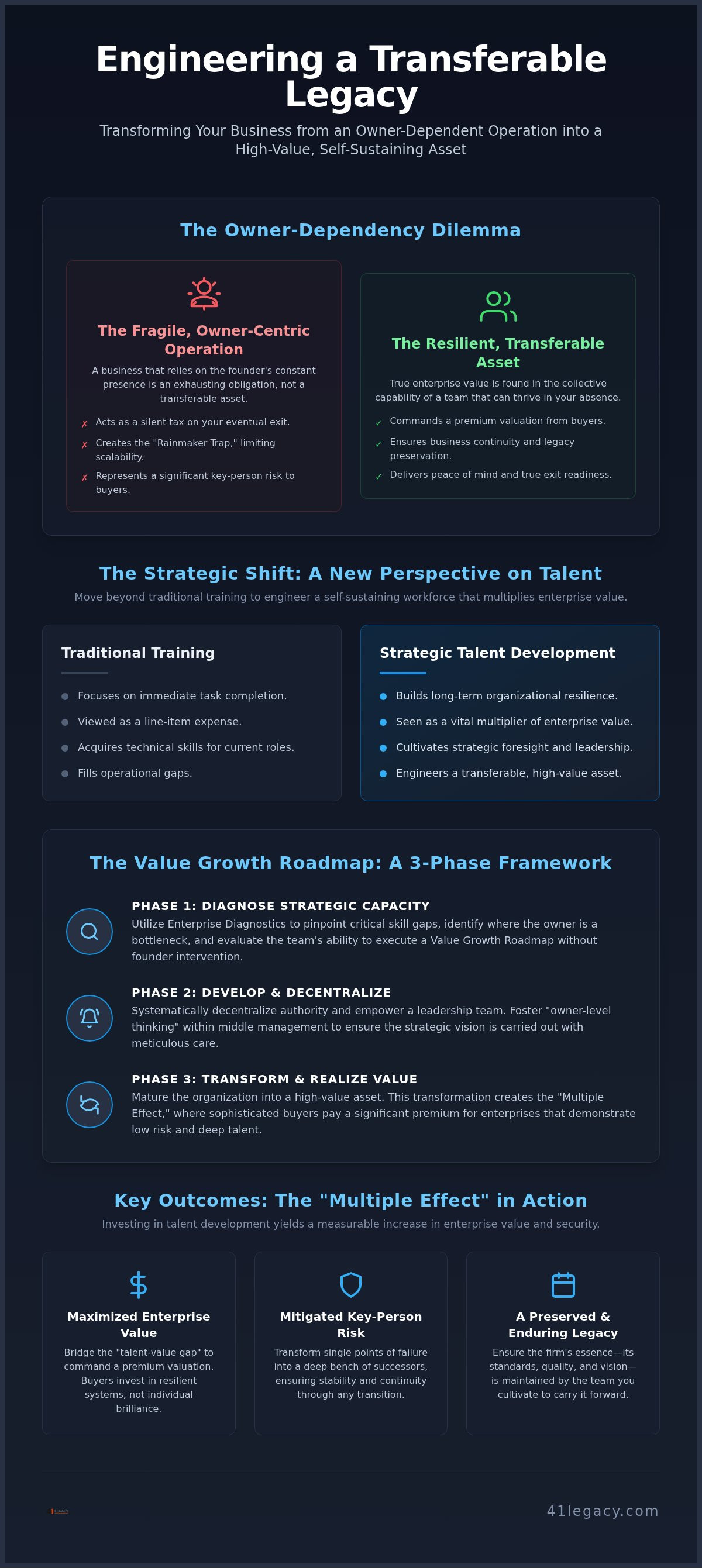
A business that requires its founder’s constant breath to survive isn't a true legacy; it's an exhausting, high-stakes obligation. You've likely spent decades as the primary engine of your company, yet the reality remains that high owner-dependency acts as a silent tax on your eventual exit. True enterprise value is found not in your personal brilliance, but in the collective capability of your team. Strategic talent development is the master stroke that transforms a fragile, owner-centric operation into a resilient, transferable asset that thrives in your absence.
It's understandable to feel that the business might crumble if you step away, but you deserve the peace of mind that comes from true stewardship. We'll show you how to reduce key-person risk and bridge the value gap by engineering a self-sustaining workforce. You'll discover how to leverage strategic 2026 initiatives, including various nationwide programs, to fuel this growth while protecting your margins. This article provides the roadmap to cultivate a team that doesn't just fill roles, but protects and enhances the heritage of the firm you've built.
Key Takeaways
- Redefine talent development as a rigorous form of transferability engineering designed to ensure the business thrives beyond your daily involvement.
- Escape the "Rainmaker Trap" by systematically decentralizing authority and empowering a leadership team capable of sustaining operations independently.
- Understand the "Multiple Effect," where sophisticated buyers pay a significant premium for enterprises that demonstrate depth of talent and minimal key-person risk.
- Utilize a Strategic Capacity Evaluation to pinpoint critical skill gaps and align your team’s growth with a structured Value Growth Roadmap.
- Transform your organization into a self-sustaining asset that preserves your professional legacy while maximizing your overall exit readiness.
What is Talent Development in the Context of Enterprise Value?
In the quiet halls of a well-curated gallery, the value of a collection isn't found in a single frame, but in the enduring integrity of the whole. For the business owner, talent development represents a similar pursuit of permanence. It's the intentional cultivation of a leadership tier that ensures business continuity, moving far beyond the simple acquisition of technical skills. While traditional training focuses on the immediate completion of tasks, developing for transferability focuses on the long-term resilience of the organization. It's a fundamental shift in perspective. We don't view employees as line-item expenses; we see them as the vital multipliers of enterprise value.
A true guardian of history understands that a legacy cannot rest upon the shoulders of one individual. It requires a deep bench of successors who possess both technical precision and strategic foresight. This evolution requires a Talent Management Overview that prioritizes the preservation of the firm's essence. When a team is developed with an eye toward exit readiness, the business matures into a high-value, transferable asset. This process is about building a lasting impact that survives the transition of leadership.
The Essence of Strategic Capacity
Strategic capacity is the engine of a self-sustaining business. It's the collective ability of your team to execute a Value Growth Roadmap without your daily intervention. This capacity acts as a sophisticated hedge against market volatility. When the founder is no longer the sole point of failure, the enterprise gains a rare kind of stability. Talent development is the meticulous engineering of a business into a transferable asset that functions with the precision of a fine timepiece.
Preserving the Legacy Through People
Legacy is not a static monument; it's a living entity maintained through the collective wisdom of those who remain after the founder exits the room. To preserve the inner essence of a brand over decades, leadership must move beyond technical excellence to cultivate a shared strategic vision. This ensures that the standards of quality and the philosophical soul of the company remain uncompromised. Your impact as a leader is ultimately measured by the harmony and performance of the team you leave behind, ensuring the work continues with an unwavering devotion to perfection.
Reducing Owner Dependency: The Path to a Transferable Asset
A business that breathes only through the lungs of its founder is a fragile entity. While your personal brilliance built the firm, that same brilliance often creates the "Rainmaker Trap," where the owner remains the primary driver of strategy and revenue. This dependency is a significant liability in the eyes of a sophisticated successor. To transform your company into a transferable asset, you must systematically decentralize decision-making power. Talent development serves as the mechanical bridge between owner-dependency and enterprise autonomy, ensuring the organization’s inner essence remains intact even when the founder is absent.
True value is found in a team that acts as stewards of the enterprise rather than mere executors of tasks. When you invest in the growth of your people, you're engineering a self-sustaining system. This shift is a core component of a successful Exit Readiness Assessment, which evaluates how well the business functions without your daily involvement. By cultivating a culture of high-level accountability, you move from being the engine of the company to becoming its architect.
Engineering the Shift from Founder to Architect
The transition from founder to architect requires the precision of a master artisan. It begins with the psychological hurdle of letting go, followed by the surgical application of delegation. We utilize Enterprise Diagnostics to identify exactly where the owner has become a bottleneck in the workflow. By identifying these points of friction, we can foster "owner-level thinking" within middle management. This ensures that the strategic vision is carried out with the same meticulous care you would provide yourself, allowing the business to scale without your constant presence.
Mitigating Key-Person Risk
A masterpiece is never held together by a single thread. In many organizations, a "Single Point of Failure" exists when critical knowledge is siloed within one or two top employees. This creates an unacceptable level of risk for any potential transition. Through cross-training and intentional talent development, we spread expertise across the leadership tier to protect the company’s operational integrity. This redundancy doesn't just reduce risk; it significantly increases the market attractiveness of the firm. A robust, deep-benched team signals to the world that your legacy is secure and the enterprise is built to endure. If you're ready to evaluate your team's current strategic capacity, our Enterprise Diagnostics can provide the clarity you need to begin this transformation.
The Talent-Value Gap: Why Buyers Pay a Premium for Depth
A connoisseur of fine assets understands that value is rarely found in the surface-level luster of revenue alone. In the world of enterprise valuation, the most sophisticated buyers look past the profit and loss statement to examine the engine beneath. They seek a masterpiece that is complete, not one that requires the original artist to remain in the studio indefinitely. Talent development is the process of finishing that masterpiece. When a buyer identifies a deep, capable management team, they see a reduced risk profile, which translates directly into a higher valuation multiple. Conversely, high owner-dependency acts as a significant discount on the final price, as the buyer must factor in the cost and uncertainty of replacing the founder's unique contribution.
We often encounter the hesitation: "What if I train my people and they leave?" It's a valid concern for any steward of a legacy. However, the more dangerous reality is the alternative: "What if you don't train them and they stay?" An undeveloped team creates a ceiling on growth and a floor on valuation. Organizations with strong learning cultures see 50% higher employee engagement rates according to industry research, which serves as a vital safeguard for your most precious human capital. The cost of turnover is high, but the value of a developed leadership pipeline is an appreciating asset that pays dividends during due diligence.
The Valuation Impact of a Self-Sustaining Team
The distinction between an owner-led firm and a management-led firm is often measured in the millions. Transferability engineering reduces the perceived risk for an acquirer by proving the business can maintain its trajectory without the founder. This depth closes the "Value Gap," the distance between what a business is worth today and its potential value as a fully autonomous entity. A self-sustaining team ensures that the brand's inner essence remains vibrant through any transition, securing the premium your life's work deserves.
Attracting the Right Suitors
Strategic buyers aren't just looking for customer lists or specialized equipment; they're looking for a high-performance engine that is ready for transition. Documented talent development processes within a structured Value Growth Roadmap provide the evidence they need. By positioning your team as the primary driver of success, you move from selling a job to selling a transferable asset. This clarity attracts a higher caliber of suitor, those who value heritage and performance as much as you do, ensuring your legacy is placed in capable hands.
Implementing a Value-Driven Talent Development Framework
Establishing a legacy requires more than a vision; it demands a blueprint. To move beyond the Rainmaker Trap described earlier, we must implement a framework that treats human capital with the same technical precision as a mechanical overhaul. This begins with a Strategic Capacity Evaluation, a diagnostic tool designed to identify the exact talent gaps that threaten your business continuity. By aligning individual growth plans with your long-term Value Growth Roadmap, we ensure every hour spent on talent development serves the ultimate goal of enterprise transferability.
Execution of this framework requires a collaborative effort. We adopt a quarterback approach, working in harmony with your existing professional advisors to ensure that the team’s growth supports the broader exit plan. Success isn't measured by vanity metrics like training hours. Instead, we look at transferability metrics: how many critical functions have been successfully moved from your desk to theirs? This shift in measurement transforms the process from an HR exercise into a strategic value-growth initiative.
The Roadmap to Team Autonomy
Achieving autonomy is a deliberate progression. First, we identify key value-driving roles that are currently owner-dependent, recognizing that these are your greatest points of vulnerability. Second, we establish a knowledge transfer protocol for those specific functions, ensuring that technical precision is documented and repeatable. Third, we provide Monthly Implementation Support to track progress and maintain accountability, ensuring the momentum of development never stalls.
Mentorship and the Preservation of Craft
True craftsmanship is preserved through the quiet exchange of wisdom between mentor and protégé. We use internal mentorship not just to teach tasks, but to pass down the essence of the business. This involves blending technical precision with your company’s unique philosophical approach. We encourage a culture of continuous refinement and professional-room altitude, where every team member understands their role as a steward of the brand's history. This commitment to excellence ensures that when the time comes for transition, the soul of the enterprise remains uncompromised.
Securing Your Legacy with 41 Legacy
Securing your legacy is an act of profound stewardship. At 41 Legacy, we don't merely offer advice; we act as the guardians of the essence you've spent a lifetime building. Our methodology integrates talent development into a comprehensive exit strategy, ensuring that the transition of leadership is as precise and intentional as the growth of the firm itself. Through our Enterprise Diagnostics, we uncover hidden talent risks that often elude even the most seasoned owners. These diagnostics reveal where the organization’s strength is concentrated and where it is dangerously thin, allowing us to build a business that is a lasting, transferable asset rather than a demanding job.
Moving beyond theory requires a dedicated rhythm. We provide structured Monthly Implementation Support to ensure the roadmap we create together is executed with surgical care. This isn't a passive process; it's a disciplined refinement of your organization’s strategic capacity. By focusing on the long-term health of the enterprise, we help you transform your team into a high-performance engine that operates independently of your daily presence. Every step is designed to protect the professional-room altitude you've established while preparing the next generation of leaders to carry the torch.
Your Value Growth Partner
As your value growth partner, we coordinate your entire team of advisors, including CPAs, attorneys, and wealth managers, to ensure every professional is aligned with your ultimate value goals. This quarterback approach, led by a Certified Exit Planning Advisor (CEPA), ensures that no detail of your transition is left to chance. The time to begin this evolution is not on the eve of your departure, but years before you intend to exit. True talent development takes time to mature, and starting early is the only way to ensure the market recognizes the full value of your life’s work.
Take the First Step Toward Transferability
The most valuable enterprises are those that can be viewed through the eyes of a buyer without hesitation. When you reduce the noise of daily operations and focus on the strategic drivers of value, you create a legacy that is both durable and desirable. We invite you to step into the role of the architect and begin engineering a future that doesn't depend on your constant involvement. Begin your journey toward exit readiness today.
The Master Stroke: Engineering a Legacy That Endures
Building an enterprise of lasting impact requires the foresight to see beyond one's own tenure. We've explored how talent development serves as the critical mechanism for transferability engineering, moving the business from a founder-dependent model to a self-sustaining asset. By decentralizing decision-making and closing the value gap, you ensure that the firm's inner essence remains vibrant long after your transition. A deep leadership bench doesn't just reduce risk; it commands a premium from the most sophisticated suitors who value heritage as much as performance.
Our work at 41 Legacy is dedicated to this pursuit of perfection. Led by Certified Exit Planning Advisor (CEPA) expertise, we utilize a proprietary Value Growth Roadmap to transform companies into high-value, transferable assets. This is the path of the steward: building something that thrives independently while preserving the standards of excellence you've established. The time to refine your organization’s strategic capacity is now, ensuring your life's work is protected for the decades to come. Secure your legacy and grow your enterprise value with 41 Legacy. We look forward to helping you architect a future of uncompromising strength.
Frequently Asked Questions
How does talent development specifically increase my company's valuation multiple?
Talent development increases your valuation multiple by systematically reducing the risk profile of the enterprise. Buyers categorize businesses with high owner dependency as high-risk assets, which often leads to a significant discount on the purchase price. By proving the organization can maintain its momentum without your daily involvement, you justify a higher earnings multiple. This transformation signals to the market that the company's success is a repeatable process rather than a personal miracle.
What is the difference between talent management and talent development in exit planning?
Talent management serves as the overarching architecture for your human capital, while talent development is the intentional process of refining individual capabilities. In the context of exit planning, management ensures you have the right roles and systems in place to support a transition. Development focuses on the growth of successors to fill those roles with technical precision. Both are essential components of transferability engineering, ensuring the business's inner essence survives a change in leadership.
Can I really reduce owner dependency if I am the face of the company?
You can reduce owner dependency by institutionalizing your personal brand into a collective firm identity. While you may be the current face of the company, your legacy is secured when your values and strategic vision are mirrored by your leadership team. This requires a shift from being the primary rainmaker to becoming the architect of the brand. Successful transitions occur when the market trusts the team's ability to deliver the same standard of perfection you established.
How much should a business owner invest in talent development annually?
Investment in growth should be viewed as a strategic allocation toward enterprise value rather than a simple expense. While industry averages for training vary, high-performance firms often dedicate resources based on the specific gaps identified in an Exit Readiness Assessment. The goal is to fund the initiatives that yield the highest return on transferability. Every dollar spent refining your team’s strategic capacity acts as a down payment on a more lucrative and seamless eventual exit.
What happens to the business value if a key employee leaves during a sale?
The departure of a key employee during a sale can severely erode business value by introducing sudden operational risk. Acquirers often view the loss of personnel who represent a "single point of failure" as a sign of organizational fragility, which can lead to re-negotiated terms or a collapsed deal. Robust talent development mitigates this by building redundancy and institutional knowledge across the team. Spreading expertise ensures that no single individual’s absence can threaten the integrity of the entire enterprise.
Is talent development relevant if I plan to transition the business to a family member?
Talent development is arguably more critical in family transitions to ensure the successor is prepared for the weight of stewardship. An internal transfer to a family member requires a rigorous period of mentorship to bridge the gap between technical skill and strategic leadership. Without a structured roadmap, the transition risks both the health of the business and family harmony. Providing the next generation with a deep, capable team ensures they aren't overwhelmed by owner-dependency on day one.
How do I identify which employees have the potential for leadership roles?
Identifying leadership potential requires a move beyond observing technical proficiency to evaluating strategic capacity. We utilize Enterprise Diagnostics to observe how employees handle decentralized decision-making and high-altitude problem-solving. Look for individuals who act as stewards of the company's mission rather than those who simply follow instructions. These are the artisans who possess the "owner-level thinking" necessary to maintain the firm’s trajectory and protect its legacy after your departure.
What role do SOPs play in a talent development strategy?
Standard Operating Procedures (SOPs) act as the foundational sheet music that allows your team to perform with technical precision. In a development strategy, SOPs ensure that knowledge transfer is documented and repeatable rather than residing solely in an individual’s head. They provide the clarity needed for employees to master their current roles and prepare for more complex leadership responsibilities. Without these documented protocols, the inner essence of your work remains trapped in the minds of a few.

Article by
Mike Laskowski
Mike Laskowski is a Business Value Growth Strategist who helps business owners uncover the truths that drive their performance, risk, and readiness. Blending forensic interviewing from a 26‑year federal career with Strategic Capacity analysis and CEPA methodology, he works upstream to reduce owner dependency, increase transferability, and strengthen enterprise value. Mike guides founders through clarity, operational evolution, and transition readiness so their companies become transferable, owner‑independent assets that endure beyond the founder.
Disclaimer
This article is for educational and informational purposes only and does not provide legal, tax, investment, or business brokerage advice. 41 Legacy does not offer M&A brokerage services, legal document drafting, tax preparation, or investment advisory services. Business owners should consult licensed professionals in those disciplines before making decisions related to business transactions, legal matters, tax strategy, or financial planning. All examples are illustrative and may not apply to your specific situation.