
Succession Planning for Key Employees: Build a Business That Can Thrive Beyond You
Succession planning for key employees is more than naming a possible replacement. It prepares people, processes, and decision-making so essential work can continue when a key person steps away. Start by identifying where critical responsibilities, relationships, or judgment depend too heavily on one individual.
That dependence can be hard to spot in the rhythm of daily work. A trusted employee may hold essential knowledge that has never been documented, while a potential successor may need practical experience and clear authority before taking on broader responsibilities. Retaining talent matters, but it is not the same as building readiness.
This article explains how to identify roles where continuity matters most, transfer knowledge in stages, and build decision-making capacity across the company. At 41 Legacy, we treat key-employee succession as part of strengthening transferability. Enterprise diagnostics and a value growth roadmap can help owners identify continuity gaps and set priorities, with strategic work coordinated alongside their existing professional advisors. The aim is a business prepared to thrive beyond any one person.
Key Takeaways
- Succession planning for key employees prepares both people and systems to sustain critical roles, rather than simply naming a replacement.
- Map the knowledge, relationships, and decisions each critical role depends on to reveal where continuity is vulnerable.
- Pair mentoring with defined responsibilities and practical experience so potential successors can demonstrate readiness.
- Start with a manageable set of high-impact roles, then assess dependencies, transfer knowledge, and review progress.
- Use diagnostics to identify owner dependency, concentrated responsibilities, and strategic capacity gaps that may affect transferability.
Why Succession Planning for Key Employees Matters to Business Continuity
Succession planning prepares people and systems to maintain essential responsibilities when someone in a critical role leaves, changes roles, or becomes unavailable. It is not simply naming a future replacement or promising a promotion. A successor needs the knowledge, authority, and practical experience to carry the work forward. The business also needs processes that make responsibilities clear and information accessible.
A role can hold more than its job description suggests. One employee may be the only person who knows how a key process works, makes a recurring operational decision, or manages an important customer relationship. When knowledge and authority are concentrated in one person, an absence or transition can disrupt daily operations and make the company less transferable. The broader concept of succession planning applies across settings, but for a business, its value is measured in continuity: critical work can proceed without relying entirely on one person.
Which roles are critical to business continuity?
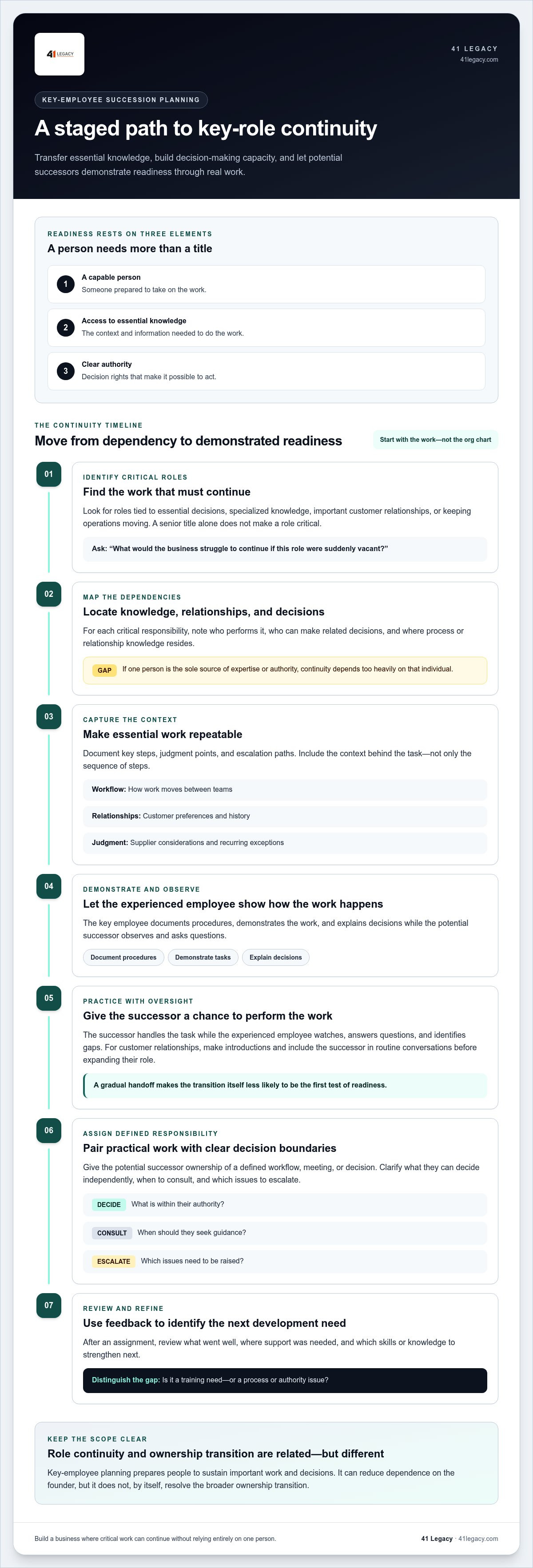
Begin with the work, not the org chart. Identify roles that shape essential decisions, hold specialized knowledge, maintain important customer relationships, or keep operations moving. A senior title does not automatically make a role critical, and a long-serving employee is not necessarily the only person whose departure would create a serious gap. Ask what the business would struggle to continue if the role were suddenly vacant.
For each critical responsibility, record who performs it, who can make related decisions, and where the process or relationship knowledge resides. If one person repeatedly appears as the sole source of expertise or authority, you have identified a continuity gap to address, not a judgment about that employee’s value.
How key-employee succession differs from owner succession
Employee-role continuity and ownership transition are related, but they answer different questions. Key-employee planning asks who can sustain important work and decisions. Owner succession addresses how ownership and leadership may transition. Preparing employees can help the business operate with less dependence on its founder, but it does not, by itself, resolve the broader ownership transition.
For owners considering that broader question, exit planning for business owners can provide a useful next perspective. As part of succession planning for key employees, clarify which responsibilities should remain with the owner, which can be delegated, and what authority future role-holders will need. This distinction helps build a company whose operating capability can endure beyond any one individual.
How Key-Employee Succession Planning Preserves Knowledge and Decision-Making
A successor needs more than familiarity with a role. Readiness depends on three elements working together: a capable person, access to the knowledge required to do the work, and clear authority to make decisions. If one is missing, the new role-holder may be left waiting for guidance or relying on the departing employee to keep operations moving.
Documented processes and shared knowledge turn individual memory into repeatable work the business can sustain. Documentation does not need to capture every detail of a job. It should make essential steps, judgment points, and escalation paths clear enough for another qualified person to act consistently.
Transfer institutional knowledge before a transition
Start by mapping what a key employee knows that is not readily available elsewhere. This might include how a workflow moves between teams, why a customer prefers a particular approach, which supplier considerations affect decisions, or how recurring exceptions are handled. Capture the context behind the task, not just a sequence of steps.
Then transfer that knowledge deliberately. The employee can document procedures, demonstrate the work, and explain decisions while a potential successor observes. Next, the successor performs the task while the experienced employee watches, answers questions, and identifies gaps. For a customer relationship, introduce the successor into routine conversations before asking them to manage more of the relationship. Each stage builds familiarity without making the eventual handoff the first test.
Build capability through responsibility, not titles alone
Mentoring is most useful when it connects to real responsibility. Give a potential successor ownership of a defined workflow, meeting, or decision within agreed boundaries. Clarify what they can decide independently, when they should consult someone, and which issues need to be escalated. A title without practical opportunities can create the appearance of readiness without showing how the person handles the work.
Make development specific through coaching and feedback. After an assignment, review what went well, where the person needed support, and which skills or knowledge to strengthen next. This helps the owner and employee assess capability without implying that a particular promotion is guaranteed. It can also reveal whether the gap is a training need or a problem with the process or authority.
This work can strengthen broader strategic capacity by clarifying where the company has enough decision-makers and where it still depends on one person. To make key-employee succession planning actionable, connect procedures and decision rights to the company’s continuity priorities. 41 Legacy’s strategic advisory support helps owners assess those dependencies and coordinate continuity work with their existing professional advisors.
Key-Employee Succession Planning: Retention Is Not the Same as Readiness
A valued employee’s commitment supports stability, but it does not establish continuity on its own. People may leave, take on different responsibilities, or become unavailable when circumstances change. Planning for those possibilities is not a prediction or a lack of confidence in the team. It is a way to respect employees while ensuring the business has options and essential work can continue.
Retention, development, and succession readiness serve different purposes. Retention efforts support an employee’s decision to stay. Development builds skills and experience that may help them take on broader responsibilities. Readiness is demonstrated when someone can handle defined duties and decisions with the necessary knowledge, judgment, and authority. An employee can be engaged and growing without being prepared to step into a critical role today.
What retention can support, and what it cannot ensure
Clear expectations, meaningful work, and opportunities to grow can contribute to a stable working relationship. They cannot guarantee how an individual’s circumstances or plans will evolve. Nor should a succession plan treat employees as interchangeable. Each person brings distinct expertise and judgment. The aim is to preserve important knowledge and create workable coverage, not to diminish an individual’s contribution.
Shared processes help the organization retain what an employee has built, even if that employee’s role changes. If a key employee manages an important customer relationship, for example, continuity may depend on more than a list of contact details. The business may also need a record of the customer’s priorities, open commitments, and the appropriate internal decision-makers. That context gives colleagues a foundation for continuity while respecting the relationship the employee has developed.
How to assess readiness without making promises
Evaluate observable work against the responsibilities of the role. Consider whether a potential successor can:
- Apply relevant experience to routine and unfamiliar situations.
- Use sound judgment within clear decision boundaries.
- Communicate effectively with the people affected by their decisions.
- Complete defined responsibilities with an appropriate level of support.
Turn any gaps into specific development goals, such as leading a recurring process, preparing a recommendation, or handling a defined set of decisions. Review the work and offer direct feedback. This creates evidence of progress without assuming the employee will remain available or promising a future promotion.
Candid conversations matter. Explain which responsibilities the business may need covered, what capability the role requires, and where uncertainty remains. Succession planning for key employees is a disciplined way to prepare for change, not a guarantee about who will stay, advance, or lead next.
Practical Succession Planning for Key Employees
A useful plan turns continuity concerns into a sequence of manageable actions. Succession planning for key employees does not require mapping every position at once. Start with a small number of roles where a gap could interrupt essential work, delay important decisions, or weaken a key relationship. Then work through five steps: identify priority roles, assess dependency, define readiness, transfer knowledge, and review progress.
Start with role and dependency mapping
For each priority role, record the responsibilities, decisions, relationships, and processes it supports. Note who currently performs each task, who has authority to act, and where essential knowledge resides. Mark responsibilities that depend on one person. Then prioritize the gaps by their potential effect on continuity and execution, so the first actions address the most consequential vulnerabilities.
A concise role map can include:
- Critical work: recurring activities that must continue.
- Key decisions: choices that require judgment or approval.
- Important relationships: customers, suppliers, or internal partners tied to the role.
- Current coverage: who can step in, and what knowledge or authority they still need.
This makes the difference between a general concern and a specific continuity gap visible. The gap may not be a lack of potential successors. It may be unclear authority to resolve a customer issue or incomplete instructions for a recurring process.
Set development actions and review the plan
Turn each priority gap into a defined action. That might mean documenting a workflow, assigning a potential successor to lead a project, or handing off a specific decision within agreed boundaries. Record who owns the action and what evidence will show progress, such as completing a process independently or communicating a decision clearly to affected teams.
Choose review intervals that fit the company’s operating rhythm and the responsibility. A recurring operational task may be reviewed after a practice handoff; a broader leadership responsibility may need to be revisited across several planning cycles. Reassess when personnel, business priorities, or role responsibilities change. The plan should evolve with the business, not sit untouched after its first draft.
If succession planning connects to a broader ownership or leadership transition, coordinate the work with the owner’s existing professional advisors. This keeps role readiness aligned with the company’s wider transition priorities. To connect continuity planning with enterprise value and transferability, explore 41 Legacy’s strategic business guidance.
Connect Key-Employee Succession Planning to a Transferable Business
Preparing someone to take on a critical role can strengthen continuity, but it is not a complete exit plan. A transferable business depends on more than who may lead a department or maintain an important relationship. It also depends on reliable processes, sufficient leadership capacity, and a clear connection between day-to-day operations and the owner’s desired transition outcomes.
That is why succession planning for key employees belongs within a wider business-readiness effort. A successor may be prepared to manage a function yet still lack clear decision authority or dependable systems around the role. Broader enterprise value drivers, including the company’s ability to operate without concentrated dependence on the owner or a few key people, are explored in guides to increasing enterprise value. Employee continuity is an important part of that work, not the whole picture.
Bring employee continuity into the wider business plan
Diagnostics can help owners see how responsibilities are distributed across the company. They can surface where the owner remains central to everyday decisions, where knowledge or authority is concentrated in one role, and where the company lacks enough leadership capacity to carry out its priorities. These gaps can overlap. Delegating a decision, for example, may have limited effect if the process behind it is undocumented or no one else has the context to act.
A value growth roadmap can organize these findings into priorities and support implementation over time. That may mean addressing the most consequential role dependencies first, clarifying decision rights, and aligning employee development with the company’s longer-term direction. The goal is steady progress toward a business that can function with less reliance on any single individual.
Coordinate strategic work with existing advisors
Broader transition planning can touch several areas of a business owner’s plans. 41 Legacy coordinates strategic work with the owner’s existing professional advisors, keeping continuity priorities connected to wider business objectives. That coordinating role is distinct from legal, tax, accounting, or investment advice.
Plans also need attention after the initial successor discussion. As responsibilities, personnel, and business priorities shift, owners can revisit progress, refine development actions, and adjust the roadmap. Naming a successor alone will not resolve a dependency that remains embedded in the business. Explore 41 Legacy’s approach to business transferability to consider how employee continuity can fit into a broader plan for a business built to operate beyond its owner.
Build Continuity Into the Business You’re Building
Succession planning for key employees is more than choosing a possible replacement. It means preparing people, processes, and decision-making so essential work can continue through change. By identifying critical roles, sharing knowledge, and giving potential successors practical responsibility, owners can reduce reliance on individual memory and judgment.
Retention supports stability, but it does not establish readiness or guarantee future availability. Review capability through observable work, set clear development goals, and revisit continuity plans as responsibilities and priorities shift. These steps help strengthen transferability while keeping employee succession distinct from the broader questions of ownership transition.
At 41 Legacy, Chris Giammarco, a Certified Exit Planning Advisor (CEPA), leads work that includes enterprise diagnostics, value growth roadmaps, and monthly implementation support. This structured approach helps owners identify dependencies, set priorities, and move continuity improvements forward over time.
Explore 41 Legacy’s strategic guidance for building a transferable business, and take a deliberate next step toward a company prepared to thrive beyond any one person.
Frequently Asked Questions
What is succession planning for key employees?
Succession planning for key employees is preparing people and business systems to maintain essential responsibilities when someone in a critical role leaves, changes roles, or becomes unavailable. It includes identifying important roles, assessing who can perform their work, transferring knowledge, and clarifying decision authority. The aim is not simply to name a replacement. It is to help the business sustain critical work through change.
Why is succession planning important for key employees?
It helps reduce the risk that essential decisions, specialized knowledge, customer relationships, or daily operations depend on one person. Preparing coverage and sharing knowledge can support smoother operations if responsibilities change unexpectedly. It can also strengthen transferability by showing that important work is supported by capable people and repeatable processes, rather than relying solely on an owner’s or employee’s individual memory and judgment.
How do you identify key employees for succession planning?
Start by identifying critical roles, then assess who currently carries their most important responsibilities. Consider which employees hold specialized knowledge, manage significant relationships, make essential decisions, or keep daily work moving. Focus on the role’s impact, not seniority, tenure, or personal popularity. A role-impact review can reveal where one person holds unique knowledge or authority, and where continuity needs further support.
Does succession planning guarantee that key employees will stay?
No. A succession plan can support employee development and continuity, but it cannot guarantee that an employee will remain with the company or accept a future role. Individual circumstances and plans may change. Build readiness through demonstrated skills, documented processes, and shared knowledge, while keeping plans adaptable. This approach respects employees as individuals and prepares the business to respond if responsibilities shift.
How can a small business transfer knowledge from key employees?
Begin with the work that would be difficult to continue without a particular employee. Document essential steps, recurring decisions, customer context, supplier considerations, and escalation points. Then use shadowing and guided practice: a colleague observes the work, tries it with support, and receives feedback. For example, have a potential backup lead a routine process while the experienced employee reviews the result and fills knowledge gaps.
When should a business start succession planning for key employees?
Start before a departure or transition is imminent. Early planning gives the business time to document important work, develop capability, and clarify decision rights without rushing a handoff. Begin when a role’s responsibilities are concentrated in one person, or when business priorities, personnel, or leadership needs change. Review the plan at intervals suited to the company and revisit it as circumstances evolve.
Is key-employee succession planning the same as owner succession planning?
No. Key-employee succession planning prepares people and systems to sustain critical roles, responsibilities, and decisions. Owner succession planning addresses the owner’s broader leadership and ownership transition. The questions are distinct, though connected: capable employees and reliable processes can help a company operate with less dependence on its founder. Employee-role planning is one part of broader business readiness, not a complete ownership transition plan.

Article by
Mike Laskowski
Mike Laskowski is a Business Value Growth Strategist who helps business owners uncover the truths that drive their performance, risk, and readiness. Blending forensic interviewing from a 26‑year federal career with Strategic Capacity analysis and CEPA methodology, he works upstream to reduce owner dependency, increase transferability, and strengthen enterprise value. Mike guides founders through clarity, operational evolution, and transition readiness so their companies become transferable, owner‑independent assets that endure beyond the founder.
Disclaimer
This article is for educational and informational purposes only and does not provide legal, tax, investment, or business brokerage advice. 41 Legacy does not offer M&A brokerage services, legal document drafting, tax preparation, or investment advisory services. Business owners should consult licensed professionals in those disciplines before making decisions related to business transactions, legal matters, tax strategy, or financial planning. All examples are illustrative and may not apply to your specific situation.

