
Transferability & Owner Dependency
Structuring a Management Buyout: A Guide to Building a Transferable Legacy
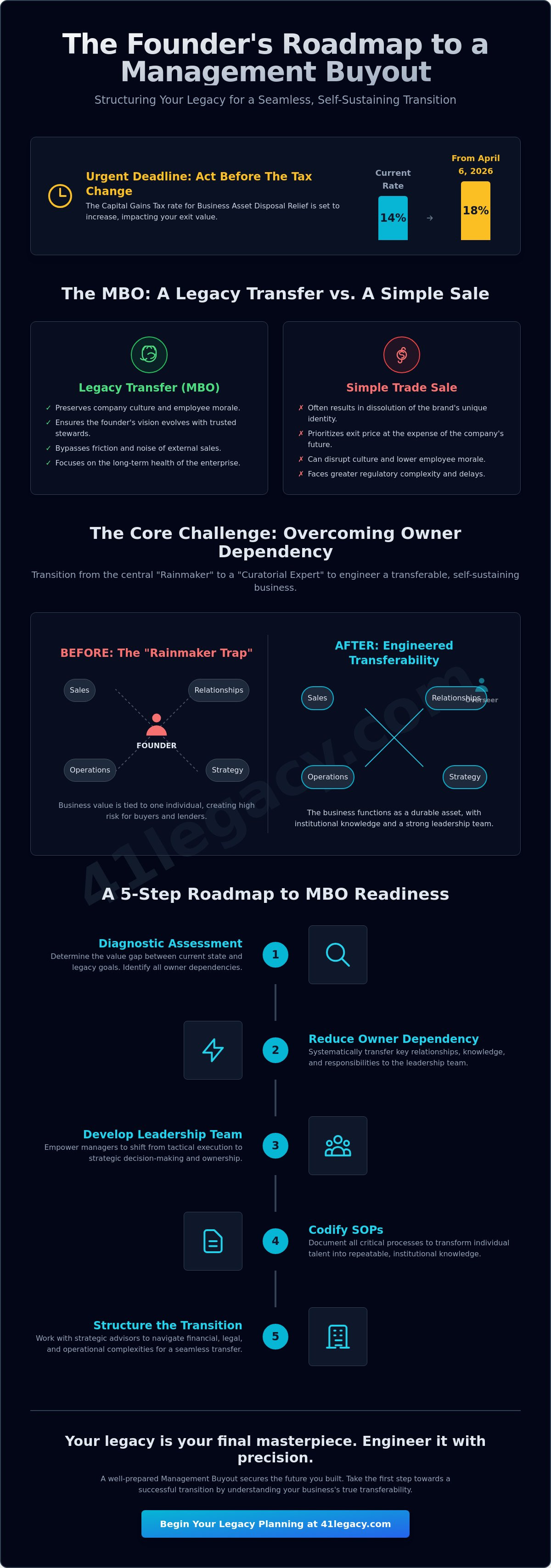
A management buyout is not a mere exit strategy; it's the final masterpiece of a founder's career. You've spent years meticulously assembling a team and a culture, yet the transition often feels fraught with the risk of mechanical failure. Understanding how to prepare your business for a management buyout requires shifting your perspective from owner-operator to that of a strategic steward. With the Capital Gains Tax rate for Business Asset Disposal Relief set to increase from 14% to 18% on April 6, 2026, the urgency to structure this legacy with precision has never been greater.
It's natural to worry that your company might lose its momentum once your hands leave the wheel. This guide provides the clarity needed to transform your business into a self-sustaining asset that functions independently of any single individual. We'll examine the diagnostic tools and value growth roadmaps necessary to minimize risk for both you and your successors while securing the long-term health of the enterprise.
Key Takeaways
- Learn to engineer transferability by reducing owner dependency, ensuring the business functions as a self-sustaining asset that thrives independently of the founder.
- Discover how to prepare your business for a management buyout by utilizing enterprise diagnostics to bridge the gap between current value and your long-term legacy goals.
- Establish a baseline for transition success with a structured readiness assessment that evaluates your leadership team's capacity to uphold the company’s standards.
- Navigate the complexities of internal transition with a value growth roadmap that provides strategic clarity and a disciplined timeline for a seamless transfer of stewardship.
What is a Management Buyout and Why Does Preparation Matter?
A management buyout represents the intentional transition of ownership from a founder to the leadership team already embedded within the company culture. At its core, What is a Management Buyout? It is the ultimate act of stewardship. This process is more than a financial event; it's the preservation of an enterprise's soul. While a trade sale often results in the dissolution of a brand's unique identity, an MBO ensures the evolution of a legacy through trusted stewards who already understand the company's DNA.
True craftsmanship requires foresight. Understanding how to prepare your business for a management buyout means moving beyond the transactional mindset. It involves engineering the business to be a transferable asset that functions with mechanical precision. Without this preparation, the transition risks collapsing under the weight of owner dependency. A "legacy transfer" focuses on the long-term health of the enterprise, whereas a simple "sale" often prioritizes the exit price at the expense of the company's future.
The Advantages of an Internal Legacy Transfer
Internal transitions protect the most delicate parts of a business: its culture and employee morale. By elevating familiar leadership, you maintain the "rhythm" of the shop floor or the office. This path also reduces the friction found in external sales. For instance, a trend identified in November 2025 shows more states adopting pre-merger notification laws, which can complicate external trades. An MBO bypasses much of this regulatory noise. It allows the founder's vision to persist through individuals who have already proven their commitment to the brand's uncompromising standards.
Common Pitfalls of Unprepared MBOs
The most frequent failure point is the "Rainmaker Trap." If the owner is the primary driver of sales or key relationships, the business lacks the strategic capacity to survive their departure. Operational fragility is another silent killer. Without documented SOPs and meticulous enterprise diagnostics, the business is untransferable. Financial misalignment also poses a significant threat. If the management team cannot secure funding because the business appears too risky, the deal stalls. With the Capital Gains Tax rate for Business Asset Disposal Relief increasing to 18% on April 6, 2026, an unprepared or delayed exit can also become a significantly more expensive endeavor for the founder.
Success requires a disciplined approach to owner dependency reduction. By identifying these gaps early, you transform the business from a personal project into a durable, transferable asset at 41 Legacy.
Engineering Transferability: Reducing Owner Dependency
The most sophisticated machinery is useless if only one person knows how to operate it. When founders ask how to prepare your business for a management buyout, the answer lies in the meticulous reduction of owner dependency. The core of exit readiness is building a business that doesn't need you to show up for it to thrive. You must transition from being the "Rainmaker," the primary source of revenue and relationships, to being a "Curatorial Expert" who oversees the standards without performing the labor. This shift is essential because lenders in 2026 are placing greater scrutiny on the financial health of private credit borrowers. They seek transparency and stability that a single-owner-dependent firm cannot provide. Engineering Transferability: Reducing Owner Dependency ensures the enterprise is viewed as a durable asset rather than a personal service.
Developing the Next Generation of Stewards
Transformation begins with a shift in authority. Managers must move from tactical execution to strategic decision-making. This evolution is not instantaneous; it requires a gradual transition to test the team's capacity within a structured Value Growth Roadmap. By stepping back, the founder identifies "Key Person Risk" before it becomes a hurdle for lenders. In a market where private credit spreads are anticipated to stabilize or widen through 2026, demonstrating a deep bench of leadership is a prerequisite for favorable terms. Conducting a strategic capacity evaluation is the first step in ensuring your team can carry the weight of the enterprise's future.
Standard Operating Procedures as the Blueprint of Value
Documented SOPs serve as the engineering specifications for a high-value enterprise. They transform individual talent into institutional knowledge. Precision in documentation ensures that critical processes, those driving the majority of enterprise value, are repeatable without the founder’s intervention. This creates a "turnkey" environment, allowing the management team to confidently approach financing with a clear understanding of operational mechanics. When the business operates as a precise, independent machine, it ceases to be a job and becomes a transferable legacy. This level of uncompromising detail is what separates a chaotic exit from a seamless transition of stewardship.
Diagnostic Assessment: Determining the Value Gap
Before a single document is signed, the enterprise must undergo a rigorous inspection. Enterprise diagnostics serve as the forensic analysis of a company's internal mechanics, revealing the true health of the operation beyond the profit and loss statement. When considering how to prepare your business for a management buyout, you must first identify the "Value Gap." This is the discrepancy between the business's current worth and the financial threshold required for the founder to successfully transition. Closing this gap is not a matter of luck; it's a matter of engineering. A high-performance business, much like a vintage engine, requires every component to be polished to a high sheen before it can be trusted to a new operator.
Beyond the EBITDA Multiple
Traditional valuations often rely on stagnant multiples that fail to capture the "intangible soul" or the specific risks of a business. Strategic capacity acts as a multiplier here. If the management team can demonstrate they're ready to scale without the founder, the enterprise value increases significantly. For those seeking external financing, a diagnostic report is a vital tool. As of March 30, 2026, the maximum loan amount for an SBA 504 loan stands at $5.5 million. Presenting a meticulous diagnostic to lenders proves the business is a low-risk, high-transferability asset capable of servicing debt at the current average fixed-rate of 7.2% as reported in late 2025.
Aligning the Management Team on Value
Transparency builds the foundation of a successful internal transition. The management team must understand the roadmap to future growth to feel confident in their investment. A shared understanding of the Value Gap prevents friction during negotiations. By utilizing a structured Exit Readiness Assessment, you establish a fair and defensible price based on data rather than emotion. This alignment ensures the buyers aren't just taking over a job. Instead, they're stepping into the role of stewards for a high-performance machine that's built to last. A clear roadmap provides the management team with the strategic clarity they need to commit to the evolution of the brand.
A 5-Step Roadmap to Structuring the MBO
The transition of a high-performance business is a deliberate sequence of engineering steps. When you evaluate how to prepare your business for a management buyout, the roadmap must be structured with the same precision as a mechanical restoration. It begins with an Exit Readiness Assessment to establish an uncompromising baseline of current health. This is followed by the implementation of a Value Growth Roadmap to bridge the gap between present value and the founder's legacy requirements. Once the asset is engineered for transfer through Owner Dependency Reduction, the focus shifts to the structural harmony of the deal itself. Finally, the founder transitions the "Quarterback" role, handing over the strategic stewardship to the new management team.
Structuring the Financial Harmony
The financial structure of a legacy transfer requires a balanced harmony of components. Seller financing, often in the form of a Seller Note, serves as a powerful declaration of confidence in the company's future. It signals to external lenders that the founder believes in the team's ability to maintain the soul of the enterprise. Balancing these notes with senior debt is critical; the company's cash flow must remain healthy enough to sustain evolution. As of Q2 2025, the average business loan interest rate for fixed-rate term loans is approximately 7.2%. For MBOs involving the purchase of shares, you must also account for the 0.5% stamp duty on the transaction value. Identifying financing partners who respect the nuances of internal transitions is essential for a seamless handover. Our Monthly Implementation Support ensures that these financial milestones are met with meticulous accuracy.
The Legal and Strategic Handover
Coordinating the transition requires a unified vision among your professional advisors. CPAs and attorneys must work in concert to ensure the deal remains tax-efficient, especially with the Capital Gains Tax rate for Business Asset Disposal Relief increasing to 18% on April 6, 2026. A documented "Legacy Plan" is the blueprint used to communicate this evolution to clients and vendors, ensuring the brand's reputation remains untarnished. You must also define your post-exit role with surgical clarity. Whether you choose to remain as an Advisor, hold an Emeritus status, or execute a complete exit, the decision must prioritize the enterprise's long-term health. Understanding how to prepare your business for a management buyout means ensuring that by the time the final document is signed, the management team is already operating with the confidence of owners.
Coordinating the Legacy: The Role of Strategic Advisory
A management buyout is a high-performance machine with many moving parts. Each professional advisor, from your CPA to your attorney, focuses on a specific component. Without a "Quarterback" to align these disparate efforts, the process risks tactical derailment or emotional fatigue. At 41 Legacy, we act as the guardian of the process. We ensure that every strategic decision serves the ultimate goal of transferability. Understanding how to prepare your business for a management buyout requires more than just technical skill; it demands a disciplined rhythm of execution. Our monthly implementation support provides the steady hand needed to keep the roadmap on course. This allows the business owner to move from the daily pressure of operations into the role of a steward. You are building an asset designed to thrive independently, preserving the soul of the company while securing its future evolution.
The Coordinated Advisory Team
We don't replace your trusted professional advisors. We enhance their effectiveness. By collaborating closely with your existing CPA and attorney, we ensure that the value growth roadmap is executed with surgical precision. This unified approach reduces the significant burden on the owner during what is often an intensive two to three year preparation phase. Our role is to ensure all tactical steps, from enterprise diagnostics to owner dependency reduction, align with the final strategic goal. This coordination is particularly vital given the tax changes effective in 2026, such as the reversion of AMT exemption thresholds. We provide the strategic clarity that allows your legal and tax experts to work within a defined, high-value framework.
Securing Your Life's Work
Building a legacy takes decades of uncompromising dedication. Protecting that legacy shouldn't be left to chance or a rushed transaction. A meticulous, unhurried transition provides the peace of mind that your life's work will endure in the hands of those you've trained. By 2026, the complexity of state-level pre-merger laws and shifting tax thresholds makes a coordinated approach more than a luxury; it is a necessity for risk mitigation. We protect enterprise value for both the founder and the successors, ensuring the company remains a living entity with its story intact. This is the final intersection of art and engineering in a founder's career. Begin your journey toward a seamless transition by exploring our Exit Readiness Assessment.
Cementing Your Legacy Through Strategic Stewardship
The transition from owner-operator to emeritus steward is the most significant evolution an entrepreneur will ever undertake. By focusing on transferability engineering and meticulous owner-dependency reduction, you ensure the enterprise remains a durable asset. Success in this arena isn't found in a single transaction; it's the result of a disciplined process that addresses the value gap through enterprise diagnostics. Understanding how to prepare your business for a management buyout allows you to protect the soul of the company while providing your leadership team with a clear path to ownership.
At 41 Legacy, our advisory is led by a Certified Exit Planning Advisor (CEPA) who specializes in the high-stakes intersection of art and engineering. We provide a structured Value Growth Roadmap designed to strengthen the enterprise’s health and minimize risk for all parties involved. You've spent years building a masterpiece; now is the time to ensure its preservation for the next generation of stewards. Secure your legacy with an Exit Readiness Assessment. The future of your business deserves the same uncompromising standard of excellence you've applied to its growth.
Common Questions Regarding Management Transitions
How long does it typically take to prepare for a management buyout?
A meticulous preparation period typically spans 24 to 36 months. This duration allows for the gradual reduction of owner dependency and the implementation of a structured Value Growth Roadmap. Rushing this process risks operational failure. Given that the Capital Gains Tax rate for Business Asset Disposal Relief increases on April 6, 2026, many founders are initiating this two year sequence now to ensure the enterprise is a stable, transferable asset before the final handover.
Can a management team buy a business if they don't have the cash up front?
Management teams rarely possess the full purchase price in liquid capital. Instead, the transition is engineered through a combination of senior debt, seller notes, and a small equity contribution from the leadership. As of late 2025, SBA 504 loans offer a maximum of $5.5 million for such transitions. Seller financing demonstrates your confidence in the company's soul, making the business more attractive to external lenders who seek to minimize their risk.
What is the difference between an MBO and an ESOP?
A management buyout transitions ownership to a specific group of leaders, while an Employee Stock Ownership Plan (ESOP) distributes ownership broadly across the entire workforce. MBOs are often preferred by founders who wish to entrust their legacy to a small circle of proven stewards. This path offers more strategic clarity and a direct evolution of the founder's vision, whereas an ESOP is a more complex, regulated retirement plan structure.
How does reducing owner dependency increase the value of the business?
Reducing owner dependency transforms the business from a personal project into a durable, independent asset. When you learn how to prepare your business for a management buyout, you are essentially de-risking the enterprise for lenders and successors. A business that functions with mechanical precision without the founder's daily intervention commands a higher multiple. This transferability engineering ensures the company's value is rooted in its systems rather than a single individual's relationships.
What happens if the management team isn't ready to take over yet?
If the leadership team lacks the necessary strategic capacity, the transition should be paused to focus on mentorship and system refinement. We utilize a Strategic Capacity Evaluation to identify these specific leadership gaps before they can derail a legacy. It's better to delay the transition than to hand over the keys to a team that isn't prepared to maintain the uncompromising standards of the enterprise. This unhurried approach protects the long-term health of the brand.
Is a management buyout better than selling to an external competitor?
An MBO is often the superior path for founders who prioritize the preservation of their company's culture and heritage. External sales frequently lead to the absorption of the brand and the dismissal of long-term staff. By understanding how to prepare your business for a management buyout, you ensure that the soul of the company remains intact. This path offers the founder the unique satisfaction of seeing their life's work continue through the stewards they have personally cultivated.
Disclaimer
This article is for educational and informational purposes only and does not provide legal, tax, investment, or business brokerage advice. 41 Legacy does not offer M&A brokerage services, legal document drafting, tax preparation, or investment advisory services. Business owners should consult licensed professionals in those disciplines before making decisions related to business transactions, legal matters, tax strategy, or financial planning. All examples are illustrative and may not apply to your specific situation.