
Strategic Capacity Evaluation for Business Growth: Building a Transferable Legacy
What if the very engine of your success has become the primary obstacle to your company’s enduring value? Many founders discover that while their sales are high, the enterprise remains tethered to their personal presence, creating a fragile architecture that limits true worth. You've likely felt this exhaustion, the quiet realization that your business hasn't yet reached its full potential. A strategic capacity evaluation for business growth is the essential first step to identifying whether your organization is a sovereign asset or merely a reflection of your own stamina.
You deserve to see your life's work evolve into a living entity that breathes without your constant intervention. This article reveals how to transform your operational potential into a high-value, transferable asset that thrives independently of your daily involvement. We'll explore the mechanics of transferability engineering and the role of enterprise diagnostics in reducing owner-dependency. You'll gain a clear roadmap to increase enterprise value, ensuring your legacy is preserved with the same meticulous precision you brought to its creation.
Key Takeaways
- Understand why traditional financial metrics often fail to capture the true potential of a legacy business and why strategic capacity is the ultimate measure of scalability.
- Learn how to conduct a strategic capacity evaluation for business growth to identify the specific operational and leadership bottlenecks that suppress enterprise value.
- Discover the "Rainmaker Paradox" and how transitioning from a founder-led model to a sovereign asset significantly reduces risk for future successors.
- Explore the mechanics of Transferability Engineering to transform your daily operations into a high-value, independent entity with its own story.
- Gain a clear roadmap for utilizing Enterprise Diagnostics to benchmark your firm’s readiness for a successful internal or external transition.
Defining Strategic Capacity: The Essence of Enterprise Value
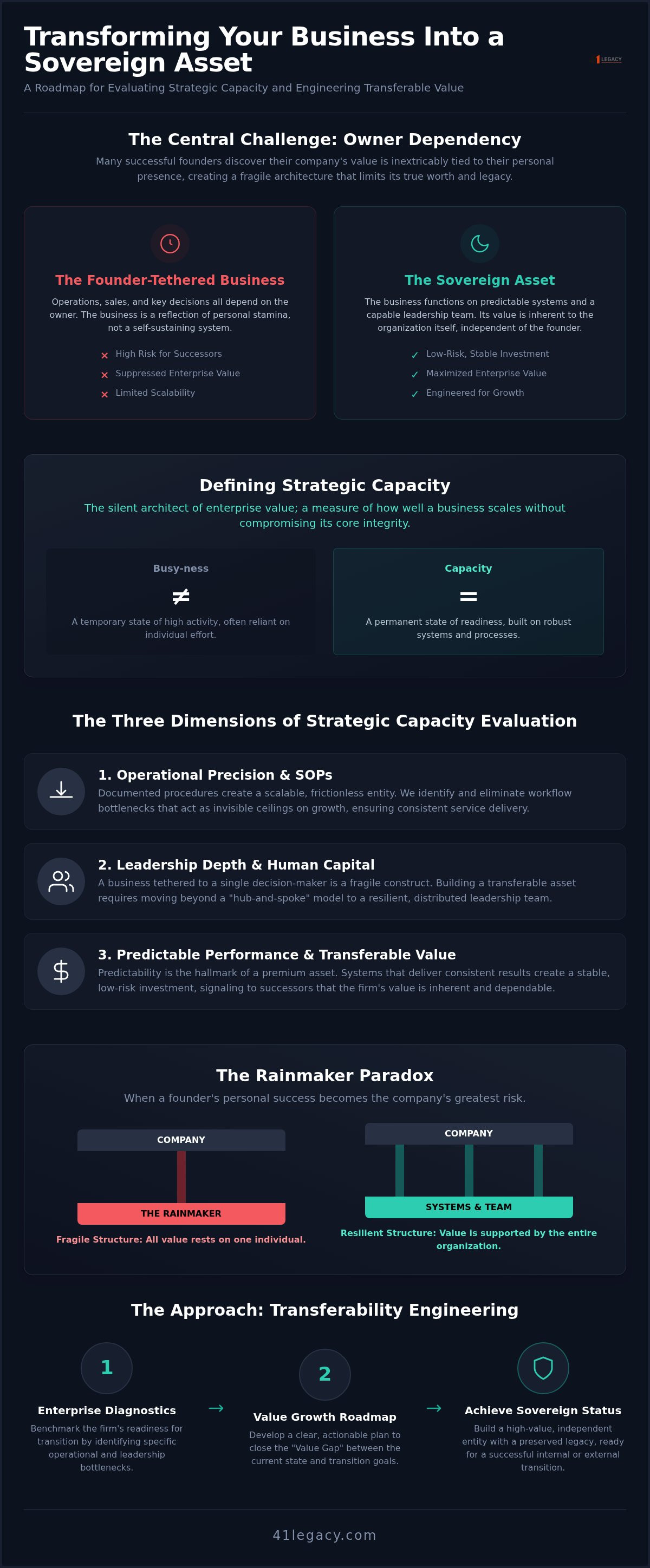
Strategic capacity is the silent architect of enterprise value. It represents the inherent strength of an organization’s skeleton, defining how much weight the structure can bear before it begins to fracture. While many owners mistake a packed calendar for progress, true capacity is the measure of how well a business scales without compromising its core integrity. A strategic capacity evaluation for business growth provides the diagnostic clarity needed to see beyond the surface of daily operations and into the actual potential of the firm.
Financial metrics, while necessary, often fail to capture the true potential of a legacy business. A balance sheet might show robust sales, but it won't reveal if those sales are entirely dependent on the founder's personal charisma or technical skill. This distinction between "busy-ness" and genuine capacity is vital. Busy-ness is a temporary state of high activity; capacity is a permanent state of readiness. At 41 Legacy, we view capacity as the foundation for a transferable asset, ensuring the business is a sovereign entity rather than a personal job for the owner.
Capacity as a Living Infrastructure
We choose to visualize the business as a masterpiece of engineering rather than a collection of mundane tasks. Every system, process, and leadership role acts as a structural beam in a living infrastructure. When these elements are designed with extreme precision, they eliminate the growth ceilings that often stifle mid-market firms. A guardian of history must first be a master of current capacity, ensuring that the inner essence of the firm is protected through rigorous strategic planning. This approach transforms the organization into an asset that possesses its own story and strength, independent of any single individual.
The Value of Predictable Performance
Predictability is the hallmark of an unapologetically premium asset. When a business builds systems that deliver consistent results regardless of external volatility, it achieves a rare level of harmony. This predictable performance serves as the heartbeat of enterprise value, signaling to future successors that the firm is a stable, low-risk investment. Transitioning from reactive management to proactive stewardship allows the owner to step back and observe the business as a curator would a private collection. It's a shift from working in the machine to refining the machine's design, ensuring its impact lasts well beyond the current generation.
The Three Dimensions of Strategic Capacity Evaluation
A rigorous strategic capacity evaluation for business growth requires a three-dimensional lens that looks beyond simple headcount or inventory. We view the enterprise as a complex, interlocking mechanism where every part must contribute to a singular, harmonious purpose. To build a legacy that survives the transition of its founder, an owner must assess the firm’s structural integrity across three distinct areas: operational excellence, human capital depth, and transferable value. This comprehensive approach ensures the business is not just growing, but maturing into a sovereign asset.
Evaluating these dimensions allows a steward to identify the "Value Gap." This is the discrepancy between the business's current operational state and the financial milestones required for a successful future transition. In the 2026 mid-market landscape, where EBITDA multiples are increasingly tied to independent performance, closing this gap is a prerequisite for any owner seeking to maximize their enterprise’s worth. By conducting these diagnostics early, you ensure the firm is engineered for resilience rather than merely surviving on the founder's stamina.
Operational Precision and SOPs
Documented procedures are the rhythmic pulse of a high-value firm. When systems are designed with mechanical excellence, they create a scalable entity that functions without friction. Through our Enterprise Diagnostics, we identify the specific friction points in your current workflow that act as invisible ceilings on your growth. Technical precision in these operations is the first step toward building a lasting legacy. It ensures that the "inner essence" of your service remains consistent, regardless of who is at the helm.
Leadership Depth and Talent Development
A business tethered to a single decision-maker is a fragile construct. To build a transferable asset, one must move beyond the restrictive "hub-and-spoke" model where all paths lead back to the owner. This requires empowering a leadership team that shares a unified vision and executes with surgical precision. Sustainable futures are built on deliberate talent development. By cultivating a team of specialists who are aligned with the firm's core philosophy, you transform the organization into a living entity capable of thriving independently. Owners often find that beginning with a Value Growth Roadmap is the most effective way to align their team with these long-term objectives.
Recent data from 2026 indicates that 86% of organizations now perform capacity forecasting regularly, yet only 6% believe their current capabilities are "extremely effective." This highlights a significant opportunity for those willing to move beyond basic forecasting and into true Transferability Engineering. When you evaluate capacity through this lens, you aren't just planning for more work; you are engineering a masterpiece of business design that is built to be transferred.
The Rainmaker Paradox: Why Your Success May Be Your Greatest Risk
The founder's brilliance often masks a structural fragility that remains invisible until the moment of transition. While you may be the firm's most gifted artisan or its most persuasive voice, this very excellence creates a profound Transferability Risk. A strategic capacity evaluation for business growth reveals whether your firm is a masterpiece of independent engineering or merely an extension of your own persona. If the inner essence of the work cannot be replicated without your direct touch, the enterprise value remains stagnant despite high sales figures.
Shifting the narrative from "I am the business" to "I am the steward of the business" is a philosophical and technical necessity. High-performing owners unintentionally create a bottleneck where every critical decision and relationship flows through them. This devalues the enterprise because a successor is not looking to buy your talent; they are looking to acquire a sovereign asset that performs perfectly in your absence. True growth requires the humility to replace your own presence with the precision of a well-crafted system.
Identifying the Owner-Dependency Trap
There are subtle signs that your business cannot breathe without your constant presence. When decisions stall in your absence or clients demand your personal intervention, the organization has reached its growth ceiling. In the sophisticated market of 2026, owner-dependency acts as a significant drag on market attractiveness and buyer confidence. Owner Dependency is the quantifiable risk factor in 2026 that measures the percentage of enterprise value lost when the founder’s personal goodwill and daily involvement are removed from the operation. Recognizing this trap is the first step toward reclaiming your role as a curator of value rather than a prisoner of production.
Engineering the Exit from Daily Operations
True stewardship requires a deliberate and clinical retreat from the company's daily mechanics. This is not a withdrawal of interest, but an elevation of focus. You must transition from being the engine to being the designer. This transformation involves a meticulous assessment of your footprint and the creation of a Value Growth Roadmap that prioritizes delegation and autonomous systems. By refining these systems with surgical precision, you ensure the business thrives as a living entity with its own story. You can explore how to reduce owner dependency through our strategic advisory, allowing you to secure a legacy that is both impactful and entirely transferable.
Conducting Your Strategic Capacity Evaluation: A Framework for Owners
A strategic capacity evaluation for business growth is a clinical examination of your firm’s structural integrity. It is the moment where we move beyond the abstract and into the granular details of your organization's mechanics. This process begins with a comprehensive look at the "inner essence" of the firm, identifying where strength is concentrated and where fragility hides. By initiating a structured Enterprise Diagnostic, you gain the clarity needed to see your business as a potential successor or buyer would: as a collection of systems, assets, and risks.
Benchmarking these findings against current 2026 industry standards allows us to quantify your firm’s readiness for transition. We look specifically at EBITDA multiples and how they are influenced by independent operational performance. This objective analysis identifies the "Value Gap," the distance between your current enterprise worth and the financial peak required to secure your desired lifestyle or legacy. Closing this gap requires a coordinated effort, where we act as the "Quarterback" to align your existing team of professional advisors, including CPAs and attorneys, toward a singular strategic objective.
The Diagnostic Phase: Uncovering the Truth
Emotional attachment often clouds an owner’s judgment of their firm’s true health. Our diagnostic phase utilizes data-driven assessments to move past these sentiments and uncover the operational reality. We evaluate your current assets, intellectual property, and market position with surgical precision. Objective, third-party insight is essential here; it provides the unvarnished truth necessary to build a resilient future. Without this clarity, any attempt at expansion is built on a foundation of assumptions rather than verified capacity.
Accountability and Implementation
Diagnostic results are only as valuable as the actions they inspire. We transform these insights into a structured Value Growth Roadmap, supported by monthly implementation guidance. This ensures that the roadmap isn't just a document on a shelf, but a living guide for your leadership team. The role of the "Quarterback" is to ensure every tactical move is executed with precision, maintaining the momentum needed for long-term transformation. Consistent execution builds the bridge to a successful transition, turning a founder-led company into a sovereign, high-value asset.
In 2026, 79% of organizations rate their forecasting capabilities as only "somewhat effective." We refuse to settle for such a low standard. By integrating strategic capacity into your broader planning, you ensure that your growth is sustainable and your legacy is protected. This is the rare intersection of technical engineering and creative stewardship, where your business finally begins to tell its own story of excellence.
Transferability Engineering: The 41 Legacy Approach to Growth
At 41 Legacy, we view a business as more than a source of current income; it's a legacy in the making, deserving of the same reverence as a fine work of art. Our approach, known as Transferability Engineering, integrates the findings of a strategic capacity evaluation for business growth into a comprehensive Exit Readiness Assessment. This ensures that every operational refinement serves a dual purpose: enhancing current performance and securing future transferability. We don't believe in growth for growth's sake. We build businesses that are built to be transferred, utilizing an unhurried craftsmanship that aligns your personal aspirations with the firm’s financial and operational mechanics.
Our Value Growth Roadmap acts as the master blueprint for this evolution. It harmonizes your personal, financial, and business goals into a single, cohesive strategy. As the enterprise matures through this process, it becomes increasingly independent of its founder, shifting from a person-centric model to a system-centric masterpiece. This meticulous planning ensures that the "inner essence" of your work is preserved, allowing the business to thrive as a sovereign entity long after your daily involvement has ceased.
The Role of the Strategic Advisory Quarterback
A masterpiece requires a conductor to ensure every note is played in harmony. Most owners find themselves exhausted by the effort of coordinating their CPA, Attorney, and Wealth Advisor. Each professional offers valuable, yet often fragmented, pieces of the puzzle. As your Strategic Advisory Quarterback, we provide a single point of coordination, ensuring that every piece of professional advice is aligned toward the singular goal of increasing enterprise value. We protect your time by handling the intricacies of this coordination, allowing you to focus on high-level stewardship while we oversee the precision of the roadmap’s execution.
Your Path to a Transferable Asset
The transition from business owner to successful exit-ready steward is a profound shift in identity. It requires moving from the center of the machine to a position of curatorial oversight. The most opportune time to evaluate your firm’s capacity is years before you intend to step away. This allows for the thoughtful planning required to refine systems and develop leadership depth without the pressure of a looming deadline. By treating your business as a living entity with its own story, you ensure its preservation for the next generation. You can begin your Enterprise Diagnostic with 41 Legacy today and witness the transformation of your life's work into an enduring, transferable legacy.
Engineering Your Sovereign Legacy
Your business is a masterpiece that deserves to survive its creator. We've explored how a strategic capacity evaluation for business growth serves as the clinical foundation for this transformation. By identifying the Value Gap and addressing owner-dependency, you move from being the engine of the firm to its master curator. This process isn't just about operational efficiency; it's about honoring the essence of your life's work by ensuring it can thrive as an independent entity.
Led by a Certified Exit Planning Advisor (CEPA), 41 Legacy brings national expertise in enterprise diagnostics to help you navigate this transition with surgical precision. We specialize in reducing owner-dependency and engineering transferability into every process. Now's the time to elevate your perspective and prepare for a future that reflects your highest standards of excellence. Secure your legacy and begin your Value Growth Roadmap today. Your firm has a story to tell; let's ensure it continues for generations to come.
Frequently Asked Questions
What is the difference between strategic capacity and operational capacity?
Strategic capacity represents the structural architecture required for future expansion, whereas operational capacity focuses on the firm's ability to meet current demand. While operational capacity measures output, strategic capacity evaluates the maturity of your leadership and the scalability of your systems. It's the difference between having enough hands for today's work and having an organization engineered to sustain growth without the founder's constant intervention.
How long does a strategic capacity evaluation typically take?
A comprehensive diagnostic process typically requires several weeks of unhurried examination to uncover the firm's true potential. This timeline allows our specialists to conduct a deep audit of your systems, leadership alignment, and transferable assets. We don't believe in superficial checklists. Instead, we take the time necessary to ensure the evaluation provides a precise roadmap for your enterprise’s long-term health and eventual transition.
Can a business be too dependent on its owner to ever be sold?
A business can indeed become so tethered to its founder that it loses its market attractiveness. If every critical relationship and decision flows through you, the enterprise lacks the sovereign strength required for a successful transfer. Our Transferability Engineering focuses on decoupling the firm’s value from your personhood. This transformation ensures the business thrives as a living entity, making it a high-value asset for any future successor.
What are the first signs that my business has reached its growth ceiling?
The primary indicator of a growth ceiling is the founder becoming the organization's most significant bottleneck. You'll notice that decisions stall when you're absent and your leadership team lacks the autonomy to execute the vision. Another sign is stagnant enterprise value even as sales increase. These friction points suggest that your current infrastructure has reached its mechanical limit and requires a structural redesign to support further expansion.
How do SOPs directly impact the enterprise value of my company?
Documented procedures are the rhythmic heartbeat of a transferable asset. SOPs ensure that the inner essence of your work is performed with surgical precision, regardless of who is at the helm. By creating predictable, repeatable results, you significantly reduce the perceived risk for a future owner. This mechanical excellence is what transforms a personal job into a high-value enterprise that commands respect in the marketplace.
Why should I involve my CPA and attorney in a capacity evaluation?
A strategic capacity evaluation for business growth is most effective when it functions as a coordinated symphony of professional advice. Your CPA and attorney hold the technical data essential for measuring risk and structural integrity. We act as the Quarterback, aligning these specialists toward the singular goal of increasing your enterprise value. This collaborative approach ensures that every strategic move is both legally sound and financially optimized for your legacy.
What is a Value Gap, and how is it measured during an evaluation?
The Value Gap represents the discrepancy between your firm’s current worth and the financial peak required to secure your future goals. We measure this gap through a structured Enterprise Diagnostic, analyzing your operational capacity and market position. By quantifying this distance, we can create a clear Value Growth Roadmap. This roadmap provides the tactical steps needed to bridge the gap and ensure your business matures into a high-value, transferable asset.
Does strategic capacity evaluation apply to service-based businesses?
Strategic capacity is arguably more critical for service-based firms where value is often concentrated in intangible assets. A strategic capacity evaluation for business growth helps these organizations institutionalize their expertise and intellectual property. By engineering systems that don't rely on the founder's personal charisma, service businesses can transform their daily operations into a scalable infrastructure. This ensures the firm's impact and story continue long after the founder's departure.

Article by
Mike Laskowski
Mike Laskowski is a Business Value Growth Strategist who helps business owners uncover the truths that drive their performance, risk, and readiness. Blending forensic interviewing from a 26‑year federal career with Strategic Capacity analysis and CEPA methodology, he works upstream to reduce owner dependency, increase transferability, and strengthen enterprise value. Mike guides founders through clarity, operational evolution, and transition readiness so their companies become transferable, owner‑independent assets that endure beyond the founder.
Disclaimer
This article is for educational and informational purposes only and does not provide legal, tax, investment, or business brokerage advice. 41 Legacy does not offer M&A brokerage services, legal document drafting, tax preparation, or investment advisory services. Business owners should consult licensed professionals in those disciplines before making decisions related to business transactions, legal matters, tax strategy, or financial planning. All examples are illustrative and may not apply to your specific situation.