
Strategic Advisor vs. M&A Advisor: Engineering Value Before the Transaction
The architect who designs a masterpiece is seldom the same curator who eventually handles its auction. When considering the path toward a transition, many owners conflate the roles of the strategic advisor vs m&a advisor, yet these disciplines operate on entirely different planes of the business lifecycle. You likely feel the immense weight of decades of effort and worry that a hasty transaction might leave your legacy undervalued. It's a valid concern; many enterprises are built as high-level jobs for their founders rather than transferable assets that can thrive in a new era.
We believe a business should be treated as a fine work of engineering, polished until its inner essence is visible to any sophisticated observer. This article reveals the critical distinctions between those who facilitate a sale and those who engineer the ultimate transferability of your life's work. You'll discover a clear roadmap for assembling a coordinated advisory team. This ensures your company becomes a resilient asset that commands respect and value well before the first letter of intent arrives. By shifting your focus from the transaction to the engineering of the asset itself, you transform your role from a daily operator to a steward of lasting value.
Key Takeaways
- Understand the fundamental difference between a strategic advisor vs m&a advisor to ensure you prioritize enterprise value growth before entering a transaction.
- Learn how to identify and close the "Value Gap" by focusing on the specific drivers that make a business attractive to sophisticated successors.
- Reduce owner dependency through deliberate engineering, evolving your business from a personal job into a transferable and autonomous asset.
- Master the art of coordinating your professional advisory team to eliminate silos and ensure every legal or financial decision supports your ultimate legacy.
- Gain a clear roadmap for utilizing enterprise diagnostics and implementation support to protect the health and longevity of your firm.
Defining the Roles: Strategic Advisor vs. M&A Advisor
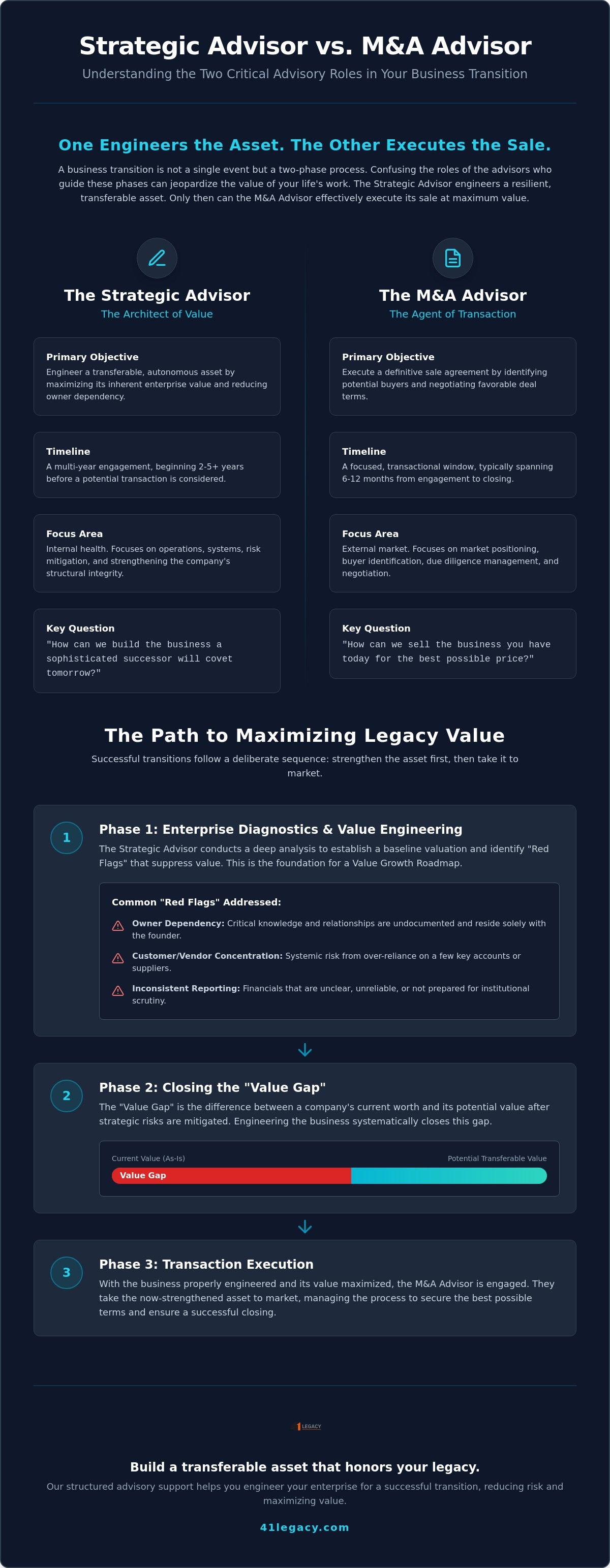
The journey from a founder led business to a transferable legacy requires two distinct types of mastery. While often confused, the distinction between a strategic advisor vs m&a advisor is the difference between the architect who strengthens a building’s foundation and the agent who lists it on the market. One focuses on the inherent integrity of the structure; the other focuses on the finality of the exchange. A Strategic Advisor acts as a guardian of enterprise value and legacy, ensuring the business is a living asset capable of flourishing beyond its origin.
We view the enterprise not as a collection of spreadsheets, but as a work of art that requires careful restoration before it's ready for a new gallery. While their timelines might overlap, their core objectives serve different stages of the business lifecycle. The M&A advisor sells the business you have today. The Strategic Advisor engineers the business that a successor will covet tomorrow. This distinction is the catalyst for maximizing the impact of your life's work.
The Mandate of the M&A Advisor
The M&A advisor is a specialist of the moment. Their expertise lies in the technical mechanics of Mergers and acquisitions, operating within a specific transaction window that typically spans six to twelve months. They excel at market positioning, identifying potential suitors, and the rigorous negotiation of deal terms. Their success is measured by the execution of a definitive agreement. It's a vital role, yet it's inherently reactive to the current market appetite rather than the internal health of the enterprise.
The Mandate of the Strategic Advisor
In contrast, the Strategic Advisor operates with a sense of unhurried precision. Their work begins years before a transaction is even contemplated. Through Enterprise Diagnostics and a Value Growth Roadmap, they focus on internal refinement and risk mitigation. This role is about transferability engineering. They seek to reduce owner dependency, ensuring the business isn't just a high paying job but a standalone entity. While the M&A professional seeks a buyer for the business you have, the Strategic Advisor builds the business a buyer actually wants.
These roles don't exist in competition; they exist in sequence. The Strategic Advisor prepares the canvas, ensuring it's worthy of the master's signature. Only then does the M&A advisor step in to showcase the work to the world. Understanding this hierarchy is the first step in protecting what you've built at 41 Legacy.
The Artisan Approach to Enterprise Value Growth
Enterprise value is often misunderstood as a static figure on a balance sheet. In truth, it is the measure of a company’s transferability. A business that depends entirely on its founder’s intuition and presence is not a transferable asset; it is a meticulously crafted job. To move beyond this limitation, an owner must embrace a philosophy of refinement that looks past the immediate transaction. This is the stage where the distinction between a strategic advisor vs m&a advisor becomes most apparent. While an M&A advisor accepts the business as it currently exists, we seek to refine the essence of the enterprise until it can stand independently of its creator.
Most owners face a significant "Value Gap." This is the discrepancy between what the business is worth today and the capital required to fund their next chapter or preserve their legacy. Closing this gap requires a refusal to settle for surface level financial statements. It demands an investigation into the hidden gears of the organization. Transitioning from a lifestyle business to a transferable asset requires surgical precision, ensuring that every operational component is polished to a high sheen.
Enterprise Diagnostics: The First Step
The engineering of value begins with Enterprise Diagnostics. This process is not a mere audit; it is a structural analysis across financial, structural, and cultural dimensions. We identify the "Red Flags" that would cause a sophisticated successor to hesitate or demand a lower price. These often include:
- High customer or vendor concentration that creates systemic risk.
- Owner dependency where critical knowledge is not documented or shared.
- Inconsistent financial reporting that obscures the true health of the firm.
By establishing a baseline valuation through these diagnostics, we create the foundation for a targeted strategy. You can begin this process of discovery by exploring our Enterprise Diagnostics to see exactly where your foundation stands today.
The Value Growth Roadmap
Once the diagnostics are complete, we architect a Value Growth Roadmap. This is a structured plan designed to increase EBITDA and the valuation multiple simultaneously. We prioritize initiatives that reduce owner dependency and increase strategic capacity. This ensures the business isn't just profitable, but autonomous. To prevent this roadmap from becoming shelf ware, we provide Monthly Implementation Support. This steady, unhurried rhythm of improvement ensures that the transformation is both deep and lasting, preparing the enterprise for a future that honors its history while embracing its potential.
Transaction vs. Transformation: A Comparison of Objectives
The distinction between a transaction and a transformation is found in the intent of the architect. Transactional work is inherently reactive, responding to the shifting tides of the market to find a suitable exit point. Transformation is proactive. It is the deliberate act of refining an enterprise until its value is undeniable and its operations are autonomous. M&A advisors maximize the deal; Strategic advisors maximize the company.
To understand the different paths, we must compare the strategic advisor vs m&a advisor across five fundamental pillars. These pillars define how each professional interacts with your legacy and what they ultimately leave behind.
- Focus: The M&A professional looks outward, gauging buyer appetite and market multiples. The Strategic Advisor looks inward, identifying the structural weaknesses and value drivers within the firm.
- Timeline: Transactions are sprints, often compressed into a high intensity window of six to twelve months. Transformation is a marathon, requiring years of consistent implementation to achieve true transferability.
- Deliverables: One delivers a signed definitive agreement; the other delivers a resilient, transferable asset and a documented Value Growth Roadmap.
- Team Role: The M&A advisor acts as the closer or negotiator. The Strategic Advisor acts as the "Quarterback," aligning all professional advice toward a singular strategic goal.
- Compensation: M&A fees are typically success based, often utilizing the Lehman or Double Lehman formulas seen in 2026. Strategic compensation focuses on the ongoing engineering of value and implementation support.
Focus and Timeline Comparison
Engaging a Strategic Advisor early is the most effective way to prevent "deal fatigue." When a business owner rushes into a transaction without preparation, the due diligence process becomes an overwhelming burden. By the time a buyer is identified, the owner is often too exhausted to negotiate from a position of strength. A transformation mindset allows for a steady, unhurried refinement. This ensures that when the transaction window eventually opens, the business is already polished and the owner is prepared for the transition.
The Shift from Brokerage to Stewardship
We believe in moving away from the purely transactional mindset of "selling a business." Instead, we embrace the role of a steward. At 41 Legacy, our focus is on Transferability Engineering. This discipline ensures the essence of the enterprise survives the founder. It is a commitment to the long term health of the organization, protecting the impact you have spent decades building. By prioritizing stewardship over a simple brokerage model, you ensure your company remains a living entity that continues to thrive long after the final documents are signed.
Coordinating the Professional Advisory Team
A masterpiece is rarely the result of a single hand, yet even the most skilled artisans require a conductor to ensure their contributions result in a unified work. Most business owners are surrounded by exceptional talent, including CPAs, attorneys, and RIAs. Yet, these professionals often operate in isolation, focusing on their specific discipline without a shared vision of the ultimate transition. This fragmentation places an immense burden on the owner, who must act as a translator between complex legal structures and intricate tax strategies. The distinction between a strategic advisor vs m&a advisor is most evident in how this coordination is handled. While the M&A advisor relies on the existing state of these silos to facilitate a deal, the Strategic Advisor acts as a "Quarterback" to harmonize them long before the transaction begins.
We believe that strategic clarity is achieved when every professional voice is aligned toward a single, uncompromising goal: the creation of a transferable asset. By managing the communication flow between specialists, we reduce the owner’s administrative weight. This allows you to remain focused on the essence of your business while we ensure the technical foundation is being meticulously prepared for its future. This level of coordination transforms a collection of individual services into a sophisticated strategy for legacy preservation.
Aligning the CPA and Attorney
The Value Growth Roadmap serves as the definitive score for your professional team. We translate this high level vision into actionable tasks for your legal and tax advisors, ensuring that "Exit Readiness" is the lens through which every financial decision is viewed. This proactive alignment is essential for identifying and resolving potential "deal-killers" during the quiet years of preparation. When a CPA and attorney work in concert under strategic guidance, they can build robust structures that withstand the intense scrutiny of due diligence, protecting the value you have spent decades creating.
The Role of Implementation Support
Strategy without execution is merely a hollow promise. Our Monthly Implementation Support provides the necessary accountability to ensure the findings of your Enterprise Diagnostics are actually addressed. We bridge the gap between high level theory and daily operational reality through consistent, unhurried progress. These regular check-ins allow us to monitor the evolution of the business, ensuring that every refinement brings the enterprise closer to its goal of autonomy. You can begin this journey of alignment today by engaging with our Strategic Advisory services to unify your professional team.
Building a Transferable Asset with 41 Legacy
The culmination of a career is not found in a single signature on a closing document. It is found in the enduring health of the institution you created. Preparing for a transition is not a transaction; it is a refinement of your life’s work. At 41 Legacy, we view this period as the final polishing of a masterpiece. While the market often focuses on the finality of a sale, our structured process protects the legacy you have spent decades building. We ensure that your departure is not the end of the story, but the beginning of the company’s next chapter of independence.
Choosing between a strategic advisor vs m&a advisor is a choice of timing and intent. If you seek to simply exit, a transaction specialist may suffice. However, if you seek to maximize the inherent value of your firm, you require an architect of transferability. We move your enterprise from owner-dependency to a state of enterprise independence. This shift positions your business as the most attractive asset in your industry, ensuring it is a prize for any sophisticated successor. This is not a process of surface level aesthetics. It is a deep, mechanical reorganization that prepares the entity for the scrutiny of a connoisseur.
The Exit Readiness Assessment
Understanding your current position requires extreme technical precision. Our Exit Readiness Assessment evaluates the business across all critical vectors, from financial stability to operational autonomy. We evaluate strategic capacity to ensure the business can scale post-acquisition, removing the "glass ceiling" that often exists in founder led firms. This diagnostic identifies the specific path to a successful internal or external transition, providing the clarity necessary to act with confidence. It is the baseline from which all future value is engineered.
Your Legacy, Protected
We maintain a commitment to excellence that mirrors the craftsmanship of the business itself. It is not enough for a business to be profitable; it must be resilient. We work to ensure the "essence" of the company remains intact through the transfer, preserving the values and culture that defined your leadership. This is the hallmark of true stewardship. Take the first step toward a transferable asset by scheduling an Enterprise Diagnostic. By engineering value today, you secure the impact of your work for generations to come. We invite you to slow down, appreciate the details of your creation, and join us in the pursuit of perfection.
Engineering a Legacy Beyond the Transaction
The distinction between a strategic advisor vs m&a advisor is ultimately a choice between preparing for an event and preparing for a legacy. One seeks a buyer; the other engineers a masterpiece. While a transaction specialist facilitates the final exchange, the strategic architect ensures there is an asset of undeniable value to transfer. By focusing on transferability engineering and reducing owner dependency, you transform your business from a personal endeavor into a resilient, autonomous entity.
We believe in the preservation of essence. Under the leadership of a Certified Exit Planning Advisor (CEPA), we utilize a structured Enterprise Diagnostic process to identify and bridge the Value Gap. Our focus remains steadfast on enterprise value growth and strategic clarity, ensuring every component of your organization is polished to a high sheen. This technical precision allows you to act as a true steward of your life's work.
Begin your journey toward exit readiness with 41 Legacy and ensure your company is prepared for a future that honors its past. Your dedication deserves a transition that is as meticulous as the business itself.
Frequently Asked Questions
What is the main difference between a Strategic Advisor and an M&A Advisor?
The primary distinction between a strategic advisor vs m&a advisor lies in the temporal focus and the core objective of their work. A Strategic Advisor acts as a value architect, refining the internal essence of the enterprise over years to ensure true transferability. Conversely, an M&A Advisor is a transaction specialist who enters the narrative when the asset is already polished, focusing on market positioning and deal execution within a narrow window.
When should I hire a Strategic Advisor versus an M&A Advisor?
You should engage a Strategic Advisor when you're three to five years from a potential transition to allow for deep engineering. This period provides the necessary time to close the Value Gap and reduce owner dependency. An M&A Advisor is typically engaged once the business is exit ready, usually six to twelve months before you intend to finalize a definitive agreement.
Does a Strategic Advisor replace my CPA or attorney?
A Strategic Advisor doesn't replace your existing professional team; instead, they harmonize the efforts of your CPA and attorney. By acting as a central point of coordination, they ensure that tax planning and legal structures align with your ultimate strategic goal. This prevents talented specialists from operating in silos, which often leads to conflicting advice or missed opportunities for value growth.
How does a Strategic Advisor help increase my business valuation?
Strategic Advisors increase valuation by simultaneously expanding EBITDA and the valuation multiple through transferability engineering. We utilize Enterprise Diagnostics to identify structural weaknesses that suppress value, such as customer concentration or undocumented processes. By systematically addressing these "Red Flags," we transform the company into a resilient asset that commands a premium from sophisticated successors.
Can a Strategic Advisor help if I want an internal transition, like an ESOP?
Yes, a Strategic Advisor is essential for internal transitions because the fundamental requirement of transferability remains unchanged. Whether you're considering an ESOP or a family succession, the business must be capable of thriving independently of your daily involvement. We focus on building strategic capacity and owner dependency reduction, ensuring the entity is a healthy, standalone asset for the next generation of stewards.
What is the "Quarterback" role in exit planning?
The "Quarterback" role is the act of providing strategic clarity and accountability across your entire advisory team. It involves managing the flow of information between your legal, financial, and tax specialists to ensure every decision supports the long term health of the enterprise. This coordination reduces your administrative burden, allowing you to remain the visionary leader while we oversee the technical implementation of your roadmap.
Why is owner-dependency a risk to my business value?
Owner dependency is a significant risk because it signals to a buyer that the company’s success is tied to a single individual rather than a repeatable system. If the founder is the primary driver of sales or operations, the business is viewed as a job rather than a transferable asset. Reducing this dependency through surgical precision in process design increases the certainty of future cash flows, which directly elevates the valuation multiple.
How long does the strategic advisory process typically take?
The strategic advisory process is a multi year endeavor that prioritizes steady, unhurried refinement over hasty shortcuts. While initial Enterprise Diagnostics and a Value Growth Roadmap can be established in months, true transformation often requires two to five years of consistent implementation. This duration ensures that changes are deeply embedded in the company culture, creating a legacy that is both durable and autonomous.

Article by
Mike Laskowski
Mike Laskowski is a Business Value Growth Strategist who helps business owners uncover the truths that drive their performance, risk, and readiness. Blending forensic interviewing from a 26‑year federal career with Strategic Capacity analysis and CEPA methodology, he works upstream to reduce owner dependency, increase transferability, and strengthen enterprise value. Mike guides founders through clarity, operational evolution, and transition readiness so their companies become transferable, owner‑independent assets that endure beyond the founder.
Disclaimer
This article is for educational and informational purposes only and does not provide legal, tax, investment, or business brokerage advice. 41 Legacy does not offer M&A brokerage services, legal document drafting, tax preparation, or investment advisory services. Business owners should consult licensed professionals in those disciplines before making decisions related to business transactions, legal matters, tax strategy, or financial planning. All examples are illustrative and may not apply to your specific situation.