
Transferability & Owner Dependency
Setting Up a Board of Advisors to Drive Enterprise Value and Transferability
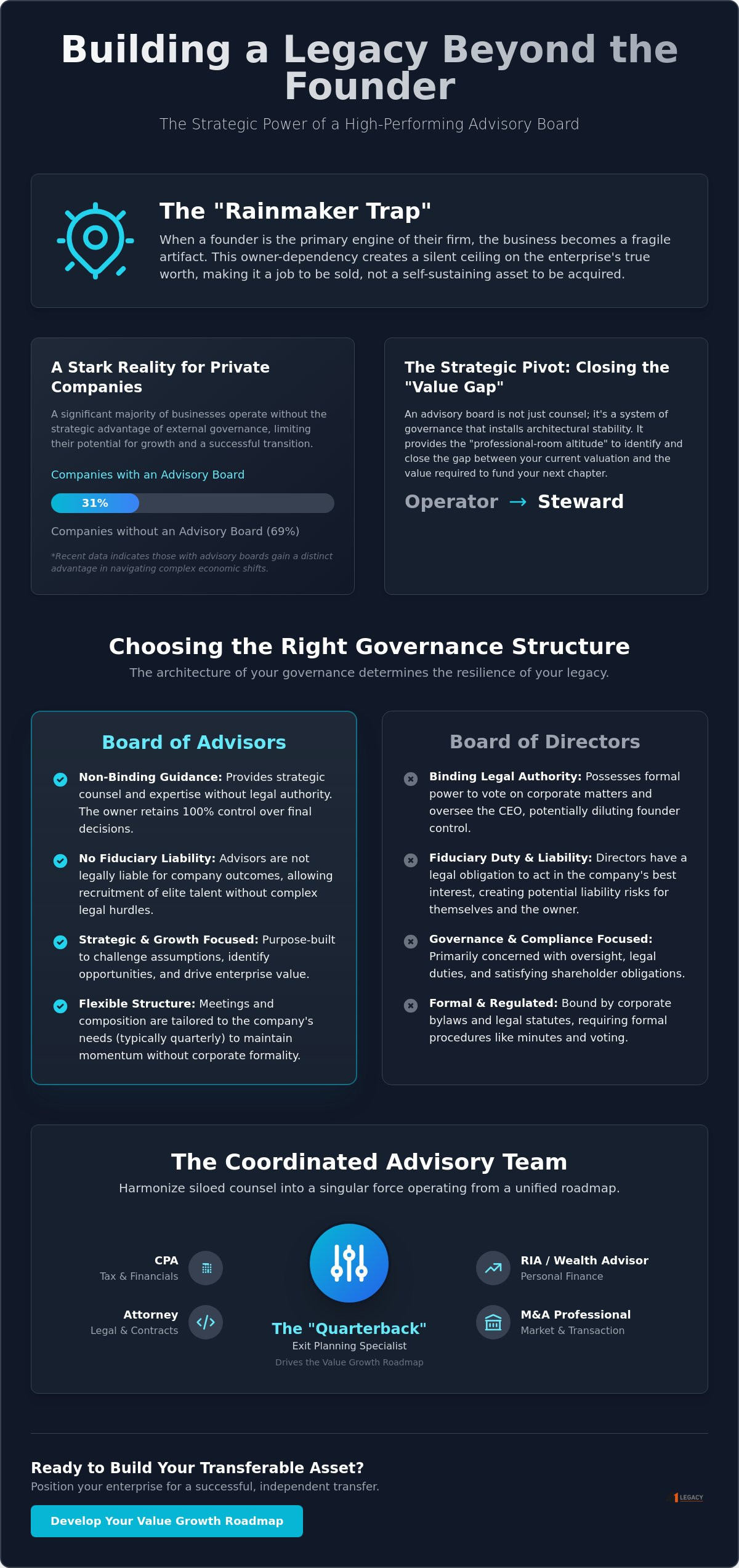
The most profound legacies are never the result of a solitary effort; they are the product of deliberate architectural curation. While many founders take pride in being the primary engine of their firm, this "Rainmaker Trap" often acts as a silent ceiling on the enterprise’s true worth. You likely recognize the tension of a business that demands your constant touch to maintain its luster. Setting up a board of advisors for your company is the strategic pivot that transforms a personal practice into a timeless institution.
Recent data from 2026 indicates that only 31% of private companies have successfully established an advisory board, yet those who do gain a distinct advantage in navigating complex economic shifts and workforce engagement. This article provides the precision needed to construct a high-level advisory team that reduces owner dependency and proactively closes the "Value Gap." You will learn to harmonize your professional advisors into a singular force, establish sophisticated compensation structures without sacrificing equity, and follow a clear roadmap toward a successful, independent transfer. We will move beyond the reactive nature of siloed counsel to create a coordinated team focused on the preservation and growth of your enterprise's essence.
Key Takeaways
- Transition from a primary operator to a strategic steward by leveraging external perspectives to dismantle owner dependency.
- Navigate the structural nuances of setting up a board of advisors for your company to secure elite expertise without the complexities of fiduciary liability.
- Implement a "Quarterback" strategy to harmonize your professional team; this ensures all advisors operate from a single, unified roadmap.
- Identify the essential roles for your inner circle, including why an exit planning specialist is vital for engineering a transferable asset.
- Bridge the gap between high-level theory and measurable results by utilizing a Value Growth Roadmap to track and drive enterprise value.
The Strategic Mandate: Why Your Company Needs an Advisory Board
Every enterprise possesses an inner essence, a narrative of value that often becomes obscured by the daily friction of operations. For many founders, the business is an extension of their own hands. While this craftsmanship is the source of initial success, it eventually becomes a tether that limits the company's ultimate worth. When you begin the process of setting up a board of advisors for your company, you are not merely seeking counsel; you are installing a system of governance that ensures the enterprise can breathe and flourish on its own. This body serves as a guardian of your legacy, moving the organization from a state of owner-dependency to one of architectural stability.
The primary role of this board is to facilitate rigorous Enterprise Diagnostics. By inviting external perspectives, you gain the "professional-room altitude" necessary to identify the "Value Gap." This is the distance between your current valuation and the price required to fund your next chapter. A coordinated board identifies the risks that suppress your multiple, ensuring that every strategic move is an intentional step toward a successful exit. It's about shifting your identity from an "Operator" who solves problems to a "Steward" who curates a transferable asset.
Reducing Owner Dependency through External Governance
A business that relies on the founder’s daily involvement is a fragile artifact. Buyers do not seek to purchase a job; they seek to acquire a self-sustaining machine. Advisors provide the objective distance needed to work ON the business rather than just IN it. By establishing systems of accountability and strategic oversight, you create a structure that outlasts your personal tenure. This transition is essential for Strategic Advisory, as it signals to the market that the company’s brilliance is embedded in its processes, not just its personality. Precision in this area reduces risk and heightens the allure for future successors.
Defining the Non-Binding Nature of Advisory Boards
An Advisory board is a strategic, non-fiduciary support system for enterprise growth. Unlike a formal board of directors, these individuals provide guidance without possessing legal authority over your decisions. This distinction is vital. It allows you to recruit high-level talent without the complexities of fiduciary liability or the loss of control. It also addresses the "loneliness at the top." You no longer have to carry the weight of every strategic pivot alone. Instead, you are supported by a team that understands the technical precision required to build a lasting impact. When setting up a board of advisors for your company, you create a space where excellence is the only standard, and the preservation of your company's essence is the shared mission.
Board of Advisors vs. Board of Directors: Choosing the Right Structure
The architecture of your governance determines the resilience of your legacy. While both boards seek to elevate the enterprise, their structural foundations differ as significantly as a blueprint differs from a finished monument. A Board of Directors carries a fiduciary weight, possessing the legal authority to vote on corporate matters and, in many cases, oversee the CEO. For a private business owner, this often introduces a level of oversight that can feel restrictive. Setting up a board of advisors for your company offers a more fluid alternative. It provides the strategic depth of elite minds without the binding legal obligations that accompany a formal board of directors.
Establishing the correct "rhythm of business" is essential for maintaining momentum. Most high-performing advisory boards operate on a quarterly cycle, though monthly sessions are often utilized during periods of rapid transition or when executing a Value Growth Roadmap. This cadence ensures that the board remains a living entity, actively shaping the company’s trajectory rather than simply reviewing historical data. It is a commitment to continuous refinement, ensuring the enterprise remains aligned with its ultimate purpose.
Fiduciary Duty and Legal Liability
The legal landscape for private, family-owned firms is often intimate and complex. Introducing a fiduciary board can inadvertently create liability risks for both the owner and the directors, especially regarding minority shareholder rights or complex succession events. Most mid-market owners find that an advisory board is the superior starting point. It allows for a trial period of collaboration without the immediate need for extensive Directors and Officers (D&O) insurance, though such coverage is still a prudent consideration. There are several key items to consider when establishing an advisory board, specifically regarding how to shield the company while still eliciting candid, high-level guidance from your inner circle.
Compensation without Dilution
Attracting master-level talent requires a sophisticated approach to compensation. In 2026, the trend has shifted decisively toward professionalization; cash retainers for established enterprises now typically range from $20,000 to $100,000 annually. This reflects a 25% increase in compensation observed since 2025, driven by the growing complexity of global markets and the demand for specialized expertise. While 43% of boards still utilize equity-only models, many private owners prefer cash retainers to avoid diluting their ownership. This approach keeps the cap table clean while aligning advisor incentives with specific enterprise milestones. By focusing on "Value Growth" incentives, you ensure that your advisors are rewarded for the tangible health and transferability of the business, rather than just their presence at the table. If you are uncertain about your current trajectory, performing an enterprise diagnostic can help determine the specific expertise your board requires most.
The Coordinated Advisory Team: The "Quarterback" Strategy
A collection of brilliant minds does not inherently result in a brilliant outcome. Most business owners possess a suite of professional advisors, a CPA, an attorney, and perhaps a wealth manager, yet these individuals often operate within intellectual silos. The attorney focuses on risk mitigation; the CPA focuses on tax minimization. While both are essential, their efforts can frequently be at cross-purposes with the ultimate goal of maximizing enterprise value. When you are setting up a board of advisors for your company, the objective is to move beyond these isolated pockets of expertise and create a single, harmonious narrative of growth.
Without a conductor, even the most skilled orchestra produces only noise. The "Siloed Advisor" problem is one of the most significant hidden risks to a successful exit. If your professional team rarely speaks until a crisis or a specific transaction occurs, you are likely leaving substantial value on the table. A coordinated advisory team ensures that tax planning, legal structure, and wealth management are all aligned with a singular roadmap for transferability. This level of orchestration requires a shift in perspective, viewing your advisors not as independent vendors, but as a unified council dedicated to the preservation of your company's essence.
Aligning the Professional Room
The foundation of a high-value enterprise is a unified front. When performing enterprise diagnostics, it's vital that every advisor operates from the same set of facts and the same long-term vision. Your exit readiness depends on this alignment. For example, a tax strategy that aggressively reduces current liability might inadvertently depress the company's EBITDA, which could significantly lower the valuation multiple during a transition. By creating a shared language for value growth, we ensure that your professional room is focused on the long-term health of the asset rather than just short-term compliance. This collective clarity reduces friction and ensures that no strategic opportunity is overlooked due to a lack of communication.
The Role of the Strategic Quarterback
Execution is where strategy meets reality. The Strategic Quarterback is the professional who ensures that the Value Growth Roadmap does not sit on a shelf, but is actively implemented month by month. This role involves coordinating the existing professional team, holding each member accountable to the transition timeline, and bridging the gap between high-level board meetings and daily operations. At 41 Legacy, we act as this coordinating force, ensuring that the owner’s vision is translated into technical precision across all disciplines. Learn how 41 Legacy quarterbacks your advisory team to transform your group of siloed experts into a high-performance board. By setting up a board of advisors for your company with a dedicated coordinator, you ensure that every hour of professional counsel is an investment in your enterprise’s ultimate transferability.
Recruiting for Value: Who Should Sit at Your Table?
The assembly of a board is an act of deliberate curatorship. It requires a vision that extends beyond the current operational horizon to the future state of the enterprise. When you begin setting up a board of advisors for your company, you are selecting the architects who will help you build a bridge to your eventual exit. This selection process must be driven by Enterprise Diagnostics, which reveal the structural blind spots within your existing leadership. By identifying these gaps, you can recruit for functional brilliance rather than just industry familiarity. It's about finding the rare intersection of technical skill and a shared reverence for the legacy you've built.
A critical addition to this table is the "Exit Specialist," often a professional with a background in transferability engineering. This individual doesn't focus on the daily mechanics of the trade but on the rigorous preparation of the asset for its next owner. They ensure that every strategic decision increases the multiple and reduces risk. Recruiting for where the company is going, rather than where it has been, ensures that your board remains relevant as the business scales and prepares for transition. This forward-looking approach is the hallmark of a steward who values heritage as much as performance.
The Functional Mix of an Elite Board
- The Financial Expert: This role must move beyond simple tax compliance to focus on strategic forecasting and value growth. They analyze the capital structure to ensure it supports long-term transferability.
- The Operations Expert: Their focus is the creation of a self-sustaining machine. By prioritizing the development of sophisticated SOPs and owner-dependency reduction, they engineer a business that thrives independently of the founder.
- The Industry Veteran: This individual provides the market intelligence and competitive positioning necessary to protect the brand's essence. They offer a high-level perspective on industry shifts that could impact future valuation.
Vetting for Cultural and Strategic Alignment
The interview process for a board member should be as meticulous as the restoration of a fine work of art. You aren't just looking for a resume; you're looking for "sophisticated passion" and a deep respect for the company's history. It is essential to set clear expectations through a formal Advisory Board Agreement that outlines the rhythm of meetings and the specific outcomes expected. The ideal advisor is a specialist who prioritizes the enterprise’s long-term transferable value and structural health over fleeting, short-term gains. This alignment ensures that every voice at the table is committed to the same uncompromising vision of perfection. To ensure your leadership team has the room for this level of growth, consider a Strategic Capacity Evaluation to identify your most pressing recruitment needs.
Setting up a board of advisors for your company is a transformative step that signals your commitment to building a lasting institution. By carefully balancing functional expertise with cultural alignment, you create a powerhouse of strategic clarity. This coordinated team becomes the catalyst for growth, ensuring that the essence of your work is preserved and its value is maximized for the generations to come.
Implementation: Turning Advice into Enterprise Value
The assembly of elite minds is merely the first step in a larger architectural process. High-level counsel only gains its true worth when it is translated into technical precision at the ground level. Without a structured method for execution, even the most sophisticated advice remains a collection of abstract ideas. Setting up a board of advisors for your company provides the strategic engine, but the implementation process provides the movement. This requires a shift from theory to a disciplined cadence of action, where every board session is anchored in the reality of the business’s current state and its future potential.
Central to this process is the "Value Gap," the difference between the current valuation of your firm and the value needed to achieve your long-term goals. A coordinated board uses this metric as a primary indicator of health. By tracking the reduction of this gap over time, the board ensures that the company is not just growing, but becoming more transferable. This focus on measurable outcomes prevents the business from falling back into the "Rainmaker Trap," keeping the emphasis on building an asset that thrives independently of the founder’s daily touch.
The Value Growth Roadmap as a North Star
The board utilizes enterprise diagnostics to identify the most critical levers for value creation. These are not general goals; they are specific, quarterly priorities that target the structural weaknesses of the firm. Every decision made by the board must answer a single question: does this move the needle on transferability? Discover how our Value Growth Roadmap guides your board toward a successful transition by aligning every professional advisor with these strategic milestones. This document acts as the board’s primary working artifact, ensuring that every hour of counsel is an investment in the enterprise's ultimate resilience.
Accountability and Execution
The greatest risk to any strategic plan is "strategy drift," where the daily demands of the business pull the leadership away from long-term objectives. Monthly implementation support bridges the gap between quarterly board sessions. It provides the steady rhythm needed to keep the board’s vision alive within the firm’s daily operations. This structured accountability ensures that the owner can step back from the "Operator" role and fully embrace the role of a steward. By setting up a board of advisors for your company with a focus on execution, you create a self-sustaining engine of growth. Through the Exit Readiness Assessment process, the board tracks the company’s progress, ensuring that the essence of the work is preserved while its market value is maximized for the generations to come.
Curating a Legacy of Transferable Excellence
The evolution from a founder-led firm to a self-sustaining institution requires more than just growth; it demands the intentional engineering of owner-independence. By harmonizing your professional council and establishing a rigorous cadence of execution, you ensure that your business’s essence is protected and its value is maximized. Setting up a board of advisors for your company is the definitive step toward bridging the gap between current operations and a successful, independent future.
At 41 Legacy, we provide the technical precision and strategic depth necessary to transform your advisory group into a high-performance engine of value. Led by a Certified Exit Planning Advisor (CEPA), our team specializes in quarterbacking your existing advisors through a structured Value Growth Roadmap. This process ensures that every strategic decision is polished to a high sheen, reflecting the meticulous nature of your life’s work.
Begin your journey toward a transferable asset with an Exit Readiness Assessment from 41 Legacy. The time to architect your final masterpiece is now.
Frequently Asked Questions
What is the difference between a Board of Advisors and a Board of Directors?
A Board of Directors possesses legal authority and fiduciary responsibility to shareholders, often exercising control over the CEO and corporate policy. In contrast, an advisory board provides non-binding strategic guidance with no legal or fiduciary authority. This structure allows a business owner to access elite expertise without the complexities of shared control or the heightened liability associated with a formal board.
How much should I pay a member of my advisory board in 2026?
For established enterprises, annual cash compensation for advisory board members typically ranges from $20,000 to $100,000. This reflects a trend toward the professionalization of board roles observed over the last year. Startups or early-stage firms may instead offer $100 to $500 per meeting, often supplemented by equity grants ranging from 0.25% to 1% to align the advisors with long-term growth.
Does a Board of Advisors have any legal control over my company?
No, an advisory board has no legal control or voting power over your enterprise. Their role is purely consultative, offering specialized insights to help you navigate complex transitions and market shifts. Because they lack fiduciary duties, these individuals can provide candid, strategic perspectives without the legal weight that a fiduciary board of directors must carry.
When is the right time for a business owner to set up an advisory board?
The ideal time for setting up a board of advisors for your company is when you identify a significant "Value Gap" or feel the constraints of the "Rainmaker Trap." Most owners begin this process three to five years before a planned transition. This lead time allows the board to engineer transferability and ensure the business can thrive independently of the founder’s daily involvement.
Can my existing CPA or Attorney serve on my Board of Advisors?
Your current professional advisors can certainly serve, but their roles must be elevated from transactional service to strategic contribution. The primary challenge is ensuring they do not remain in silos. A successful board requires these professionals to work in a coordinated fashion, often guided by a strategic quarterback who aligns their specific expertise with the overall Value Growth Roadmap.
How many people should be on a private company’s advisory board?
The most effective advisory boards typically consist of five to nine members. This size is large enough to provide a diverse mix of functional brilliance, such as finance and operations, while remaining small enough for intimate, high-level discussion. A 2025 survey indicated that the median size for private company boards is seven directors, providing a balanced rhythm of governance.
What should be included in a startup or private company advisory agreement?
A sophisticated advisory agreement should clearly define the scope of work, meeting cadence, and compensation structures. It is also vital to include confidentiality clauses and specific term limits, often recommended at two years. This ensures a healthy balance of continuity and fresh perspective, allowing the board to evolve as the company moves toward its future state.
How does an advisory board help with the sale or transfer of a business?
An advisory board acts as a catalyst for transferability by systematically reducing owner dependency and identifying risks that could depress your valuation multiple. Setting up a board of advisors for your company signals to potential successors or buyers that the enterprise is a stable, well-governed asset. This professional-room altitude ensures the business’s essence is preserved through the transition, maximizing both legacy and value.
Disclaimer
This article is for educational and informational purposes only and does not provide legal, tax, investment, or business brokerage advice. 41 Legacy does not offer M&A brokerage services, legal document drafting, tax preparation, or investment advisory services. Business owners should consult licensed professionals in those disciplines before making decisions related to business transactions, legal matters, tax strategy, or financial planning. All examples are illustrative and may not apply to your specific situation.