
Transferability & Owner Dependency
Selling to a Third Party vs. Management Buyout: A Strategic Comparison for Business Owners
The highest bid for your business might actually be its greatest threat. While Goldman Sachs predicts pure M&A volume will reach $3.8 trillion in 2026, the real tension for most founders isn't the number on the check; it's the strategic choice between selling to a third party vs management buyout. You've spent decades meticulously building a legacy. Now you face a philosophical crossroads. One path offers the immediate liquidity of a 9.8x premium multiple. The other promises the continuity of the culture you've nurtured. Every chapter of your company's story deserves a deliberate, polished conclusion.
You likely feel a profound responsibility to protect what you've created, yet you're rightfully anxious about the value gap between your personal needs and current market realities. We believe a business is a living entity, not just a line item. This article will help you discover the critical differences between internal and external transitions to determine which path best preserves your legacy and maximizes enterprise value. We'll explore how to engineer transferability so your company thrives regardless of who holds the keys, ensuring your personal financial goals align perfectly with the long-term health of the enterprise.
Key Takeaways
- Define your exit horizon by evaluating how selling to a third party vs management buyout impacts both your immediate financial liquidity and the long-term preservation of your company's heritage.
- Bridge the "Value Gap" through precise enterprise diagnostics that align your business's current worth with the capital required to sustain your post-transition lifestyle.
- Master the nuances of transferability engineering to ensure your business remains an attractive, high-performance asset that can thrive independently of your daily involvement.
- Discover why reducing owner dependency is the most critical step in preparing for a transition that honors your role as a dedicated steward of the company’s legacy.
- Utilize a structured Exit Readiness Assessment to gain strategic clarity, ensuring you choose the exit path that offers the most uncompromising alignment with your personal and professional goals.
The Fork in the Road: Evaluating Your Exit Horizon
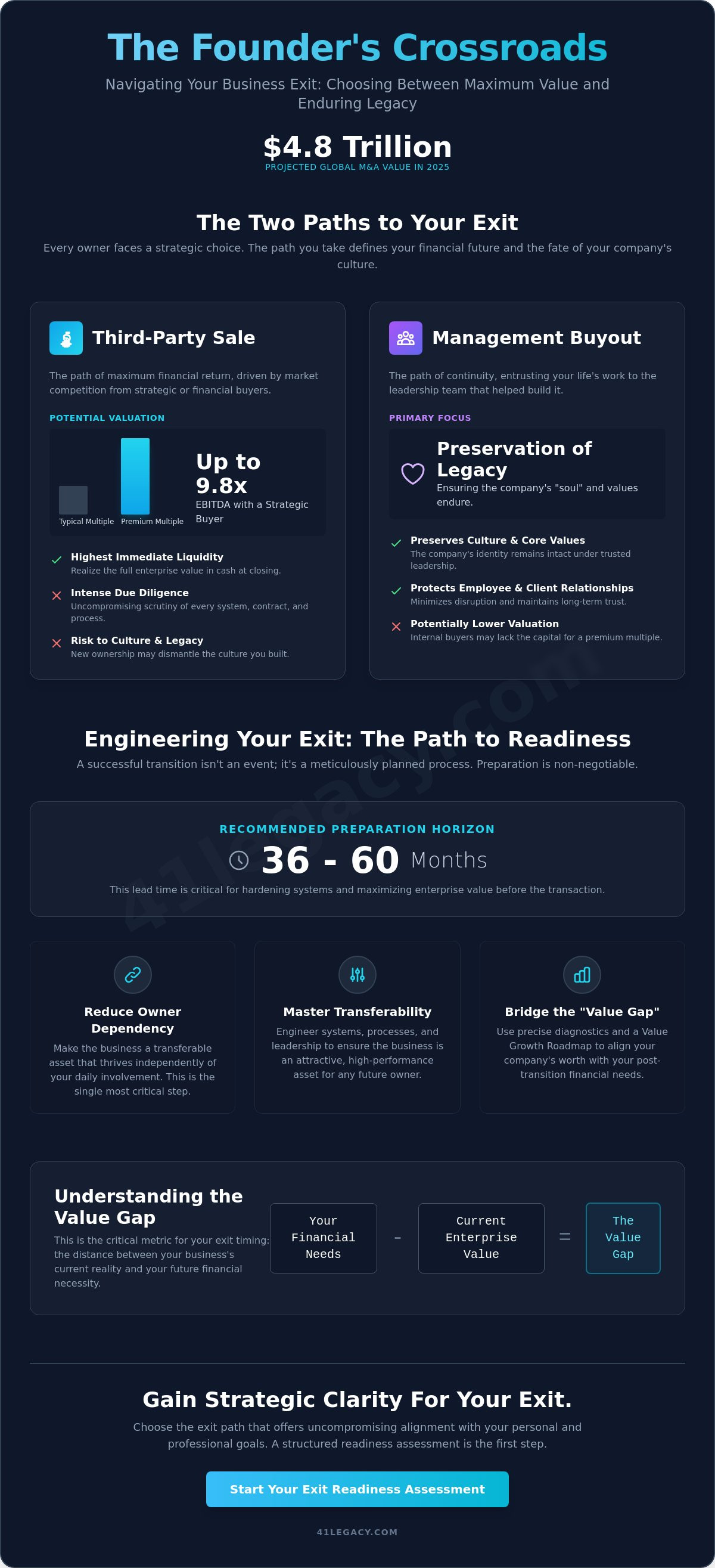
Every significant endeavor reaches a point where the architect must consider the future of the structure. For the business owner, this horizon represents a choice that will define their legacy. This decision is not a sudden event but a calculated transition that requires years of preparation. Choosing between selling to a third party vs management buyout is a fundamental strategic fork. One path leads to an external buyer, often a strategic competitor or a private equity group, while the other involves a transition to the internal leadership team that has shaped the company's evolution. With global M&A value rising by 41% in 2025 to reach $4.8 trillion, the external market is active, yet many owners find the internal path more aligned with their personal philosophy.
This strategic alignment should be established at least 36 to 60 months before the anticipated exit. This lead time allows for the reduction of owner dependency and the hardening of internal systems. A third-party sale often involves intense scrutiny from external auditors, while a Management buyout (MBO) relies on the existing trust and operational knowledge of the current leadership. Each path carries distinct implications for the company's future culture and the owner's liquidity.
The Stewardship Mindset
We view the business owner as a steward rather than a mere proprietor. Transferring a company is not simply the disposal of an asset; it's the delicate handover of a life’s work. Preserving the "soul" of the enterprise requires an uncompromising commitment to meticulous planning. A business only achieves its full potential when it becomes a truly transferable asset. This means the company must possess the structural integrity to thrive independently of its founder. To honor your legacy, consider these stewardship priorities:
- The preservation of core values and the company’s unique culture.
- The protection of long-term employee and client relationships.
- The pursuit of an exit that reflects your professional craftsmanship.
Identifying the Value Gap
Strategic clarity begins with a cold, honest look at the numbers. Owners frequently discover a discrepancy between their current enterprise value and the capital required to fund their post-exit life. This discrepancy is known as the Value Gap. Bridging this distance is essential for a successful transition, whether you are looking at an internal or external path. Implementing a Value Growth Roadmap allows you to engineer the necessary value long before the transaction occurs. It provides the tactical precision needed to ensure the business can support your future needs while maintaining its operational excellence. The Value Gap serves as the fundamental metric for exit timing, representing the distance between current enterprise reality and future financial necessity.
The Third-Party Sale: Maximizing Enterprise Value through Competition
An external sale represents the ultimate test of a company's market position. When evaluating selling to a third party vs management buyout, the external path often yields the highest immediate financial return. In 2025, global M&A activity reached $4.8 trillion, driven by buyers seeking to acquire established excellence. This path requires a meticulous approach to enterprise diagnostics. External buyers, whether strategic or financial, will subject your life’s work to an uncompromising level of due diligence. Every system, contract, and cultural nuance is scrutinized with surgical precision. This process carries the inherent risk of confidentiality breaches, which can destabilize employee morale and client trust if not managed correctly. Exploring various business succession planning options early ensures you maintain control over the narrative of your transition while mitigating these risks.
Strategic vs. Financial Buyers
Strategic buyers are typically competitors who value your company for its unique synergies. They might pay a premium multiple, reaching as high as 9.8x EBITDA, to acquire your technology, market share, or specialized talent. Financial buyers, such as private equity firms, focus on cash flow and scalability. While they offer significant liquidity, they may lack the emotional reverence for your heritage that an internal team possesses. The trade-off is often cultural. An external entity may prioritize operational efficiency over the bespoke craftsmanship that defined your tenure. You must decide if the highest price justifies a potential shift in the company’s soul.
The Rainmaker Trap in External Sales
The most significant hurdle in an external sale is the "Rainmaker Trap." If the company’s success is inextricably tied to your personal relationships or daily presence, its value to an outsider diminishes rapidly. A business that cannot function without its founder is not a transferable asset; it's a high-stress role for the next owner. To maximize your return, you must implement Owner Dependency Reduction strategies years in advance. This involves documenting bespoke operating procedures that serve as a manual for the company’s future. It ensures your legacy continues to thrive under new stewardship while you secure the maximum enterprise value. Performing a structured Enterprise Diagnostic allows you to identify these dependencies and engineer them out of the business before you ever go to market.
The Management Buyout: Continuity and Culture Preserved
A management buyout (MBO) represents a deliberate passing of the torch to those who have already mastered the internal rhythms of the company. While an external sale focuses on the highest bidder, the internal path prioritizes the preservation of the company’s soul. This transition allows the owner to leave the keys with trusted lieutenants who helped build the legacy. It offers a sense of psychological closure that a third-party sale rarely provides. However, when weighing selling to a third party vs management buyout, the primary hurdle is almost always the lack of liquid capital within the management team. The artisans who run the shop floor or the directors who manage the accounts typically don't have the personal wealth to fund a total acquisition upfront.
Financing an MBO requires a sophisticated blend of debt and equity. As of January 28, 2026, the Secured Overnight Financing Rate (SOFR) for leveraged loans was 3.64%, a benchmark that directly influences the cost of the capital needed to fuel these transitions. Because management teams often lack the required funds, the owner frequently assumes a higher risk profile by providing seller financing. This means you effectively act as the bank, accepting a promissory note for a portion of the enterprise value. Your post-exit financial security becomes inextricably linked to the future performance of the team you've left behind. This reality demands that the business be engineered for uncompromising transferability long before the papers are signed.
Structuring the Internal Transition
Internal transfer mechanisms, such as Employee Stock Ownership Plans (ESOPs) or direct equity grants, provide structured pathways for this migration of ownership. To ensure the team can sustain the necessary debt service, a Value Growth Roadmap is essential. This roadmap prepares the company’s cash flow to handle the transition without suffocating its growth. It's also vital that the management team retains their own professional advisory team. This separation of counsel ensures that the transition remains a respectful negotiation between two distinct parties rather than a blurred internal discussion that could lead to resentment.
The Quarterback Role in MBOs
Executing an MBO is an exercise in complex coordination. It requires a "quarterback" to align the efforts of CPAs, attorneys, and RIAs. Without this centralized guidance, the deal can easily stall due to technicalities or a lack of strategic momentum. Our Strategic Advisory services provide this necessary oversight, ensuring every professional in the room operates with the same precision as a master mechanic. We maintain a "professional-room altitude" during sensitive internal negotiations, keeping the focus on the long-term health of the enterprise. This structured approach prevents the emotional weight of the transition from compromising the strategic clarity required to finalize the deal.
Strategic Comparison: Which Path Aligns with Your Legacy?
Selecting the correct trajectory requires more than a cursory glance at a balance sheet. It demands a deep understanding of the enterprise's structural integrity. When debating selling to a third party vs management buyout, the decision hinges on your definition of success. While an external sale often commands a premium EBITDA multiple, reaching 9.8x for high-performing assets in 2026, it subjects the company to an invasive level of scrutiny. Conversely, a management buyout offers a sense of continuity that preserves the company’s soul. The "best" path isn't universally defined; it's the one that achieves the owner’s personal Enterprise Goal.
This decision is ultimately a matter of Transferability Engineering. You aren't just choosing a buyer; you're choosing the future environment in which your life’s work will either evolve or erode. An MBO often requires a lower valuation because the internal team lacks the "synergy premium" a competitor might pay. However, it offers significantly higher peace of mind for the staff, as the leadership remains familiar. The certainty of closing also varies. Internal teams are known entities, reducing the risk of the deal collapsing during the final hour, whereas external buyers may retreat if market conditions shift or due diligence uncovers minor imperfections.
Comparison Framework
To navigate this choice, we must evaluate the variables with the same precision one would apply to a bespoke engine restoration. Consider these primary differences:
- Owner Involvement Post-Sale: High in MBOs, often requiring years of mentorship; typically low in third-party sales after a standard transition period.
- Due Diligence Intensity: Lower in MBOs as the team knows the assets; extremely high in third-party sales, where every diagnostic is challenged.
- Certainty of Closing: MBOs provide higher certainty because the buyers are known entities, while external deals face higher failure rates during the final stages of negotiation.
The Transferability Litmus Test
Before choosing a path, you must determine if the business is even ready for a transition. Not every company is equipped for an external sale, nor is every management team ready to lead. Utilizing Enterprise Diagnostics reveals which path is actually viable based on the current health of the organization. Some businesses are "un-buyable" for third parties due to extreme owner dependency but remain perfect for an MBO where that knowledge can be transferred over time. To gauge your team's Strategic Capacity, assess whether they possess the leadership depth to operate without your daily oversight and if the business can sustain debt service based on current cash flow. If you're ready to define your trajectory, we recommend beginning with a structured Exit Readiness Assessment to illuminate the road ahead.
Engineering Your Exit: Why Readiness Precedes the Transaction
The choice regarding selling to a third party vs management buyout is often the final note in a long, complex symphony. While the identity of the next owner carries weight, the structural integrity of the enterprise determines if the music continues. A business must be engineered to function with the precision of a master-crafted instrument, independent of its founder's daily touch. This level of transferability isn't a happy accident. It's the result of a deliberate, uncompromising focus on asset quality. By prioritizing readiness, you aren't just preparing to leave; you're ensuring the company's soul remains intact. With Goldman Sachs predicting pure M&A volume to reach $3.8 trillion in 2026, the market rewards those who have meticulously prepared their assets for transition.
Achieving this level of sophistication requires more than just intent. It demands a structured approach to value growth. By focusing on transferability engineering, you aren't just preparing to leave; you're strengthening the business for its next stage of evolution. This process ensures that when the time comes to step away, you do so with the confidence that your life's work is protected. The choice between an internal or external path becomes a strategic preference rather than a forced necessity when the asset is prepared with uncompromising care.
The 41 Legacy Process
Our methodology transforms the abstract goal of an exit into a series of technical milestones. We begin with Enterprise Diagnostics to identify the structural weaknesses that often remain hidden beneath a profitable surface. These findings inform a bespoke Value Growth Roadmap, a tactical guide designed to harden your systems and reduce risk. To ensure these strategies are executed with precision, we provide Monthly Implementation Support. We act as the lead coordinator for your professional team, providing the expert "quarterbacking" your CPA and legal advisors need to stay aligned. This structured oversight reduces your personal stress, allowing you to focus on your role as a steward while we manage the granular details of the transition.
Your Next Strategic Move
It's time to move beyond theoretical discussions and begin the work of diagnostic action. Exit planning is simply high-level business planning with a clear end in mind. It's the ultimate expression of professional craftsmanship to build a legacy that outlasts its creator. We invite you to step into the role of the visionary founder who leaves nothing to chance. Your next move determines the future health of everything you've built. Schedule your Exit Readiness Assessment with 41 Legacy today to begin the process of engineering a truly transferable asset.
Engineering a Legacy That Endures
The ultimate success of your transition is not found in the identity of the buyer but in the structural integrity of the asset you've created. Whether your path involves selling to a third party vs management buyout, the objective remains the same: to ensure your business thrives as a standalone entity. By focusing on transferability engineering and reducing owner dependency, you protect the soul of your enterprise while maximizing its value for the next chapter. A business that can operate with surgical precision without its founder is the hallmark of a master craftsman.
Our process is led by a Certified Exit Planning Advisor (CEPA) who understands the emotional and financial weight of your decision. We provide a structured Value Growth Roadmap and expert quarterbacking to align your existing CPA and legal team toward your singular Enterprise Goal. This coordination ensures every professional in the room operates with the technical excellence required to honor your heritage. Your role as a steward is to build something that lasts, and we provide the strategic clarity needed to finalize that vision.
Begin your journey toward a transferable legacy with an Exit Readiness Assessment.
The road ahead is clear when the foundation is sound. Your legacy deserves a transition as meticulous as the business you've built.
Frequently Asked Questions
What is the main difference between an MBO and a third-party sale?
The primary difference lies in the identity of the successor and the origin of the capital. A management buyout transitions ownership to internal leadership using a combination of debt and equity, while a third-party sale transfers the asset to an external entity, such as a strategic competitor. This choice fundamentally alters the risk profile and the long-term preservation of the company's heritage.
Can I get a higher price for my business in a third-party sale?
Yes, third-party sales typically command a premium multiple due to strategic synergies that external buyers can leverage. In 2026, average M&A EBITDA multiples reached 6.8x, with premium strategic deals hitting 9.8x. While an MBO often yields a lower valuation, it provides a unique level of cultural continuity that many founders value more than a maximized check.
How long does a management buyout typically take compared to an external sale?
A third-party sale generally takes 6 to 12 months from marketing to close, whereas a management buyout often requires a longer horizon of 2 to 5 years for preparation. This extended timeline in an MBO allows for the gradual transfer of leadership and the engineering of cash flow to support debt service. Meticulous planning ensures the transition doesn't destabilize the company's daily operations.
What happens if my management team cannot afford to buy the business?
Financing challenges are common in MBOs, often requiring a combination of seller financing and external debt. If the team lacks capital, the owner may accept a promissory note for a portion of the value, effectively acting as the bank. This structure links your future financial security to the team's ongoing success, making transferability engineering a critical prerequisite for the deal.
Is a management buyout better for company culture than an external sale?
Management buyouts are widely considered superior for preserving culture because the buyers are already stewards of the company's values. Unlike external buyers who may prioritize immediate operational efficiency, internal teams understand the soul of the business. This path reduces anxiety for employees and clients, maintaining the harmony established during your tenure.
Do I need to stay involved in the business after a third-party sale?
Most third-party sales require a transition period ranging from 6 months to 2 years to ensure the transfer of knowledge. Strategic buyers want to minimize risk by retaining the founder until the "Rainmaker Trap" is neutralized. If you've already reduced owner dependency, this period can be significantly shortened, allowing for a cleaner exit.
How does owner dependency affect the value in both transition types?
High owner dependency acts as a significant discount on enterprise value in both scenarios. For a third-party buyer, a business that cannot function without its founder is viewed as an un-transferable risk. In an MBO, excessive dependency makes it impossible for the management team to sustain the debt service required to buy you out.
What is an Exit Readiness Assessment and why do I need one before choosing a path?
An Exit Readiness Assessment is a comprehensive diagnostic that evaluates the transferability and value of your business before you choose a path. It identifies the "Value Gap" and provides the strategic clarity needed to decide between selling to a third party vs management buyout. This assessment serves as the foundation for your Value Growth Roadmap, ensuring your legacy is preserved regardless of the buyer.
Disclaimer
This article is for educational and informational purposes only and does not provide legal, tax, investment, or business brokerage advice. 41 Legacy does not offer M&A brokerage services, legal document drafting, tax preparation, or investment advisory services. Business owners should consult licensed professionals in those disciplines before making decisions related to business transactions, legal matters, tax strategy, or financial planning. All examples are illustrative and may not apply to your specific situation.