
Reducing Owner Dependency: The Master Key to Maximizing Enterprise Value Before an Exit
A business is only a true masterpiece when it no longer requires the artist’s hand to sustain its beauty and value. You have likely spent decades refining every detail of your enterprise, yet the very dedication that fueled its growth now creates a silent ceiling on its worth. It's a heavy realization that the business you built to provide freedom can become a cage of your own design. Focusing on reducing owner dependency before selling is not merely a tactical choice; it's an act of stewardship that preserves the essence of your work for the next generation.
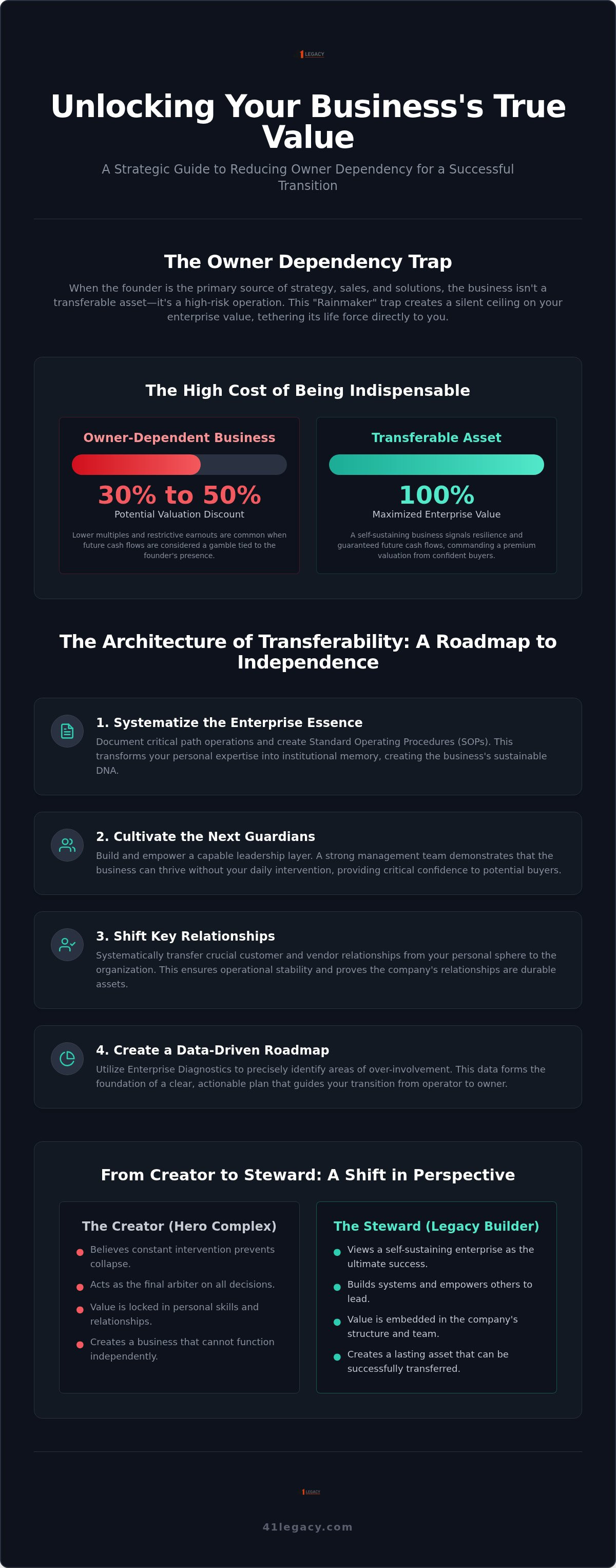
We understand the quiet anxiety of wondering if the engine will stall the moment you step away from the controls. Industry data reveals that businesses with significant owner dependency often face valuation discounts of 30% to 50% compared to their independent counterparts. This article provides the strategic clarity you need to transform your daily involvement into a transferable asset. You'll discover how to implement a Value Growth Roadmap that empowers your team, secures your legacy, and ensures the enterprise thrives long after your final day in the office.
Key Takeaways
- Understand how the "Rainmaker" trap creates an invisible ceiling on enterprise value by making the business too reliant on your personal essence.
- Discover how to engineer transferability by documenting critical path operations, treating standard operating procedures as the essential DNA of a sustainable asset.
- Master the strategic methodology for reducing owner dependency before selling to recapture the valuation premium often lost to founder-centric operations.
- Learn how to shift key customer and vendor relationships from your personal sphere to the organization to ensure long-term stability and buyer confidence.
- Identify precise areas of over-involvement using Enterprise Diagnostics to create a clear, actionable roadmap toward your eventual exit.
The Invisible Weight: Defining Owner Dependency and Its Impact on Value
Owner dependency is the degree to which an organization’s life force is tethered to its founder. It's the silent friction within an otherwise high-performing engine. When you are the primary source of strategy, the lead rainmaker, and the final arbiter of every technical nuance, you aren't just the leader; you are the business itself. This creates a profound fragility. A potential buyer doesn't see a resilient, self-sustaining asset. They see a risk that requires your physical presence to survive. The very skills that allowed you to sculpt this enterprise from nothing now act as the barriers to its future.
This is the paradox of the successful creator. The intuition and grit that built the company often become the very things that prevent it from being transferred. If the "essence" of the business resides in your head rather than in the company's systems, the value is locked away. To unlock it, we must shift the focus from personal execution to institutional excellence. This transition ensures that the impact you've made becomes a lasting legacy rather than a temporary achievement.
The Financial Cost of Being Indispensable
The market distinguishes sharply between a lifestyle business and a transferable asset. While you may enjoy high annual profits, those profits are viewed through a lens of extreme risk if they depend on your personal relationships or unique daily involvement. Industry data suggests that businesses with high founder reliance can face a valuation discount of 30% to 50% compared to independent peers. This Value Gap results in lower multiples and forces owners into lengthy, restrictive earnout periods where they must remain as employees to prove the company’s stability. Owner-centricity lowers the multiple a buyer is willing to pay by signaling that the enterprise's future cash flows are a gamble rather than a guarantee.
The Psychological Barrier to Transferability
Many founders suffer from a Hero Complex, a belief that their constant intervention is the only thing preventing total collapse. This mindset often stalls the essential process of succession planning and prevents the development of a capable leadership layer. We must reframe the exit. It isn't a loss of control or an admission that you are no longer needed. Instead, the ultimate validation of your craftsmanship is an enterprise that thrives without you. Actively reducing owner dependency before selling provides immediate returns, offering you the freedom to choose your exit timing while restoring your personal flexibility today. You transition from being the source of the business's life to being the steward of its enduring health.
The Architecture of Transferability: Systematizing the Enterprise Essence
A business achieves its highest form when its operations are no longer a collection of individual efforts, but a synchronized symphony. This transformation requires moving beyond tribal knowledge, where the "how" and "why" of the enterprise reside solely within the founder's intuition. To build a lasting legacy, we must translate this wisdom into institutional memory. By codifying the unique essence of your work, you create a blueprint that others can follow with the same meticulous precision you once provided. Order breeds value. This transition from oral tradition to a documented framework is the cornerstone of reducing owner dependency before selling.
When operations remain locked in the minds of a few, the enterprise remains inherently fragile. Research highlights the high cost of poor succession planning, noting that a lack of structured transition can erode years of built-up value. We view this documentation not as a bureaucratic exercise, but as the creation of the organization's DNA. It is the technical engineering that ensures your standards of excellence are maintained even in your absence. By identifying the critical path operations, those vital few processes that drive the majority of your value, you protect the core of your life's work from the erosion of time.
Documenting the Harmony of Operations
Standard operating procedures (SOPs) shouldn't be stagnant manuals. Instead, they must function as living documents that evolve alongside the enterprise. Our approach to Transferability Engineering treats these systems as a plug-and-play model, allowing a new steward to step into the role with strategic clarity. You must embrace the role of the Chief Architect, designing the structures that allow the Lead Builders to excel. This shift ensures the business becomes a transferable asset that reflects your vision without requiring your daily intervention. To begin this transformation, our team can help you map your unique processes through a structured Value Growth Roadmap.
Implementing Scalable Technology Frameworks
Technology serves as the silent guardian of your business legacy, providing the infrastructure for a self-sustaining entity. By implementing robust Information Systems (IS), you can track key performance metrics without the need for manual oversight. These digital dashboards offer the transparency and strategic depth that sophisticated buyers demand during due diligence. They prove the enterprise is governed by data rather than founder whim. To demonstrate true independence and the success of reducing owner dependency before selling, we focus on four core metrics:
- Recurring Revenue Stability: Proving the business generates cash flow without founder-led sales.
- Employee Retention Rates: Highlighting a culture that thrives under a leadership layer rather than a single individual.
- Customer Concentration: Ensuring no single relationship, especially one held by the owner, dictates the company's health.
- Operational Margin Consistency: Demonstrating that systems maintain profitability regardless of who is at the helm.
Cultivating the Next Guardians: Building a Leadership Layer
Systems alone cannot sustain the spirit of an organization. While the Architecture of Transferability provides the skeletal frame, your leadership team serves as the vital nervous system. True stewardship requires you to identify and mentor individuals who share your reverence for the brand's history and its future potential. These are the next guardians of your legacy. By cultivating a leadership layer that operates with technical precision and emotional alignment, you ensure the enterprise retains its soul even after your departure. This human element is the final, most critical component of reducing owner dependency before selling.
A business that relies on a single charismatic leader is a fragile entity. Investors and buyers seek the assurance of a deep bench. They look for "Intrapreneurs" who don't just follow orders, but actively execute the Value Growth Roadmap with an owner's mindset. When your team is empowered to drive results independently, the business transitions from a personal job into a high-value asset. This development of internal talent serves as a powerful signal to the market that the company’s success is a repeatable process rather than a founder-led miracle.
Transferring the "Essence" of Relationships
One of the most delicate tasks in preparing for an exit is decoupling your personal identity from key client and vendor relationships. If the "keys to the kingdom" are held only in your pocket, the revenue is at risk. We advocate for the creation of a Relationship Matrix. This strategic tool ensures that every high-value connection has multiple touchpoints within your organization. By introducing new points of contact early and often, you transfer institutional trust from yourself to the brand. Revenue tied to a brand’s reputation commands a significantly higher multiple than revenue tied to a founder’s personal charisma.
Empowerment Through Accountability
A culture of decision-making must exist where "final approval" from the founder is no longer the default requirement. This requires a shift from a top-down hierarchy to a framework of structured accountability. We utilize monthly implementation support to keep your leadership team aligned with the broader exit strategy, ensuring that everyone moves in harmony toward the same strategic goals. A strong, second-tier management team functions as the ultimate insurance policy for a buyer. It proves that the business can navigate challenges and maintain its trajectory without your constant intervention, which is the hallmark of successfully reducing owner dependency before selling.
The Strategic Roadmap to Independence: A Structured Transition
The journey toward a transferable asset requires more than good intentions; it demands a rigorous, structured path. A successful transition begins with a comprehensive Exit Readiness Assessment. This diagnostic process moves beyond surface-level observations to reveal the structural integrity of your enterprise. We use Enterprise Diagnostics to pinpoint exactly where your personal essence is too deeply embedded in daily execution. By conducting a Strategic Capacity Evaluation, we determine if your organization possesses the internal strength to sustain its current trajectory without your constant guidance. Precision in the planning phase prevents chaos in the execution phase.
We act as the "quarterback" for your entire advisory team. This specific role ensures that every step of your roadmap is synchronized with the technical precision of your CPAs and the legal foresight of your attorneys. A fragmented approach often leads to strategic friction. By coordinating these professional voices, we ensure your transition is financially sound, legally robust, and focused on the ultimate goal of reducing owner dependency before selling. We provide the strategic depth necessary to bridge the gap between your current reality and a self-sustaining future.
Diagnostic Clarity: Identifying the Value Gap
A project-based diagnostic exposes the distance between your current valuation and the potential value realized through reducing owner dependency before selling. We calculate an "Owner Dependency Score" to serve as a primary metric for your readiness. This analysis identifies "Red Flag" dependencies that would likely terminate a deal during the first week of due diligence. For example, if the founder is the only individual authorized to approve major vendor contracts or technical specifications, the business is inherently fragile. Identifying these risks early allows us to engineer solutions that protect your enterprise value.
The Implementation Phase: Monthly Rhythms of Growth
Strategic clarity is maintained through consistent, monthly advisory support. This rhythm prevents the "gravity" of daily operations from pulling you back into micromanagement. External accountability is the essential catalyst for behavioral change. We measure progress through the lens of risk reduction, ensuring that each month brings you closer to a business that functions as a self-sustaining entity. This steady, unhurried progression reflects the thoughtful nature of high-end craftsmanship. You are not just preparing for a transaction; you are refining a masterpiece. To begin defining your path, we invite you to explore our Value Growth Roadmap services.
From Creator to Steward: Solidifying Your Legacy for the Future
The final evolution of a founder is the transition from creator to steward. You are no longer the single source of life for the enterprise; instead, you've become the guardian of its enduring essence. This shift is both a technical achievement and a philosophical one. By reducing owner dependency before selling, you ensure that the organization can breathe, grow, and innovate without your direct heartbeat. This protects the livelihoods of your employees and the trust of your customers. It transforms your life's work from a personal achievement into a community pillar that stands independent of your daily presence.
Preparing for the life that follows is as critical as preparing the business itself. Many owners fear the silence that follows an exit. However, when you've successfully engineered transferability, you aren't just leaving; you are graduating. You've built a living entity that honors your standards while providing you the freedom to pursue your next calling. A successful transition honors the past by securing the future. It is the ultimate validation of your craftsmanship to see the essence of your work preserved and expanded by the next generation of leadership.
The Stewardship Mindset
The most elegant exits occur when the owner is no longer needed for daily operations but is still profoundly wanted for their wisdom. There's a quiet, sophisticated pride in watching your business thrive under new guardianship. We help you achieve this through strategic precision, ensuring your impact is felt long after the keys have changed hands. Our work is about building a lasting impact that survives the progression of time. This mindset allows you to step away with confidence, knowing the "inner essence" of the brand remains intact and vibrant.
Securing the Legacy
The final stages of the Value Growth Roadmap focus on a clean, decisive break. This is where our coordinated advisory team ensures every legal and financial detail aligns with your vision of perfection. By reducing owner dependency before selling, you provide the ultimate gift to the next owner: a masterpiece that's ready for its next chapter. We believe that a business that can stand alone is the greatest tribute to the founder who had the foresight to build it for independence.
Engineering the Independence of Your Life's Work
Transitioning from the operator of a business to the steward of a transferable asset is the ultimate act of leadership. We've explored how systematizing your enterprise essence and cultivating a dedicated leadership layer can protect your valuation from the steep discounts often associated with founder-led companies. By reducing owner dependency before selling, you ensure that the masterpiece you've spent decades building can sustain its beauty and impact long after your tenure concludes. Order and autonomy are the hallmarks of a truly resilient organization.
Our team at 41 Legacy, led by a Certified Exit Planning Advisor (CEPA), is dedicated to this process of transferability engineering. We utilize a proven Enterprise Diagnostics framework and comprehensive Value Growth Roadmaps to provide the strategic clarity you need for a successful transition. Begin your journey toward a transferable asset with an Exit Readiness Assessment from 41 Legacy. Your business is a living entity with a story that deserves to continue. It's time to secure the legacy you've worked so tirelessly to create.
Frequently Asked Questions
What is the most common sign of owner dependency in a mid-sized business?
The most common sign is the "Hub and Spoke" decision-making structure. If your team cannot execute a technical project or close a sale without your direct intervention, the business is tethered to your presence. True independence exists when the organization’s rhythm continues unabated during your absence, reflecting a culture where systems, not individuals, govern the outcome.
How long does it typically take to reduce owner dependency enough to sell?
Reducing dependency typically requires a deliberate timeline of 12 to 24 months. This period allows for the meticulous documentation of institutional memory and the gradual empowerment of a leadership layer. It's a steady, unhurried progression that ensures the transfer of authority is seamless rather than disruptive, protecting the integrity of the enterprise during the transition.
Will my business value decrease if I step back from the daily operations?
Stepping back from daily operations actually increases the multiple a buyer is willing to pay. While your personal output might be high, a buyer is purchasing future cash flows that must persist without you. By reducing owner dependency before selling, you transform the business from a lifestyle company into a high-value, transferable asset that commands a premium in the market.
Do I need to hire a CEO to replace myself before I can sell my company?
You don't always need to hire an external CEO to achieve transferability. Often, the most effective strategy involves cultivating the "Next Guardians" from within your existing team. Buyers frequently look for a robust second-tier management layer that understands the brand's essence and can maintain operational harmony without a single figurehead at the top.
How do potential buyers test for owner dependency during the due diligence process?
Buyers test for dependency by analyzing relationship concentration and decision-making logs. During due diligence, they will scrutinize who holds the primary keys to your top 10% of revenue. If those relationships are tied exclusively to the founder, they perceive a "Fragility Factor" that often leads to lower offers or restrictive earnout requirements.
Can a business be too dependent on an owner even if it has high revenue?
A business can absolutely be too dependent on its founder despite generating significant revenue. High revenue often masks structural weaknesses that become apparent only when the owner attempts to exit. Reducing owner dependency before selling is essential because buyers aren't just looking for top-line performance; they are looking for the resilience and sustainability of the underlying systems.
What role do SOPs play in the final valuation of my company?
SOPs function as the verified DNA of your company, directly influencing the final valuation multiple. They provide the technical evidence that your standards of excellence are repeatable and not dependent on founder intuition. A well-documented enterprise reduces the buyer's perceived risk, which naturally leads to a higher enterprise value and a cleaner transition.
How does an Exit Readiness Assessment identify my specific dependencies?
An Exit Readiness Assessment utilizes Enterprise Diagnostics to provide a precise "Owner Dependency Score." This diagnostic identifies specific red flags, such as founder-led sales or technical bottlenecks, that could impede a successful sale. It serves as the initial blueprint for your Value Growth Roadmap, allowing you to prioritize the most critical areas for systemic improvement.

Article by
Mike Laskowski
Mike Laskowski is a Business Value Growth Strategist who helps business owners uncover the truths that drive their performance, risk, and readiness. Blending forensic interviewing from a 26‑year federal career with Strategic Capacity analysis and CEPA methodology, he works upstream to reduce owner dependency, increase transferability, and strengthen enterprise value. Mike guides founders through clarity, operational evolution, and transition readiness so their companies become transferable, owner‑independent assets that endure beyond the founder.
Disclaimer
This article is for educational and informational purposes only and does not provide legal, tax, investment, or business brokerage advice. 41 Legacy does not offer M&A brokerage services, legal document drafting, tax preparation, or investment advisory services. Business owners should consult licensed professionals in those disciplines before making decisions related to business transactions, legal matters, tax strategy, or financial planning. All examples are illustrative and may not apply to your specific situation.