
Reducing Owner Dependency: The Master Craftsman’s Path to a Transferable Business Legacy
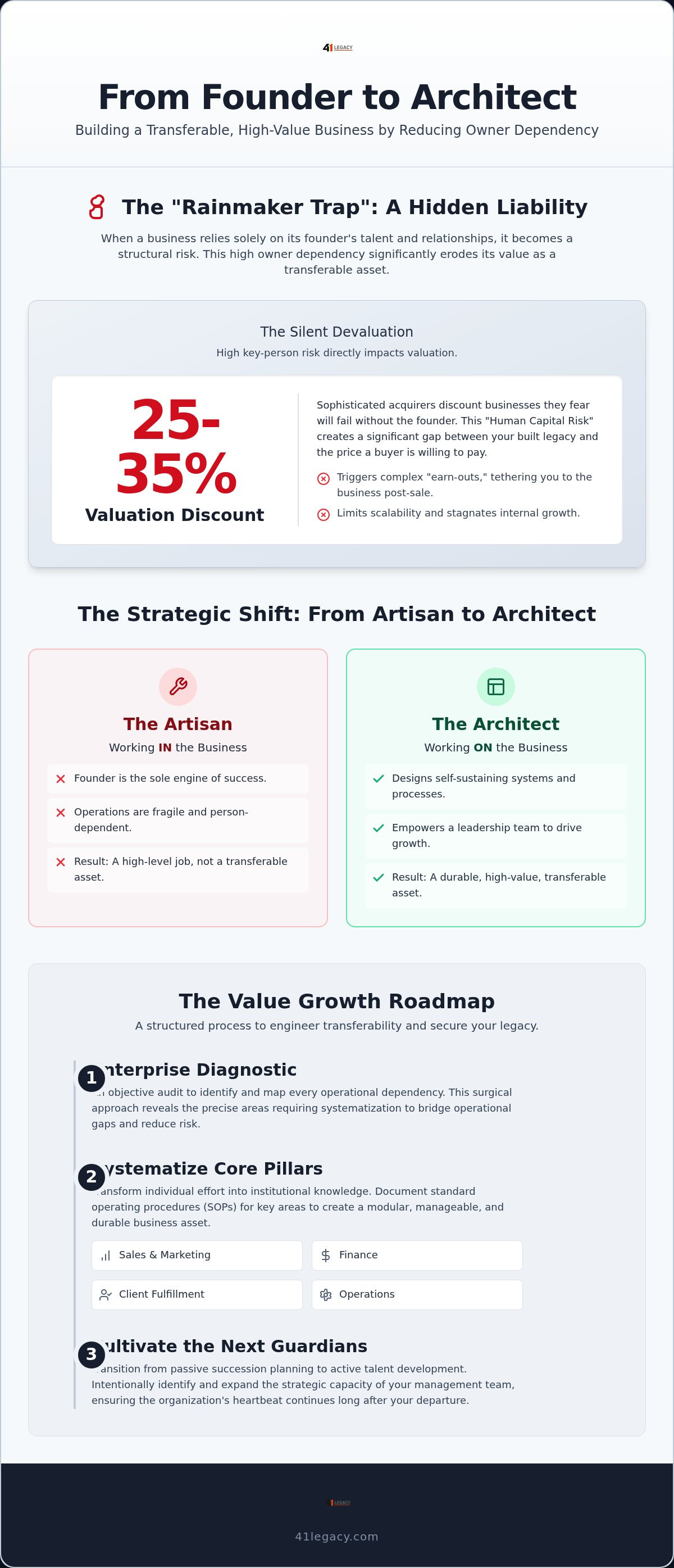
A business that cannot breathe without its founder is not an asset; it is a beautifully crafted cage. For the master artisan who has poured decades into their enterprise, the realization that daily operations grind to a halt in their absence is both a point of pride and a significant financial liability. Industry data suggests that businesses with high key person risk often face a 25 to 35 percent valuation discount. This makes reducing owner dependency before selling business the most critical strategic shift you can undertake. It is the vital transition from being the engine of the company to becoming its architect.
We recognize the weight of stewardship and the desire to see your life's work flourish long after your exit. You deserve an enterprise that functions with the same precision and elegance you brought to its inception. This article provides a roadmap for transforming a founder-led operation into a transferable, high-value asset that thrives independently. We will examine how structured enterprise diagnostics and transferability engineering can eliminate operational bottlenecks, elevate your valuation, and secure a legacy that survives your departure.
Key Takeaways
- Identify the "Rainmaker Trap" where founder-led excellence creates a structural liability that erodes enterprise value and limits market interest.
- Implement Transferability Engineering to transform standard operating procedures into a definitive blueprint for a self-sustaining legacy.
- Transition from passive succession planning to active talent development by identifying and expanding the strategic capacity of your management team.
- Utilize an Enterprise Diagnostic as an objective audit for reducing owner dependency before selling business, ensuring the entity is attractive to sophisticated acquirers.
- Orchestrate your transition using a Value Growth Roadmap to bridge the gap between your current operations and a high-value, transferable asset.
The Silent Devaluation: Why Owner Dependency Erodes Enterprise Value
Excellence is a double-edged sword. Many founders find themselves caught in the "Rainmaker Trap," where their personal talent and vision are the sole engines of the firm's success. While this mastery is a source of immense pride, it eventually becomes a structural liability during a transition. A business that relies on the founder’s unique relationships or technical skill is not a true enterprise; it is a high-level job. When you begin the process of reducing owner dependency before selling business, you are decoupling the entity's performance from your personal presence, transforming a job into a transferable asset.
Buyers do not simply invest in your past success. They are securing a claim on future cash flows. If those flows are tied to your daily involvement, they perceive a high level of "Human Capital Risk." This leads to the "Value Gap," the distance between the legacy you have built and the price a buyer is willing to pay for a business they fear will fail without you. Research from CT Acquisitions suggests that businesses with high owner dependency often suffer a valuation discount of 25 to 35 percent compared to their systematized peers. At 41 Legacy, we view the closure of this gap as a vital act of stewardship.
The Psychology of the Indispensable Owner
The emotional weight of being the sole decision-maker is often masked by founder pride. It is natural to feel a sense of accomplishment when every critical problem requires your hand to solve. However, this often hides operational fragility. True stewardship involves transitioning from a master artisan of the craft to a master architect of the business. This shift requires a commitment to Succession planning, ensuring that the organization’s heartbeat continues even when yours is no longer at the center of the office. This is not about relinquishing control; it is about establishing a legacy that endures.
Calculating the Cost of Your Presence
Dependency does more than just lower the initial offer. It often triggers complex "Earn-outs," where a significant portion of the sale price is contingent on you staying with the business for several years post-sale. If the business cannot run on autopilot, you remain tethered to the desk, unable to truly move on to your next chapter. Additionally, a founder-dependent model severely limits scalability. Internal growth stagnates because every new initiative must pass through a single bottleneck: you. By focusing on reducing owner dependency before selling business, you increase the multiples applied to your earnings and secure the freedom to depart on your own terms. A business that can thrive without you is the ultimate testament to your leadership.
The Architecture of Transferability: Systematization Beyond the Individual
Precision in engineering is what separates a fragile prototype from a timeless machine. In the context of your business, we call this Transferability Engineering. It is the deliberate process of shifting your focus from the daily craft to the structural architecture of the firm. While most owners spend years working "in" the business, true legacy is built by working "on" the systems that sustain it. This transition is verified through an Enterprise Diagnostic, which serves as a surgical audit to identify where your personal presence is still required to bridge operational gaps. By mapping these dependencies, we can begin the work of reducing owner dependency before selling business by replacing individual effort with institutional knowledge.
Standard Operating Procedures as Value Drivers
Documented systems are far more than administrative checklists; they are the tangible evidence of a company’s durability. When a buyer evaluates your firm, they are looking for proof that the results they see today can be replicated tomorrow without your intervention. This is why understanding what is an SOP in business is vital. These blueprints for excellence provide the confidence required to justify a premium valuation. By categorizing your operations into distinct pillars, such as Sales, Finance, Client Fulfillment, and Operations, you create a modular asset that is easy for a successor to manage. A well-documented process is a silent promise of future performance, effectively de-risking the acquisition for the next steward.
Implementing Technology as a Force Multiplier
In the modern landscape, manual intervention is often a symptom of structural inefficiency. High-value enterprises utilize Information Systems (IS) to replace the owner’s intuition with automated, repeatable workflows. This technological layer ensures that critical tasks are executed with surgical precision, regardless of who is in the room. By tracking Key Performance Indicators (KPIs), you can monitor the health of the organization from a distance. You move from a role of constant supervision to one of strategic oversight. This shift is essential for reducing owner dependency before selling business, as it proves the business is governed by data rather than personality.
Achieving this level of autonomy is the ultimate goal of any founder seeking a clean exit. It ensures that the essence of your brand is preserved through its systems rather than just its people. If you are ready to begin this process, our team can help you design a Value Growth Roadmap tailored to your specific legacy. This structured support allows you to build a business that thrives independently, reflecting the meticulous nature of your life’s work and ensuring it remains a high-value asset for years to come.
Cultivating the Next Guardians: Building a Leadership Team That Endures
The transition from a founder-led operation to a self-sustaining enterprise requires more than just systems; it requires souls capable of carrying the vision forward. We often see owners mistake a management layer for a leadership team. True reducing owner dependency before selling business involves elevating your staff from employees to stewards of a shared standard. This isn't merely succession planning, which often feels like a final act. Instead, it is a deliberate investment in Strategic Capacity Evaluation to identify those ready for stewardship. You must ensure your management layer has the width and depth to handle complexity without your daily intervention. Empowering decision-making at the lowest possible levels de-risks the enterprise and signals to future acquirers that the company's intelligence is distributed, not centralized.
From Management to Stewardship
To build a team that endures, you must align their personal success with the long-term health of the firm. Incentives such as phantom stock or stay bonuses transform the psychology of the workplace. It shifts the culture from one of passive compliance to one of active accountability. When your team views themselves as guardians of the legacy, they no longer require your oversight to maintain excellence. They become the curators of the brand's reputation. This evolution is often accelerated through Monthly Implementation Support, providing the structured guidance needed to bridge the gap between management and true leadership. This shift has a direct Talent Development’s Impact on Value, as it provides empirical evidence that the business can survive the departure of its creator.
Transferring the Essence of Client Relationships
One of the most significant threats to enterprise value is "Key Person Risk" within client relationships. According to Mercer Marsh Benefits, 67 percent of business leaders believe it is likely that a "key person risk" event will affect their business within the next three years. Reducing owner dependency before selling business requires a graceful, structured hand-off of these vital connections to your junior guardians. This process shouldn't be rushed. It involves a gradual introduction where the team demonstrates the same technical precision and care the client has come to expect. The craftsmanship of your service must be embedded in your documented processes, ensuring the client receives the same essence of quality regardless of who leads the meeting. By building a brand that stands for an uncompromising standard, you create an entity that is truly transferable and resilient.
The Exit Readiness Audit: Measuring the Depth of Your Footprints
An honest assessment is the first step toward true liberation. For the master artisan, the business is often an extension of the self, but for a buyer, that entanglement is a significant risk. By conducting a rigorous Enterprise Diagnostic, you begin the essential work of reducing owner dependency before selling business. This process is not a mere checklist; it is a surgical audit of your company’s autonomy. It forces you to look in the mirror and ask if the entity you’ve built can breathe on its own. If your fingerprints are on every decision, the business’s value is capped by your personal capacity.
The most revealing metric in this audit is the "Vacation Test." Can your business survive, or even thrive, during your 30-day absence? If you cannot step away for a month without the machinery of the firm grinding to a halt, you haven't built an enterprise; you've built a sophisticated cage. Acquirers will perform their own "Dependency Audit" during due diligence, looking for any concentration of knowledge that resides solely in your head. They seek to ensure that the keys to the kingdom are held by the organization’s systems and its secondary leadership, not just its founder.
The Five Pillars of Dependency Assessment
To understand the depth of the challenge, we analyze the business through five distinct pillars of involvement. Each one represents a potential bottleneck that could erode your legacy. We examine your role in:
- Sales and Business Development: Is the brand’s reputation tied to your personal charisma or a repeatable marketing engine?
- Technical Production: Can the service be delivered with surgical precision by your team without your constant oversight?
- Financial Management: Are bank relationships and capital structures institutionalized, or do they rely on your personal credit?
- Vendor Management: Do suppliers respond to the company’s standing or your personal handshakes?
- Conflict Resolution: Is there a professional culture of accountability, or are you the sole arbiter of employee disputes?
Identifying the "Value Gap"
The distance between your current valuation and your business's true potential is known as the "Value Gap." This gap is often widened by the very dependency you've cultivated to ensure quality. By comparing your current state to a future where the business is independent of your daily presence, you can set a clear timeline for reducing owner dependency before selling business. You can explore this further in our Determining Enterprise Value Guide, which outlines how to transition from a founder-centric model to a transferable asset. Closing this gap is the final act of stewardship, ensuring your life's work is prepared for its next guardian. If you're ready to see where your business stands, our Enterprise Diagnostic provides the clarity needed to begin your transformation.
The Value Growth Roadmap: Orchestrating Your Transition with Precision
The final movement in the creation of a transferable legacy is the orchestration of the transition itself. This is not a task for a single individual; it requires a symphony of experts working in perfect harmony. At 41 Legacy, we serve as the "Quarterback" of your professional advisory team, ensuring that every strategic move is aligned with your ultimate vision. Our Value Growth Roadmap is a structured, multi-year plan designed to build a transferable asset that remains resilient long after your departure. By reducing owner dependency before selling business, we transform the entity from a founder-led operation into a self-sustaining institution. This process is led by a Certified Exit Planning Advisor (CEPA) who specializes in aligning your personal, financial, and business goals into a single, cohesive strategy.
Strategic clarity is easily lost in the friction of daily operations. This is why our Monthly Implementation Support is vital. It provides the steady, unhurried guidance needed to ensure that the work of systematization and leadership development continues despite the demands of the present. We move beyond theoretical advice, providing the surgical precision required to execute the roadmap. This disciplined approach ensures that your business doesn't just look good on paper but functions with extreme precision in reality. We act as the guardians of your progress, keeping the focus on enterprise value while you continue to lead with passion.
The Coordinated Advisory Team
A successful transition requires the seamless integration of your CPA, Attorney, and Strategic Advisor. Without a central architect, these professionals often operate in silos, providing conflicting advice that can stall progress and erode value. Understanding The CEPA Difference is essential for any owner who values heritage as much as performance. We eliminate the silo effect by ensuring that every legal document, tax strategy, and operational system is designed to support the same legacy goal. This unified front de-risks the transition and ensures that the essence of the enterprise is preserved through the change of guard.
Securing Your Legacy
The transition from owner to steward is the ultimate act of leadership. It is the moment you realize that the greatest expression of your craft is not the service you provide, but the organization you have built to provide it. By reducing owner dependency before selling business, you are creating an entity capable of thriving for 41 years and beyond. This is the difference between a simple transaction and a lasting legacy. We invite you to slow down and appreciate the details of your firm’s potential. Your life's work deserves a future that is as uncompromising as your pursuit of perfection. To begin this transformation, we encourage you to Begin your Enterprise Diagnostic with 41 Legacy and discover the true depth of your business's value.
Architecting Your Final Masterpiece
Transitioning from a founder-led operation to a self-sustaining enterprise is the ultimate act of stewardship. It requires a deliberate shift from the daily craft to the structural architecture of the firm. By focusing on reducing owner dependency before selling business, you ensure that the essence of your brand survives while maximizing the enterprise value you've spent decades building. True legacy isn't found in being indispensable; it's found in creating a masterpiece that functions with surgical precision long after your departure.
Our team of specialists, led by Certified Exit Planning Advisors, provides the strategic clarity needed to bridge the gap between your current operations and a transferable asset. We utilize comprehensive Enterprise Diagnostics and a coordinated "Quarterback" approach to align your CPA, attorney, and advisors toward a single, uncompromising vision of perfection. This disciplined path transforms your business into a high-value entity that thrives independently of your daily presence. It's time to build a business that stands as a testament to your dedication, resilient enough to endure for generations.
Secure Your Legacy with a Value Growth Roadmap
Common Questions Regarding Enterprise Autonomy
How does owner dependency specifically affect my business valuation?
Owner dependency functions as a multiplier of risk. When a buyer perceives that cash flow relies on your personal involvement, they apply a steep discount to the valuation. Industry data suggests that businesses with high key person risk often see a valuation discount between 25 and 35 percent. This gap reflects the buyer's fear that the enterprise will collapse without your presence. It turns your life's work from a transferable asset into a personal obligation.
What is the "Vacation Test" and how do I perform it?
The Vacation Test is a practical audit of your company's autonomy. To perform it, you must step away from all operations for 30 consecutive days without any contact with your team. This absence reveals exactly where the machinery of the business fails. It highlights the bottlenecks and critical knowledge gaps that must be addressed. Successfully passing this test is a definitive milestone in reducing owner dependency before selling business and securing a lasting legacy.
Can I reduce owner dependency if I am the primary salesperson?
Yes, but it requires shifting from a charisma-led sales model to a process-driven marketing engine. You must document your unique approach to client relationships and train a secondary layer of guardians to manage these interactions. This ensures that the brand's reputation is institutionalized rather than tied to your personal identity. De-risking the revenue stream is essential for creating an asset that remains attractive to sophisticated acquirers who value stability over individual performance.
How long does it typically take to build a leadership team capable of running the business?
Cultivating a high-functioning leadership team is a deliberate process that typically requires 12 to 36 months. This timeline allows for the gradual transfer of decision-making authority and the testing of new systems under various conditions. It isn't a quick fix; it's a sophisticated engineering project. During this period, you move from active management to strategic oversight, ensuring your team possesses the strategic capacity to navigate the firm's future with surgical precision.
Do I need a Certified Exit Planning Advisor (CEPA) to reduce dependency?
While a founder can implement changes alone, a Certified Exit Planning Advisor (CEPA) provides the architectural framework necessary for success. They act as a quarterback for your advisory team, aligning your personal and financial goals with the business's structural readiness. A CEPA utilizes structured diagnostics and Value Growth Roadmaps to ensure that your efforts are efficient. This professional guidance helps you avoid the common pitfalls that often stall the transition process.
Will my business lose its "soul" if I systematize the operations?
Systematization is actually the most effective way to preserve your business's essence. By documenting your standards and philosophies, you ensure that the "soul" of the company is embedded in its DNA rather than just your personal habits. This captures your unique craftsmanship in a repeatable format. It allows your standards of excellence to endure for decades, protecting the legacy you've built from the natural erosion that occurs during a change of leadership.
What happens if I try to sell my business while it is still highly dependent on me?
Attempting to sell a highly dependent business often leads to disappointing outcomes. Only 20 to 30 percent of businesses put on the market successfully sell, often due to a lack of readiness. If a sale does occur, it usually involves heavy "earn-outs" that require you to stay with the firm for years post-sale. By reducing owner dependency before selling business, you increase the likelihood of a successful transaction and secure the freedom to depart on your own terms.
How do SOPs contribute to the transferability of my business?
Standard Operating Procedures (SOPs) are the blueprints of a transferable legacy. They provide a buyer with tangible proof that your results are not accidental but the product of a well-engineered system. Documented processes reduce the learning curve for a successor and ensure that the quality of service remains consistent. SOPs transform individual expertise into institutional capital, justifying a premium valuation and providing the strategic clarity needed for a smooth and successful transition.

Article by
Mike Laskowski
Mike Laskowski is a Business Value Growth Strategist who helps business owners uncover the truths that drive their performance, risk, and readiness. Blending forensic interviewing from a 26‑year federal career with Strategic Capacity analysis and CEPA methodology, he works upstream to reduce owner dependency, increase transferability, and strengthen enterprise value. Mike guides founders through clarity, operational evolution, and transition readiness so their companies become transferable, owner‑independent assets that endure beyond the founder.
Disclaimer
This article is for educational and informational purposes only and does not provide legal, tax, investment, or business brokerage advice. 41 Legacy does not offer M&A brokerage services, legal document drafting, tax preparation, or investment advisory services. Business owners should consult licensed professionals in those disciplines before making decisions related to business transactions, legal matters, tax strategy, or financial planning. All examples are illustrative and may not apply to your specific situation.