
Protecting Your Legacy When Selling Your Business: Build a Transferable Company
What if the strongest way to preserve your company’s legacy is to make it less dependent on you? If decisions, customer relationships, or financial insight rest largely with the owner, a future sale can put more than continuity at risk. Protecting your legacy when selling your business starts with clarifying what must endure, then building the people, systems, and financial visibility to support it beyond your leadership.
Legacy is about more than the final transaction. It includes the company’s identity, its people, and the value it can carry into its next chapter. This article explains how to identify what matters most, reduce owner dependency, and set clearer financial and strategic priorities for a future transition. “80 to 90 % of an owner’s net worth sits inside the business”. “Three weeks late is how old the average owner’s financial picture is when the decision has to be made”. For owners seeking greater financial clarity, 41 Legacy offers a fixed, six-week financial clarity intensive with one working session per week and weekly deliverables. Weeks 1 and 6 are identical for every client; weeks 2-5 are customized after week 1, and week 3 delivers a 13-week cash-flow forecast. The scope of each engagement is defined in the client’s written agreement. This article provides general information, not advice for a specific situation. 41 Legacy is not a CPA firm and does not provide audit, review, or other attest services, legal advice, or investment advice.
Key Takeaways
- Business legacy includes the value, culture, relationships, and capabilities that can continue beyond the founder, not just personal attachment to the company.
- Protecting your legacy when selling your business means reducing reliance on your decisions and relationships so the company can keep serving customers and employees.
- Make cultural priorities concrete by identifying the shared practices and observable decisions that should endure, while leaving future leaders room to adapt.
- Use a practical readiness framework to define what matters, map owner dependencies, assess continuity, clarify financial visibility, and align priorities.
- 41 Legacy’s fixed, six-week financial clarity intensive includes one working session per week and weekly deliverables. Weeks 1 and 6 are identical for every client, weeks 2-5 are customized after week 1, and week 3 delivers a 13-week cash-flow forecast. The scope of each engagement is defined in the client’s written agreement. This article provides general information, not advice for a specific situation. 41 Legacy is not a CPA firm and does not provide audit, review, or other attest services, legal advice, or investment advice.
What Does Protecting Your Legacy When Selling Your Business Really Mean?
A business legacy is the enduring value, culture, relationships, and capabilities an owner hopes to leave behind. It may be reflected in the company’s reputation, the standards behind its work, or the expertise that has shaped its place in the market. These qualities become part of the company’s story, but they are not the same as the founder’s personal memories or preferred way of doing business.
That distinction matters. An owner may feel deeply connected to a particular routine, decision, or chapter in the company’s history. The business, however, must be able to keep serving customers and employees as leadership changes. Protecting your legacy when selling your business means considering what should endure for the company’s sake, not assuming that every personal attachment must become a permanent operating rule. Preserving a legacy does not mean controlling every decision after ownership changes.
Which parts of your company’s legacy should continue?
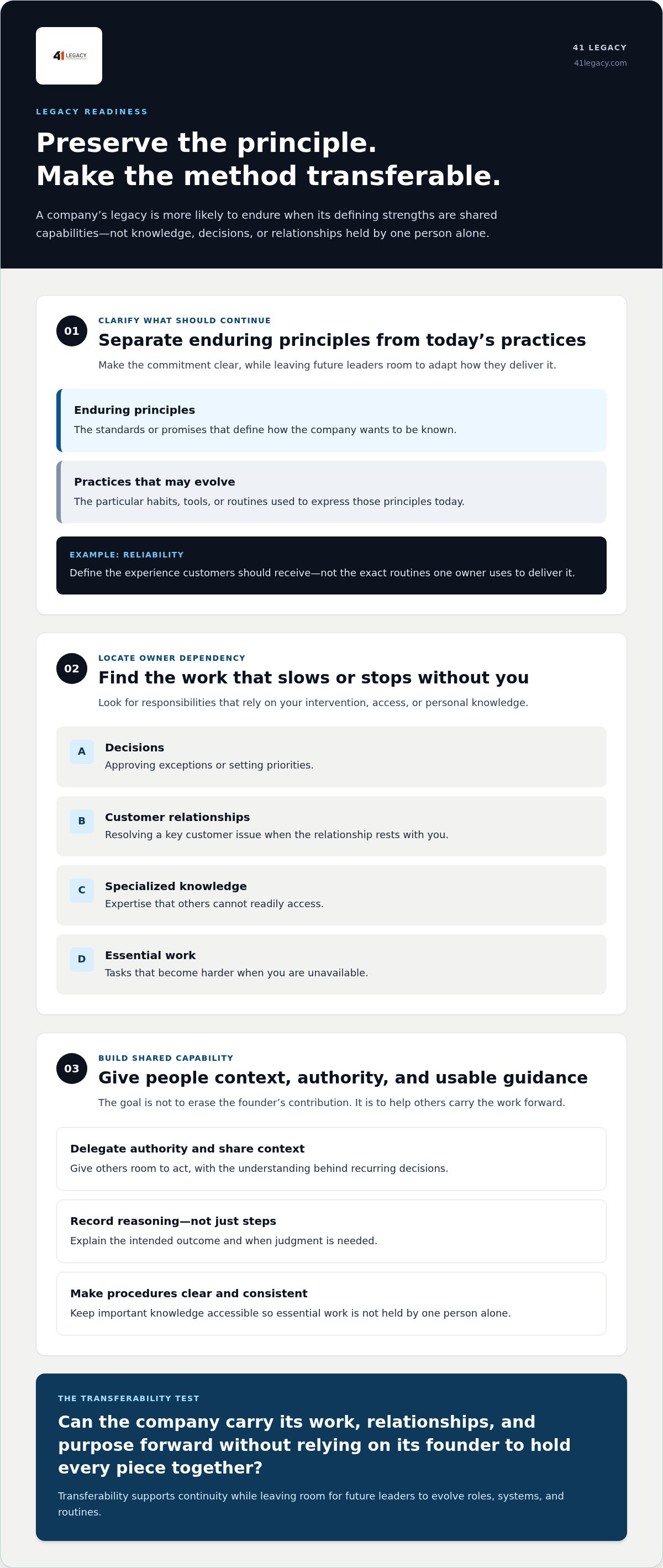
Begin by writing down the commitments you would want a future leader to understand. Then describe what each commitment means in practice. If the principle is reliability, for example, define the experience customers should receive rather than insisting on the exact routines you personally use to deliver it. That distinction gives the commitment substance while leaving room for another leader to adapt the method.
Consider each item in two categories:
- Enduring principles: the standards or promises that define how the company wants to be known.
- Practices that may evolve: the particular habits, tools, or routines used to express those principles today.
This separation can reveal where the company’s identity has become tied to personal preference. It also gives you a more useful way to talk about legacy: not as a demand that the company remain unchanged, but as a clear account of what should continue to matter.
Why a future sale deserves preparation before it feels immediate
Reflection is easier before a transition becomes urgent. With room to think, you can distinguish the company’s enduring purpose from the parts of its current form that reflect your individual style. You can also see whether people understand why certain commitments matter or simply follow familiar routines without that context.
Try recording one commitment you hope will endure, why it matters to the company, and what could change without compromising its meaning. For instance, a service promise might remain central even if the team changes how it schedules or delivers the work. Revisit the note as your understanding of the company’s future develops. This article offers general information, not advice for a specific situation.
How Transferability Helps Your Business Legacy Survive a Sale
Transferability is the company’s ability to keep doing its essential work without constant intervention from the owner. It depends on more than documented processes. Capable leaders need authority to make decisions, important knowledge must be accessible, and customer relationships should be supported by the business rather than held by one person alone.
Transferability is the ability of a company to carry its work, relationships, and purpose forward without relying on its founder to hold every piece together. That is the practical connection between transferability and legacy: the company’s defining strengths are more likely to endure when they are built into shared capabilities.
This does not mean a future owner will preserve every current practice. A new leader may change roles, systems, or routines. The goal is to make the principles and capabilities behind the company’s performance clear, so they can inform decisions even as the business evolves. Nationwide’s Succession Planning Guide also emphasizes connecting succession planning to long-term goals and the company’s changing needs.
Reduce owner dependency without erasing the founder’s contribution
Look for work that stops, slows, or becomes harder when you are unavailable. This may include approving exceptions, resolving a key customer issue, setting priorities, or holding specialized knowledge that no one else can readily access. Delegating authority and sharing context give others room to act. They do not diminish what the founder built; they help make that contribution useful beyond one person.
Capture the reasoning behind recurring decisions, not just the steps. A process note is more useful when it explains the intended outcome and when judgment is needed. Build on that foundation with clear, consistent procedures that the people responsible for the work can find and apply.
Make financial visibility part of a transferable foundation
Leaders need timely, decision-useful financial information to understand what the company can support and how choices may affect its direction. A clear view of profit and cash, considered alongside enterprise-value impact, can help an owner assess trade-offs and set priorities. It also gives future leadership a more coherent picture of the business than scattered reports or information held in the founder’s memory.
A useful question is whether your current financial picture arrives in time to inform a decision and whether it shows the expected cash and profit implications. Strategic financial visibility helps owners look ahead and weigh choices, rather than relying only on information that describes past activity.
Owners who want to examine financial priorities alongside transferability can explore 41 Legacy’s approach to strategic financial clarity. Clearer information can support thoughtful planning, but it cannot guarantee a particular transition outcome.
How to Balance Legacy Priorities With a Future Owner’s Needs
A company’s identity can endure without every current routine remaining unchanged. The practical task is to distinguish the commitments that define the business from the founder’s preferred way of expressing them. A future leader needs room to respond to customers, employees, and changing operating conditions. Clear priorities provide direction without prescribing every decision.
As part of protecting your legacy when selling your business, write down what you hope continues and why it matters. Then compare each priority with the company’s day-to-day needs and the flexibility future leadership will require. This is a planning aid, not a promise that every preference will remain in place.
Which legacy priorities are essential, and which can evolve?
Rank commitments by their importance to the company’s identity. Ask whether a priority protects a customer or employee commitment, or whether it reflects a personal preference about how work gets done. A founder may value responsiveness, for example, while a particular approval process is simply the current way of achieving it.
| Founder priority | Business continuity need | Room for future leadership |
|---|---|---|
| Customers receive a clear response to concerns. | Employees know who owns follow-up and how issues are resolved. | Leaders can update communication channels or assign responsibilities differently. |
| Employees have opportunities to develop. | Managers make time for useful feedback and skill-building. | Future leaders can adapt roles and development methods to the company’s needs. |
| Work meets the founder’s standard of quality. | Teams understand how quality is assessed and who addresses gaps. | Processes and tools can change while the intended standard remains clear. |
Use the comparison to identify which commitments are essential, which practices support them today, and which practices can change. A short legacy statement might say, “We earn customer trust by addressing concerns clearly and following through.” That is more useful than requiring a future leader to copy the founder’s exact communication style. Keep the statement as a guide for discussion, not as a legal agreement or a forecast of what future leadership will do.
How can the company’s story support continuity?
Record a concise account of the company’s milestones, difficult lessons, and decisions that shaped its values. Include the context behind important customer commitments and the knowledge employees rely on to deliver consistently. The purpose is not to create a polished origin story; it is to help future leaders understand why certain principles matter and how they became part of the company’s work.
A company story can deepen understanding of the trust customers have placed in the business and preserve institutional knowledge that might otherwise remain with its founder. Pair that context with observable practices, such as how teams handle a service concern or share expertise. Storytelling alone cannot ensure cultural continuity or a suitable sale. Shared expectations and the ability to apply them in daily decisions give the story practical weight.
A Practical Legacy-Readiness Framework Before You Sell
Legacy preparation becomes more useful when it moves from intention to a set of questions you can revisit. The aim is not to predict a sale outcome or lock the company into a fixed plan. It is to see where your purpose, people, operations, and financial information support a business that can continue beyond you. Use this framework to identify what is clear and where further work may be needed.
- Define the legacy you intend to carry forward. Write down the commitments that matter most to customers, employees, and the company’s identity. Describe how each commitment shows up in decisions or shared practices, rather than relying on broad values alone.
- Map dependencies. Identify essential relationships, recurring decisions, and specialized knowledge concentrated with you. For each one, note who else understands the context and could take greater responsibility. This is a high-level view of reliance, not a detailed operating manual.
- Assess continuity. Consider whether key work can continue if you are unavailable. Look at leadership capacity, access to important knowledge, and how responsibilities are understood across the company. Flag single points of dependence that could interrupt service or decision-making.
- Clarify financial visibility. Ask whether current information arrives in time to guide decisions and whether you can see the cash and profit implications of key choices. Consider those alongside enterprise-value impact, rather than viewing financial measures in isolation.
- Align priorities. Compare your legacy commitments with the company’s operating needs and the flexibility future leadership may require. Identify what should remain a guiding principle, what can change, and which legal, tax, or financial questions belong with your existing qualified professionals.
Map the people, knowledge, and decisions the business relies on
Make the dependency map concrete. Note relationships that rely on your personal history, decisions that routinely wait for your approval, and expertise that has no clear backup. Then consider where responsibility can be shared and where others need access to the reasoning behind past choices. This is not about removing the founder’s influence. It is about making the company’s capability less fragile.
Align legacy intentions with financial and strategic priorities
Before setting transition priorities, ask: What does the company need to sustain its work? Which commitments depend on owner involvement? What financial information would help me weigh a decision? How might a choice affect both current profit and cash, and the company’s longer-term enterprise value? A dual-lens view makes those trade-offs easier to examine without treating any one measure as a guaranteed result.
Preparation can clarify what you want the business to carry forward, but it cannot guarantee what a future transition will deliver. Use the answers to guide strategic work, and coordinate legal, tax, and financial questions with your existing qualified professionals. For support assessing financial clarity alongside enterprise-value priorities, explore 41 Legacy’s strategic financial support.
This article provides general information, not advice for a specific situation. 41 Legacy is not a CPA firm and does not provide audit, review, or other attest services, legal advice, or investment advice.
How 41 Legacy Supports Financial Clarity as You Protect Your Legacy
Protecting your legacy when selling your business also means understanding the financial choices shaping its next chapter. 41 Legacy’s fixed, six-week financial clarity intensive is a structured diagnostic for owner-operated companies with $1 M to $30 M in annual revenue. It clarifies the financial picture and identifies top profit levers before any ongoing work begins. The intensive supports informed strategic decisions, not a guaranteed sale or valuation outcome.
What the financial clarity intensive delivers
The Six-Week Financial Clarity Intensive includes one working session per week and weekly deliverables. Weeks 1 and 6 are identical for every client; weeks 2-5 are customized after week 1. The week 3 deliverable is a 13-week cash-flow forecast. The intensive also delivers a custom KPI tracking sheet, giving owners a focused way to track relevant performance measures.
Every recommendation uses a dual-lens evaluation: profit and cash impact alongside enterprise-value impact. This lets owners consider the near-term financial implications of a decision alongside its relationship to the company’s longer-term strength and transferability. The intensive provides structured insight for planning, not a prediction of what a future transition will deliver.
41 Legacy provides fractional CFO, financial advisory, and enterprise-value services. The scope of each engagement is defined in the client’s written agreement.
What ongoing strategic support can look like
After the intensive, the ongoing CFO Seat provides a monthly strategic finance rhythm. It includes budgeting, forecasting, KPI review, decision support, working-capital discipline, and enterprise-value tracking. For example, leadership can use a forecast to consider how a planned investment may affect available cash, then review relevant performance measures as the plan progresses.
The CFO Seat focuses on forward-looking decisions rather than backward-looking reports. Its strategic financial perspective can help owners connect financial information to the choices in front of them, including plans for capacity, cash needs, and enterprise value, without promising a particular result. It does not provide audit, review, legal, or investment advice.
A first conversation lasts 30 minutes: “No pitch. No pressure.” Information shared here is general, not advice for a specific situation. To explore a structured approach to financial clarity, Explore a structured financial clarity process.
Shape the Next Chapter With Intention
A future transition is not the only measure of a company’s legacy. The next chapter begins with the choices you make now: which commitments guide the business, how responsibility is shared, and what financial questions need clearer answers. Those choices can help turn protecting your legacy when selling your business from an aspiration into deliberate stewardship.
Choose one priority that matters to your company’s future and make it actionable. If customer trust is central, define how the team recognizes and maintains it. If continuity depends on your judgment, identify where another leader needs context or authority. Small, clear steps can make the company’s strengths more visible and more capable of enduring change.
Financial clarity can help you assess those priorities with greater perspective. Explore a structured financial clarity process to bring sharper insight to the decisions shaping your company’s next chapter.
Your legacy is not confined to what you built. It can live in a company prepared to carry its purpose forward.
Frequently Asked Questions
Can I protect my company’s culture after selling my business?
You can make the culture easier to understand and carry forward, but you cannot control every choice future leadership makes. Translate cultural expectations into examples: how managers respond when a deadline is missed, how customer concerns are escalated, or how employees receive feedback. These examples give new leaders context for decisions. They also help distinguish the company’s underlying commitments from habits that may change as the business evolves.
Is selling my business the only way to preserve my legacy?
No. A sale is one possible transition, not the only way to shape what you leave behind. You might develop leaders who can assume greater responsibility, plan for an internal transition, or continue building the company while retaining ownership. Consider what matters most to you: the company’s independence, its people, its customer relationships, or your own changing role. Clarifying those priorities can help you compare paths without assuming one outcome is right for every owner.
How far in advance should I prepare to sell my business?
There is no single preparation period that fits every company. Start examining readiness when a transition becomes a meaningful possibility, rather than waiting until a decision feels urgent. For example, if customer relationships or important approvals rest with you, strengthening leadership capacity may take attention before a transition is practical. The right preparation depends on your company’s needs, personal priorities, and the questions you need to resolve with your existing professional advisors.
What happens if my business depends heavily on me?
Heavy owner dependence can make routine decisions, customer service, or specialized work harder to sustain during a transition. Begin by identifying where your absence would cause a delay or leave others without the context to act. Then choose one responsibility to share more deliberately, such as giving a manager authority to resolve a defined class of customer issues. This helps reveal what additional judgment, information, or leadership support the company needs.
Can financial planning help me make decisions before a sale?
Yes. A clearer financial picture can help you compare business choices before a transition is imminent. For example, if you are considering a major investment, assess how it could affect cash available for operations as well as the company’s longer-term direction. Protecting your legacy when selling your business involves more than a future event; informed decisions today can help you build a company prepared for change. Legal, tax, and investment matters should be handled by your qualified professionals.
Should I tell employees and customers before selling my business?
There is no universal announcement schedule that suits every transition. Consider who needs information to maintain trust and keep the business operating, what can be shared responsibly, and how employees or customers may be affected by uncertainty. For instance, a team may need clear direction about reporting relationships, while a customer may mainly need reassurance about service continuity. Coordinate communication decisions with your existing qualified legal and professional advisors, based on your circumstances.

Article by
Mike Laskowski
Mike Laskowski is a Business Value Growth Strategist who helps business owners uncover the truths that drive their performance, risk, and readiness. Blending forensic interviewing from a 26‑year federal career with Strategic Capacity analysis and CEPA methodology, he works upstream to reduce owner dependency, increase transferability, and strengthen enterprise value. Mike guides founders through clarity, operational evolution, and transition readiness so their companies become transferable, owner‑independent assets that endure beyond the founder.
Disclaimer
This article is for educational and informational purposes only and does not provide legal, tax, investment, or business brokerage advice. 41 Legacy does not offer M&A brokerage services, legal document drafting, tax preparation, or investment advisory services. Business owners should consult licensed professionals in those disciplines before making decisions related to business transactions, legal matters, tax strategy, or financial planning. All examples are illustrative and may not apply to your specific situation.

