
Preparing Your Spouse for a Business Sale: A Guide
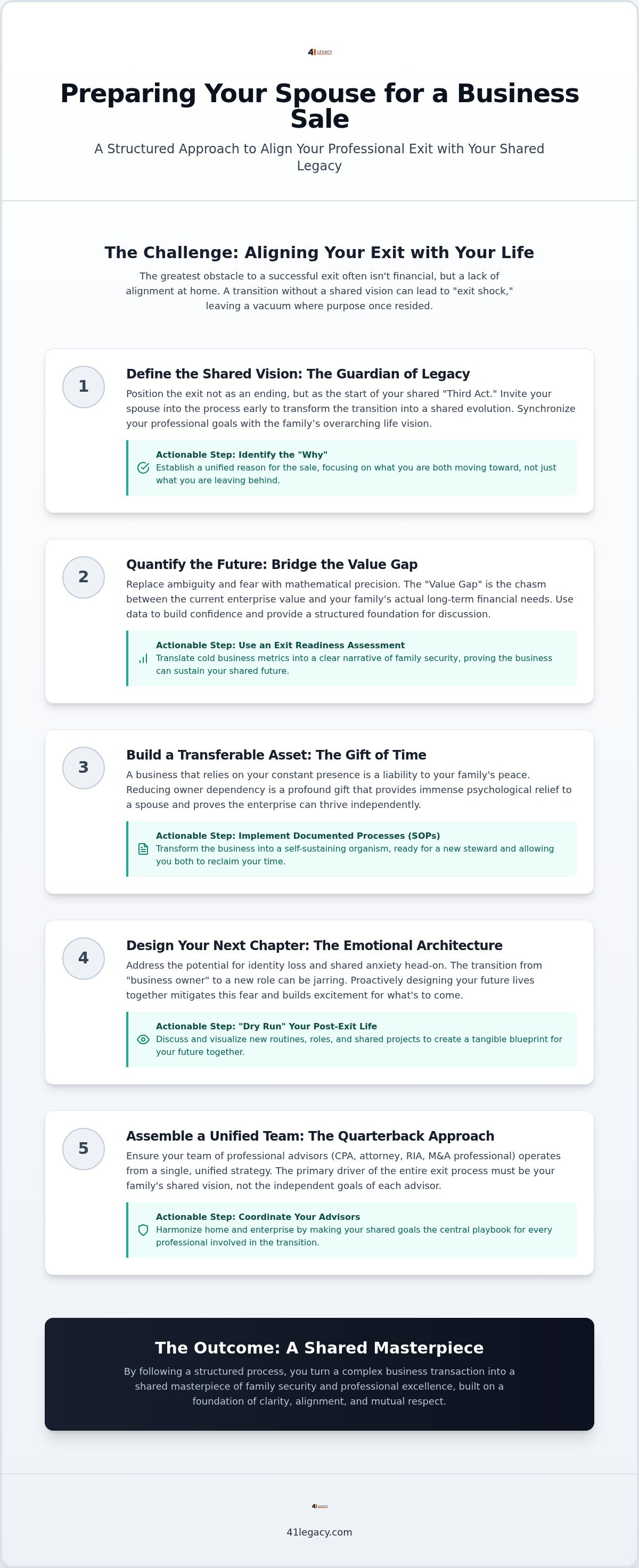
What if the most significant obstacle to your successful exit isn't a low valuation or a complex tax code, but a lack of alignment at your own dinner table? You've spent decades pouring your essence into an enterprise, treating it as a living entity that demands your constant devotion. It's natural to feel a sense of protective silence about its future, especially when you are considering how to prepare your spouse for selling the business. You likely worry about the void that remains when the work is finished and whether the enterprise value truly secures your shared future.
We'll show you how to master the sophisticated art of aligning your professional exit with your personal legacy. This process isn't merely about numbers; it's about stewardship. We will explore how to build a structured vision for your next chapter, ensuring your life's work becomes a transferable asset that provides lasting peace. By the end, you'll have the clarity needed to turn a complex transition into a shared masterpiece of family security and professional excellence.
Key Takeaways
- Define the spouse's role as a guardian of legacy to synchronize professional goals with the family’s overarching life vision.
- Master how to prepare your spouse for selling the business by using an Exit Readiness Assessment to bridge the gap between enterprise value and long-term financial security.
- Address the emotional architecture of a transition by "dry running" your post-exit life to mitigate identity loss and shared anxiety.
- Utilize Enterprise Diagnostics to provide a factual, structured foundation for home-based discussions regarding the business’s future and transferability.
- Coordinate your professional advisors through a unified strategy to ensure your family’s vision remains the primary driver of the exit process.
The Essential Alignment: Recognizing the Spouse as a Guardian of Legacy
The enterprise you have built is more than a collection of contracts and capital; it is a living narrative. For years, your spouse has acted as the silent steward of this narrative, supporting the culture of the business and the well-being of its founder from behind the scenes. When the time comes to transition, the most critical step is not found in the ledger, but in the synchronization of your professional exit with your family’s life vision. Understanding how to prepare your spouse for selling the business is the fundamental act of stewardship that ensures the transition is a triumph of legacy rather than a source of domestic friction.
Failing to achieve this alignment often leads to "exit shock." This occurs when the business is liquidated without an emotional or strategic foundation at home, leaving a vacuum where purpose once resided. You must position the exit not as a finality, but as the meticulous curation of a lasting impact. By inviting your spouse into the process early, you transform a potentially jarring separation into a shared evolution, where the business becomes a gift of security rather than a burden of identity.
The Philosophical Shift from Owner to Steward
Moving toward a successful exit requires a profound shift in perspective. You are no longer merely an owner fighting daily fires; you are a steward building a transferable asset. This distinction changes every conversation at the dinner table. When the focus moves away from operational chaos and toward long-term enterprise value growth, it creates space for your spouse to view the business through the lens of heritage. It's about crafting something that can thrive independently of your daily presence, ensuring the work you've done continues to provide for your family and community long after you've stepped away.
Identifying the Shared "Why" Behind the Exit
Establishing a shared vision for your "Third Act" is the anchor that prevents second-guessing during the high-pressure stages of a transaction. Your spouse likely possesses an intuitive understanding of the toll the business has taken on your time and spirit. Respecting this insight is vital for creating a unified front. Part of this preparation involves understanding business valuation as a tool for personal liberty. When you both agree on the "why" behind the sale, the financial outcomes align with your family goals, allowing you to step into the next chapter with confidence and mutual respect.
Quantifying the Future: Bridging the Value Gap Together
The transition of a business is often clouded by a specific, unspoken anxiety: the Value Gap. This is the chasm between the current enterprise value and the actual financial requirements of your family's next chapter. When considering how to prepare your spouse for selling the business, you must replace ambiguity with mathematical precision. An Exit Readiness Assessment serves as the diagnostic tool that illuminates this gap, offering your spouse the clarity needed to replace fear with confidence. It translates cold metrics into a narrative of security, proving the business is not just a source of income but a transferable asset capable of sustaining your shared future.
Enterprise Diagnostics go beyond simple accounting. They examine the very marrow of the organization to prove it can thrive without your daily presence. For a spouse who has witnessed the weight of the business on your shoulders, seeing objective proof of its independence is transformative. This process shifts the conversation from "what we are losing" to "what we have built." It turns technical valuation metrics into the language of family freedom, ensuring that the enterprise value is high enough to support the lifestyle you’ve both envisioned for your Third Act.
Reducing Owner Dependency as a Gift of Time
A business that requires your constant intervention is a liability to your family's peace. Reducing owner dependency is the most profound gift you can offer your spouse during this transition. By implementing SOPs and documented processes, you transform the enterprise into a self-sustaining organism. This technical refinement ensures the business survives the departure of its founder. For a spouse, the psychological relief is immense. They no longer see a business that consumes your every hour; they see a refined machine ready for a new steward, allowing you both to reclaim your time.
The Value Growth Roadmap as a Shared Blueprint
Trust is built through transparency and progress. A Value Growth Roadmap acts as a shared blueprint, detailing the milestones that signal when the business is truly "transferable." This isn't a vague hope but a structured progression. As you check off these milestones, your spouse witnesses the tangible increase in enterprise value and the simultaneous decrease in risk. This shared journey ensures that when the final signature is required, there is no hesitation. Engaging in Strategic Advisory provides the necessary coordination to keep these goals in focus, ensuring the business is always being prepared for its ultimate purpose: your family's lasting security.
Navigating the Emotional Architecture of a Business Transition
The transition of a life's work is an architectural feat that extends far beyond the balance sheet. It requires a deep understanding of the emotional structures that support your family's identity. For many founders, the business has served as the centerpiece of their daily existence for decades. Its removal can create an "Identity Void" that affects both the owner and the spouse. Addressing this void is a central component of how to prepare your spouse for selling the business. Without a clear vision for what replaces the enterprise, the silence that follows a sale can become overwhelming.
One effective strategy to mitigate this anxiety is "dry running" your post-exit lifestyle. This involves taking extended periods away from the business to test the rhythms of your next chapter before the transition is finalized. It allows both you and your spouse to discover whether your envisioned retirement or next venture actually provides the fulfillment you seek. This practice helps avoid "Connoisseur’s Regret," that lingering feeling of having sold a masterpiece too early or to a steward who doesn't respect its essence. By maintaining a "professional-room altitude" in these discussions, you keep emotional volatility at bay, treating your family’s future with the same strategic reverence you applied to the business itself.
The Spouse’s Role in Protecting the Essence
Your spouse often possesses a clearer view of the business’s soul than you do. While you are mired in the technicalities of the transition, they act as a guardian of your core values. Use their perspective to identify the "non-negotiables" of the sale, such as the preservation of company culture or the security of long-term employees. They serve as a vital sounding board for the "Market Attractiveness" of your plan, ensuring the transition honors your history while securing your future. Their intuition is a powerful tool for vetting potential successors who will respect the legacy you've built.
Building Strategic Capacity for the Next Chapter
Success in a transition isn't just about leaving; it's about where you are going. Building strategic capacity means developing interests and roles outside the enterprise well before the final signature. We call this "Legacy Engineering." It's the deliberate design of your family’s future impact, whether through philanthropy, mentorship, or new creative pursuits. When you view the sale as a victory for the family’s long-term mission rather than a loss of status, the transition becomes a moment of profound liberation. This alignment ensures that the next chapter is authored with purpose and shared excitement.
A Structured Framework for Spousal Preparation
The journey from business ownership to a successful exit shouldn't be a solitary endeavor. It requires a structured, intentional framework that invites your spouse into the process with clarity and respect. When you consider how to prepare your spouse for selling the business, you're essentially designing a shared path toward freedom. This isn't a single conversation but a series of deliberate steps taken over several years to ensure the enterprise is ready and the family is aligned.
- Step 1: Initiate early. Begin the dialogue three to five years before your desired exit date. This timeframe allows for the meticulous refinement of the business without the pressure of an imminent transaction.
- Step 2: Share Enterprise Diagnostics. Use the results of your initial diagnostics to ground every discussion in reality. It moves the conversation from emotion to objective fact, showing exactly where the business stands.
- Step 3: Define the Gaps. Identify the "Wealth Gap" and "Value Gap" together. Financial alignment is the bedrock of spousal confidence; they need to know the sale will support the family’s long-term vision.
- Step 4: Formalize the Advisory Team. Implement the "Quarterback" model. By introducing your spouse to a coordinated team of experts, you demonstrate that the transition is being handled with professional precision.
- Step 5: Review the Roadmap. Commit to reviewing your Value Growth Roadmap quarterly. This maintains momentum and ensures transparency throughout the multi-year preparation phase.
The Power of the Quarterly Update
Treat your spouse with the same reverence you'd accord a board member. Regular, high-level strategic updates keep them informed without overwhelming them with daily operational fires. During these sessions, focus on "Transferability Engineering" progress. Highlight how the business is becoming less dependent on you and more attractive to future stewards. These meetings are also the ideal time to recalibrate your timeline if family needs or market conditions shift, ensuring you're always moving in harmony.
Inviting a CEPA into the Family Conversation
A Certified Exit Planning Advisor acts as a neutral facilitator, helping to bridge the gap between your professional ambitions and your spouse’s personal needs. Professional mediation is invaluable for navigating difficult discussions about risk and identity. It ensures your spouse feels heard and respected by the entire advisory team. By bringing in a specialist, you elevate the conversation to a "professional-room altitude," where every decision is made with the family’s legacy in mind. To begin building this foundation of trust, you can explore our Strategic Advisory services for structured guidance.
The Quarterback Approach: Harmonizing Home and Enterprise
The culmination of a life's work deserves a transition that is as meticulously crafted as the enterprise itself. A successful exit is rarely the result of a single brilliant move; it's the product of a harmonized advisory team. 41 Legacy serves as the Quarterback in this process, ensuring that the technical precision of your CPAs and attorneys is perfectly aligned with your family’s vision. This coordination is the final, essential element of how to prepare your spouse for selling the business. By centralizing the strategic direction, we filter out the technical noise that often creates unnecessary stress at home, allowing you and your spouse to focus on the curation of your next chapter.
A structured implementation support model ensures the exit plan doesn't become an additional burden or another "job" for the owner to manage. Instead, it serves as an authoritative guide that keeps all parties moving in the same direction. By positioning the Exit Planning process as a tool for family harmony, we transform what could be a period of high volatility into a period of shared purpose. It's about building a bridge between your professional success and your family’s long-term legacy preservation.
Coordinating the Professional Advisory Team
Professional advisors often operate within the narrow confines of their specific disciplines. An attorney might focus exclusively on risk mitigation, while a CPA prioritizes tax efficiency. Without a central guiding force, the owner is forced to act as a translator between these silos, a role that often leads to exhaustion and domestic tension. Our model ensures that every advisor is working toward the singular goal of creating a "Transferable Asset." This unified approach reduces the emotional burden on the owner and provides the spouse with a clear, consistent narrative of progress. It transforms a complex transaction into a seamless, low-stress environment where the family’s needs remain the primary focus.
Securing the Legacy Through Strategic Clarity
Finalizing a business transition should feel like the unveiling of a masterpiece. It's the moment where years of disciplined value growth and owner-dependency reduction finally manifest as true freedom. When you have the strategic clarity that comes from objective diagnostics, you can step away with the absolute confidence that the business will thrive under new stewardship. This is the pinnacle of stewardship: building an entity so resilient it no longer needs its creator. We invite you to begin this diagnostic journey today by exploring our Strategic Advisory support. It's the first step in ensuring your professional exit is a lasting gift of security to your family.
Cultivating a Shared Vision for Your Third Act
The transition of your life's work is the ultimate act of stewardship. By aligning your professional exit with your family's vision, you transform a complex transaction into a shared legacy of security. We've explored the necessity of bridging the Value Gap and navigating the emotional architecture of change through a structured, multi-year framework. Understanding how to prepare your spouse for selling the business ensures that the final signature is met with confidence rather than uncertainty.
Under the leadership of a Certified Exit Planning Advisor (CEPA), we provide the strategic clarity needed to reduce owner dependency and strengthen transferability. Our custom Value Growth Roadmaps and expert coordination of your entire advisory team ensure your enterprise thrives independently while your family's future remains protected. You've built a masterpiece; now it's time to engineer its lasting impact through precise coordination and a unified strategy.
Begin your journey toward a transferable legacy with an Exit Readiness Assessment from 41 Legacy. Your next chapter deserves the same dedication to excellence that defined your career. We're here to ensure your transition is as seamless as it is significant.
Frequently Asked Questions
When is the best time to tell my spouse I am thinking about selling?
The most effective time to initiate this conversation is three to five years before your anticipated transition date. Early dialogue provides the necessary space to align your professional goals with your family's life vision without the pressure of an imminent sale. This timeframe allows you to utilize Enterprise Diagnostics to build a transferable asset. It ensures your spouse is a partner in the curation of your legacy rather than a spectator to a sudden change.
How much information should my spouse have about the business valuation?
Your spouse should have access to high-level strategic data that confirms the business's ability to support your shared future. While they don't need to master every granular accounting metric, understanding the core enterprise value is essential for their peace of mind. Providing this clarity during an Exit Readiness Assessment transforms the business from a complex operation into a tangible asset. It allows them to see the enterprise as a source of long-term family security.
What if my spouse is afraid of our financial future after the sale?
Fear often stems from a lack of objective data regarding post-exit stability. You can alleviate this anxiety by sharing the results of a Value Growth Roadmap, which illustrates the path toward bridging the financial gap. Knowing how to prepare your spouse for selling the business involves replacing uncertainty with a structured plan for wealth preservation. When the numbers align with your family's needs, the transition feels like a victory rather than a risk to your lifestyle.
How can an Exit Planning Advisor help with family disagreements about the exit?
A Certified Exit Planning Advisor (CEPA) serves as a neutral facilitator who maintains a professional-room altitude during sensitive discussions. They help align your professional ambitions with your spouse's personal needs, ensuring both voices are heard and respected. By acting as a Quarterback for your advisory team, they coordinate the technical efforts of CPAs and attorneys. This structured support reduces domestic friction and keeps the focus on building a lasting, transferable legacy for the family.
Does my spouse need to be involved in every meeting with my advisors?
Involvement should be strategic rather than operational. Your spouse doesn't need to attend every technical meeting with CPAs or attorneys, but they should participate in high-level milestones. These include the initial Enterprise Diagnostics and quarterly reviews of the Value Growth Roadmap. This balanced approach respects their time while ensuring they remain a guardian of the family's vision. It keeps them informed of progress without dragging them into the daily minutiae of the business.
How do we handle the emotional attachment my spouse has to the business?
Emotional attachment is a testament to the reverence you've both shown the business over the years. We address this by viewing the transition as the curation of a masterpiece rather than a simple liquidation. Through Legacy Engineering, you can design a future impact that honors the business's history while creating new purpose. Dry running your post-exit life also helps ease this transition. It allows you both to discover meaningful roles outside the enterprise before the sale.
What is the "Value Gap" and why does it matter to my spouse?
The Value Gap represents the difference between the current enterprise value and the amount required to fund your family's desired lifestyle after the exit. It matters to your spouse because it's the primary metric of their future financial security. Identifying this gap through an Exit Readiness Assessment provides the clarity needed for a confident transition. Closing this gap ensures the business is a truly transferable asset that can thrive independently while providing for your family's next chapter.
Can preparing my spouse actually increase the value of my business?
Strategic alignment at home directly impacts enterprise value by allowing the owner to focus on Transferability Engineering. When you know how to prepare your spouse for selling the business, you reduce the emotional volatility that can lead to rushed or poor decisions. A spouse who supports the Value Growth Roadmap helps ensure the business becomes less dependent on the owner. This reduction in risk makes the company significantly more attractive to potential buyers and future stewards.

Article by
Mike Laskowski
Mike Laskowski is a Business Value Growth Strategist who helps business owners uncover the truths that drive their performance, risk, and readiness. Blending forensic interviewing from a 26‑year federal career with Strategic Capacity analysis and CEPA methodology, he works upstream to reduce owner dependency, increase transferability, and strengthen enterprise value. Mike guides founders through clarity, operational evolution, and transition readiness so their companies become transferable, owner‑independent assets that endure beyond the founder.
Disclaimer
This article is for educational and informational purposes only and does not provide legal, tax, investment, or business brokerage advice. 41 Legacy does not offer M&A brokerage services, legal document drafting, tax preparation, or investment advisory services. Business owners should consult licensed professionals in those disciplines before making decisions related to business transactions, legal matters, tax strategy, or financial planning. All examples are illustrative and may not apply to your specific situation.

