
Transferability & Owner Dependency
Preparing Your Business for Transition: Maximize Your Value
The most profound measure of a master's work is not how it functions in their presence, but how it thrives once they've departed. If your daily involvement is the only thing keeping the gears turning, you haven't built an enduring enterprise; you've built a high-stakes job. We recognize the weight of this reality. You've spent decades as a dedicated steward of your craft, yet the uncertainty of market value and the fear of a messy departure can feel overwhelming. Preparing business for transition is not merely an exit strategy. It is the highest form of operational maturity and the ultimate expression of enterprise value.
In a market where lower-middle-market businesses currently see EBITDA multiples averaging 5.5x, the difference between a founder-dependent firm and a transferable asset is measured in significant capital. We'll show you how to transform your life's work into a high-value legacy that thrives independently. This guide outlines the roadmap to increase value through strategic capacity evaluation and owner-dependency reduction. You'll gain the clarity needed to coordinate your advisory team and ensure your business remains a polished, transferable asset ready for its next chapter.
Key Takeaways
- Shift your perspective from being a daily operator to a steward of a transferable asset, recognizing that true business maturity is found in its ability to thrive without you.
- Utilize an Enterprise Diagnostic to uncover the "Value Gap" and gain absolute clarity on the distance between your current valuation and your ultimate financial goals.
- Protect your life's work by reducing owner dependency, effectively dismantling the "Rainmaker Trap" to ensure the business functions as a sophisticated, independent entity.
- Master the art of preparing business for transition by deploying a Value Growth Roadmap that orchestrates your team of advisors with surgical precision.
- Transition from high-level strategy to tangible results through monthly implementation support, securing your legacy through intentional transferability engineering.
The Philosophy of Exit Readiness: From Founder to Steward
The true essence of an enterprise is rarely found in its current cash flow. Instead, it lives in the business's ability to exist, evolve, and flourish long after its architect has stepped away. Preparing business for transition is the deliberate act of refining a founder-dependent operation into a sophisticated, transferable asset. This process is less about the finality of an exit and more about the precision of stewardship. We view the business owner not as a temporary manager, but as a curator of a legacy that deserves to endure. This requires a rigorous discipline we call Transferability Engineering. It is the surgical process of decoupling the company’s value from the founder’s daily breath, ensuring the internal mechanics are polished to a high sheen.
The Distinction Between Succession and Transition
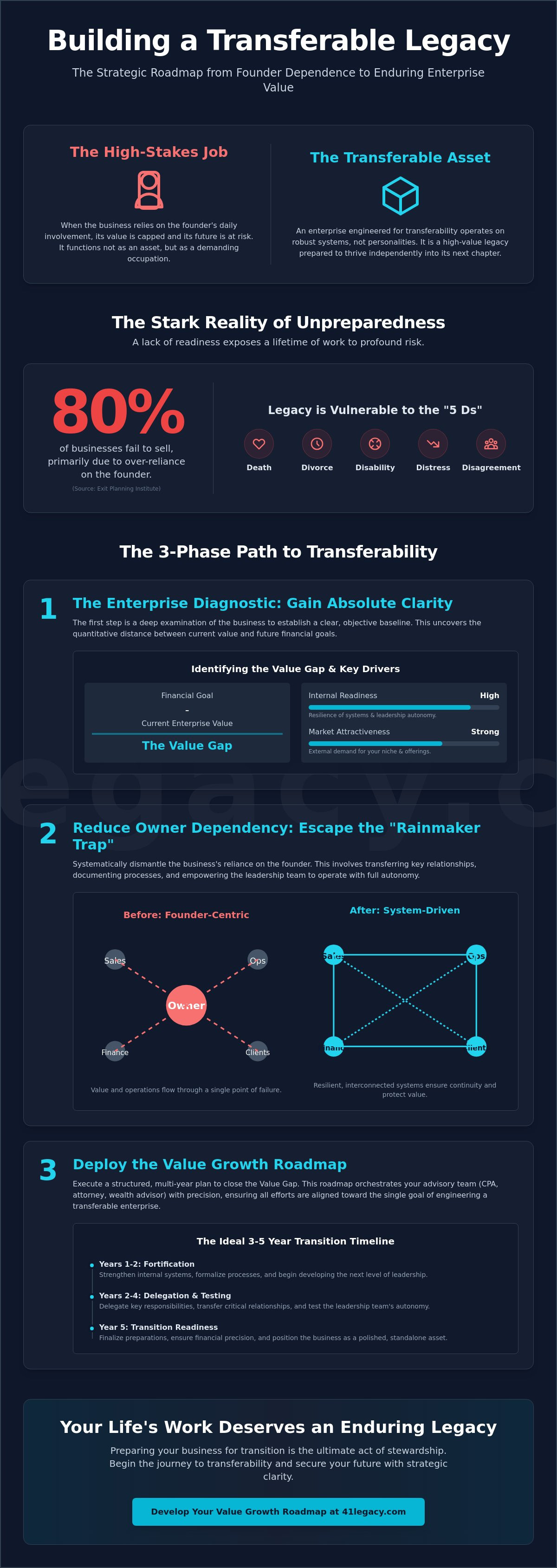
Many owners conflate the appointment of a new leader with the complete transfer of a business's essence. Succession planning addresses the "who" of future leadership, focusing on talent pipelines and management continuity. However, a true transition encompasses the "how" of ownership and the preservation of institutional value. It’s a deeply emotional endeavor, as it involves the handoff of a life’s work. To achieve this harmony, the process must begin three to five years before the intended departure. This window allows for the meticulous strengthening of systems that ensure the business is a standalone masterpiece rather than a reflection of a single individual. It is during this time that the foundation of a transferable asset is truly poured and set.
The Cost of Unpreparedness
The tragedy of a messy transition is often preventable, yet the data suggests a widespread lack of readiness among even the most successful entrepreneurs. According to the Exit Planning Institute, approximately 80% of businesses fail to sell, often because they remain too deeply intertwined with their founders to be viewed as viable assets by outsiders. Without proactive preparation, owners leave their legacies vulnerable to the "5 Ds": Death, Divorce, Disability, Distress, and Disagreement. These catalysts force a transition under duress, often eroding decades of value in a matter of months. By engaging in a structured Exit Readiness Assessment, owners can identify these vulnerabilities early. Proactive planning acts as a protective layer, ensuring that the transition occurs on the owner’s terms rather than as a reaction to external chaos. This level of preparation transforms the business into a durable entity that can withstand the progression of time.
The Diagnostic Phase: Identifying the Value Gap
To build a lasting legacy, one must first confront the current reality with unflinching clarity. The Enterprise Diagnostic serves as the initial masterstroke in preparing business for transition. It’s more than a cursory glance at the ledger; it’s a deep examination of the business's inner essence. Central to this phase is identifying the "Value Gap." This is the quantitative distance between the current market value of the enterprise and the financial harvest required to fund the owner's future aspirations. Bridging this chasm requires a baseline valuation that transcends simple industry multiples, accounting for the unique craftsmanship inherent in the operation. Without this baseline, an owner is navigating without a compass, risking a lifetime of work on a guess.
Measuring Market Attractiveness and Internal Readiness
Value is not a static number but a reflection of harmony between internal strength and external demand. We evaluate internal readiness by the resilience of your systems and the autonomy of your leadership team. If the business cannot breathe without the founder, readiness is low. Conversely, market attractiveness measures the appetite of the world for your specific niche. When these two forces intersect, they create the "Value Multiple." A business with high internal readiness but low market attractiveness may struggle to find a steward. However, a business that excels in both becomes a rare, high-value asset. Understanding this intersection is vital for any owner seeking Enterprise Diagnostics to secure their future. It allows us to pinpoint exactly where the infrastructure needs reinforcement to command a premium in the eyes of a successor.
The Role of Financial Precision
Standard accounting often prioritizes tax mitigation, which obscures the true earning power of a legacy. For a successful transition, financials must be "recast" to reflect the actual economic benefit the business provides. This process strips away owner-specific expenses and non-recurring events to reveal the underlying pulse of the company. It transforms a tax document into a testament of performance. Enterprise value is the present value of future risk-adjusted cash flows. Achieving this level of precision ensures that you aren't just selling a company, but transferring a verified engine of wealth. It's about moving from raw data to a narrative of excellence that sophisticated advisors and successors can respect. This financial clarity is the bedrock upon which the entire transition is built, providing the confidence that your life's work is valued appropriately.
Reducing Owner Dependency: Escaping the Rainmaker Trap
The presence of a founder is often the very thing that limits the future of an enterprise. While your personal involvement was the catalyst for early growth, it eventually becomes the single greatest risk to enterprise value. We frequently observe this in the "Rainmaker Trap," a state where the architect of the business remains its primary engine of sales and operational decision-making. This creates a fragile structure that cannot survive the weight of its own success without you. To a successor, your indispensability is not a virtue; it is a liability that requires mitigation. Preparing business for transition necessitates a profound psychological shift. You must evolve from being the indispensable center of the universe to becoming the silent observer of a self-sustaining system. When a business relies on a single individual’s intuition, it introduces a significant discount factor for potential buyers, as the risk of failure increases the moment you depart.
Engineering Transferability Through Systems
True transferability is engineered through the rigorous documentation of Standard Operating Procedures (SOPs). These documents serve as the blueprints that protect the essence of your brand, ensuring that your meticulous standards of excellence are maintained without your direct oversight. Systems act as the connective tissue of the organization, allowing it to function as a living entity with its own story to tell. We provide strategic advisory to help owners cultivate this system-driven growth, transforming intangible knowledge into a tangible, transferable asset. By codifying your unique processes, you ensure the integrity of the work remains uncompromised during the transition of ownership.
Building Strategic Capacity in Leadership
Strategic capacity is built by dismantling the traditional "hub and spoke" management model. Instead of every decision flowing through a single point of failure, we help you empower a decentralized, second-tier management team. This shift increases buyer confidence by proving the business possesses its own pulse and intellectual capital. A strong leadership layer demonstrates that the company’s success is a result of collective engineering rather than individual heroics. We recommend testing this capacity through a deliberate, extended owner absence. If the enterprise continues to function at a high level while you are away, you have successfully built strategic capacity. This evidence of autonomy is what ultimately commands a premium valuation in the marketplace, signaling that the business is truly ready for its next chapter.
The Value Growth Roadmap: Orchestrating the Transition
True enterprise value is not discovered; it's engineered with the same precision one might find in a master artisan's studio. The Value Growth Roadmap serves as the definitive implementation plan for those preparing business for transition, moving beyond high-level theory into the granular details of enterprise enhancement. We believe that strategic clarity is the foundation of every advisory decision. Without this clarity, the various facets of your business, financial, operational, and structural, remain disconnected and vulnerable. This roadmap ensures that every action taken is a deliberate step toward increasing the intrinsic worth of your life's work. It treats the transition as a continuous evolution of maturity rather than a single, isolated transaction that occurs at the end of a career.
Aligning the Professional Advisory Team
A common tragedy in the world of high-stakes business is the siloed nature of professional advice. Your CPA focuses on tax mitigation, your attorney on risk management, and your RIA on personal wealth, yet these specialists rarely speak the same language or share a singular vision. We assume the "Quarterback" role to harmonize these voices. By providing a lead advisor, often a Certified Exit Planning Advisor (CEPA), we ensure that legal structures, tax strategies, and growth initiatives are perfectly aligned. The coordination of these experts requires more than just communication; it requires a singular vision that prioritizes the health of the enterprise. When advisors operate in isolation, the owner is often left to translate complex technical advice into a cohesive strategy. We act as the central point of integration, ensuring that a tax decision made by the CPA doesn't inadvertently compromise a legal protection drafted by the attorney. This level of oversight ensures the business remains a polished, transferable asset at every stage of the journey.
Monthly Implementation and Accountability
The most sophisticated strategies often fail not due to a lack of vision, but a lack of momentum. The Value Growth phase is where the roadmap meets the reality of daily operations. We provide Monthly Implementation Support to ensure that the work of building a transferable asset remains a priority amidst the noise of running a company. This ongoing discipline keeps the leadership team focused on high-value activities that directly impact the bottom line. Consistency in execution is what transforms a roadmap into realized value. Through this steady, unhurried rhythm of accountability, we help you secure the future you've envisioned. To begin crafting your own tactical path, explore our Value Growth Roadmap and strategic advisory services.
Securing Your Legacy with 41 Legacy
Every masterpiece requires a guardian who understands its inherent worth. At 41 Legacy, we don't view your company as a mere series of transactions; we see it as a legacy that demands a profound level of preservation and respect. Preparing business for transition is the most significant undertaking of your professional life, requiring a partner who operates with the same level of technical precision you applied to building the firm. We're dedicated to the belief that a business should be a transferable asset, capable of flourishing long after its architect has moved to the next chapter. This is achieved through the rigorous discipline of Transferability Engineering. Our commitment to stewardship ensures your impact is felt for generations, protecting the essence of what you've created while maximizing its enterprise value.
The 41 Legacy Process: Precision and Reverence
Our unique "Diagnostic to Implementation" framework begins with an Enterprise Diagnostic, a surgical assessment that uncovers the hidden risks and opportunities within your operation. This leads directly to a Value Gap analysis. We quantify the distance between your current reality and the financial harvest required to fund your future aspirations. From there, we engineer a custom Value Growth Roadmap. This tactical plan isn't a simple suggestion; it's a blueprint for operational maturity. We focus heavily on Owner Dependency Reduction and Strategic Capacity Evaluation, ensuring your leadership team is prepared to carry the torch with confidence. Throughout the implementation phase, we provide the "Quarterback" support needed to coordinate your CPAs, attorneys, and RIAs. We ensure every professional is aligned with your singular vision of excellence, removing the burden of coordination from your shoulders and replacing it with strategic clarity.
Taking the First Step Toward Exit Readiness
The most opportune moment to begin this journey is while the sun is shining on your enterprise. Waiting for a "5 D" event to force your hand is a risk that compromises decades of meticulous work. By starting three to five years in advance, you afford yourself the luxury of time to refine systems and build the strategic capacity necessary for a seamless handoff. Preparing business for transition requires a willingness to view your creation through a new lens, moving from the role of daily operator to that of a visionary steward. We invite you to begin with a candid assessment of your current state, as this clarity is the first step toward transforming your daily involvement into a lasting, high-value asset. Explore how 41 Legacy can help you protect and grow your enterprise value.
The Architecture of an Enduring Legacy
The transition of a business is the final, most intricate layer of its construction. It requires a shift from the intensity of a founder to the quiet strength of a steward. By identifying the value gap through rigorous diagnostics and dismantling the rainmaker trap, you transform your life's work into a self-sustaining asset. Preparing business for transition isn't an end; it's the realization of true enterprise maturity. This process ensures that the essence of your brand remains uncompromised as it passes to the next generation of leadership.
Our team, led by a Certified Exit Planning Advisor (CEPA), provides the surgical precision needed to navigate this evolution. We utilize a structured Enterprise Diagnostic framework and a proven Value Growth Roadmap methodology to ensure every strategic move is aligned with your ultimate goals. This isn't a solitary endeavor but a coordinated orchestration of your professional advisory team toward a singular vision of excellence. Your legacy deserves a guardian who values its history as much as its future potential.
Begin Your Exit Readiness Journey with 41 Legacy
You've spent a lifetime building something remarkable. Now, let's ensure it stands the test of time.
Frequently Asked Questions
What is the difference between business succession and business transition?
Succession focuses on leadership continuity, while transition encompasses the total handoff of ownership and the business's core essence. Succession ensures a new leader is ready to hold the reins, but transition ensures the business itself is a transferable asset. It's the difference between appointing a new conductor and ensuring the orchestra can play the masterpiece without the original composer.
How far in advance should I start preparing my business for a transition?
You should ideally begin the process 3 to 5 years before your intended departure. This unhurried timeline allows for the meticulous refinement of systems and the strengthening of the leadership layer. Preparing business for transition is a time-intensive endeavor that shouldn't be rushed if you wish to maximize the enterprise's market value and ensure its long-term health.
What are the main drivers of enterprise value in a private company?
Enterprise value is driven by financial performance, the resilience of internal systems, and the autonomy of the management team. While revenue is the pulse, the "Value Multiple" is determined by how well the business functions as a standalone entity. A high-value business is one where the internal mechanics are polished to a high sheen, attracting successors who value both heritage and performance.
Why is my business worth less if I am the primary rainmaker?
A business is worth less when the founder is the primary rainmaker because it introduces significant risk to the successor. If the founder’s personal intuition is the only engine of growth, the enterprise lacks its own intellectual capital. Reducing this dependency is a core discipline in preparing business for transition, as it proves the company can thrive independently of its architect.
Can my current CPA handle my business transition planning?
While your CPA is a vital member of the team, transition planning usually requires a dedicated lead advisor to orchestrate the entire process. CPAs are traditionally focused on historical compliance and tax mitigation rather than the forward-looking engineering of transferability. You need a lead advisor who can coordinate your CPA, attorney, and wealth advisor toward a single, strategic goal.
What is an Exit Readiness Assessment and why do I need one?
An Exit Readiness Assessment is a sophisticated diagnostic that measures the transferability of your business and identifies the "Value Gap." It provides an unflinching look at your current readiness and market attractiveness. You need this assessment to transform your intuition into a data-driven roadmap, ensuring your life's work is positioned as a premium asset for its next steward.
How do Standard Operating Procedures (SOPs) impact the sale price of a business?
Standard Operating Procedures significantly increase the sale price by proving the business is a self-sustaining entity. They act as the blueprints that protect the brand's essence, ensuring meticulous standards are maintained without founder oversight. By codifying these processes, you transform intangible knowledge into tangible value, signaling to successors that the operation is a reliable, high-performance engine.
What is the role of a Certified Exit Planning Advisor (CEPA)?
A Certified Exit Planning Advisor acts as the strategic architect of your transition, ensuring all facets of the process are aligned. Their role is to provide the "Quarterback" support needed to harmonize the advice of your professional team. A CEPA ensures that tax, legal, and growth strategies work in concert to protect and grow your enterprise value while maintaining strategic clarity.
Disclaimer
This article is for educational and informational purposes only and does not provide legal, tax, investment, or business brokerage advice. 41 Legacy does not offer M&A brokerage services, legal document drafting, tax preparation, or investment advisory services. Business owners should consult licensed professionals in those disciplines before making decisions related to business transactions, legal matters, tax strategy, or financial planning. All examples are illustrative and may not apply to your specific situation.