
Preparing Your Business for Private Equity Acquisition: The Art of Building a Transferable Asset
Private equity firms do not pay a premium for your history; they invest in the architecture of your future. While your personal dedication has forged the company's current success, the true measure of a legacy is its ability to thrive in your absence. Understanding how to prepare your business for private equity acquisition requires a shift in perspective from being the central engine to becoming the master architect of a transferable asset. With over $1.1 trillion in private equity dry powder currently seeking high-quality opportunities, the market is ready for businesses that exhibit institutional-grade precision.
You likely feel a deep sense of stewardship over what you've built, yet you may also sense the "Rainmaker Trap" where your personal relationships remain the primary driver of growth. We believe that true enterprise value is found in the harmony of systems rather than the heroics of an individual. In this article, you'll discover how to bridge the "Value Gap" between your current worth and your ultimate goals. We provide a strategic overview of how to reduce owner dependency and strengthen your enterprise diagnostics to ensure a clean, successful exit that honors your life's work.
Key Takeaways
- Transition from the role of central engine to master architect by reducing owner dependency to ensure the business thrives independently of your daily involvement.
- Learn how to prepare your business for private equity acquisition by prioritizing institutional-grade transferability engineering over mere historical success.
- Identify and fortify the strategic moats and operational systems that protect your margins and command a premium valuation from sophisticated investors.
- Establish a Value Growth Roadmap at least 24 months in advance to bridge the Value Gap with the precision required for institutional due diligence.
- Coordinate your professional advisors through a unified Quarterback approach to ensure every legal and financial detail serves the long-term health of the enterprise.
The Evolution of Stewardship: Understanding the Private Equity Lens
To master the transition from founder to steward, one must first view the enterprise through the cold, clear lens of institutional capital. Private equity firms aren't looking for a job to fill or a personality to follow. They seek a scalable engine that functions with the rhythmic regularity of a fine timepiece. Understanding Private Equity requires recognizing that these investors operate with a fiduciary duty to deploy capital into assets where risk is mitigated by systems, not individual heroics. When you consider how to prepare your business for private equity acquisition, the focus must shift from your past achievements to the future durability of your infrastructure.
In this high-stakes environment, your financial statements are merely the prologue. While a healthy EBITDA provides the floor for your valuation, transferability creates the ceiling. A business that relies on the owner’s personal relationships is a fragile entity in the eyes of an institutional buyer. They look for "professional-room altitude" — a level of operational maturity where the vision is clear, the data is unimpeachable, and the founder is no longer the primary driver of daily growth. This shift in perspective is the first step in curating a legacy that commands a premium.
Institutional Scrutiny vs. Traditional Sales
Selling to a private equity group is vastly different from a local trade sale. These firms conduct rigorous due diligence that centers on the Quality of Earnings (QofE). They aren't just checking if the numbers are real; they're verifying if those earnings are sustainable without your presence. Every process is examined for its ability to scale, ensuring the business fits their specific investment thesis of growth and efficiency. This level of scrutiny demands a level of precision that most founder-led businesses haven't yet achieved.
The Value Gap: Identifying the Disconnect
Many owners suffer from a significant "Value Gap" — the distance between their current enterprise value and the capital required to fund their next chapter. This gap often remains hidden until an institutional buyer begins their audit. We use Enterprise Diagnostics to reveal these vulnerabilities early. By identifying risks in customer concentration or management depth, you can address the disconnect before it devalues your legacy. Closing this gap is not about working harder; it's about engineering a business that is ready for the intensity of a sophisticated exit.
Engineering Transferability: Reducing Owner Dependency and Risk
A business that requires its founder’s daily presence to function is not a transferable asset; it is a high-paying job. For the sophisticated investor, the value of an enterprise is found in its ability to generate predictable results without the constant intervention of its creator. Private equity firms seek a machine, not a magician. When you analyze how to prepare your business for private equity acquisition, you must realize that every time you solve a problem personally, you are potentially devaluing the company. True stewardship involves building an architecture that thrives in your absence.
Many founders fall into the "Rainmaker Trap," where they remain the primary keeper of key client relationships and the sole architect of sales. While this may have driven early growth, it now represents a catastrophic risk to a buyer. Sophisticated investors will heavily discount a company where the "secret sauce" resides exclusively in the founder’s mind. Data from early 2026 indicates that middle-market transactions averaged 7.3x trailing twelve-month adjusted EBITDA, but companies burdened by high owner dependency often struggle to reach these median multiples. Reducing your personal footprint in daily operations is the most direct path to increasing your enterprise value.
We view this transition as Transferability Engineering. It is the deliberate act of building systems that make performance repeatable and predictable. When excellence is decoupled from your personal effort, the risk profile of the business drops. This transformation ensures that the essence of your legacy is preserved while the operational burden is shifted to a robust institutional framework.
The Role of Standard Operating Procedures (SOPs)
SOPs serve as the blueprints of your enterprise. They ensure that institutional knowledge remains intact after the sale and that quality is never an accident. By documenting every critical process, you reduce the perceived risk for a buyer. These documents prove that the engine will continue to hum long after you have exited the building, turning abstract expertise into a tangible, transferable asset.
Strategic Capacity and Management Depth
Private equity firms do not just buy businesses; they back leadership teams. They need to see a capable "Second-in-Command" and a middle management layer that can execute the next stage of growth. A Strategic Capacity Evaluation is essential to identify leadership gaps before they become deal-breakers during due diligence. Strengthening your team’s depth ensures that the buyer is inheriting a functioning organization rather than a leadership vacuum.
Beyond the Balance Sheet: Assessing Strategic Attractiveness
While transferability engineering builds the engine of your enterprise, strategic attractiveness ensures that this engine operates within a protected and fertile environment. Institutional investors seek what is often described as a "moat." These are the structural barriers to entry that protect your margins from the inevitable erosion of competition. Whether it's proprietary technology, exclusive supply chains, or a dominant niche position, these moats provide the security that private equity firms require to justify a premium multiple. When you study how to prepare your business for private equity acquisition, you must look past the profit and loss statement to evaluate the defensibility of your market position.
The "Essence" of a business is its most intangible yet vital component. It's the unique culture and set of values that have driven your success. However, for a business to scale under institutional ownership, this essence must be codified so it can survive the transition. Sophisticated buyers aren't just looking for a company; they're looking for a culture that can handle the rigors of rapid expansion without losing its core identity. Stewardship involves the delicate balance of preserving this soul while simultaneously preparing the infrastructure for a much larger, global stage.
Customer and Vendor Diversification
Customer concentration is one of the most common "deal killers" in the middle market. If more than 15% of your revenue is anchored to a single client, your business carries a risk profile that many institutional buyers find unacceptable. A single departure could collapse the entire investment thesis. True diversification requires a deliberate effort to spread revenue across a broader base long before you consider an exit. Similarly, vendor relationships must be institutionalized. Relying on personal handshakes or decades-old friendships for critical supplies creates a "single point of failure." Ensuring these relationships are contractually transferable is a hallmark of a mature, high-value asset.
Enterprise Diagnostics: The Value Growth Tool
To view your business through the eyes of a buyer, you must employ a level of scrutiny that matches their due diligence process. Enterprise Diagnostics is a rigorous analytical tool designed to identify and remediate value-leaking risks before they are exposed to institutional scrutiny. This process allows you to uncover "red flags" such as technical debt, aging infrastructure, or hidden liabilities on your own terms. By addressing these vulnerabilities early, you maintain control of the narrative. This proactive approach ensures that when you finally engage with private equity, you're presenting a polished, institutional-grade asset that commands respect and maximizes enterprise value.
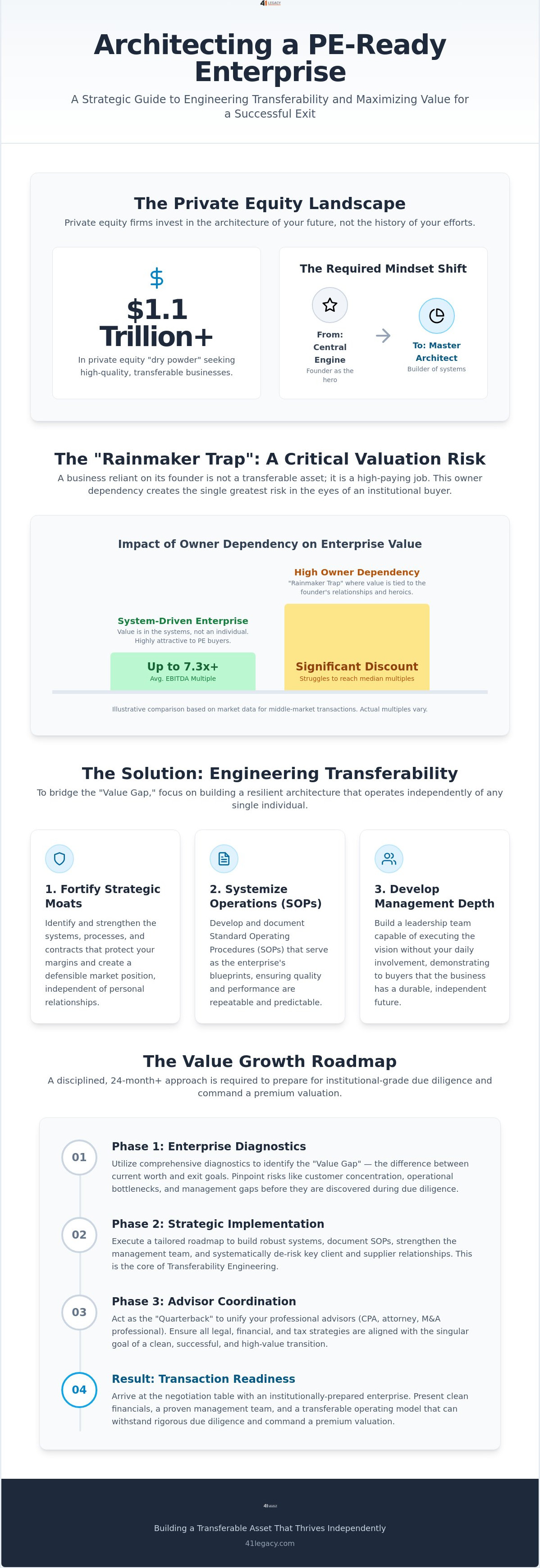
The Value Growth Roadmap: A Structured Approach to Acquisition
Exit readiness is a marathon of precision, not a sprint to the closing table. While a transaction may conclude in a matter of months, the architecture of a high-value exit is built over years. We believe the ideal timeline for this transformation begins 24 to 36 months before a planned transition. This window allows for the deliberate refinement of systems and the accumulation of institutional-grade data that private equity firms demand. Understanding how to prepare your business for private equity acquisition involves aligning your personal legacy, your financial requirements, and the operational health of the enterprise into a single, cohesive strategy.
A structured approach ensures that no element of your legacy is left to chance. It moves the business from a state of "readiness" to a state of "attractiveness." This distinction is critical; a ready business can be sold, but an attractive business commands a premium. To achieve this, the roadmap must be executed with relentless consistency. Monthly implementation support provides the necessary accountability to ensure that strategic goals do not succumb to the pressures of daily operations. It is the difference between a visionary plan and a realized transformation.
Phase 1: The Exit Readiness Assessment
The journey begins with a baseline valuation and a comprehensive operational audit. This initial assessment serves as a diagnostic tool to identify "low-hanging fruit" where immediate value can be unlocked. We look for hidden risks and operational inefficiencies that could lead to a "Value Gap" during due diligence. By establishing this baseline, we set the strategic direction for the preparation period, ensuring every effort is focused on the levers that most significantly impact enterprise value. It is the first step in viewing your business through the sophisticated lens of an institutional buyer.
Phase 2: Implementation and Accountability
Execution is where the true value is forged. During this phase, we focus on cleaning up "pro forma" financials to ensure they reflect the true earning potential of the enterprise. This involves more than just accounting; it is about presenting a narrative of sustainable growth. We systematically reduce the risks identified in the diagnostic phase, such as owner dependency or customer concentration. Through a structured Value Growth Roadmap, we provide the advisory support needed to navigate this complex transition, acting as a quarterback to coordinate your existing professional advisors toward a singular, successful exit goal.
Coordinating the Legacy: The Role of Strategic Advisory
The final stage of learning how to prepare your business for private equity acquisition is the orchestration of your professional advisory team. Most owners rely on a trusted CPA and a dedicated attorney, yet these specialists often operate in silos. The attorney is naturally focused on the precision of the contract and the mitigation of legal risk. The CPA is focused on historical accuracy and tax minimization. While these are critical functions, they don't inherently drive enterprise value. Without a unified strategy, you may find that your legal protections or tax structures actually hinder the transferability of the asset.
We believe that true stewardship requires a "Quarterback" to align these disparate efforts. By acting as the central coordinator, 41 Legacy ensures that every decision supports the long-term health and valuation of the enterprise. This collaborative approach prevents the friction that often occurs when specialists prioritize their specific niche over the owner’s ultimate goal of a clean, successful exit. We work to ensure that legal, tax, and operational decisions all harmonize to support the highest possible enterprise value.
Building a Coordinated Advisory Team
A transaction lawyer is vital for the closing table, but a strategic exit advisor is essential for the years leading up to it. It's about more than just the deal; it's about the evolution of the asset. You need a CPA who understands how to prepare your business for private equity acquisition by focusing on value growth rather than just tax mitigation. In the professional room, a Certified Exit Planning Advisor (CEPA) provides the strategic depth needed to bridge the gap between technical excellence and market attractiveness. This coordination ensures your advisors are building toward the same vision.
Your Legacy as a Transferable Asset
Your legacy is not defined by what you did while you were there, but by what continues to thrive after you leave. Building a transferable asset is a profound responsibility. It is an act of respect for the employees who have dedicated their careers to your vision and the customers who have trusted your brand. When the business is prepared with institutional precision, it survives the transition with its essence intact. This is the ultimate goal of the steward. To begin this journey of preservation and growth, we invite you to discover your current standing through our Exit Readiness Assessment.
Architecting Your Final Act: From Founder to Steward
Transforming a business into a transferable asset is the ultimate act of professional craftsmanship. It requires a deliberate shift from the daily mechanics of operation to the high-level design of a scalable engine. By neutralizing owner dependency and fortifying your strategic moats, you create an entity that commands respect from institutional investors. Mastering how to prepare your business for private equity acquisition is a multi-year discipline that demands surgical precision across legal, financial, and operational silos.
As you look toward your next chapter, remember that a well-prepared exit is not just a financial transaction; it is the preservation of your life's work. Our CEPA-led strategy and structured Value Growth Roadmap are designed to bridge the gap between your current enterprise value and your ultimate goals. We act as your quarterback, ensuring that your legacy remains a living entity that thrives long after your departure. This process honors the history you've written while preparing the business for a new, institutional stage.
Begin your journey toward a successful exit with 41 Legacy. You've built something remarkable. Now is the time to ensure it endures.
Frequently Asked Questions
How long does it take to prepare a business for a private equity sale?
A minimum of 24 to 36 months is the ideal window for meaningful preparation. This duration allows you to systematically address owner dependency and document the institutional knowledge required for a successful transition. When you understand how to prepare your business for private equity acquisition, you realize that rushing the process often results in a significant "Value Gap" at the closing table.
What is the difference between a strategic buyer and a private equity firm?
Strategic buyers are usually competitors or companies in adjacent industries seeking synergies and integration into their existing operations. Private equity firms, conversely, view your company as a platform for growth or a scalable engine. They typically focus on operational improvements and market consolidation, often keeping the existing brand and essence intact while injecting institutional-grade capital and systems.
Will I have to stay with the company after a private equity acquisition?
Institutional buyers typically require founders to remain for a transition period ranging from 12 to 36 months. This ensures a stable transfer of relationships and institutional knowledge to the new leadership team. While the daily operational burden often decreases, your role shifts toward high-level stewardship and strategic advisory to protect the continuity of the asset you've built.
How does owner dependency affect my business valuation?
Owner dependency acts as a direct anchor on your EBITDA multiple by increasing the perceived risk for the buyer. If the enterprise cannot function without your personal intervention, sophisticated investors will classify it as a high-paying job rather than a transferable asset. Reducing this dependency is a core driver of value growth, ensuring the business thrives independently of your daily involvement.
What are the most common mistakes owners make when preparing for an exit?
The most frequent error is waiting until the point of burnout to begin the preparation process. Owners often operate in silos, failing to coordinate their CPA, attorney, and strategic advisors toward a single exit goal. This lack of a unified Value Growth Roadmap results in unaddressed risks that are only discovered during the intense scrutiny of institutional due diligence.
Do I need a business broker to sell to private equity?
While you don't strictly need a broker to engage with private equity, you absolutely require strategic advisory to ensure the enterprise is ready for the transaction. Sophisticated buyers often approach founders directly, but without an Exit Readiness Assessment, you may lack the leverage to command a premium. Focus on engineering a transferable asset before entering any formal negotiation.
What is an EBITDA multiple and how is it determined?
An EBITDA multiple is a valuation metric that represents the enterprise value as a factor of its annual earnings before interest, taxes, depreciation, and amortization. It's determined by market conditions, industry growth, and company-specific risk factors. In early 2026, middle-market transactions saw an average multiple of 7.3x, though businesses with institutional-grade systems often command significantly higher figures.
Can I sell my business if I don't have documented SOPs?
You can sell without documented processes, but you'll likely face a substantial discount on your valuation. Documented Standard Operating Procedures serve as the blueprints of your enterprise, proving to the buyer that your success is repeatable and predictable. Without them, you're asking a private equity firm to take a leap of faith on your personal "secret sauce."

Article by
Mike Laskowski
Mike Laskowski is a Business Value Growth Strategist who helps business owners uncover the truths that drive their performance, risk, and readiness. Blending forensic interviewing from a 26‑year federal career with Strategic Capacity analysis and CEPA methodology, he works upstream to reduce owner dependency, increase transferability, and strengthen enterprise value. Mike guides founders through clarity, operational evolution, and transition readiness so their companies become transferable, owner‑independent assets that endure beyond the founder.
Disclaimer
This article is for educational and informational purposes only and does not provide legal, tax, investment, or business brokerage advice. 41 Legacy does not offer M&A brokerage services, legal document drafting, tax preparation, or investment advisory services. Business owners should consult licensed professionals in those disciplines before making decisions related to business transactions, legal matters, tax strategy, or financial planning. All examples are illustrative and may not apply to your specific situation.