
Transferability & Owner Dependency
Preparing Your Business for a Management Buyout: A Strategic Blueprint for 2026
A management buyout is not a mere exit; it is the ultimate preservation of a company's essence. For the dedicated owner, the true weight of leadership often manifests as the fear that the enterprise might falter once the founder steps away. We believe that preparing your business for a management buyout requires more than just financial spreadsheets. It demands the meticulous engineering of a transferable asset. By shifting your focus from daily operations to strategic capacity, you ensure the heritage you've built remains intact while empowering your team to lead with precision.
It's natural to feel uncertain about your true enterprise value or the absence of a formal succession roadmap. You've spent years as the steward of this organization, and you deserve an exit that reflects that dedication. This blueprint offers a path to achieving a fair valuation and a seamless transition of leadership. We'll examine how to transform your company into an independent entity that thrives through owner dependency reduction and structured advisory support. By following this strategic approach, you'll secure a legacy that is both protected and profoundly impactful.
Key Takeaways
- View the management buyout as a sophisticated act of stewardship that preserves your company’s heritage and ensures its continued impact.
- Master the art of preparing your business for a management buyout by identifying and resolving the dependencies that tie the enterprise to its founder.
- Utilize Enterprise Diagnostics to uncover the value gap and establish a precise roadmap for the transition ahead.
- Build the structural integrity of your organization through documented systems that transform individual knowledge into a transferable asset.
- Learn why a coordinated advisory team is essential to orchestrating a harmonious transition that respects both the past and the future.
The Essence of the Management Buyout: More Than a Transaction
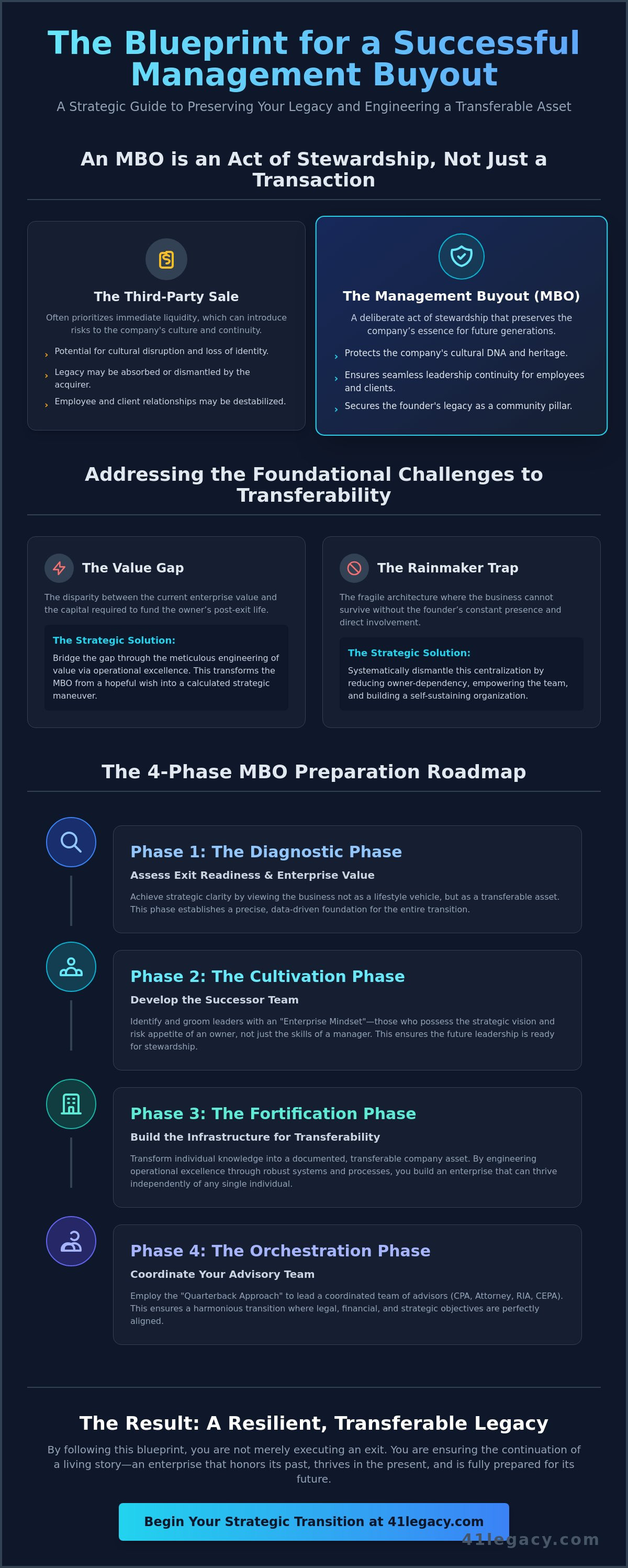
A management buyout is the ultimate expression of stewardship. It represents the deliberate choice to entrust the future of an organization to the very individuals who have labored alongside the founder to shape its culture. Unlike a third-party sale, which often prioritizes immediate liquidity at the expense of historical continuity, a Management buyout (MBO) preserves the internal essence of the enterprise. It's an act of legacy preservation. In the current 2026 landscape, where the aggregate value of US buyout deals has recently surpassed $376 billion, internal transitions offer a stable harbor amidst broader market volatility. Preparing your business for a management buyout begins with understanding that you aren't just selling shares; you're ensuring the survival of a living story.
The first obstacle many owners face is the Value Gap. This is the disparity between the current enterprise value and the capital required to fund the owner’s post-exit life. Bridging this gap isn't a matter of financial manipulation. It's a process of engineering value through operational excellence. By identifying this gap early, you transform the buyout from a hopeful wish into a calculated strategic maneuver. This requires a level of Strategic Advisory that looks beyond the balance sheet to the long-term health of the organization.
Why an MBO is a Guardian’s Exit
There is a profound emotional weight in passing the torch. When you transition ownership to your management team, you protect the company’s cultural DNA. Employees feel secure. Clients experience seamless continuity. The owner acts as a guardian, ensuring the asset they've built remains a pillar of the community rather than a line item on a competitor’s balance sheet. It’s a transition rooted in deep respect for the subject matter and the people who drive it.
The Philosophical Shift from Owner to Asset
To succeed, an owner must adopt a professional-room altitude. This requires viewing the business not as a personal lifestyle vehicle, but as a transferable asset. It’s the difference between a business that requires your presence and one that operates with surgical precision in your absence. Engaging a Certified Exit Planning Advisor (CEPA) provides the strategic clarity needed for this shift. Preparing your business for a management buyout requires this detachment to ensure the management team is empowered to lead effectively from day one. You're moving from being the hero of the story to the architect of its next chapter.
Cultivating the Successor Team: Engineering Owner-Dependency Reduction
The business owner often occupies the center of a delicate ecosystem, serving as the sole engine of sales or the final arbiter of every operational detail. This is the Rainmaker Trap. While it represents the founder's dedication, it creates a fragile architecture that cannot survive a transition. Preparing your business for a management buyout requires a deliberate dismantling of this centralization. You must move from being the indispensable artisan to the curatorial expert who oversees a self-sustaining masterpiece. The value of your legacy depends on the organization's ability to breathe without your constant presence.
A successful transition isn't just about financial capacity; it's about the mental and operational readiness of those left behind. We use Strategic Capacity Evaluation to determine if your current leadership possesses the internal fortitude to manage the weight of ownership. This isn't a surface-level review. It's a deep diagnostic of the team's ability to innovate and maintain the enterprise's essence under pressure. Without this clarity, the buyout remains a theoretical exercise rather than a viable strategic path.
Identifying the Core Successor Group
Selecting the right leaders requires distinguishing between a "Job Mindset" and an "Enterprise Mindset." Many talented managers excel at executing tasks but lack the appetite for the risks inherent in ownership. Transferability Engineering involves identifying those who view the company as a living asset. You're looking for individuals who don't just want to keep their positions, but who possess the sophisticated passion required to steward the company's history into the future. This group must demonstrate a commitment to the long-term health of the organization, moving beyond daily performance to focus on strategic growth.
The Roadmap to Independence
Once the team is identified, the founder’s withdrawal must be gradual and rhythmic. This period is best managed through a Value Growth Roadmap, where the management team begins to take ownership of key strategic initiatives. It's a time for testing the business’s resilience through founder-absent simulations. These aren't mere vacations; they're controlled experiments designed to reveal where the structure remains too dependent on the founder. Each simulation provides technical precision, highlighting the specific areas where systems must be strengthened before the final handoff. Owner Dependency Reduction is the primary driver of enterprise value. By the time the final documents are signed, your absence should be a non-event for the company's daily operations.
The Diagnostic Phase: Assessing Exit Readiness and Enterprise Value
The foundation of any enduring legacy is a clear-eyed understanding of its current state. Preparing your business for a management buyout begins with a rigorous examination that goes far beyond the surface of a standard balance sheet. We utilize Enterprise Diagnostics to provide this essential baseline. It's a process of uncovering the structural integrity of the organization, ensuring that the transition is built on a bedrock of technical precision rather than optimistic assumptions. A "back-of-the-napkin" valuation is insufficient for an enterprise of significant history; it lacks the depth required to honor the work you've built.
Central to this phase is identifying the Value Gap. This is the difference between the current worth of the business and the capital you require to secure your financial future and legacy goals. By quantifying this gap early, we move from the conceptual to the actionable. We also evaluate the business through the lens of the Market Attractiveness vs. Exit Readiness matrix. A company may operate in a thriving sector, but if it remains tethered to the founder’s daily involvement, its readiness for a transition is compromised. True readiness is the intersection of a healthy market and a business that can thrive independently of its creator.
Uncovering the Hidden Value Drivers
An MBO team is not just purchasing equipment or a client list; they are acquiring a living system. Our diagnostics reveal the "intangible" drivers that dictate the final deal structure. We analyze customer concentration risks and the strength of recurring revenue streams, which serve as the heartbeat of a stable enterprise. Proprietary processes and a refined brand reputation are the essence of what makes the company unique. By documenting these drivers, we show the management team exactly what they are inheriting: a transferable asset with a proven roadmap for continued success.
Bridging the Value Gap
Once the diagnostic phase is complete, we establish a precise target for value growth. This isn't about rapid, unsustainable expansion. It's about utilizing a Value Growth Roadmap to prioritize improvements that yield the highest return on investment while reducing risk. We focus on the areas that most directly impact transferability, such as strengthening the leadership tier and formalizing internal systems. This strategic clarity ensures that every effort made in preparing your business for a management buyout aligns with your long-term financial objectives. You're not just waiting for an exit; you're actively engineering the business to reach its peak enterprise value before the handoff occurs.
Operational Excellence: Building the Infrastructure for Transferability
Infrastructure is the silent guardian of an enterprise. While the founder’s intuition often drives early success, a transferable asset requires the cold, clear logic of documented systems. Preparing your business for a management buyout is an exercise in codifying this intuition into a repeatable process. We must move beyond tribal knowledge, those unwritten rules known only to a few, and establish a framework that any competent leader can navigate. This transformation ensures the company’s essence isn't lost during the transition but is instead reinforced by operational precision.
A critical component of this foundation is the Strategic Capacity Evaluation. This goes beyond current performance to assess whether the business possesses the structural strength to support future growth under new stewardship. If the infrastructure is brittle, the buyout team will inherit a burden rather than an opportunity. Preparing your business for a management buyout through this lens ensures the company remains resilient, regardless of who sits in the founder's chair. By refining these systems now, you provide the management team with the tools they need to succeed from their first day of ownership.
Systematizing the Essence of the Business
Standard Operating Procedures (SOPs) are the master blueprints of a lasting organization. When processes are documented with surgical precision, they reduce the perceived risk for the management team and their external lenders. Lenders look for stability and predictability above all else. SOPs act as a comprehensive instruction manual, ensuring that the company’s unique methodology is preserved. Integrating modern technology further automates core functions, allowing the new leadership to focus on high-level strategy rather than daily technical fires. To begin refining your organization's internal structures, consider how our Transferability Engineering can help you document the processes that define your success.
Financial Readiness for the Buyout
Financial transparency is the language of professional-room altitude. The buyout team needs clean reporting and pro forma financial statements that project post-buyout performance with absolute clarity. These projections must demonstrate that the enterprise can comfortably service the debt often required in a management buyout structure. It's about proving the business's health through data, showing that the cash flow is robust enough to sustain the transition and fuel future innovation. Operational precision directly correlates to a higher valuation multiple. When the numbers are beyond reproach, the path to a successful transition becomes clear for everyone involved.
The Quarterback Approach: Coordinating Your Advisory Team
Orchestrating the final act of your leadership requires more than technical skill; it demands a unified vision. In the intricate process of preparing your business for a management buyout, many owners find themselves overwhelmed by the friction of siloed advice. The Quarterback approach addresses this by establishing a central point of strategic coordination. Rather than the owner spending their final months managing administrative details, they're empowered to remain at a professional-room altitude. This ensures the transition is not merely a financial exit but a sophisticated transfer of stewardship that honors the company’s history. Every specialist must work in harmony to preserve the essence of what you've built.
The role of the Quarterback is to maintain the integrity of the mission while managing the intricacies of the deal. When the CPA, attorney, and wealth advisor operate in isolation, the owner is often forced to mediate between conflicting professional opinions. This creates unnecessary risk and emotional weight. By providing a structured framework for communication, we ensure that every decision serves the long-term health of the enterprise. Preparing your business for a management buyout requires this level of dedication to detail, ensuring the management team inherits a stable and well-coordinated organization.
Aligning Professional Perspectives
The most common failure in exit planning is the lack of harmony between tax planning, legal structures, and enterprise growth. An attorney might draft a structure that protects the entity but inadvertently complicates the management team's ability to secure financing. Similarly, a CPA might focus on immediate tax mitigation while overlooking the impact on the final enterprise value. Using Exit Readiness Assessments allows us to ground every professional in the same set of objective data. This shared foundation prevents conflicting advice and ensures the transition respects both the historical essence of the company and its future potential.
The 41 Legacy Implementation Framework
Execution is where many strategic plans lose their sheen. To prevent the roadmap from becoming a static document, we provide Monthly Implementation Support that maintains a steady and unhurried rhythm of progress. This framework moves the business from theoretical readiness to actual transferability through a structured Value Growth Roadmap. It allows the owner to remain the steward of the vision rather than the project manager of the transaction. By delegating the coordination of the advisory team, you can focus on the artistic calling of leadership during your final chapters. We invite you to Begin your journey toward a transferable legacy with 41 Legacy.
Architecting a Timeless Transition
The transition of ownership to your management team is the final masterpiece of your career. It requires a deliberate shift from operational necessity to strategic stewardship. By focusing on owner-dependency reduction and the engineering of transferable systems, you ensure the company’s essence remains intact. Preparing your business for a management buyout is a commitment to the enduring health of your organization. It's about transforming a lifetime of work into a legacy that thrives independently of your daily presence.
Led by a Certified Exit Planning Advisor (CEPA), our specialists provide the national advisory expertise needed to navigate this complex journey with technical precision. We utilize a structured Value Growth Roadmap process to provide strategic clarity and keep your transition on track. You don't have to manage this evolution alone. Secure Your Legacy: Schedule Your Exit Readiness Assessment. With the right blueprint, your business can become a lasting asset that empowers your team to lead with confidence and precision for years to come.
Frequently Asked Questions
What is the first step in preparing for a management buyout?
The first step is conducting an Exit Readiness Assessment to establish a precise baseline of the company’s current transferability. This diagnostic process identifies the Value Gap and reveals the structural integrity of the enterprise. By starting with an objective view of the organization’s readiness, you can prioritize the technical improvements required to ensure a successful and harmonious transition.
How long does it typically take to prepare a business for an MBO?
Preparing your business for a management buyout typically requires a timeline of one to three years. This duration allows for the meticulous engineering of owner-dependency reduction and the implementation of a Value Growth Roadmap. A rushed transition often overlooks the granular details that protect the company's long-term essence and historical continuity, whereas a steady rhythm ensures every system is polished to a high sheen.
Can a management team afford to buy the business they work for?
Management teams rarely utilize personal liquid assets alone; instead, they secure financing through a combination of bank loans, seller notes, or private equity backing. In 2026, the resurgence of MBOs is supported by improved access to capital for teams that demonstrate high operational expertise. These sophisticated structures allow the team to acquire the asset while ensuring the owner receives a fair valuation for their life's work.
What is the difference between an MBO and an ESOP?
A management buyout is a targeted transfer of ownership to a specific group of key leaders, whereas an Employee Stock Ownership Plan (ESOP) is a broad-based benefit plan for the entire workforce. While both paths can preserve the company's culture, an MBO focuses on empowering the core successors most capable of driving future growth. Each path requires distinct strategic clarity to protect the owner’s legacy and the company's future impact.
How does owner-dependency affect the valuation in an MBO?
High owner-dependency acts as a significant drag on enterprise value because it increases the perceived risk for lenders and successors. When an owner is the primary driver of sales or operations, the business is viewed as a personal lifestyle vehicle rather than a transferable asset. Reducing this dependency through documented systems directly correlates to a higher valuation multiple and ensures the company can breathe independently of its creator.
What happens if the management team is not ready for leadership?
If a Strategic Capacity Evaluation reveals that the team lacks the necessary "Enterprise Mindset," a period of structured mentorship and implementation support is essential. This process focuses on elevating high-potential leaders and testing their resilience through founder-absent simulations. It is far better to address these gaps during the preparation phase than to risk the company's failure after the final handoff has occurred.
Why do I need an Exit Readiness Assessment if I already have a CPA?
While a CPA provides essential tax and compliance guidance, an Exit Readiness Assessment focuses specifically on the transferability and growth potential of the enterprise. This diagnostic looks beyond the balance sheet to evaluate internal systems, leadership strength, and market attractiveness. It provides the strategic blueprint that allows your entire advisory team to work in harmony toward a common, elevated goal.
Is a management buyout better than selling to a third party?
A management buyout is often the preferred choice for owners who prioritize the preservation of their company’s cultural DNA and heritage. While a third-party sale might offer immediate liquidity, it frequently leads to significant changes in the organization's character. Preparing your business for a management buyout allows the owner to act as a guardian, ensuring the business continues to thrive under the stewardship of those who helped build it.
Disclaimer
This article is for educational and informational purposes only and does not provide legal, tax, investment, or business brokerage advice. 41 Legacy does not offer M&A brokerage services, legal document drafting, tax preparation, or investment advisory services. Business owners should consult licensed professionals in those disciplines before making decisions related to business transactions, legal matters, tax strategy, or financial planning. All examples are illustrative and may not apply to your specific situation.