
Preparing for Due Diligence When Selling a Company: A Strategic Roadmap for 2026
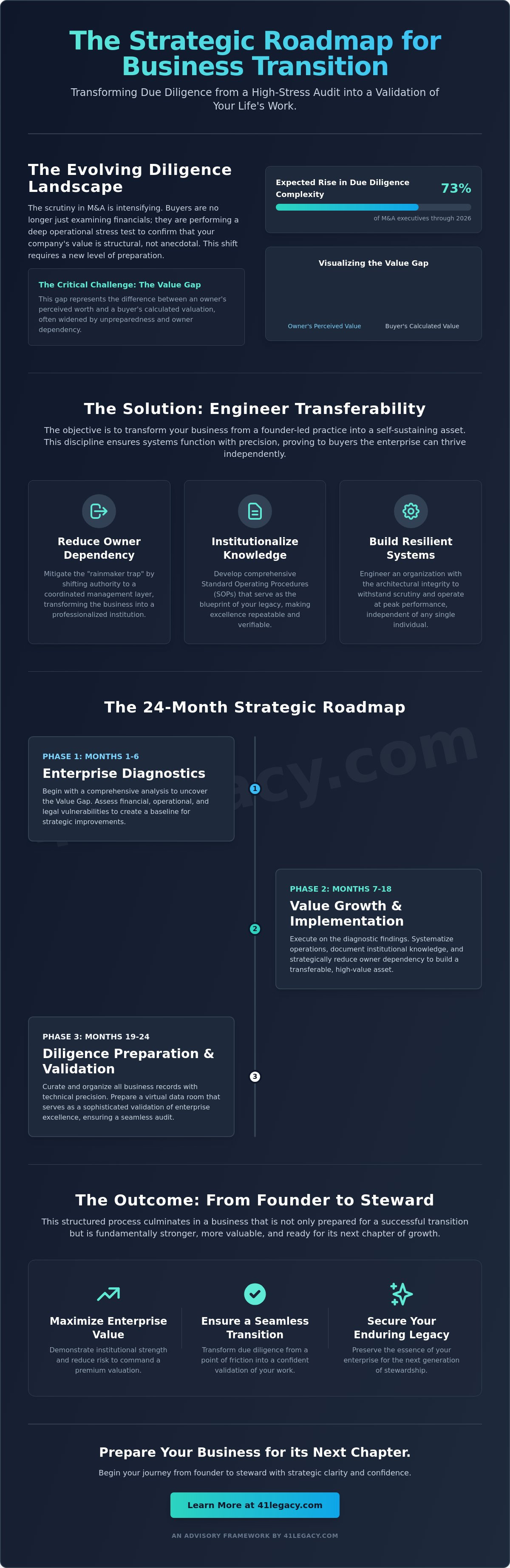
What if the most intrusive phase of your business transition became the ultimate testament to your life's work? While 73% of M&A executives expect due diligence to become more complex through 2026, the process shouldn't be a source of attrition. You've spent years refining the intricacies of your operation; now, the focus shifts to how to organize your business records before an exit so that every file serves as a sophisticated validation of your enterprise value.
We recognize the weight of the audit, especially the fear that deal fatigue or price re-trading might mar the culmination of your career. It's a standard many owners find overwhelming, yet we view it as the final preservation of a legacy. This roadmap provides the strategic clarity needed to transform due diligence into a seamless transition. You’ll learn how to engineer transferability, maximize your final exit price, and ensure your organization thrives independently of your daily presence. We're here to help you move from the role of an operator to that of a steward, preparing a masterpiece for its next chapter.
Key Takeaways
- Reframe due diligence as a sophisticated validation of your company's enduring enterprise value rather than a high-stress administrative audit.
- Master how to organize your business records before an exit to ensure every document serves as a blueprint of your company’s institutional strength and precision.
- Identify and mitigate owner dependency through Transferability Engineering, transforming your business into a self-sustaining asset that thrives independently of your daily presence.
- Utilize a 24-month strategic roadmap, beginning with Enterprise Diagnostics, to uncover and close the Value Gap between your current valuation and your ultimate transition goals.
- Transition from a founder to a steward by securing your legacy through structured advisory support that preserves the essence of your work for the next generation.
Beyond the Checklist: Due Diligence as a Validation of Enterprise Excellence
The concept of due diligence is often viewed with a sense of trepidation; however, we see it as the ultimate curatorial validation of a life's work. It is the investigative process used to verify the essence and precision of the enterprise. This ensures that what was built with passion can be sustained with logic. In 2026, this process has evolved far beyond the administrative audits of the past. With 73% of M&A executives expecting increased complexity, it's now a deep-dive operational stress test. Buyers aren't just looking at the numbers. They are searching for the architectural integrity of the business itself, seeking proof that the value is structural rather than anecdotal.
Our goal is to eliminate the Value Gap. This is the silent friction between an owner's perception of worth and a buyer's calculated reality. When you master how to organize your business records before an exit, you aren't just filing papers. You're establishing a "professional-room altitude" that signals excellence. Transparency in this context isn't an admission of vulnerability. It's an act of confidence that builds trust and maintains a sense of exclusivity throughout the transaction. It shows that the business is a transferable asset ready for its next chapter, engineered to survive the scrutiny of the most sophisticated acquirers.
The Three Pillars of Modern Scrutiny
The contemporary audit rests on three distinct foundations. Financial diligence requires verifying EBITDA and the integrity of add-backs with surgical precision. Legal and compliance scrutiny ensures the historical significance of contracts and entity structures remains intact. Finally, operational diligence assesses the rhythm of the business. It asks if the enterprise possesses the capacity to thrive without its founder. We utilize Transferability Engineering to ensure the answer is a resounding yes.
Preparation as a Philosophical Endeavor
We view a business as a living entity, a masterpiece polished to a high sheen before presentation to a new steward. Early preparation isn't merely a tactical advantage; it's a commitment to preserving your legacy. Understanding how to organize your business records before an exit allows for a clear, unburdened vision. Due diligence is the curatorial validation of enterprise excellence, proving your work is both rare and repeatable.
Engineering Transferability: Why Documentation is the Blueprint of Your Legacy
In the gallery of enterprise, the most valuable works are those that possess their own internal logic. Owner dependency is the primary risk that devalues a company during the diligence phase. If the founder’s presence is required for the daily rhythm, the asset is inherently fragile. We address this through Transferability Engineering. This discipline transforms a business from a personal practice into a transferable asset, ensuring the systems function with the harmony of a well-crafted timepiece. Buyers in 2026 are increasingly sophisticated, with private equity firms holding over $800 billion in "dry powder." These investors seek businesses that do not require the master artisan’s daily touch to maintain their performance.
When an enterprise can thrive independently, it commands a premium. Documentation serves as the tangible proof of this independence. It moves the business from the realm of the founder’s intuition into the realm of institutional knowledge. By building systems that function like fine art, you provide a buyer with the certainty they need to commit. This level of preparation protects the enterprise value you have spent a lifetime creating.
Escaping the Rainmaker Trap
Many founders find themselves caught in the rainmaker trap, acting as the primary engine for sales and strategic relationships. This creates a single point of failure that sophisticated acquirers will quickly identify. To protect your legacy, you must shift authority to a coordinated management layer. This transition increases the strategic capacity of the organization and allows the business to breathe on its own. By reducing dependency, you elevate the enterprise from a founder-led project to a professionalized institution ready for stewardship.
Documenting the Essence: The Role of SOPs
Precision in documentation translates directly to certainty for a buyer during an audit. Standard Operating Procedures (SOPs) are the blueprints of your legacy. When considering how to organize your business records before an exit, focus on creating a Data Room that tells a story of meticulous craftsmanship. Every file should validate the integrity of your operations and the rhythm of your success. A comprehensive due diligence checklist serves as an excellent starting point to identify where your records may lack the necessary depth. To ensure these systems are engineered for maximum impact, engaging in 41 Legacy strategic advisory can help you curate the essence of your work. This level of preparation ensures that when the time comes, the transition is a natural progression rather than a disruption.
Closing the Value Gap: Mitigating Risks That Devalue Your Life’s Work
The Value Gap represents the silent distance between an owner’s financial aspirations and the cold, market-ready valuation of the enterprise. Many founders mistakenly believe that profitability alone guarantees a successful transition. This is a dangerous assumption. Profit is the heartbeat of today, but transferability is the survival of tomorrow. When we discuss how to organize your business records before an exit, we are talking about more than filing. We are talking about risk mitigation. If a buyer discovers unaddressed liabilities or operational friction during the audit, they will engage in re-trading. This is the practice of lowering the initial offer price mid-diligence to account for newfound risks.
To prevent this erosion of value, we employ Enterprise Diagnostics. This surgical approach uncovers the structural weaknesses that a buyer’s team will eventually find. By identifying these gaps 24 to 36 months in advance, you can close the Value Gap and present a business that is beyond reproach. It is about moving from a state of reactive defense to one of proactive excellence. You are not just selling a company; you are transitioning a legacy to a new steward.
Identifying Invisible Risks
A masterpiece loses its luster if it relies on a single patron. Customer concentration is a significant risk; if one client accounts for a large percentage of revenue, the entire enterprise value is at the mercy of that relationship. Buyers look for a diversified portfolio that proves the business's enduring appeal. We must also look beyond historical records to assess future strategic capacity. While your past performance provides the foundation, your financial forecasting must demonstrate the scalability of the asset. Regulatory safety is not the same as operational excellence. A business can be compliant with every law yet still possess operational friction that devalues the work in the eyes of a connoisseur.
Defending the EBITDA with Evidence
In 2026, the M&A market has reached a total value of $640 billion, and buyers are more discerning than ever. Defending your EBITDA requires more than just high-value adjectives. It requires hard, verifiable data. When justifying add-backs, you must do so with surgical precision to avoid the appearance of settling for less than perfection. This is where a Quarterback advisor becomes essential. By aligning your CPA and attorney, a strategic advisor ensures that every piece of evidence supports a singular narrative of value. This coordinated defense protects the integrity of the deal and ensures you receive the full merit of your life’s work.
The 24-Month Strategic Roadmap: Organizing Records with Technical Precision
Excellence is never accidental. It is the result of a deliberate, multi-year process that begins long before a buyer ever enters the room. Understanding how to organize your business records before an exit requires more than a casual inventory; it demands a multi-year commitment to structural integrity. This roadmap is designed to move your enterprise from a state of owner-dependency to a position of transferable strength. By following a structured progression, you ensure that every document and process serves as a sophisticated validation of your company's value.
- Step 1: Exit Readiness Assessment. Conduct this evaluation 24 to 36 months before your desired transition to establish a baseline of your current standing.
- Step 2: Enterprise Diagnostics. Perform a deep dive into your operations to uncover the Value Gap and identify areas of operational friction that could devalue the asset.
- Step 3: Value Growth Roadmap. Implement a strategic plan specifically designed to engineer owner-independence and enhance the transferability of the organization.
- Step 4: Virtual Data Room (VDR) Curation. Assemble your records with meticulous organization, ensuring that every file is easily accessible and technically precise.
- Step 5: Advisory Coordination. Align your professional team under a singular, uncompromising vision to ensure the essence of your work is preserved throughout the process.
The 24-Month Countdown
Time-intensive craftsmanship cannot be rushed in the final months of a sale. A rushed preparation often leads to overlooked details that buyers will use to justify price re-trading. We utilize Monthly Implementation Support to keep your roadmap on track, ensuring that strategic improvements are made consistently. This structured approach allows you to maintain strategic clarity while still running day-to-day operations. It ensures that when the time comes to exit, your business is a finished masterpiece rather than a work in progress.
Assembling the Guardians of Your Legacy
There is a profound difference between a transactional broker and a strategic advisor. While a broker focuses on the mechanics of a sale, a strategic advisor acts as a guardian of your legacy. A Certified Exit Planning Advisor (CEPA) brings a sophisticated passion to the process, viewing your business as a transferable asset with a story to tell. By coordinating your CPA, attorney, and other professionals, we ensure that every decision serves the long-term health of the enterprise. For those seeking a partner to lead this transformation, we invite you to explore our coordinated advisory support to secure the future of your life's work.
From Founder to Steward: Securing the Future Through Coordinated Advisory
The final transition of a business is not a conclusion. It is the commencement of a new era for the asset you've nurtured with such deliberate care. A founder is, at their core, a steward. You're building a transferable asset designed to thrive for the next generation. This evolution requires a shift from the role of an active artisan to that of a visionary curator. When you understand how to organize your business records before an exit, you're doing more than preparing for an audit. You're ensuring the internal logic of your enterprise is visible to all who follow. When you master how to organize your business records before an exit, the audit becomes a validation of excellence rather than a source of stress.
At 41 Legacy, we act as the quarterback for this journey. We coordinate with your existing team of professionals to ensure the essence of your work is never lost in translation. Our philosophy is rooted in the belief that growth is the natural byproduct of meticulous preparation. By focusing on the structural integrity of the business, we remove the friction that devalues so many transitions. We invite you to move beyond the theoretical and embrace a path of actionable stewardship.
The 41 Legacy Approach
Our process begins with Enterprise Diagnostics. These assessments provide the surgical clarity needed to identify the Value Gap and operational dependency. We don't settle for surface-level observations. Instead, we perform a deep dive into the technical precision of your systems. This is followed by Monthly Strategic Advisory, a commitment to uncompromising perfection. We position ourselves as the master artisans of exit planning, guiding you through each stage of the Value Growth Roadmap with steady, unhurried expertise. This is not a transactional service; it's a dedicated partnership in excellence.
Building a Legacy That Endures
There is a profound emotional weight to seeing a life's work transition successfully to new hands. It's a moment of deep respect for both the past and the future. Transferability is the ultimate tribute to a founder's original vision. It proves that the essence of the work was not dependent on a single individual but was instead woven into the very fabric of the organization. A well-prepared exit is a masterpiece of coordination and foresight. It allows the founder to step away with the confidence that their legacy is secure and the business is poised to flourish under new stewardship. We are here to help you engineer that future. Begin your journey toward a secure legacy with our Strategic Advisory services today.
Securing the Merit of Your Life’s Work
The transition of a business is the ultimate test of its architectural integrity. By viewing due diligence as a curatorial validation rather than a survival exercise, you elevate the entire process to a professional-room altitude. We have explored the necessity of reducing owner dependency and the strategic importance of a multi-year roadmap to close the Value Gap. Understanding how to organize your business records before an exit is the final, essential step in preparing your masterpiece for its next steward. This meticulous preparation ensures that your enterprise value is protected and your legacy remains untarnished by the friction of a transaction.
Our team, led by a Certified Exit Planning Advisor (CEPA), provides the national strategic advisory high-value enterprises require to thrive beyond their founders. Through our structured Value Growth Roadmap process, we help you engineer a business that is both rare and repeatable. Secure your legacy with a professional Exit Readiness Assessment from 41 Legacy. You have built something of profound significance; now is the time to ensure it endures with the same precision and passion that defined its creation.
Frequently Asked Questions
When should I actually start preparing for due diligence when selling my company?
Preparation should ideally begin 24 to 36 months before your intended transition. This timeframe allows for the meticulous refinement of operations and the closing of the Value Gap. Rushing this process in the final months often leads to overlooked risks that sophisticated buyers will exploit to lower the price during the audit phase.
What are the most common deal killers found during the due diligence process?
The most frequent deal killers include high customer concentration, significant owner dependency, and unverified financial adjustments. When a buyer perceives that the enterprise cannot thrive without the founder, the risk profile increases significantly. These invisible risks, alongside labor quality concerns cited by 21% of owners in 2026, often lead to re-trading or deal dissolution.
Can my current CPA or attorney handle the due diligence preparation alone?
While your CPA and attorney are essential specialists, they typically focus on their respective silos of tax compliance and legal structure. Strategic due diligence preparation requires a quarterback to ensure all elements align with a singular vision of enterprise value. We provide the strategic advisory necessary to coordinate these professionals and preserve the essence of your work.
How does owner dependency specifically impact my company’s valuation?
Owner dependency acts as a direct weight on your company's valuation multiple. If the business relies on your personal artistry or individual relationships, it's a practice rather than a transferable asset. Reducing this dependency through Transferability Engineering transforms the company into a self-sustaining entity that commands a premium from sophisticated acquirers seeking enduring stability.
What is a Virtual Data Room and why is it essential for 2026 transactions?
A Virtual Data Room is a secure, encrypted digital repository used to house all sensitive business documentation for buyer review. In 2026, it's the standard for maintaining transparency and technical precision during a transaction. Learning how to organize your business records before an exit within a VDR signals to buyers that you're a disciplined steward of a high-value asset.
Is it possible to fail due diligence even if my business is highly profitable?
It's entirely possible to fail due diligence despite high profitability. Profit represents the present, but buyers pay for the certainty of future cash flows. If your records are disorganized or the business lacks structural independence, a buyer may determine the risk is too high to proceed, regardless of the health of your current bottom line.
How do I defend my EBITDA add-backs without looking like I am inflating numbers?
Defending add-backs requires surgical precision and hard, verifiable data. You must justify every adjustment with evidence that proves the expense is truly non-recurring or personal in nature. Mastering how to organize your business records before an exit ensures that every add-back is documented with the integrity required to withstand the scrutiny of a buyer's financial team.
What is the difference between an Exit Readiness Assessment and a standard valuation?
A standard valuation provides a snapshot of current worth, while an Exit Readiness Assessment is a deep-dive diagnostic of transferability and risk. Our assessment uncovers the structural weaknesses and operational friction that a simple valuation ignores. It serves as the foundation for a Value Growth Roadmap, focusing on building a masterpiece that can thrive under new stewardship.

Article by
Mike Laskowski
Mike Laskowski is a Business Value Growth Strategist who helps business owners uncover the truths that drive their performance, risk, and readiness. Blending forensic interviewing from a 26‑year federal career with Strategic Capacity analysis and CEPA methodology, he works upstream to reduce owner dependency, increase transferability, and strengthen enterprise value. Mike guides founders through clarity, operational evolution, and transition readiness so their companies become transferable, owner‑independent assets that endure beyond the founder.
Disclaimer
This article is for educational and informational purposes only and does not provide legal, tax, investment, or business brokerage advice. 41 Legacy does not offer M&A brokerage services, legal document drafting, tax preparation, or investment advisory services. Business owners should consult licensed professionals in those disciplines before making decisions related to business transactions, legal matters, tax strategy, or financial planning. All examples are illustrative and may not apply to your specific situation.