
Preparing for Due Diligence When Selling a Company: A Strategic Guide to Transferability
The true measure of a masterpiece isn't found in its surface luster but in the integrity of its foundation when the light is most unforgiving. Preparing for due diligence when selling a company often feels like a clinical interrogation, yet for the visionary owner, it's actually the ultimate validation of an asset built to endure. You've likely felt the persistent anxiety of the Value Gap or the concern that your personal involvement has become a structural necessity rather than a strategic choice. It's a heavy burden to carry when you're ready to transition your stewardship to the next generation of leadership.
This guide will help you transform the daunting scrutiny of a 2026 market, where 73% of executives expect due diligence to grow even more complex, into a sophisticated showcase of your business's enterprise value. We'll show you how to move beyond disorganized records and toward a state of strategic readiness that maximizes your final sale price. We'll examine the precise engineering required to reduce owner dependency and the structural clarity needed to ensure your legacy thrives long after the ink has dried.
Key Takeaways
- Reframe the due diligence process as a sophisticated validation of your business’s structural integrity rather than a mere transactional hurdle.
- Identify the four essential pillars of transferability—financial, legal, operational, and strategic—that sophisticated acquirers scrutinize to determine enterprise value.
- Understand why preparing for due diligence when selling a company requires a 24-to-36-month lead time to effectively bridge the Value Gap and ensure a smooth transition.
- Learn how to utilize an Enterprise Diagnostic and a Value Growth Roadmap to proactively reduce owner-dependency and strengthen the business’s independent performance.
- Discover the importance of a strategic advisor in aligning your legal and financial teams to ensure every decision serves the preservation of your legacy.
The Philosophy of Preparation: Due Diligence as Validation
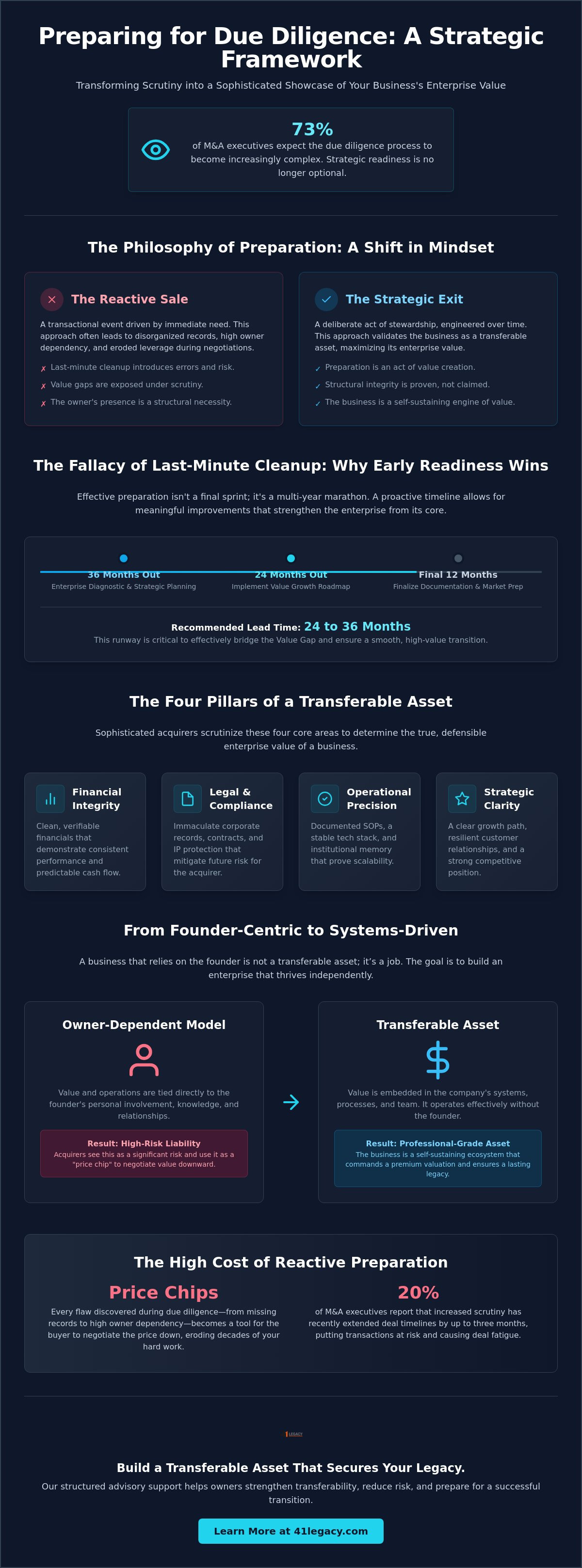
The true measure of a masterpiece isn't found in its surface luster but in the integrity of its foundation when the light is most unforgiving. Preparing for due diligence when selling a company often feels like a clinical interrogation, yet for the visionary owner, it's actually the ultimate validation of an asset built to endure. In the landscape of 2026, where 73% of M&A executives expect the due diligence process to become increasingly complex, this phase serves as a sophisticated gallery opening for your life's work. Every operational logic and financial record is examined under the harsh, white light of scrutiny. This is where the distinction between a mere transaction and a lasting legacy is finally drawn.
To "sell" is often a reactive, transactional event. To "exit" is a deliberate act of stewardship. This psychological shift requires you to view your organization through the lens of a sophisticated acquirer who seeks not just cash flow, but a resilient, transferable engine of value. When you approach preparation as an act of engineering rather than a cleanup, you naturally eliminate the "Value Gap." This gap represents the difference between what you believe the business is worth and what a buyer can actually verify. By establishing strategic clarity long before a transition, you ensure that your enterprise value remains untarnished by the chaos of disorganized records or personal dependency.
The Anatomy of a Transferable Asset
A business that relies on the founder's daily presence is not an asset; it's a job. True transferability is the metric that quantifies how easily your enterprise can thrive under new leadership. It requires a harmonious balance where the heritage of the brand is supported by modern, precise systems. Buyers in 2026 prioritize these "intangibles," looking for a self-sustaining ecosystem where the culture, processes, and customer relationships are documented with surgical precision. Preparing for due diligence when selling a company means proving that the essence of the business is captured within its structure, not just its owner.
The Cost of Reactive Preparation
Precision demands patience. Many owners wait until they are ready to leave before they begin to organize, but this reactive stance often leads to the erosion of leverage. When records are missing or owner dependency is high, buyers use these flaws as "price chips" to negotiate the value downward. Statistics show that 20% of M&A executives have seen deal timelines extend by up to three months recently due to increased scrutiny. Moving from a "Rainmaker" to a "Steward" of value ensures you don't lose the leverage you've spent decades building during the final, critical 30 days of a deal.
Engineering the Transferable Asset: What Acquirers Scrutinize
The transition of a business is the ultimate test of its engineering. While many owners focus solely on the final figure, a sophisticated buyer is looking at the mechanics under the hood. When preparing for due diligence when selling a company, you must address four primary pillars: financial, legal, operational, and strategic. In the current market of 2026, the focus has shifted significantly toward intangibles. Buyers are no longer satisfied with historical EBITDA; they want to see the resilience of your cybersecurity protocols and the stability of your technology stack. They are looking for an asset that has been curated with the same care as a private collection.
A critical component of this scrutiny is the "Owner Dependency" audit. A business that requires the founder's constant intervention is viewed as a high-risk liability. Acquirers seek an enterprise that can breathe on its own. They want to verify your "Value Roadmap," proving that your recent growth was the result of a repeatable system rather than a series of fortunate accidents. This level of verification ensures that the enterprise value is rooted in the organization's structure, not just your personal charisma. It transforms the business from a personal project into a professional-grade asset.
Operational Precision and SOPs
Standard Operating Procedures (SOPs) are the blueprints of a transferable asset. They provide the evidence of "Institutional Memory," ensuring that vital knowledge is captured and protected within the firm. This documentation proves scalability, showing a buyer that the business can expand without breaking. It also reveals your organization's strategic capacity. Strategic Capacity is the ability of an organization to absorb growth without founder intervention. Without this, a buyer sees a ceiling on their investment rather than a horizon of opportunity.
Customer and Revenue Diversification
Revenue concentration remains one of the most significant threats to enterprise value. Relying on a single "whale" client creates a precarious foundation; if that client leaves, the business collapses. Acquirers look for a broad, diversified customer base and contractual stability. Moving from informal handshakes to transferable, long-term agreements protects the legacy you've built. Strengthening these operational foundations is a core part of Transferability Engineering, ensuring your business is ready for the intense scrutiny of a professional transition.
In 2026, strategic due diligence has also become more rigorous. Buyers are evaluating how well a company can navigate regulatory shifts, such as the proposed SEC rule changes regarding public float and reporting history. They are looking for businesses that have already done the hard work of aligning their internal governance with these higher standards. This proactive alignment demonstrates that the business is ready for the next level of growth. It shows you are a steward who values precision as much as performance.
The Fallacy of Last-Minute Cleanup: Why Early Readiness Wins
A legacy cannot be polished in a week. Many owners believe they can resolve years of structural neglect in the final months before a sale. This is a dangerous fallacy. Sophisticated acquirers in 2026 are trained to look past a "fresh coat of paint" to find the true integrity of the asset. When you attempt to dress up a business at the last minute, the lack of depth becomes obvious during the verification of records. Preparing for due diligence when selling a company is not a clerical task to be performed under pressure; it's a strategic evolution that requires time to take root.
The ideal window for this preparation is 24 to 36 months before your intended exit. This lead time is essential because meaningful changes, such as shifting from a founder-led sales model to a process-driven system, cannot be rushed. Buyers want to see at least two to three years of clean, consistent data that proves your improvements are permanent. By starting early, you move from a defensive posture to one of strength. You aren't just fixing problems; you're engineering an asset that commands a premium because its value is undeniable and easily verified.
The Diagnostic Advantage
Success begins with an objective baseline. Utilizing an Enterprise Diagnostic allows you to identify hidden "Value Killers" long before a buyer discovers them. These might include high customer churn, undocumented intellectual property, or significant owner dependency. A "Value Gap" analysis compares your personal financial goals to the current market reality of your business. Relying on internal intuition is often a mistake; an objective third-party assessment provides the cold, hard clarity needed to make strategic adjustments that actually move the needle on your valuation.
Reducing Owner Dependency
The "Vacation Test" is the most practical measure of your readiness to exit. If the organization's performance stalls the moment you step away for two weeks, the business isn't a transferable asset. True readiness involves empowering the next generation of leadership and creating a culture of accountability that survives your departure. You've spent years being the "Rainmaker," but to maximize value, you must become a steward. This transition ensures that the business operates with the same precision and excellence whether you are in the room or a thousand miles away. It's the ultimate proof that the enterprise is ready for its next chapter.
The Exit Readiness Framework: A Strategic Roadmap to Closing
A successful transition is not an accident of timing; it is the result of a deliberate, five-step architecture. While previous sections explored the mindset and pillars of value, this framework provides the tactical sequence required for a seamless transition. Preparing for due diligence when selling a company demands that every operational gear is synchronized long before the first inquiry arrives. This roadmap ensures that your enterprise is not just ready for a sale, but engineered for a legacy. It moves the owner from a state of reactive stress to one of calm, authoritative control.
The sequence of refinement includes:
- Step 1: Enterprise Diagnostic. A profound examination to baseline value and expose structural vulnerabilities that could derail a future deal.
- Step 2: Value Growth Roadmap. A strategic plan focusing on the highest-leverage gaps in transferability and operational resilience.
- Step 3: Monthly Implementation Support. Structured accountability to ensure consistent progress toward readiness and the reduction of owner dependency.
- Step 4: Advisory Team Coordination. We align your CPA, attorney, and other specialists to ensure tax and risk strategies are in perfect harmony with your exit goals.
- Step 5: Mock Due Diligence. A rigorous stress-test of your systems to eliminate "Value Killers" before they ever reach a potential buyer's desk.
The Value Growth Roadmap
This roadmap serves as the master blueprint for your organization’s evolution. It moves beyond simple revenue growth to prioritize the KPIs that sophisticated acquirers value most, such as strategic capacity and recurring revenue stability. Central to this phase is the creation of a "Data Room," a curated digital vault that serves as a living history of your firm’s excellence. When you are preparing for due diligence when selling a company, having this repository ready demonstrates a level of precision that commands respect and protects your price. You can begin this journey by engaging with our Enterprise Diagnostics to uncover the true baseline of your firm.
Monthly Implementation Support
The most elegant strategy fails without consistent execution. Monthly support provides the "quarterbacking" needed to move from a founder-led environment to a process-driven enterprise. This iterative approach allows for the gradual polishing of the asset, ensuring that improvements are deeply woven into the culture of the company. It allows the owner to remain at a professional-room altitude, focused on high-level vision while the team handles the granular details of the transition. This structured support ensures that the momentum of the business remains strong, even as you prepare for your next chapter.
The Strategic Quarterback: Aligning Your Advisory Team
The transition of a significant enterprise is rarely hindered by a lack of expertise. It is more often compromised by a lack of alignment. Most owners find themselves at the center of an "Advisory Silo," where their CPA, attorney, and financial advisors operate in isolation. The CPA seeks tax efficiency; the attorney seeks risk mitigation. These objectives are both vital, yet they often pull the business in opposite directions. This friction creates "Advisory Fatigue," forcing the owner to act as a mediator rather than a visionary steward. It's a heavy burden that can distract from the essential work of maintaining the company's performance.
41 Legacy acts as the Strategic Quarterback for your existing professional team. We don't seek to replace the trusted advisors who have helped you build your company. Instead, we provide the centralized leadership necessary to ensure every decision serves the integrity of the whole. When preparing for due diligence when selling a company, this coordination is the difference between a fragmented process and a sophisticated validation of value. We ensure that your exit plan is a cohesive narrative, reflecting a business that has been engineered for seamless transferability. This alignment allows the professional room to operate at its highest capacity, with every specialist contributing to a singular vision of excellence.
Coordinating the Professional Room
A professional room requires a steady hand to maintain harmony. We bridge the gap between the technical precision of a CPA and the defensive posture of an attorney. By centralizing the flow of information, we reduce the burden on the owner. You are the master of your craft, not a project manager for legal and financial disputes. Our structured advisory support allows you to maintain a high-level perspective while we manage the granular details of the Value Growth Roadmap. This ensures that tax strategies don't inadvertently create legal liabilities, and risk mitigation doesn't stifle the growth necessary to maximize the sale price.
Protecting Your Legacy
A successful transfer is the ultimate mark of a master artisan. It is proof that you have built an entity capable of thriving independently of its creator. We believe that the essence of your business should remain intact long after the transition. This requires more than just financial preparation; it requires a deep respect for the history and culture of the firm. Learn how 41 Legacy protects your enterprise value by ensuring your company is positioned as a resilient, transferable asset. This final act of stewardship is what transforms a simple sale into a lasting legacy. When the business can breathe without its founder, the heritage you've built is truly preserved for the future.
Securing Your Legacy Through Strategic Readiness
The journey from founder to steward is the final, most significant refinement of your life's work. By reframing the process of preparing for due diligence when selling a company as a deliberate act of engineering, you transform a period of intense scrutiny into a sophisticated validation of your legacy. True enterprise value resides in transferability, documented precision, and a structure that thrives independently of your daily presence. This evolution ensures that the essence of what you've built remains untarnished during the transition.
Success in this transition requires more than just clean records; it demands the coordinated effort of a professional room aligned toward a singular vision. 41 Legacy provides the centralized leadership necessary to bridge the gap between your various advisors. Led by a Certified Exit Planning Advisor (CEPA), our team utilizes custom Value Growth Roadmaps and a proven "Quarterback" approach to ensure your transition is a cohesive narrative of excellence. The time to baseline your value and identify high-leverage gaps is long before the transition begins.
Begin Your Exit Readiness Assessment with 41 Legacy
Your business is a masterpiece. We're here to ensure its foundation is as enduring as the vision that created it.
Frequently Asked Questions
What is the most important document in due diligence?
The Quality of Earnings (QoE) report is the most critical document for validating the integrity of your financial performance. While tax returns show what was paid, the QoE provides a sophisticated analysis of the sustainability of your cash flow. It serves as the primary evidence that your enterprise value is rooted in repeatable systems rather than accounting anomalies.
How long does the due diligence process typically take in 2026?
Timelines have become increasingly deliberate, with 20% of M&A executives reporting that the process has extended over the last two years. Among those experiencing delays, 57% state that an additional one to three months has been added to the schedule. Preparing for due diligence when selling a company requires accounting for this extended scrutiny to maintain your negotiating leverage.
Can I fail due diligence even if my revenue is high?
High revenue cannot mask structural fragility or a lack of institutional memory. A deal may collapse if the buyer discovers that the revenue is overly dependent on the founder or if the underlying documentation is disorganized. Success depends on the transferability of the asset; a buyer is purchasing the future of the company, not just its historical output.
What happens if a buyer finds a mistake during the audit?
Discovered errors typically become "price chips" that the buyer uses to negotiate a lower valuation or more restrictive terms. These mistakes erode the trust that's essential for a smooth transition and can lead to significant delays. Proactive preparation allows you to identify and resolve these issues internally before they are exposed to the harsh light of external scrutiny.
How does owner dependency affect my company valuation?
Owner dependency acts as a significant drag on enterprise value because it represents a fundamental risk to the business's survival after the sale. When you're preparing for due diligence when selling a company, you'll find that buyers apply a higher discount rate to businesses where the founder is the primary "Rainmaker." Reducing this dependency is the most effective way to close the Value Gap.
What is an Exit Readiness Assessment and why do I need one?
An Exit Readiness Assessment is a comprehensive diagnostic that baselines your current level of preparation and identifies hidden "Value Killers." It provides the strategic clarity needed to move from a reactive posture to a state of readiness. Without this baseline, you risk entering negotiations without a clear understanding of how a buyer will perceive the structural integrity of your work.
Do I need a "Data Room" before I find a buyer?
Establishing a virtual data room early is a hallmark of a sophisticated steward who values precision and transparency. A living data room serves as a repository for your SOPs, contracts, and financial records, proving that the business is ready for a transition at any moment. This proactive approach signals to potential acquirers that they're dealing with a professional-grade asset that's been meticulously curated.
Should I tell my employees about the due diligence process?
Confidentiality is a guardian of your company's culture and stability during a sensitive transition. Telling employees too early can lead to anxiety, talent flight, and a decline in operational performance, all of which can devalue the firm. Most owners only inform a very small "deal team" of key executives who are essential for gathering the necessary documentation while the broader organization remains focused.

Article by
Mike Laskowski
Mike Laskowski is a Business Value Growth Strategist who helps business owners uncover the truths that drive their performance, risk, and readiness. Blending forensic interviewing from a 26‑year federal career with Strategic Capacity analysis and CEPA methodology, he works upstream to reduce owner dependency, increase transferability, and strengthen enterprise value. Mike guides founders through clarity, operational evolution, and transition readiness so their companies become transferable, owner‑independent assets that endure beyond the founder.
Disclaimer
This article is for educational and informational purposes only and does not provide legal, tax, investment, or business brokerage advice. 41 Legacy does not offer M&A brokerage services, legal document drafting, tax preparation, or investment advisory services. Business owners should consult licensed professionals in those disciplines before making decisions related to business transactions, legal matters, tax strategy, or financial planning. All examples are illustrative and may not apply to your specific situation.