
Transferability & Owner Dependency
Preparing for a Management Buyout: A Strategic Guide to Engineering Enterprise Value
The true measure of a founder's legacy isn't the wealth they've accumulated; it's the resilience of the vessel they leave behind. For many business owners, the process of preparing for a management buyout feels like a precarious balancing act between preserving heritage and securing a financial future. You've likely spent decades pouring your essence into this enterprise, yet you might still harbor a quiet fear that the 'Value Gap' between your current worth and your retirement needs remains too wide. It's a common concern that the team you've mentored isn't quite ready to navigate the helm without your direct guidance.
We believe your company is a masterpiece of engineering that deserves a transition as precise as its creation. This guide provides the strategic clarity you need to transform your company into a truly transferable asset, ensuring a seamless exit and maximum enterprise value. We'll examine how structured diagnostics and value growth roadmaps can reduce owner dependency and empower your management team to lead independently. By the end, you'll have a clear path to a high-value exit that honors your life's work while providing the financial freedom you've earned.
Key Takeaways
- View the management buyout as a transition of stewardship that honors your legacy while ensuring the enterprise thrives independently.
- Utilize Enterprise Diagnostics to identify your current "Value Gap" and establish a precise baseline for market attractiveness.
- Learn why preparing for a management buyout requires systematic Transferability Engineering to eliminate owner dependency and increase the asset's worth.
- Understand how Pro Forma financial statements and risk mitigation strategies directly influence the earnings multiple applied to your business.
- Discover how a Value Growth Roadmap provides the structured implementation needed to bridge the gap between current operations and a successful exit.
The Philosophy of the Management Buyout: Preserving a Legacy
A business is more than a balance sheet; it's the physical manifestation of a founder's vision and years of dedicated craftsmanship. When a founder begins preparing for a management buyout, they aren't merely looking for an exit. They're seeking a guardian. A Management Buyout (MBO) represents a profound transition of stewardship. In this model, the leadership team that helped build the enterprise takes the helm to ensure its continued evolution. It's an act of preservation that treats the company as a living legacy rather than a disposable commodity.
Selling to a competitor often results in the dissolution of history. Cultural nuances are smoothed over. Individual legacies are absorbed into a larger, indifferent machine. By contrast, an MBO empowers those who already understand the company's inner essence. It prioritizes the preservation of impact over the simple pursuit of immediate liquidity. This path honors the years of dedication required to build a reputable brand and keeps the core values of the organization intact.
MBO vs. External Sale: A Question of Intent
Choosing an internal transition is a deliberate act of loyalty to the organization's soul. While an external sale might offer a different financial profile, it frequently comes at the cost of the company’s identity. MBOs maintain the steady rhythm of the workplace for employees and ensure that long standing customer relationships remain unchanged. It's a choice that balances the founder's need for a successful exit with a deep respect for the community they've cultivated. For the steward who values continuity, the internal path offers a rare harmony between personal reward and professional duty.
The Concept of the Transferable Asset
At its core, preparing for a management buyout is the ultimate test of a business's structural integrity. We view the enterprise as a masterpiece of engineering that must eventually function without its original creator. This requires a fundamental mindset shift from operator to asset engineer. You are no longer just running a company; you are refining a machine designed to run itself. Transferability is the primary driver of enterprise value in an MBO. If the business cannot thrive independently of the founder, it remains a job rather than a transferable asset. Engineering this independence is the highest form of stewardship. It ensures the work continues long after the founder has departed. By focusing on owner-dependency reduction, you create a more resilient, higher-value organization that appeals to both lenders and the management team taking the reins.
Evaluating Exit Readiness: The Diagnostic Phase
Excellence in transition demands more than intuition; it requires the clinical precision of data. Before the architecture of a deal can be drafted, one must understand the current state of the machine. Enterprise Diagnostics serve as the essential baseline, measuring the market attractiveness of the organization against its internal readiness. This diagnostic phase is a prerequisite for anyone seriously preparing for a management buyout. It moves the conversation from speculative worth to documented reality, ensuring that the founder’s final act of stewardship is grounded in strategic clarity.
A formal assessment must precede any negotiation. Without this baseline, the founder and the management team are navigating in the dark, often blinded by a shared history that may obscure structural flaws. We view this phase as a forensic audit of the company's soul, identifying exactly where the enterprise stands today and what it must become to support a successful transition.
Quantifying the Value Gap
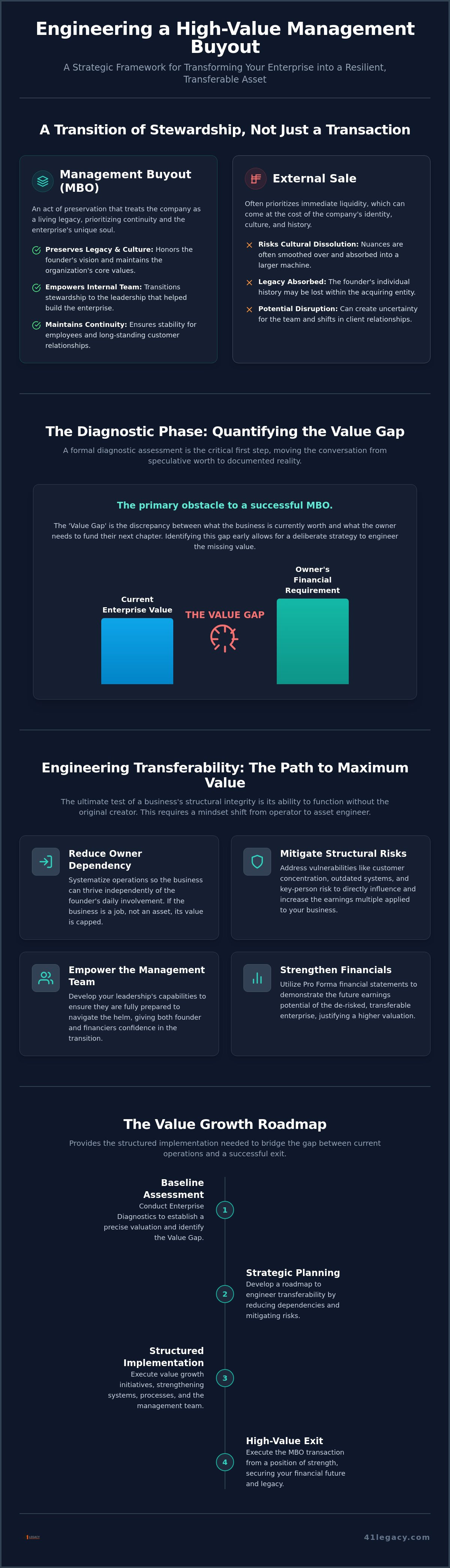
The distance between the current valuation and the financial requirements of the owner's post-exit life is often wider than anticipated. This discrepancy is fueled by hidden risks that devalue the enterprise, such as customer concentration or outdated systems. Market attractiveness and business readiness converge here to dictate the final multiple. The 'Value Gap' acts as the primary obstacle to a successful MBO, representing the discrepancy between what the business is currently worth and what the owner actually needs to fund their next chapter. Identifying this gap early allows for a deliberate strategy to engineer the missing value before the transaction occurs.
The Enterprise Diagnostic Process
The diagnostic process examines the internal mechanisms that either drive or drain value. We analyze the 'Four Pillars' of readiness to ensure the asset is truly transferable. Human capital focuses on the leadership team’s ability to operate without the founder, while structural capital evaluates the maturity of internal systems. Customer capital measures the diversity of the revenue stream, and social capital assesses the strength of the brand’s culture and reputation. A formal Exit Readiness Assessment illuminates these hidden vulnerabilities before they can derail a transition. This deep dive ensures the management team possesses the strategic capacity to execute the buyout and sustain the legacy they are inheriting. Only by addressing these pillars can a founder move from being an operator to a steward of a high-value, independent asset.
Engineering Transferability: Reducing Owner Dependency
The most intricate mechanism within a business is often its founder. While your vision sparked the enterprise, your ongoing presence in daily operations can become a structural weakness. This is the 'Rainmaker Trap'. If you are the primary driver of sales or the sole keeper of client relationships, the company lacks independent life. For a leadership team preparing for a management buyout, an owner-dependent business is a high-risk liability. They aren't just buying your past successes; they are buying the certainty of future performance without you.
To solve this, we utilize a Value Growth Roadmap. This is a deliberate, step-by-step engineering process designed to systematically extract the founder from the center of the enterprise. It requires a profound psychological transition. You must move from being the hero of the story to being its architect. Letting go is not an admission of irrelevance; it's the ultimate act of leadership that allows the business to grow into its own independent entity. This transition is often the hardest part of preparing for a management buyout, as it demands the founder trust the very systems they spent years building.
The Role of SOPs in Business Value
Documented Standard Operating Procedures (SOPs) are the blueprints of your legacy. They institutionalize the 'tribal knowledge' that currently exists only in your mind or the minds of a few key veterans. By turning these insights into a scalable, transferable framework, you create a manual for the business. A management team will pay a premium for a company where the processes are predictable and repeatable. This structural capital transforms a chaotic operation into a polished, high-value asset that functions with surgical precision.
Talent Development as Value Growth
True value growth is found in the hands of the next generation. Identifying and mentoring future leaders is the most effective way to reduce 'Key Man Risk'. Through a Strategic Capacity Evaluation, we align management incentives with the long-term health of the enterprise. Cross-training and delegation aren't just management tasks; they are value-driving activities. When your team demonstrates the ability to solve complex problems and drive revenue without your intervention, the enterprise value naturally ascends. This transition ensures that when you finally step away, the essence of the company remains vibrant and secure. It turns a group of managers into a cohesive unit of owners ready to protect and grow what you created.
Financial and Structural Groundwork for a Successful MBO
The financial architecture of an enterprise is the silent guardian of its future value. While previous phases of preparing for a management buyout focus on diagnostic clarity and operational independence, this stage demands a meticulous refinement of the company’s fiscal narrative. It's not enough for the books to be accurate; they must be compelling. Financial integrity serves as the bedrock of trust between the founder, the management team, and the lending institutions that will ultimately fund the transition. By cleaning the balance sheet and institutionalizing transparency, you transform a private ledger into a professional-grade asset ready for scrutiny.
Mitigating enterprise risk is the most direct way to enhance the earnings multiple applied to the business. Lenders and buyers look for stability, and any unresolved risk acts as a friction point that devalues your life's work. Whether it's diversifying a concentrated customer base or formalizing vendor agreements, every risk removed is value engineered back into the enterprise. This structural groundwork ensures that the transition is not just a change in ownership, but a graduation into a more resilient corporate form.
The Power of Pro Forma Statements
Pro forma financial statements act as the canvas upon which the next chapter of the business is painted. These documents move beyond historical data to show the business's trajectory under the stewardship of the new management guard. By stripping away owner-related expenses and modeling future growth initiatives, you provide lenders with a rigorous, evidence-based forecast. This level of financial modeling significantly reduces perceived risk, demonstrating that the business possesses the cash flow necessary to service debt while continuing to innovate. Pro forma statements bridge the gap between current performance and future value by translating the founder’s strategic vision into a quantifiable financial roadmap.
Coordinating the Advisory Team
A successful MBO is a symphony that requires every instrument to be in tune. Your existing CPA, Attorney, and RIA are essential specialists, yet they often operate in isolation, unaware of how their specific advice impacts the broader exit strategy. Without a central figure to coordinate these efforts, you risk the 'silo effect,' where conflicting tax and legal strategies create unnecessary complexity and delay. We serve as the 'quarterback' for your professional team, ensuring that every piece of advice is aligned with the singular goal of a successful, high-value transition. To ensure your professional team is moving in harmony, we recommend a Strategic Advisory engagement to unify your transition efforts. This collaborative approach prevents the friction that often derails internal buyouts, allowing you to focus on the higher purpose of preserving your legacy.
The Value Growth Roadmap: Executing the Transition with 41 Legacy
Execution is the bridge between a founder’s vision and the enduring reality of a transferable asset. While the diagnostic phase provides the blueprints, the Value Growth Roadmap serves as the disciplined cadence of construction. Moving from theory to action requires more than just a plan; it demands a relentless commitment to monthly implementation. When preparing for a management buyout, the goal is to refine the enterprise until it possesses the structural integrity to stand alone. This is where the meticulous engineering of value transforms a closely held business into a legacy that thrives across generations.
The final act of stewardship is ensuring that the transition occurs with surgical precision. It’s a period of intentional evolution where the founder’s role diminishes as the management team’s strategic capacity expands. By the time the transaction concludes, the business shouldn't just be sold; it should be liberated to pursue its next chapter of growth under new, yet familiar, leadership.
The Strategic Advisory Quarterback
A sophisticated transition involves multiple disciplines, often leading to a fragmented strategy. 41 Legacy acts as the strategic quarterback, ensuring your CPA, attorney, and other trusted advisors are perfectly aligned with your exit goals. We eliminate the friction of conflicting advice by maintaining a singular focus on enterprise value. Through Monthly Implementation Support, we provide the accountability necessary to execute the roadmap, protecting the owner’s financial interests while preparing the management team for the weight of leadership. This collaborative harmony ensures that legal and tax structures serve the broader vision of a successful, high-value transition.
Steps to a Successful MBO Launch
The journey toward a successful management buyout follows a structured path of refinement. Each step is designed to strengthen the organization’s essence while reducing its dependency on any single individual.
- Step 1: Conduct the initial Enterprise Diagnostic. We establish a baseline of market attractiveness and identify the specific risks that currently devalue the asset.
- Step 2: Identify and close the Value Gap. Through Transferability Engineering, we address the discrepancies between current worth and your retirement needs.
- Step 3: Gradually transition operational authority. We utilize Strategic Capacity Evaluation to empower the management team, testing their ability to lead before the founder departs.
- Step 4: Execute the buyout. When readiness meets opportunity, the transition occurs with a business that is fully transferable and primed for independent success.
By the time you reach the final stage of preparing for a management buyout, the enterprise has become a masterpiece of operational harmony. It no longer requires the founder’s daily intervention to maintain its rhythm. Instead, it stands as a testament to a career defined by excellence, ready to be handed to the next generation of stewards with confidence and pride.
Securing Your Legacy Through Strategic Stewardship
The transition of a business is not merely a financial event; it's the final act of a founder’s creative journey. By refining the enterprise into a transferable asset, you ensure its essence remains vibrant long after your departure. The journey of preparing for a management buyout is a deliberate evolution of your life's work into a lasting institution. This process requires a shift in perspective, moving from the role of operator to that of an architect who builds for the future.
We believe every masterpiece deserves a guardian who understands the complexity of its engineering. Led by a Certified Exit Planning Advisor (CEPA), our team acts as the strategic quarterback for your professional advisors, ensuring a unified path toward your goals. We focus on reducing owner dependency to maximize your enterprise value, protecting your heritage while providing the strategic clarity needed for a seamless transition. Your company is a legacy worth preserving with the highest level of technical precision.
Begin your journey toward a transferable legacy with an Exit Readiness Assessment from 41 Legacy.
Your dedication has built something extraordinary. It's time to ensure it thrives for years to come.
Frequently Asked Questions
What is the difference between a management buyout and a management buy-in?
A Management Buyout (MBO) occurs when the existing leadership team acquires the company, whereas a Management Buy-In (MBI) involves an external team coming in to purchase and run the enterprise. MBOs are generally preferred by founders who value the preservation of the company's internal essence and cultural harmony. MBIs often introduce a period of significant structural change that can disrupt the rhythm of a legacy-driven organization.
How do I know if my management team is actually capable of buying the business?
You can determine your team's readiness through a Strategic Capacity Evaluation that tests their ability to lead without your direct intervention. Look for evidence of independent problem-solving and the consistent execution of key operational tasks. If the enterprise requires your presence for high-level decision-making, the leadership team isn't yet prepared to assume full stewardship of the asset.
What are the common reasons why management buyouts fail?
Management buyouts most frequently fail due to over-leverage, where the business cannot comfortably service the debt used for the acquisition. Other common causes include a lack of strategic alignment among the new owners or a failure to reduce owner dependency before the transition. When the founder's tribal knowledge isn't institutionalized, the business often falters under the weight of its own complexity once the creator departs.
How is the valuation of a company determined for an MBO?
Valuation for an MBO is typically determined by applying a multiple to the company’s normalized EBITDA, often ranging from 4 to 7 times for mid-market firms. This multiple is refined based on the Four Pillars of readiness: human, structural, customer, and social capital. Lenders focus heavily on debt-service coverage ratios, often requiring a ratio of 1.25x to 1.5x to ensure the business remains financially resilient.
Do I need to stay on as a consultant after the management buyout is complete?
While a brief transition period is standard, your goal in preparing for a management buyout is to engineer a business that no longer requires your presence. Staying on as a consultant for too long can hinder the new leadership team's growth and maintain a culture of dependency. A successful exit is defined by the moment the founder becomes optional, allowing the enterprise to flourish as an independent entity.
What is a 'Value Gap' and how does it affect my exit planning?
The Value Gap is the discrepancy between the current net value of your business and the financial resources you need to fund your post-exit lifestyle. Identifying this gap is a critical first step in exit planning because it dictates the level of value growth required before the transaction. Closing this gap ensures that your retirement is secure and that your legacy isn't compromised by financial necessity.
How long does the preparation for a management buyout typically take?
The transaction itself usually takes six to twelve months, but the process of preparing for a management buyout through value engineering should ideally begin one to three years in advance. This lead time allows for the systematic reduction of owner dependency and the institutionalization of key processes. Rushing the preparation often leads to a lower valuation and increased risk for the management team taking the helm.
Disclaimer
This article is for educational and informational purposes only and does not provide legal, tax, investment, or business brokerage advice. 41 Legacy does not offer M&A brokerage services, legal document drafting, tax preparation, or investment advisory services. Business owners should consult licensed professionals in those disciplines before making decisions related to business transactions, legal matters, tax strategy, or financial planning. All examples are illustrative and may not apply to your specific situation.