
Prepare Your Business for Sale: Artisan’s Exit Guide
Your business is a masterpiece of your own making, yet its true value remains hidden as long as it requires your hands to stay in motion. Understanding how to prepare business for sale isn't a matter of finding a buyer; it's the disciplined art of engineering a legacy that thrives in your absence. You've likely spent years refining your craft, but you may still feel the heavy weight of owner-dependency or the frustration of advisors who don't speak the same language. It's natural to worry whether your life's work can truly endure as a standalone entity.
We believe that a business should be a transferable asset, polished to a high sheen and ready for its next chapter. This guide will help you transform your life's work by prioritizing strategic readiness over a mere transaction. We'll provide a clear roadmap to increase enterprise value and reduce risk through the lens of a steward rather than a seller. You'll discover how to move from daily operator to strategic guardian, ensuring your history is preserved through precise diagnostics and structured implementation support.
Key Takeaways
- Distinguish between the finality of a transaction and the discipline of exit readiness so it's clear your enterprise possesses the strength to stand on its own.
- Utilize Enterprise Diagnostics to uncover the inner essence of your organization and bridge the Value Gap between current performance and your long-term goals.
- Discover how to prepare business for sale by engineering transferability, a process that removes the founder as the primary driver of daily operations.
- Adopt a "Quarterback" philosophy to harmonize your advisory team, ensuring that disparate specialists work in concert toward a singular, strategic vision.
- Commit to a Value Growth Roadmap with structured monthly support to transform your business into a transferable asset that thrives long after your departure.
The Distinction Between Selling and Being Ready to Sell
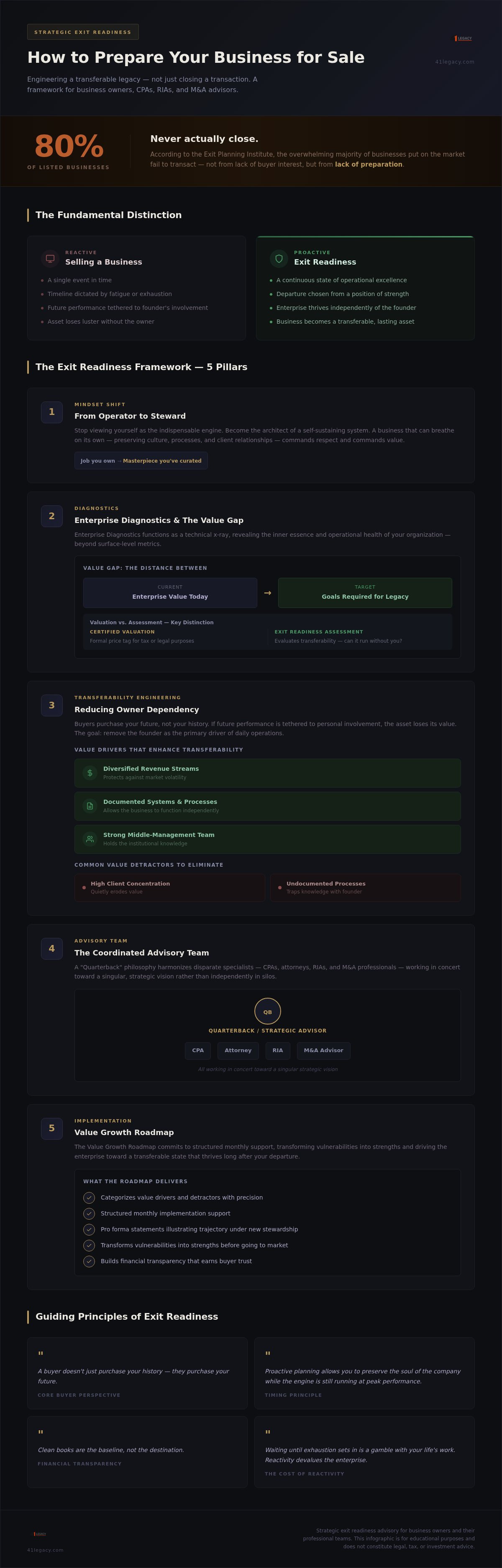
A transaction is a single event in time, but exit readiness is a continuous state of operational excellence. Many owners mistake the desire to exit for the capacity to do so. True readiness represents the strategic ability to transfer the inner essence of an enterprise without compromising its performance. When we discuss how to prepare business for sale, we aren't merely checking boxes for a closing date. We're refining a living entity until it can breathe on its own.
The stakes are high. Research from the Exit Planning Institute indicates that approximately 80% of businesses put on the market never actually close. This failure rarely stems from a lack of interest; it arises from a lack of preparation. A buyer doesn't just purchase your history; they purchase your future. If that future is tethered solely to your personal involvement, the asset loses its luster. We view the owner as a Master Craftsman, one who constructs a legacy designed for longevity rather than mere liquidity.
The Cost of Reactivity in Exit Planning
Waiting until exhaustion sets in is a gamble with your life's work. Reactivity devalues the enterprise because it forces a timeline dictated by fatigue rather than market strength. While a professional business valuation provides a technical baseline, operational readiness ensures you capture every bit of that potential value. Proactive planning allows you to preserve the soul of the company while the engine is still running at peak performance. It's about choosing the moment of departure from a position of strength.
Stewardship: Building a Transferable Asset
The transition from owner to steward requires a profound psychological shift. You must stop viewing yourself as the indispensable engine and start seeing yourself as the architect of a self-sustaining system. Transferability engineering acts as a guardian for the company's future. It ensures the culture, processes, and client relationships remain intact during a hand-off. By focusing on how to prepare business for sale through the lens of stewardship, you build an asset that commands respect because it no longer needs you to survive. This shift transforms your business from a job you own into a masterpiece you've curated.
Establishing the Baseline: Enterprise Diagnostics and the Value Gap
Before you can chart a course for the future, you must understand the present state of your enterprise with surgical precision. Enterprise Diagnostics serves as a technical x-ray, revealing the inner essence and operational health of your organization. This process goes beyond surface-level metrics to identify the "Value Gap." This gap represents the distance between your current determining enterprise value and the financial goals required to secure your legacy. Understanding this delta is the first step in learning how to prepare business for sale. It's the difference between hoping for a specific outcome and engineering one.
Many owners confuse a Certified Business Valuation with an Exit Readiness Assessment. While a valuation provides a formal price tag for tax or legal purposes, an assessment evaluates the transferability of the asset. It's a look under the hood to see if the engine can run without the lead mechanic. When you begin the process of selling your business, you'll find that buyers are more interested in the reliability of future cash flows than in historical trophies.
Identifying Value Drivers and Detractors
Precision is paramount. While a business may appear attractive to the market, it often harbors internal detractors that quietly erode value. These might include high client concentration or undocumented proprietary processes. We use a Value Growth Roadmap to categorize these elements, turning vulnerabilities into strengths. Common drivers that enhance the essence of a transferable asset include:
- Diversified revenue streams that protect against market volatility.
- Documented systems that allow the business to function independently.
- A strong middle-management team that holds the institutional knowledge.
The Role of Financial Transparency
Clean books are the baseline, not the destination. To truly showcase the future potential of your work, you must utilize pro forma statements that illustrate the company's trajectory under new stewardship. This level of transparency builds trust and reduces the perception of risk. Viewing diagnostic fees as a project-based investment in clarity allows you to see the true health of your asset. If you're ready to see what lies beneath the surface, an Exit Readiness Assessment can provide the strategic clarity you need. By focusing on how to prepare business for sale through data-driven insights, you ensure that no detail is left to chance and your legacy remains protected.
Engineering Transferability: Reducing Owner Dependency
Engineering transferability is the most critical phase when considering how to prepare business for sale. In the middle market, owner-dependency stands as the primary value killer. If the organization's heartbeat is synchronized with your own, the asset is fragile. We see this most clearly in the "Rainmaker Trap," where the founder remains the lead salesperson. While impressive, this dynamic suggests that revenue will vanish the moment you step away. A buyer isn't looking to purchase your personal charisma; they want a self-sustaining engine.
To identify these risks, we conduct a Strategic Capacity Evaluation. This process uncovers bottlenecks within your leadership team that might stifle future growth. It's a clinical look at whether your team can handle the weight of the enterprise without your constant intervention. This aligns with the U.S. Small Business Administration guidance on selling your business, which emphasizes the need for a business that can stand on its own operational merits.
The Blueprint of Standard Operating Procedures (SOPs)
SOPs are the DNA of a transferable legacy. They transform "tribal knowledge," locked in the minds of a few, into a documented and repeatable system. When we define what is sop in business, we describe the blueprint that allows the enterprise to breathe without your presence. Precise documentation ensures that the essence of your craftsmanship is preserved, even when different hands are at the wheel. It's the difference between a collection of talented individuals and a high-performance machine.
Empowering the Next Generation of Leadership
Talent development is a strategic necessity for enterprise value growth. You must shift your perspective from "command and control" to "strategic oversight." By building a leadership team that functions as a primary asset, you create a legacy that survives your departure. Buyers pay a premium for a team that has already proven its ability to navigate challenges independently. This transition ensures that the company's future is secured, not by your presence, but by the strength of the culture and leadership you've curated. Learning how to prepare business for sale is ultimately about making yourself obsolete so that the business can truly live.
Assembling the Coordinated Advisory Team
A masterpiece requires a guild of specialists, yet even the finest artisans need a master architect to ensure the final work remains harmonious. Many owners possess a talented circle of advisors, but these professionals often operate in isolation. Without a central point of strategic alignment, the disparate efforts of your CPA, attorney, and wealth manager can inadvertently create friction. Learning how to prepare business for sale is as much about managing these relationships as it is about refining operations. We believe in the "Quarterback" philosophy, where a single lead advisor ensures every professional decision reinforces the enterprise's ultimate value.
The the certified exit planning advisor (CEPA) occupies this essential role within the advisory ecosystem. By bridging the gap between technical disciplines, the CEPA ensures that your financial goals, personal aspirations, and business health are treated as a singular, cohesive narrative. This stewardship protects the essence of your legacy from being diluted by fragmented planning. It is a process of curation that demands technical precision and a deep respect for the history you have built.
Avoiding the 'Silo Effect' in Professional Advice
The "Silo Effect" occurs when advisors provide excellent technical guidance that fails to account for the broader strategic vision. For example, tax advice focused solely on immediate liability reduction might inadvertently conflict with strategies designed to maximize enterprise value. Legal structures must be engineered to support eventual transferability long before a transition is on the horizon. We provide monthly implementation support to keep your advisory team synchronized, ensuring that every professional contribution serves the long-term health of the asset rather than just a seasonal deadline.
The Quarterback vs. The Broker
It is vital to distinguish between strategic advisory and transaction brokerage. While a broker typically enters the narrative at the end of the journey to manage a transaction, a Quarterback acts as a guardian who begins the work years in advance. This distinction is fundamental to how to prepare business for sale with integrity. A Quarterback focuses on the strategic capacity of the organization, identifying value gaps and engineering transferability while you are still at the helm. This proactive approach ensures that when the time for a transition arrives, the business is a polished, transferable asset rather than a collection of uncoordinated parts. To align your professional team toward a singular, uncompromising vision of perfection, explore our Strategic Advisory support.
The Value Growth Roadmap: Implementation as Stewardship
The Value Growth Roadmap is far more than a strategic document; it is a living testament to the health and future potential of your enterprise. While earlier sections explored the diagnostics and the advisory team, the roadmap is where theory meets the disciplined reality of execution. Learning how to prepare business for sale requires a commitment to constant refinement. This document serves as a guide for enhancing the inner essence of the company, ensuring that every operational adjustment increases the asset's transferability. By following specific growth tactics, such as those outlined in our guide on how to increase enterprise value, you transform the business into a masterpiece of efficiency.
Execution is rarely a solitary endeavor. Monthly Implementation Support provides the necessary heartbeat for this process, ensuring that the vision established by your coordinated advisory team remains on track. It's easy to lose focus on daily performance while distracted by the complexities of a future transition. However, maintaining peak performance is vital. A buyer is purchasing a moving vehicle, not a stationary relic. Accountability ensures that the business continues to breathe and grow even as you prepare for the eventual hand-off.
Protecting the Essence During Transition
A successful transition is defined by the survival of the company's soul. Stewardship means ensuring that the culture and values you've meticulously cultivated endure long after your departure. During the post-sale integration phase, the owner often transitions into a curatorial role, guiding the new leadership through the intricacies of the organization's history. This final act of devotion to the craft ensures that the legacy remains untarnished and the impact is lasting. It is the final polish on a work of art that has taken a lifetime to create.
Next Steps for the Visionary Owner
The journey from operator to steward begins with a single moment of clarity. Moving from theoretical planning to disciplined execution is what separates a mere business owner from a legacy builder. If you're ready to discover the true strategic capacity of your enterprise, the Exit Readiness Assessment is your starting point. It provides the technical precision needed to understand your baseline and the roadmap required to bridge the value gap. This is the most effective way to understand how to prepare business for sale with confidence. Begin your journey toward a transferable legacy with 41 Legacy and ensure your life's work thrives independently for generations to come.
Securing the Future of Your Masterpiece
Your business is the culmination of years of meticulous craft. Securing its future requires a shift from daily management to intentional stewardship. By focusing on how to prepare business for sale through the lens of transferability engineering, you transform your life's work into a self-sustaining asset. This process ensures the inner essence of your organization survives your departure and thrives under new leadership.
Success is found in the precision of your diagnostics and the coordination of your advisory team. We provide national strategic advisory expertise led by a Certified Exit Planning Advisor (CEPA) to help you bridge the value gap and refine your operational DNA. This structured approach moves beyond theoretical planning, offering a disciplined roadmap to protect the legacy you've built.
The final chapter of your ownership should be an act of devotion, not a period of exhaustion. Secure Your Legacy with an Exit Readiness Assessment and begin the work of engineering a truly transferable asset. Your masterpiece deserves a future that is as enduring as its history.
Frequently Asked Questions
How long does it take to prepare a business for sale?
Preparing an enterprise for a transition typically requires 12 to 36 months of disciplined refinement. While a transaction can happen quickly, building a truly transferable asset takes time to bridge the Value Gap. This duration allows for the implementation of a Value Growth Roadmap and the reduction of owner-dependency. Starting early ensures that you're operating from a position of strength rather than reacting to fatigue or sudden market shifts.
What is the difference between a business valuation and an exit readiness assessment?
A business valuation provides a technical price tag based on historical data, while an Exit Readiness Assessment evaluates the structural integrity of the organization. One measures what the business is worth today; the other determines if it can actually function without the founder. Understanding how to prepare business for sale requires looking beyond the numbers to see if the internal systems and leadership are strong enough to endure a change in stewardship.
Why is owner-dependency such a significant risk for buyers?
Owner-dependency is a primary value killer because it represents a single point of failure for the buyer. If the company's relationships, sales, and technical precision reside solely with you, the asset's future is uncertain. Buyers seek a self-sustaining engine that produces predictable cash flow. When the founder is the only rainmaker, the perceived risk increases, which often results in a lower valuation or restrictive deal terms that require the owner to stay longer.
How can I increase my business value without significantly increasing sales?
You can elevate enterprise value by focusing on the quality of your operations and reducing perceived risk. Improving profit margins through precise cost management and documenting proprietary processes creates a more attractive asset. When you refine the inner essence of the company, you increase the valuation multiple buyers are willing to pay. This approach ensures that how to prepare business for sale is a strategic endeavor focused on efficiency and transferability rather than just top-line revenue growth.
What role does a CPA play in the exit planning process?
Your CPA provides the financial transparency necessary for a successful transition by ensuring your books are clean and defensible. They play a vital role in identifying historical performance trends and potential tax implications. However, their work must be coordinated by a Quarterback advisor to ensure their technical guidance aligns with your long-term legacy goals. This alignment prevents the silo effect and ensures that financial planning supports the overall growth of your transferable asset.
Is it possible to sell a business if it isn't 'exit ready'?
It's possible to sell an unready business, but the cost is often a significant reduction in value and a loss of control over the legacy. Such businesses frequently fail to close or involve restrictive earn-outs where the owner must meet future targets to receive the full price. Without proper preparation, you risk leaving the future of your life's work to chance. True readiness ensures that you transition on your own terms with a business that thrives independently.
What does a 'Quarterback' advisor actually do for a business owner?
A Quarterback advisor provides the strategic alignment necessary to harmonize your entire professional team. They act as the single point of contact who coordinates your CPA, attorney, and wealth manager toward a singular vision. By managing these disparate specialists, the Quarterback ensures that every decision reinforces the company's transferability. This stewardship prevents conflicting advice and keeps the implementation of your Value Growth Roadmap on schedule through monthly support and disciplined oversight.
How do SOPs directly impact the final sale price of a company?
Standard Operating Procedures (SOPs) serve as the DNA of your organization, proving that your success is repeatable and systematic. They directly impact the sale price by reducing the buyer's operational risk. When a buyer sees that the company's inner essence is documented, they gain confidence in the continuity of future cash flows. This precision transforms a collection of individual talents into a high-performance, transferable asset that commands a premium in the market.

Article by
Mike Laskowski
Mike Laskowski is a Business Value Growth Strategist who helps business owners uncover the truths that drive their performance, risk, and readiness. Blending forensic interviewing from a 26‑year federal career with Strategic Capacity analysis and CEPA methodology, he works upstream to reduce owner dependency, increase transferability, and strengthen enterprise value. Mike guides founders through clarity, operational evolution, and transition readiness so their companies become transferable, owner‑independent assets that endure beyond the founder.
Disclaimer
This article is for educational and informational purposes only and does not provide legal, tax, investment, or business brokerage advice. 41 Legacy does not offer M&A brokerage services, legal document drafting, tax preparation, or investment advisory services. Business owners should consult licensed professionals in those disciplines before making decisions related to business transactions, legal matters, tax strategy, or financial planning. All examples are illustrative and may not apply to your specific situation.

