
Prepare Your Business for Sale: Artisan Exit Guide
What happens to the masterpiece once the artisan lays down the brush? For many founders, the business is far more than a collection of assets; it's a living testament to decades of vision and meticulous craft. You likely feel a profound sense of stewardship, yet you may worry that the enterprise cannot function without your daily presence. We believe that a true legacy is defined by its ability to endure. By utilizing a comprehensive exit readiness checklist, you can begin the transition from operator to architect, transforming your life's work into a transferable asset that commands its full market value.
This guide offers a clear roadmap to increase enterprise value by prioritizing strategic readiness over a mere transaction. We'll show you how to reduce owner dependency and harmonize your disparate advisors into a unified force. You'll discover how to engineer a business that functions with technical precision, ensuring your impact remains long after your departure. It's time to view your exit not as an end, but as the ultimate refinement of everything you've built.
Key Takeaways
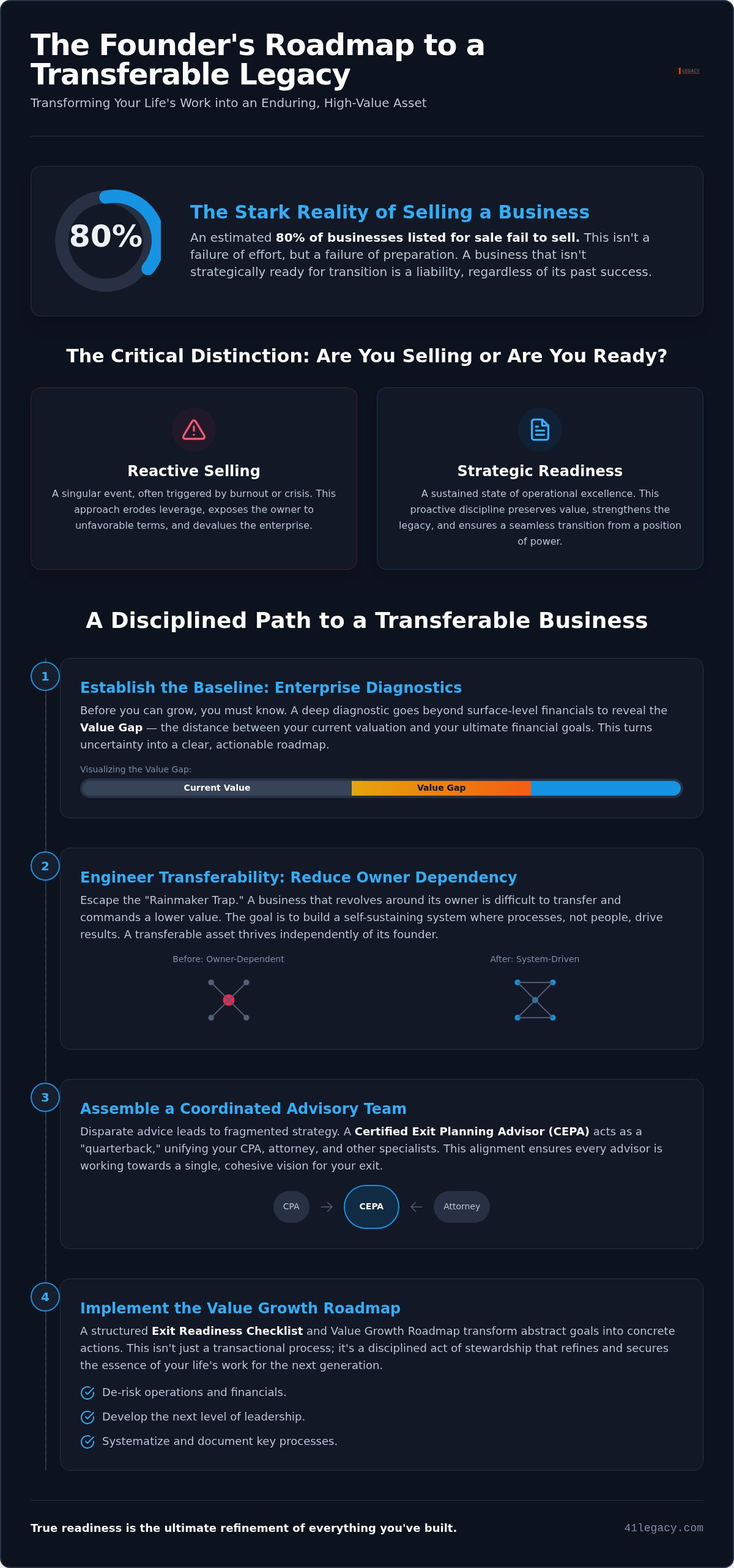
- Understand the critical distinction between merely listing a business and achieving true readiness, ensuring your enterprise doesn't fall into the 80% of companies that fail to sell.
- Discover how Enterprise Diagnostics reveal the Value Gap between your current operational reality and the financial goals required to secure your future.
- Learn to identify and dismantle owner-dependency, escaping the "Rainmaker Trap" to build a business that thrives as a standalone, transferable asset.
- Recognize the importance of a Certified Exit Planning Advisor (CEPA) acting as a quarterback to align your CPA, attorney, and other advisors toward a single strategic vision.
- Utilize a structured exit readiness checklist and Value Growth Roadmap to transform technical improvements into a disciplined act of legacy stewardship.
The Distinction Between Selling and Being Ready to Sell
Selling a business is a singular event, but being ready to sell is a sustained state of strategic excellence. Many founders confuse the desire to move on with the operational capacity to do so. Exit readiness is the structural and strategic capability to transfer ownership seamlessly, ensuring the company's essence remains intact. It's a precise discipline. Statistics indicate that 80% of businesses put on the market fail to sell. This failure rarely results from a lack of effort; it's almost always a lack of preparation. A business that isn't ready for transition is a liability, regardless of its past success.
We invite you to adopt the mindset of a master craftsman. A craftsman doesn't just create for the moment; they build for the progression of time. They ensure every internal mechanism is as polished as the exterior finish. By shifting your focus from finding a buyer to engineering a transferable asset, you create something a sophisticated investor naturally covets. Utilizing a rigorous exit readiness checklist allows you to identify the friction points that might hinder a transition. This isn't a transactional exercise. It's a commitment to the longevity of your life's work.
The Cost of Reactivity in Exit Planning
Waiting until burnout or a personal crisis forces a transition is a high-stakes gamble that often devalues the enterprise. Reactivity erodes leverage and leaves the owner vulnerable to unfavorable terms. While market timing is a fickle variable beyond your control, operational readiness is a driver you can master. Proactive Exit Planning preserves the technical precision and history of your brand. It ensures that when you choose to step away, you do so from a position of strength. Preparation is the guardian of value, preventing the erosion of the legacy you've spent decades refining.
Stewardship: Building a Transferable Asset
A successful transition requires a profound psychological shift. You must evolve from the central engine of the business to its dedicated steward. A steward doesn't just manage daily operations; they curate the organization for its future. This involves transferability engineering, where we systematically reduce owner dependency to ensure the business thrives independently. It's about building a legacy that survives your departure. By adhering to a structured exit readiness checklist, you transform the business from a personal project into a durable institution. At 41 Legacy, we believe this process is an act of stewardship. By refining the company's internal systems, you're not just preparing for a hand-off; you're securing the company's essence for the next generation.
Establishing the Baseline: Enterprise Diagnostics and the Value Gap
To build toward a meaningful future, one must first understand the present with surgical clarity. Enterprise Diagnostics serve as the curatorial lens through which we view the operational health and inner essence of your life's work. This process transcends the surface-level metrics of revenue and profit. It's a deep investigation into the structural integrity of the organization. We must define the Value Gap: the specific distance between your company's current market valuation and the financial goals required to fulfill your vision for the next chapter. Without this baseline, any effort to grow value is merely guesswork.
While a standard Certified Business Valuation provides a historical snapshot, an Exit Readiness Assessment is a forward-looking diagnostic map. It's the difference between knowing the current price of a masterpiece and understanding the long-term integrity of the canvas. This clarity is achieved through a focused, project-based investment in Enterprise Diagnostics. By identifying exactly where value is leaking or where risks are hidden, you turn uncertainty into a manageable roadmap for growth. Including this diagnostic phase in your exit readiness checklist ensures you aren't building on a fractured foundation. It's the first step in treating your business as a transferable asset rather than a personal job.
Identifying Value Drivers and Detractors
Technical precision is required to separate external market attractiveness from internal operational performance. A business might look appealing to the outside world, but internal risks can quietly erode its enterprise value. We utilize the Determining Enterprise Value framework to guide this assessment. This framework helps distinguish between what the market desires and how your business actually functions on a granular level. Identifying these detractors early allows you to address them before they become significant liabilities. To gain this level of strategic clarity, you may wish to begin with a formal Enterprise Diagnostic to reveal the true health of your organization.
The Role of Financial Transparency
Clean financial records are the baseline, not the final destination. True financial readiness requires a transparent narrative of growth that sophisticated successors or buyers can trust implicitly. Pro forma statements are essential because they showcase the future potential of the asset under different scenarios. They illustrate what the business can become once the founder's personal influence is removed. Accurate financial forecasting builds the trust necessary for a seamless hand-off. When these elements are integrated into your exit readiness checklist, they act as undeniable proof of the company's enduring health and technical excellence. This transparency ensures that the legacy you've built is valued for its future, not just its past.
Engineering Transferability: Reducing Owner Dependency
In the world of high-end craftsmanship, the master’s touch is revered. However, in the realm of enterprise value, a business that relies entirely on the founder’s touch is a fragile entity. Owner dependency is the primary value killer for middle-market enterprises. If you are the sole source of key relationships or the primary driver of revenue, you've encountered the Rainmaker Trap. While your personal brilliance has fueled the company’s history, a sophisticated buyer views this as a significant risk. They aren't looking to buy your daily labor; they're looking to acquire a self-sustaining asset.
Reducing this dependency is the most critical prerequisite for a successful exit readiness checklist. We address this through a Strategic Capacity Evaluation, a diagnostic designed to identify leadership bottlenecks and operational silos. This evaluation reveals where your personal involvement has become a constraint rather than a catalyst. By engineering transferability, we ensure that the company’s essence is woven into its organizational fabric. This technical precision allows the business to function with the same excellence in your absence as it does during your tenure.
The Blueprint of Standard Operating Procedures (SOPs)
Documented processes are the DNA of a lasting legacy. Moving from tribal knowledge to a repeatable system is essential for building buyer confidence. We view the creation of a What is an SOP in Business? framework as the blueprint for your company’s future. These systems allow the enterprise to breathe and grow without your constant intervention. When every intricate process is polished and documented, you provide a map that a successor can follow with surgical precision. This ensures the mechanical and aesthetic standards of your work survive the transition.
Empowering the Next Generation of Leadership
Talent development is a core strategy for increasing enterprise value. A management team that functions independently is one of the most valuable assets you can offer a potential successor. This requires a deliberate shift in your role, moving from command-and-control to strategic oversight. By empowering your leadership team, you demonstrate that the business possesses the strategic capacity to thrive independently. This evolution is a vital component of your exit readiness checklist. It transforms the business from a personal project into a durable, transferable institution that reflects your uncompromising vision of perfection.
Assembling the Coordinated Advisory Team
Excellence in a transition is rarely the result of a single hand; it requires a symphony of specialists operating in perfect harmony. Most business owners possess an existing team of advisors, including a CPA, an attorney, and a wealth manager. However, these professionals often work in silos, providing advice that is technically sound but strategically misaligned. To ensure your exit readiness checklist results in a successful hand-off, you need a single point of alignment. This is the Quarterback philosophy. It's the belief that a complex legacy requires a central architect to coordinate every moving part toward a singular vision of transferability.
A Certified Exit Planning Advisor (CEPA) serves as this essential coordinator. Unlike the transactional nature of a broker, whose focus is often limited to the moment of sale, a strategic advisor is a guardian of the company’s long-term health. We work to ensure that the technical precision of your legal structure mirrors the aesthetic and operational standards of your brand. This coordination prevents the friction that often occurs when disparate advisors pull the enterprise in conflicting directions. By aligning your team early, you preserve the essence of the business while maximizing its eventual market value.
Avoiding the Silo Effect in Professional Advice
The silo effect occurs when professional advice is given without considering the broader strategic roadmap. For example, a CPA might focus solely on tax mitigation, which could inadvertently devalue the enterprise by suppressing reported earnings. Similarly, legal structures must be engineered to support the eventual transfer of the legacy, rather than just protecting against immediate liability. We recommend reviewing The Certified Exit Planning Advisor to understand how structural alignment serves as the foundation of your transition. When your advisors communicate through a central quarterback, the resulting strategy is cohesive, resilient, and focused on growth.
The Necessity of Monthly Implementation Support
Execution is the bridge between a theoretical plan and a transferable asset. Many exit plans fail because they lack a mechanism for accountability during the years of preparation. Monthly Implementation Support ensures that the roadmap is executed with the same meticulous nature you apply to your craft. We coordinate with your existing advisors to ensure that every task on your exit readiness checklist is completed on schedule. This steady, unhurried rhythm maintains a professional-room altitude, allowing you to focus on stewardship while we manage the granular details of the transition. To begin aligning your team for a successful future, explore our Strategic Advisory support today.
The Value Growth Roadmap: Implementation as Stewardship
A vision without execution is merely a dream; in the context of your legacy, it's a missed opportunity. The Value Growth Roadmap acts as the living manifesto for your enterprise, evolving alongside the business to ensure every strategic move is intentional. This document isn't a static report intended for a shelf. It's a dynamic guide that dictates the rhythm of your company’s progression. By utilizing this roadmap as your primary exit readiness checklist, you transform the abstract goal of "readiness" into a series of disciplined, technical refinements.
Monthly Implementation Support serves as the bridge across the Value Gap we identified during the diagnostic phase. It provides the accountability necessary to ensure that growth isn't just discussed, but realized. This process is the final act of devotion to your craft. You're not just preparing for a transaction; you're polishing the internal mechanisms of your life's work until they shine with a high sheen of operational excellence. For specific tactics on refining these internal systems, you may find our guide on How to Increase Enterprise Value to be an essential resource in your journey.
Protecting the Essence During Transition
The true measure of a legacy is its ability to survive the hands of its creator. Protecting the company's culture and core values during a transition requires the same precision as the work itself. A transferable asset doesn't just offer financial security; it provides profound peace of mind for the founder and the employees who carry the torch forward. If a post-sale integration phase is required, your role shifts from operator to mentor, ensuring the company’s essence remains uncompromised. This stewardship ensures that the heritage you've built continues to thrive, regardless of who holds the keys to the office.
Next Steps for the Visionary Owner
Strategic clarity begins with a single, decisive step. Moving from theoretical planning to disciplined, monthly execution is what separates a successful transition from the 80% of businesses that fail to sell due to lack of readiness. An Exit Readiness Assessment provides the technical baseline you need to begin this transformation. It's time to stop viewing your departure as a distant event and start viewing it as the ultimate refinement of your professional life. We invite you to begin your journey toward a transferable legacy with 41 Legacy, where we treat your business with the reverence it deserves. Together, we can ensure your exit readiness checklist leads to a future defined by impact and enduring value.
Architecting the Future of Your Business Legacy
Your business is a living testament to your dedication, a masterpiece refined through years of technical precision. Securing its future requires a shift from daily operation to strategic stewardship. By utilizing a rigorous exit readiness checklist, you transform the enterprise into a self-sustaining asset that thrives independently of your presence. We've explored how bridging the Value Gap and dismantling owner dependency are essential acts of preservation for your company’s essence.
True readiness is achieved when your advisory team operates with the harmony of a well-conducted symphony. At 41 Legacy, we provide national strategic advisory expertise led by a Certified Exit Planning Advisor (CEPA) to act as the architect of this transition. Our focus on transferability engineering ensures that the mechanical and aesthetic standards you've established endure long after the hand-off. It's time to move beyond theoretical planning and embrace the disciplined execution your life's work deserves.
Secure Your Legacy with an Exit Readiness Assessment
The next chapter of your journey begins with the clarity of a proven roadmap. You've built a remarkable foundation; now, let's ensure it stands the test of time.
Frequently Asked Questions
How long does it take to prepare a business for sale?
Preparation typically requires a horizon of twelve to twenty-four months to achieve optimal results. This duration allows for the meticulous refinement of internal systems and the systematic reduction of owner dependency. Rushing the process often leads to the erosion of enterprise value. By following a structured exit readiness checklist over this period, you ensure the company’s essence is preserved and its transferability is engineered with surgical precision.
What is the difference between a business valuation and an exit readiness assessment?
A business valuation provides a historical snapshot of a company's price at a specific moment. In contrast, an exit readiness assessment is a forward-looking diagnostic of operational health and strategic capacity. While a valuation tells you what the business was worth, an assessment reveals how to increase its future value. It identifies the Value Gap and establishes the technical baseline needed to transform the enterprise into a transferable asset.
Why is owner-dependency such a significant risk for buyers?
Buyers view owner dependency as an inherent risk to the continuity of future cash flows. If the founder is the sole driver of key relationships or sales, the business's integrity is compromised once they depart. This "Rainmaker Trap" often results in lower valuation multiples or demanding earn-out structures. Strategic Capacity Evaluation helps identify these leadership bottlenecks, allowing for the engineering of a management team that functions as a primary asset.
How can I increase my business value without significantly increasing sales?
Enterprise value can be significantly enhanced by improving the quality of earnings and reducing operational risks. This involves refining internal processes, securing recurring revenue streams, and establishing a robust management team. By focusing on transferability engineering, you can command a higher EBITDA multiple from sophisticated buyers. Enhancing the structural integrity of the organization often yields a greater return than a simple increase in top-line revenue.
What role does a CPA play in the exit planning process?
A CPA provides the financial transparency and tax efficiency necessary for a successful transition. They ensure the company’s books are clean and defensible during the rigorous due diligence process. However, their advice must be coordinated within a broader strategic vision. By working alongside a Certified Exit Planning Advisor (CEPA), the CPA helps align financial reporting with the long-term goal of maximizing the company’s transferable legacy.
Is it possible to sell a business if it is not exit ready?
While it is technically possible to list a business that is not exit ready, the statistical likelihood of a successful sale is low. Industry data suggests that 80% of businesses fail to sell, often due to a lack of preparation or unrealistic expectations. Those that do sell without a proper exit readiness checklist often face significant price reductions. Preparation is the only reliable guardian of the value you've built.
What does a Quarterback advisor actually do for a business owner?
A Quarterback advisor serves as the central architect of your transition, ensuring all professional specialists operate in perfect harmony. They coordinate the efforts of your CPA, attorney, and wealth manager to prevent conflicting advice and the silo effect. By maintaining a professional-room altitude, they manage the granular details of the Value Growth Roadmap. This alignment ensures that every decision serves the singular goal of building a transferable, high-value asset.
How do SOPs directly impact the final sale price of a company?
Standard Operating Procedures serve as the DNA of a repeatable, transferable legacy. They provide potential successors with the documented proof that the business can function with technical excellence without the founder’s presence. This de-risks the acquisition, often leading to a higher final sale price and more favorable deal terms. Systems allow the business to breathe independently, transforming tribal knowledge into a durable institutional asset that buyers value highly.

Article by
Mike Laskowski
Mike Laskowski is a Business Value Growth Strategist who helps business owners uncover the truths that drive their performance, risk, and readiness. Blending forensic interviewing from a 26‑year federal career with Strategic Capacity analysis and CEPA methodology, he works upstream to reduce owner dependency, increase transferability, and strengthen enterprise value. Mike guides founders through clarity, operational evolution, and transition readiness so their companies become transferable, owner‑independent assets that endure beyond the founder.
Disclaimer
This article is for educational and informational purposes only and does not provide legal, tax, investment, or business brokerage advice. 41 Legacy does not offer M&A brokerage services, legal document drafting, tax preparation, or investment advisory services. Business owners should consult licensed professionals in those disciplines before making decisions related to business transactions, legal matters, tax strategy, or financial planning. All examples are illustrative and may not apply to your specific situation.

