
Owner Readiness for Exit: Prepare the Business, and Yourself
What if preparing for a future exit didn’t mean deciding to sell? Owner readiness for exit is less a single decision than a measure of whether the business can thrive beyond its founder and whether the owner has clarity about what comes next. It’s understandable to hesitate when planning feels like it could disrupt today’s priorities or set an irreversible process in motion. It doesn’t have to.
Readiness grows through deliberate steps. A business may rely heavily on its owner for key decisions, customer relationships, or daily operations, while the owner is still weighing personal goals and possible transition paths. Looking at these factors together can turn uncertainty into a practical starting point.
This article explains how to assess business transferability and personal preparation, identify gaps in operations, leadership, and financial visibility, and choose next steps without committing to an immediate sale. At 41 Legacy, an Exit Readiness Assessment helps clarify the company’s current position and identify value gaps. A Value Growth Roadmap and ongoing strategic advisory can then help owners prioritize improvements alongside their existing CPA and attorney. The aim is a more transferable business and more options for the future.
Key Takeaways
- Owner readiness for exit develops over time; assessing it doesn’t commit you to a sale.
- Review owner dependency, leadership continuity, financial clarity, and operational stability to see how well the business can function beyond you.
- Consider personal goals alongside business transferability, including what you want your next chapter to look like.
- Document the current picture, prioritize gaps, assign responsibility, and review progress to make preparation manageable.
- An Exit Readiness Assessment can clarify your current position and the distance between the business as it stands and your goals.
Owner readiness for exit starts before you decide to leave
You may know that one day you’ll step away from your business without having a fixed timetable or a clear picture of what should happen next. That uncertainty is normal. Readiness can begin with a review, not a decision to sell.
Owner readiness for exit is the clarity to make an informed transition decision when circumstances warrant, based on your goals, the business’s condition, and the options available. It is not a pass-or-fail label or a commitment to an immediate transition. Assessing readiness helps you understand your choices and what could strengthen them.
What does owner readiness for exit actually mean?
Readiness has distinct but connected dimensions. Personal clarity concerns what you want from the next chapter, how you see your role changing, and what timing feels workable. Business condition concerns whether the enterprise can maintain performance and key relationships without relying on you for every important decision. Transition options concern the paths that may fit your goals and circumstances.
These dimensions are related, but they aren’t interchangeable. You might feel personally prepared to step back while the business still depends on your daily involvement. Or the company may have capable leaders and reliable processes while you’re not ready to share control. Either way, the gap is useful information. Readiness can improve as your goals become clearer and the business becomes more transferable.
Exit planning can encompass both financial and non-financial objectives. An owner’s review should make room for more than the enterprise’s condition. It should also clarify what the owner wants a transition to make possible. For a broader view of exit planning for business owners, consider how personal goals and business preparation can inform one another.
Why assess readiness before a transition feels urgent?
Starting early gives you room to understand a gap before it becomes a constraint. If a few customer relationships depend entirely on you, for example, you can document how those relationships are managed and involve other leaders in them. If decisions routinely wait for your approval, identify which responsibilities could be delegated and what support the team needs.
These actions don’t promise a particular outcome or require you to select a transition date. They build clarity and preserve options. A measured review can also help distinguish what needs attention now from what depends on goals you haven’t settled yet.
To begin, write down three things separately: what you want from your next chapter, where the business currently depends on you, and which transition paths you want to understand. That gives you a more useful starting point than treating “exit readiness” as a yes-or-no question.
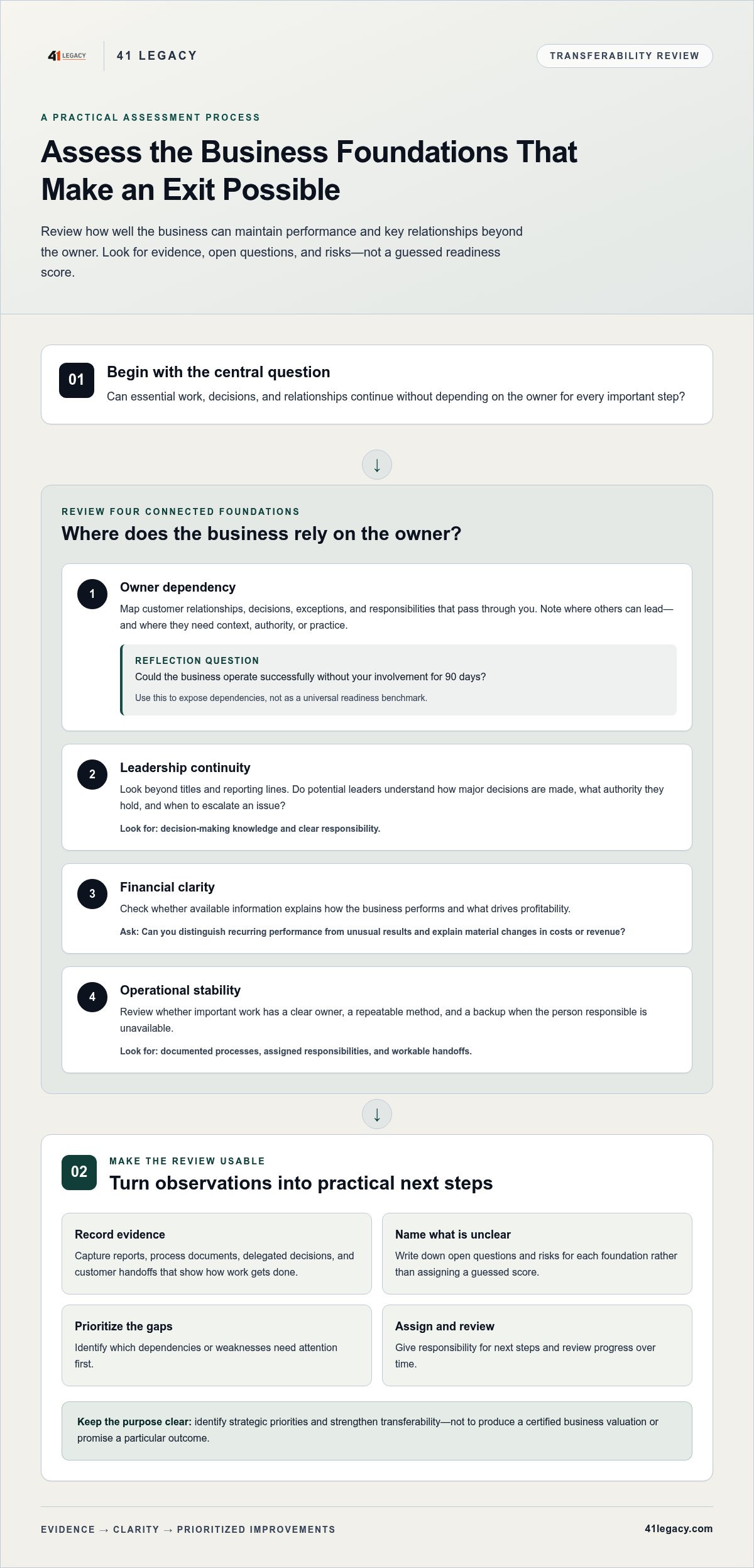
Assess the business foundations that make an exit possible
A transferable business can continue to perform when its current owner steps back. That doesn’t require the owner to be absent from every decision. It means the enterprise isn’t held together by knowledge, relationships, or approvals that only one person can provide. Reduced owner dependency is a signal of transferability because it shows that essential work and value can continue beyond the founder.
Review four foundations: owner dependency, leadership continuity, financial clarity, and operational stability. For each, record evidence, open questions, and risks rather than assigning a guessed readiness score. The goal is to identify strategic priorities, not to produce a certified business valuation or promise a particular outcome. A broader view of readiness across business and financial factors is also reflected in eMoney Advisor’s discussion of client readiness for exit planning.
Can the business operate without the owner at its center?
Start with the relationships and decisions that pass through you. Which customers call you directly when an issue arises? Who handles supplier negotiations, employee concerns, or exceptions to the usual process? Note where other people can take the lead today and where they need context, authority, or practice.
Then review whether recurring work has clear processes and responsibilities. A useful reflection question, also raised by Eide Bailly, is whether the business could operate successfully without your involvement for 90 days. Treat this as a way to expose dependencies, not as a universal readiness benchmark. If the answer is no, identify what would stop: a key decision, a customer handoff, or an undocumented process.
Are leadership, finances, and operations clear enough to transfer?
Look beyond whether capable people are on the team. Do potential leaders understand how major decisions are made, what authority they hold, and when to escalate an issue? Continuity depends on decision-making knowledge as well as titles and reporting lines.
Financial clarity means the available information helps explain how the business performs and what drives its profitability. Can you distinguish recurring performance from unusual results and explain material changes in costs or revenue? Operational stability asks whether important work has an owner, a repeatable method, and a backup when the person responsible is unavailable. These questions turn a general concern into specific follow-up.
- Evidence: Existing reports, process documents, delegated decisions, or customer handoffs that show how work gets done.
- Open questions: Information or responsibilities that remain unclear, undocumented, or concentrated with one person.
- Risks: Gaps that could interrupt service, decision-making, financial understanding, or continuity if the owner stepped back.
This record gives you a practical basis for prioritizing transferability work. An enterprise transferability review can help organize those findings into strategic priorities, keeping the focus on strengthening the business rather than forcing an immediate transition.
Compare business readiness with your personal readiness
A business can become more transferable while its owner remains unsure about stepping back. The reverse can also be true: an owner may be ready for a new chapter while the company still relies on them for key relationships or decisions. Owner readiness for exit means looking at both sides without treating one as proof of the other.
Use the questions below to locate areas that need thought or follow-up. They’re prompts for reflection, not a scorecard.
| Personal clarity | Business transferability |
|---|---|
| Can I describe what I want my days and responsibilities to look like after a transition? | Can leaders explain who makes key decisions and when they have authority to act? |
| What parts of leading the business would I miss, and which responsibilities would I welcome handing over? | Are important customer, employee, and supplier relationships shared beyond the owner? |
| Am I open to sharing control, and what would make that change feel workable? | Can someone else follow documented processes and understand the information needed to maintain operations? |
| What do I want to preserve about the company’s purpose, culture, or impact? | Can the company’s essential practices and priorities continue without relying on the owner’s memory? |
What personal questions help clarify readiness?
Picture an ordinary week after a transition, not just the milestone day. What would fill your time? Which work, relationships, or decisions would you miss? Would you want a different role, or would you prefer to step away more fully? There’s no preferred answer. The value is in making your hopes specific enough to compare with the choices available.
It can also help to separate attachment to the business from uncertainty about its future. You may feel proud of what you’ve built and still want to reduce your involvement. You may be concerned about employees or customers without being ready to leave. Name each concern plainly instead of forcing it into a yes-or-no conclusion.
How can owners think about seller’s remorse before a transition?
Some owners may experience sadness, doubt, or a sense of loss around a transition. These feelings are possible, not inevitable, and they don’t follow a set timeline. A strong attachment to the work can coexist with a considered decision to change roles. Mixed feelings are a reason to reflect, not proof that preparation has failed.
Try keeping a private record of concerns as they arise. Note what you might miss, what you hope will change, and what remains uncertain. Discussing those reflections with trusted personal and professional advisors can help you consider them alongside practical questions. Those conversations support clearer decisions; they don’t determine whether you should exit.
Readiness is not emotional certainty. It’s a clearer understanding of what matters to you and what the business may need, so personal priorities and enterprise preparation can be considered together.
Turn an owner-readiness review into practical next steps
A review becomes useful when it leads to clear action. The aim isn’t to fix every gap at once; it’s to build a sequence the business can sustain while you retain strategic oversight. Treat owner readiness for exit as an ongoing review that can change as your goals, leadership, and company conditions change.
Use four steps to turn findings into a working plan:
- Document the current picture. Record each issue, the evidence behind it, what remains unclear, and how it may affect continuity or your future options.
- Prioritize the gaps. Focus first on risks that increase owner dependency or could interrupt important relationships, decisions, or operations.
- Assign ownership. Give each agreed action a responsible person, a defined next step, and a practical checkpoint.
- Review progress. Revisit the plan regularly and adjust priorities as the business or your goals evolve.
Separate immediate clarity-building from longer-term transferability improvements. Clarifying who approves a recurring decision may be a near-term action. Training another leader to manage an important customer relationship may take sustained attention. Choose a manageable first priority rather than launching several disconnected initiatives.
How do you prioritize the gaps you find?
Compare each gap by its effect on continuity, reliance on you, and the options available later. A missing process document may be straightforward to address; a key relationship known only to the owner may require a careful handoff plan. For each priority, state what progress would look like, who is accountable, and when you’ll review it. A checkpoint creates follow-through without implying that every issue must be resolved on a fixed timetable.
Sample action tracker
- Issue: Customer relationship depends on the owner. Evidence: Key discussions and service decisions are handled directly by the owner. Responsible person: Owner and designated relationship lead. Review date: Set a practical checkpoint.
- Issue: Approval responsibilities are unclear. Evidence: Routine decisions wait for owner sign-off. Responsible person: Relevant team leader. Review date: Set a practical checkpoint.
How should professional advisors contribute?
Your existing professional advisors can inform priorities within their respective areas. A strategic advisor can help coordinate the broader work, keep attention on business goals, and connect related initiatives across the advisory team. Legal, tax, accounting, and investment decisions should remain within each advisor’s professional scope. You set direction and decide which actions fit the business.
For owners considering how to increase enterprise value, a useful starting point is to connect improvement priorities to stronger transferability and reduced owner dependency. 41 Legacy’s strategic advisory can help organize findings into a Value Growth Roadmap and support implementation. Explore strategic support for your readiness priorities.
How 41 Legacy supports a deliberate path to exit readiness
Once you’ve considered personal goals, business transferability, and practical next steps, the challenge is connecting those findings into a coordinated plan. 41 Legacy helps owners understand, grow, and protect enterprise value through diagnostics, strategic guidance, and structured implementation. The focus is preparation: building a business that can operate with less dependence on its owner, whether or not a transition date has been chosen.
What can an Exit Readiness Assessment clarify?
The Exit Readiness Assessment examines the company’s current position in relation to the owner’s goals. Enterprise diagnostics can surface questions about transferability, owner dependency, leadership capacity, and the systems that support continuity. The assessment helps identify where the business stands and where a gap remains between its current condition and the owner’s objectives.
These findings guide strategic priorities. They aren’t a certified business valuation, a guarantee of a sale, or a promise of a particular outcome. The assessment can still be useful when an owner has no fixed transition date: clearer information can help determine which improvements matter now and which can be revisited as circumstances change. Preparation supports options; it doesn’t require an immediate decision.
How does a roadmap support readiness over time?
A Value Growth Roadmap turns diagnostic findings into a sequence of agreed priorities. If an owner identifies a leadership gap and a process that exists only in their knowledge, the roadmap can help organize the work, clarify responsibility, and keep attention on improvements relevant to transferability. The sequence is tailored to the company’s position and goals rather than treating every possible project as urgent.
Monthly implementation support adds structure and accountability as priorities advance. Progress can be reviewed, barriers surfaced, and actions adjusted when company conditions or owner goals shift. This is measured work, not a countdown to a transaction. You remain responsible for strategic direction, while the roadmap helps maintain continuity between decisions and follow-through.
How does strategic coordination support the owner’s advisors?
Preparing for a transition can involve several professional perspectives. 41 Legacy’s strategic advisor can serve as a coordinating point, helping connect business priorities with your existing CPA and attorney. The role is to keep strategic work aligned and clarify which questions belong with each advisor, not to replace their professional work. Legal, tax, accounting, and investment matters remain with the appropriate qualified professionals.
This coordination keeps enterprise priorities visible while you and your advisors address your respective areas. It also gives you a clearer view of how individual actions relate to the broader goal of a more transferable business.
If you’re ready to turn your findings into a structured plan, explore a structured approach to exit readiness. Start by clarifying your current position and the priorities that can strengthen the business, without committing to an immediate sale.
Shape the next chapter on your own terms
A transition doesn’t need a date on the calendar to deserve thoughtful preparation. The choices you make now can help the business grow beyond your daily involvement while preserving what matters about the enterprise you’ve built. Owner readiness for exit is ultimately about retaining agency: making future decisions from a position of clarity rather than allowing urgency to decide for you.
Choose one question that deserves attention and give it a practical next step. You might clarify a decision that still depends on you, reflect on what you want your role to become, or document an important responsibility that exists mainly in your knowledge. Each step can strengthen the business without requiring a sale or a fixed timetable. Your plans can take shape as your priorities and the company evolve.
Founded and led by Chris Giammarco, a Certified Exit Planning Advisor, 41 Legacy helps owners bring strategic structure to this preparation. Explore a structured readiness conversation and identify a deliberate starting point for building a more transferable enterprise. Prepare thoughtfully, preserve your options, and move forward at a pace that reflects your goals.
Frequently Asked Questions
Is owner readiness for exit the same as business readiness?
No. Personal readiness concerns whether you understand what you want from a transition and can consider a different role or next chapter. Business readiness concerns whether the company can sustain its performance, relationships, and decision-making beyond your direct involvement. Both matter because a transferable company doesn’t automatically mean its owner is ready to step away, and personal readiness alone can’t address business dependencies. Consider each separately, then look at where they connect.
Can I assess exit readiness if I do not plan to sell soon?
Yes. An early review can help you strengthen the business and understand your choices without starting a sale process. For example, you might document how a key service is delivered or clarify which leaders can approve routine decisions. Those steps can support continuity regardless of when, or whether, you pursue a transition. Owner readiness for exit is an evolving picture, so revisit it as your goals or circumstances change to keep future options visible.
How do I know whether my business depends too much on me?
Look for points where work pauses until you respond. Do customer issues escalate directly to you? Do routine approvals wait for your sign-off? Do employees rely on your memory to complete recurring tasks? These patterns can indicate concentrated knowledge or authority. Ask a team member to describe how they would handle a common exception without your help. Their questions can reveal dependencies that aren’t obvious during your usual workday.
What should I do first if my business is not ready for a transition?
Start by choosing one concern and recording what you know about it. If a process depends on your knowledge, note where that knowledge is used and what documentation or training might help others do the work. Then select a responsible person and agree on a practical review point. This creates a defined first action without requiring a complete plan or assuming that a particular improvement will produce a specific outcome.
Can an exit readiness assessment tell me what my business is worth?
No. An Exit Readiness Assessment is a strategic diagnostic, not a certified business valuation. It can examine factors such as transferability, owner dependency, and the gap between your current position and your goals. That information can help establish priorities, but it doesn’t provide a certified value or predict a future transaction outcome. If you need a valuation for a specific purpose, discuss that need with the appropriate qualified professional.
How can I prepare emotionally for leaving a business I built?
Begin by imagining a typical week after your role changes. Consider which parts of the work give you purpose, which responsibilities you’d be comfortable handing over, and what you might want to pursue next. Write down concerns rather than forcing immediate answers. You can discuss them with trusted personal and professional advisors. These conversations can help you understand what feels unresolved while leaving the decision about timing and direction in your hands.
Is seller’s remorse inevitable after a business transition?
No. Owners can respond to a transition in different ways, and there’s no single emotional outcome to expect. If you’re concerned about regret, identify what you fear losing, such as daily contact with employees or influence over the company’s direction. Then consider which relationships, activities, or forms of involvement could continue in a changed role. Reflection can inform personal readiness, but it doesn’t decide whether a transition is right for you.

Article by
Mike Laskowski
Mike Laskowski is a Business Value Growth Strategist who helps business owners uncover the truths that drive their performance, risk, and readiness. Blending forensic interviewing from a 26‑year federal career with Strategic Capacity analysis and CEPA methodology, he works upstream to reduce owner dependency, increase transferability, and strengthen enterprise value. Mike guides founders through clarity, operational evolution, and transition readiness so their companies become transferable, owner‑independent assets that endure beyond the founder.
Disclaimer
This article is for educational and informational purposes only and does not provide legal, tax, investment, or business brokerage advice. 41 Legacy does not offer M&A brokerage services, legal document drafting, tax preparation, or investment advisory services. Business owners should consult licensed professionals in those disciplines before making decisions related to business transactions, legal matters, tax strategy, or financial planning. All examples are illustrative and may not apply to your specific situation.

