
Modernizing Operations to Increase Company Value
A faster process isn’t automatically a more valuable company. The real test of modernizing operations to increase company value is whether improvements strengthen performance while making the business less dependent on its owner. New software or automation may help, but without clear priorities, a technology upgrade can add complexity without improving how the company runs.
Owners know inefficient workflows consume time and attention. The harder question is which changes will create durable results, clarify who makes key decisions, and help the business operate consistently without the founder at the center of every process. Modernization works best as a strategic sequence, not a shopping list.
This article explores operational changes that can support sustainable performance and greater transferability, from documenting critical workflows to setting clear decision rights and choosing tools that address defined business needs. At 41 Legacy, enterprise diagnostics and a value growth roadmap help owners identify priorities, while structured implementation support helps turn them into lasting operating changes. The aim is a company built to perform with greater continuity, today and through a future transition.
Key Takeaways
- Start modernization by identifying the operating problem and the business outcome it should improve, before selecting a tool or system.
- Document critical decisions and clarify responsibilities so essential work can continue without constant owner involvement.
- Compare process, technology, management visibility, and talent priorities by their potential to improve performance and reduce risk.
- Approach modernizing operations to increase company value as a sequence: diagnose, prioritize, assign ownership, implement, measure, and refine.
- Use enterprise diagnostics and a value growth roadmap to turn operational gaps into sequenced initiatives with clear owners and measures.
Modernizing Operations to Increase Company Value Starts With the Right Problem
Operational modernization isn’t a technology project by default. It’s the deliberate improvement of how work moves through the company, how responsibilities are assigned, and how decisions are made. Start with a business problem: delays in fulfilling orders, inconsistent service, unclear accountability, or routine decisions that keep returning to the owner.
Operational modernization strengthens company value when it makes performance more consistent, visible, and transferable beyond the owner. Better execution can support durable performance, while clear operating information helps owners and managers understand what is working and where attention is needed. When essential work depends less on the founder’s memory or approval, the company is better positioned to continue through change.
Modernizing operations to increase company value means choosing improvements for their effect on the business, not their novelty. A new system may be useful when it addresses a defined need, has an accountable owner, and fits a workable process. Otherwise, technology can digitize confusion rather than resolve it.
What does operational modernization mean for an owner-led company?
It may mean mapping a workflow, clarifying who approves exceptions, recording how recurring decisions are made, or creating a simple way to track service, delivery, or production. Sometimes the most valuable first step is redesigning the process itself. The principles behind Business Process Re-engineering focus on reconsidering how work is organized, rather than assuming existing steps should simply be automated.
When people can follow a shared process and managers can see how work is progressing, results become easier to understand and sustain. That consistency makes operations less reliant on unwritten knowledge held by one person.
Why efficiency alone does not guarantee greater company value
Cutting a step or reducing an expense may improve short-term efficiency, but it doesn’t necessarily strengthen the company’s ability to perform reliably. If customer relationships, approvals, or problem-solving still depend on the owner, the business may remain difficult to operate without them.
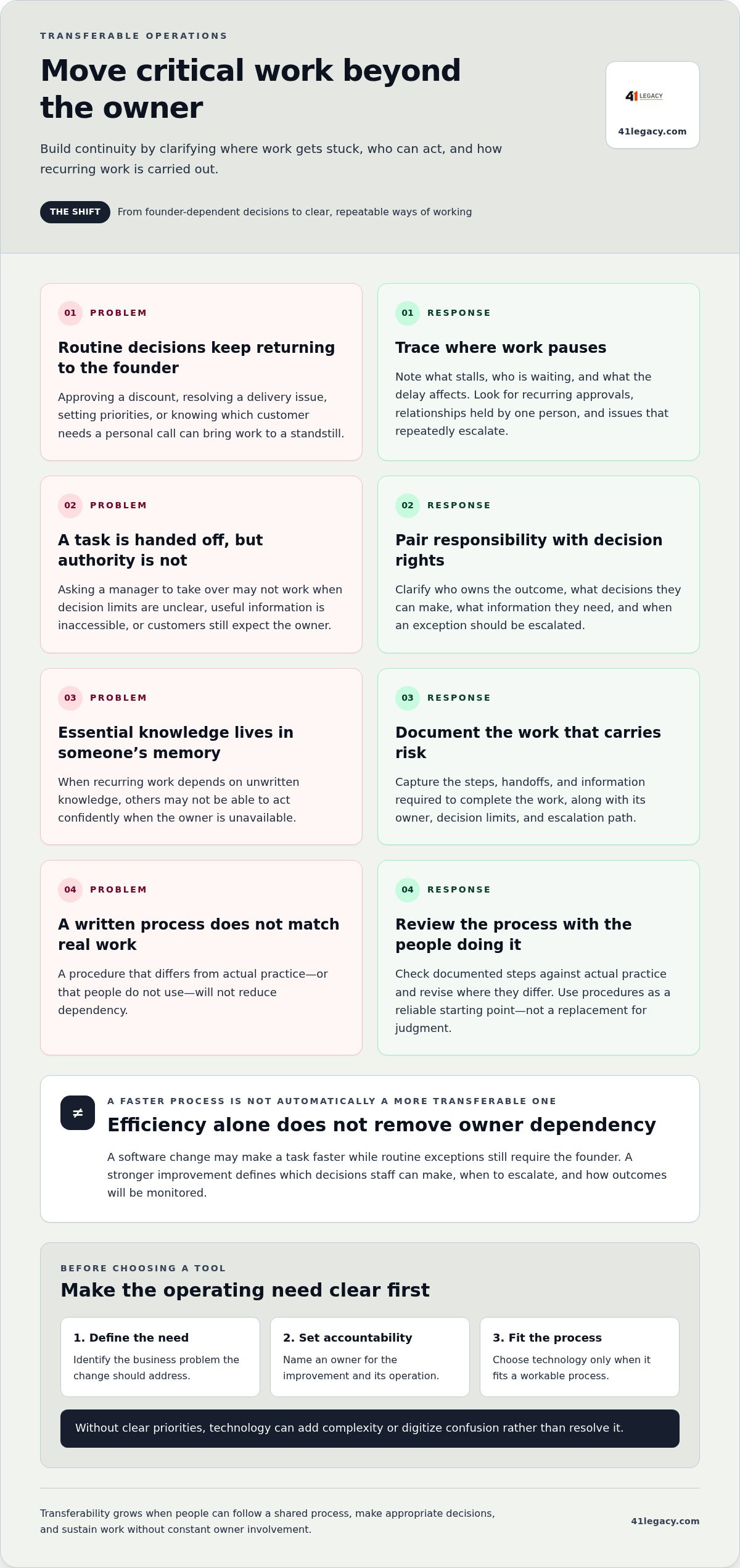
Consider a process that becomes faster after a software change but still requires the founder to resolve routine exceptions. The immediate task takes less time, yet the dependency remains. A stronger improvement defines which decisions staff can make, when to escalate, and how outcomes will be monitored. The test isn’t simply whether work costs less or moves faster. It’s whether the company can deliver consistent results with greater continuity.
Build Transferable Operations by Reducing Owner Dependency
A company may have capable employees and strong demand yet still depend on its owner to keep work moving. The bottleneck is often hidden in routine decisions: approving a discount, resolving a delivery issue, setting priorities, or knowing which customer needs a personal call. If those decisions live only in the owner’s memory, others may be unable to act confidently when the owner is unavailable.
Start by tracing where work pauses. Look for recurring approvals, customer or supplier relationships held by one person, and issues that repeatedly escalate to the founder. Note what stalls, who is waiting, and what the delay affects. This creates a practical map of dependency, rather than relying on a general impression that the owner is “too involved.”
Delegation is not the same as transferability
Delegation assigns a task to someone else. Transferability requires the surrounding structure: clear authority, access to the information needed to act, defined accountability, and a process for handling exceptions. Simply asking a manager to “take over” a relationship or approval may not work if customers expect the owner, decision limits are unclear, or relevant history is undocumented.
Thoughtful operational innovation can involve changing not only tasks, but also how people coordinate and make decisions. For an owner-led company, the test is whether work can continue with appropriate judgment when the founder steps back.
How documented processes strengthen continuity
Document recurring work that carries the greatest operational or relationship risk first. A useful procedure can capture:
- The steps, handoffs, and information required to complete the work.
- Who owns the outcome and what decisions they can make.
- When to escalate an exception, and to whom.
Standard operating procedures preserve institutional knowledge, but they shouldn’t replace judgment. They provide a reliable starting point and clarify where discretion belongs. Review them with the people who perform the work. If the written process differs from actual practice, revise it. A document that no one uses won’t reduce dependency.
These changes help modernizing operations to increase company value by making performance less reliant on a single person and more consistent across people and transitions. Owners can use 41 Legacy’s strategic advisory support to identify operating dependencies and connect improvement priorities to a broader transferability plan.
Compare Modernization Priorities by Their Effect on Value and Risk
Not every operational improvement deserves equal attention. Compare opportunities by the problem they address, their contribution to consistent performance, and the effort required to make the change stick. The strongest priority is often not the newest technology. It’s the change that resolves a recurring bottleneck or material risk and can be adopted in daily work.
The table offers a decision framework, not a universal ranking. A company with inconsistent handoffs may need process clarity before software. One with reliable workflows but limited insight into delays may benefit more from better management visibility. Broader value drivers are explored in this guide to increasing enterprise value.
| Modernization opportunity | Intended outcome | Value connection | Execution consideration |
|---|---|---|---|
| Process standardization | Make recurring work and handoffs more consistent. | Reduces variation and reliance on individual memory. | Map how work actually happens before documenting a revised process. |
| Technology enablement | Support a defined workflow or improve access to useful information. | Can help teams complete work reliably and give managers clearer operating insight. | Resolve process and accountability gaps first; a tool alone won’t fix them. |
| Management visibility | Make progress, delays, quality, or capacity easier to see. | Helps leaders identify issues earlier and manage performance beyond the owner’s direct oversight. | Choose information that supports decisions, and assign someone to review it. |
| Talent capability | Give employees the knowledge and authority to carry out key responsibilities. | Builds continuity and reduces dependence on a single person. | Clarify decision limits and provide practical guidance for exceptions. |
Assess the change, then measure what matters
Before committing resources, ask whether the opportunity addresses a recurring constraint or operational risk. Consider who will use the new process, what responsibilities will change, and whether the team can maintain the improvement in routine work. Separate enabling technology from the underlying issue: if approvals are unclear, new software may simply make the confusion faster.
To assess whether modernizing operations to increase company value is producing the intended result, select a small set of company-specific measures. Depending on the initiative, these might track quality, delivery, capacity, or consistency. Establish the current baseline, name an accountable owner, set a review rhythm, and define the intended outcome. Avoid adopting external benchmark targets without a reliable, relevant comparison. The evidence should show whether the change is working in this company and whether its benefits are being sustained.
Prioritize Operational Modernization With a Practical Value-Growth Sequence
Modernization is easier to manage when it follows a defined sequence. Start with the owner’s goals and current operating constraints, not a technology purchase. Is the priority to improve delivery consistency, create more management capacity, reduce reliance on the founder, or prepare the company to operate through a future transition? The answer helps determine which operating problem deserves attention first.
A diagnostic-led sequence turns modernization into accountable execution by connecting each initiative to a business need, a responsible owner, and evidence of progress.
Use this sequence to move from observation to sustained improvement:
- Diagnose: Describe the operating issue and its effect on performance, continuity, or owner capacity.
- Prioritize: Weigh the urgency, consequences of inaction, available capacity, and dependencies on other work.
- Assign ownership: Name the person responsible for decisions, coordination, and the intended result.
- Implement: Put the process, role, or system change into daily use, with practical guidance for affected employees.
- Measure: Compare results with the starting point using a small set of relevant measures.
- Refine: Adjust the approach when evidence, employee experience, or business conditions indicate a change is needed.
Keep the first initiative manageable. For example, if a recurring handoff is delaying customer work, clarify the steps and decision authority before committing to a larger systems project. This helps reveal what is causing the delay and whether the revised process works in practice.
Choose work the company can absorb
A promising improvement can still falter if employees lack time to adopt it or if essential work depends on the same people needed to implement it. Before starting, identify who will be affected, what other work may be disrupted, and which dependencies must be resolved. A focused initiative can build confidence and evidence for the next priority without overloading the business.
Keep responsibility and review in place
Implementation isn’t complete when a new process or tool goes live. Assign responsibility for maintaining it, checking the intended measures, and raising issues. Review progress on a consistent cadence, then refine the change based on actual results. This ongoing discipline helps modernization support long-term transition readiness, rather than becoming a one-time project. Owners developing that broader readiness can explore 41 Legacy’s strategic advisory support to connect operating priorities with transferability goals.
Modernizing operations to increase company value is ultimately a practice of disciplined choices: address the right constraint, match the work to available capacity, and sustain what proves useful.
Turn Operational Modernization Into a Transferable Value-Growth Roadmap
Operational improvements create direction only when they connect to the company’s broader priorities. Enterprise diagnostics help owners understand current conditions, identify gaps that may affect performance or transferability, and distinguish urgent constraints from attractive but lower-priority projects. The result is a clearer basis for deciding what to improve, and why.
A value growth roadmap turns those findings into coordinated work. Rather than treating modernization as a collection of unrelated projects, it links each initiative to a defined business objective, assigns responsibility, identifies dependencies, and establishes how progress will be reviewed. That structure helps owners focus effort where it can strengthen the enterprise, without assuming every initiative will produce the same result in every company.
What belongs in an owner-focused value growth roadmap?
Each initiative should address an identified need and its connection to transferability. For example, a project to clarify customer handoffs might support more consistent service while reducing reliance on the owner to manage every relationship. The roadmap should name the person accountable for execution, the people or decisions the work depends on, the evidence that will indicate progress, and the points at which the plan will be reviewed.
It should also reflect the company’s capacity. If operating demands change or employees need more time to adopt a new process, the sequence may need to adapt. A roadmap provides disciplined direction, not a fixed promise about timing or financial outcomes.
How strategic advisory support keeps modernization aligned
Implementation can lose momentum when operational projects sit apart from the company’s broader value priorities or when existing advisors have no shared view of the work. 41 Legacy’s strategic quarterback role is to help maintain that coordination: connecting diagnostics, roadmap priorities, and implementation support while working alongside the owner’s existing professional advisors. Each advisor retains their specialist role; the operating priorities remain tied to the owner’s goals for the enterprise.
For owners, this creates a practical way to keep initiatives connected as conditions evolve. It also makes progress easier to discuss with the people who support the company, because the purpose, ownership, dependencies, and evidence of progress are visible.
If you’re ready to connect operational priorities with transferability and long-term enterprise value, explore strategic support for building company value.
Build Operations That Can Carry the Company Forward
Modernization creates lasting value when it improves how the company performs and how well it can operate beyond the owner. Start with a clear business need, then prioritize changes that strengthen consistency, visibility, and continuity. Assign responsibility and measure whether the improvement holds in daily operations.
Modernizing operations to increase company value is not a technology checklist. It’s a disciplined effort to build a more capable, transferable enterprise. Enterprise diagnostics can reveal current conditions and value gaps; a value growth roadmap and monthly implementation support help maintain focus as priorities move into action. 41 Legacy also coordinates with the owner’s existing professional advisors, keeping operational work aligned with the broader needs of the company.
Explore a strategic path to stronger, more transferable operations. With clear priorities and steady execution, you can strengthen a company prepared to perform well into its next chapter.
Frequently Asked Questions
How does modernizing operations increase company value?
Modernizing operations can support company value by improving consistency, making performance easier to understand, and reducing reliance on the owner. Clear processes and decision rights help the company continue operating across changes in people or leadership. The connection depends on whether the improvement addresses a real business need and is sustained in daily work. A new tool alone does not guarantee stronger performance or greater transferability.
What should a company modernize first?
Start with an operational issue that affects an important business outcome, creates owner dependency, or threatens continuity. Identify where work regularly slows, requires repeated approvals, or depends on knowledge held by one person. Then consider urgency, available employee capacity, and related work that must happen first. A manageable initial improvement, such as clarifying a recurring handoff, can provide useful evidence before the company takes on broader changes.
Can automation make a business more transferable?
Automation can contribute to transferability when it supports a well-understood process and reduces dependence on manual, owner-led work. First clarify the workflow, decision rules, and responsibility for handling exceptions. Otherwise, automation may simply reproduce unclear steps in a new system. A transferable operation still needs people who understand the process, authority to act, and a way to monitor whether the automated work is producing the intended result.
How do you measure whether operational modernization is working?
Choose a small set of measures tied to the initiative’s intended outcome, such as quality, delivery, capacity, or consistency. Record the starting point, assign someone to review the measure, and establish a regular review rhythm. For example, a change designed to improve handoffs should be assessed using evidence related to those handoffs, not a general impression that the process feels faster. Use company-specific results rather than unsupported benchmark targets.
Does modernizing operations mean replacing existing systems?
No. Modernization may begin with redesigning a process, clarifying responsibilities, or improving how information is shared. Replacing a system makes sense only when it addresses a defined operating need and the company can adopt and maintain the change. Before investing in a new tool, examine whether the problem comes from the technology itself or from unclear steps, decision rights, or accountability. The answer may be process improvement rather than replacement.
How can an owner reduce dependence on themselves during modernization?
Identify recurring decisions, approvals, and relationships that currently rely on the owner. Document key workflows and decision rules, then assign responsibility and clear authority to others, including guidance for exceptions. Make sure employees have access to the information needed to act and understand how results will be reviewed. Modernization is more transferable when the owner gradually shifts from being the essential point of action to overseeing a process the company can sustain.

Article by
Mike Laskowski
Mike Laskowski is a Business Value Growth Strategist who helps business owners uncover the truths that drive their performance, risk, and readiness. Blending forensic interviewing from a 26‑year federal career with Strategic Capacity analysis and CEPA methodology, he works upstream to reduce owner dependency, increase transferability, and strengthen enterprise value. Mike guides founders through clarity, operational evolution, and transition readiness so their companies become transferable, owner‑independent assets that endure beyond the founder.
Disclaimer
This article is for educational and informational purposes only and does not provide legal, tax, investment, or business brokerage advice. 41 Legacy does not offer M&A brokerage services, legal document drafting, tax preparation, or investment advisory services. Business owners should consult licensed professionals in those disciplines before making decisions related to business transactions, legal matters, tax strategy, or financial planning. All examples are illustrative and may not apply to your specific situation.

