
Transferability & Owner Dependency
Maximize Your Sale: Professional Business Exit Planning
The most profound measure of your achievement isn't found in the daily operations you oversee, but in the strength of the legacy you leave behind. With an estimated $30 trillion set to transfer between generations over the next three decades, professional business exit planning has become the essential discipline of the modern founder. You've dedicated your life to crafting an enterprise of substance, yet you might fear that its value is too closely tied to your personal involvement. It's a heavy burden to wonder if the masterpiece you've built can survive without your daily touch.
We believe your life's work deserves to be a transferable asset that thrives independently of your presence. By utilizing enterprise diagnostics and owner dependency reduction, you can transition from an active operator to a strategic steward. This article provides a clear roadmap to increase enterprise value and prepare for a transition that honors your history. We'll examine the strategic steps required to secure your financial peace of mind while preserving the essence of what you've created.
Key Takeaways
- Adopt a stewardship mindset by viewing your business as a sophisticated asset that's designed to outlast its founder.
- Master the discipline of business exit planning through Transferability Engineering, allowing the enterprise to function with surgical precision without your daily involvement.
- Use Enterprise Diagnostics to identify the "Value Gap" and transform hidden operational risks into tangible, enduring enterprise value.
- Follow a structured Value Growth Roadmap to systematically mitigate the specific dependencies that devalue the work you've built.
- Coordinate your professional advisors through strategic advisory to ensure every facet of your transition is polished and protected from value leakage.
The Stewardship of Value: What is Business Exit Planning?
Business exit planning is far more than a final transaction; it is the ultimate expression of stewardship. It represents a comprehensive strategy to grow, protect, and eventually transition an enterprise while maximizing its inherent worth. Many owners mistakenly view an exit as a singular event, a "selling out" that occurs at the end of a career. In reality, What is Exit Planning? It's a multi-year discipline that transforms a lifestyle business, which exists to support the owner's immediate needs, into a transferable asset that possesses its own independent life. This evolution ensures the company’s essence is preserved through a successful internal or external transition.
The Philosophical Shift from Operator to Steward
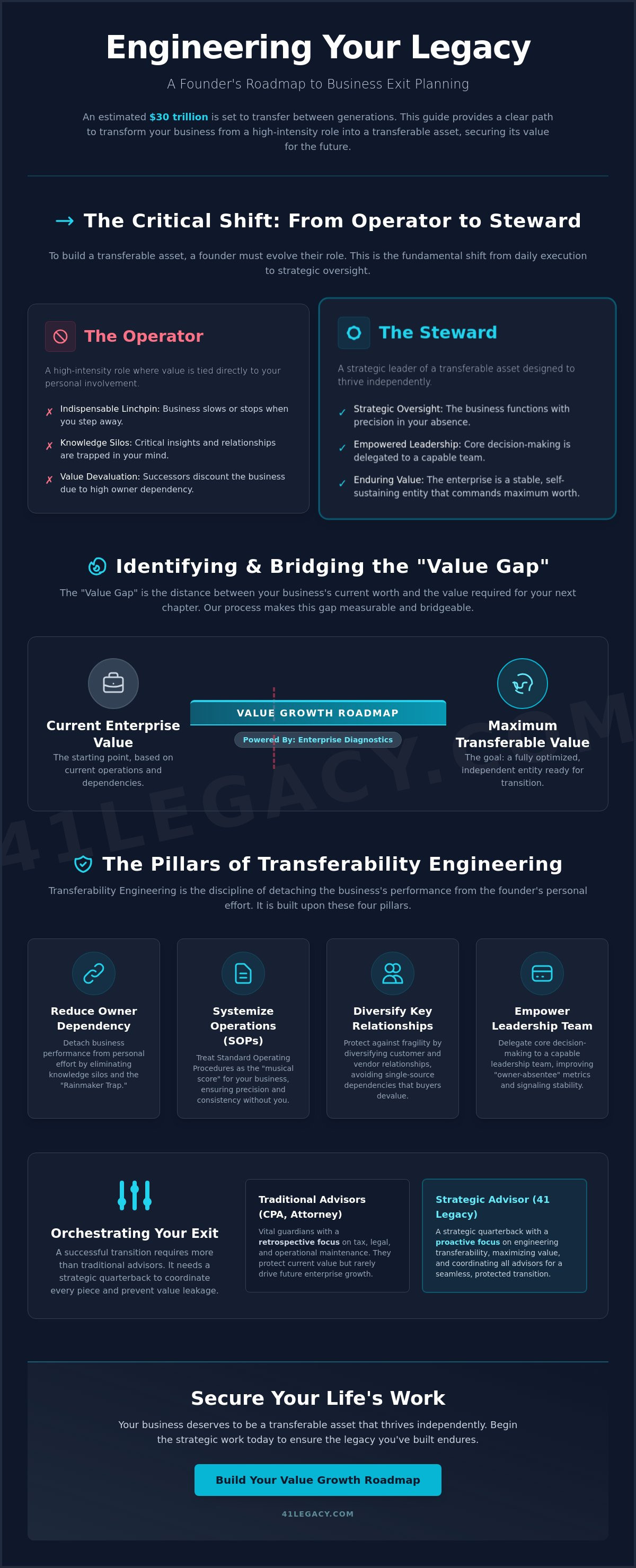
Most founders find themselves as the indispensable linchpin of their organization. If the machinery of the business slows or stops when you step away, you don't yet own a transferable asset; you own a high-intensity role. Professional business exit planning requires a profound internal shift. You must move from the technical precision of an operator to the strategic oversight of a steward. We facilitate this through Transferability Engineering, meticulously documenting systems and empowering leadership teams. This ensures the brand's essence remains intact without your daily input. It’s about honoring the history of what you’ve built by ensuring it can thrive in your absence.
Why Your Current Financial Team Isn't Enough
Your CPA and attorney are vital guardians of your current operations, but their focus is often retrospective. Tax preparation and legal drafting are essential for maintenance, yet they rarely drive enterprise value growth. A standard financial advisor focuses on the capital after the sale, but they often lack the "Value Growth" roadmap needed to prepare the business itself for the market. To bridge this gap, we utilize Enterprise Diagnostics to identify the "Value Gap." This is the distance between your current enterprise value and the financial requirements for your next chapter. Because engineering a legacy requires extreme precision, this strategic work must begin years before a transaction is even considered. Our Exit Readiness Assessment provides the baseline for this journey, positioning you as a steward of a lasting, independent entity.
The Pillars of Transferability: Engineering a Business That Outlasts You
The true measure of an enterprise's strength is found in the silence that follows an owner's departure. While we previously explored the mindset of stewardship, the actualization of that vision requires the technical discipline of Transferability Engineering. This is the meticulous process of detaching the business's performance from the founder's personal effort. Within the framework of business exit planning, a business that demands your daily presence is not an asset; it's a high-stakes obligation. To maximize value, the enterprise must be refined into a standalone entity that functions with the precision of a masterwork.
Sophisticated successors look for a self-sustaining engine, yet many founders remain caught in the "Rainmaker Trap." If you're the primary driver of sales or the sole keeper of key client relationships, the enterprise devalues. We treat Standard Operating Procedures (SOPs) as the musical score of the business. Just as a symphony can be performed with precision by different musicians when the score is clear, your business must execute its core functions without your direct baton. This structural integrity also requires customer and vendor diversification. Relying on a single source for revenue or supplies creates a fragility that buyers will aggressively discount. Diversification is the armor that protects the essence of your work.
Reducing Owner Dependency: The Ultimate Value Driver
A business's worth is often inversely proportional to its owner's involvement. We meticulously identify "knowledge silos," those critical insights trapped in your mind or the minds of a few veterans. By delegating core decision-making to an empowered leadership team, you improve your "owner-absentee" metrics. These figures signal to the market that the business is a stable, living entity. You can begin this refinement by utilizing our Transferability Engineering services to identify where your presence currently creates a bottleneck.
Strategic Capacity and Scalability
A successful transition requires more than just current stability; it demands a clear path for future growth. We evaluate your strategic capacity to ensure the infrastructure can handle increased volume under new stewardship. During the due diligence phase, buyers scrutinize documented, repeatable processes that prove the business is scalable. Positioning your company as a "turnkey" solution means the successor isn't just buying your past achievements, but a refined mechanism ready for the future. This level of preparation is the cornerstone of business exit planning, ensuring that the impact of your life's work remains untarnished through the change of hands.
Identifying the Value Gap: The Role of Enterprise Diagnostics
The pursuit of excellence requires a clear-eyed understanding of current reality. In the context of business exit planning, we define the "Value Gap" as the critical distance between the current market value of your enterprise and the financial milestones required to secure your next chapter. While a traditional balance sheet offers a glimpse into performance, it often fails to capture the structural vulnerabilities that devalue an asset during a transition. A certified valuation might satisfy a lender or a tax authority, but it lacks the strategic depth of an Exit Readiness Assessment. The latter is designed to uncover hidden risks, such as high customer concentration or a lack of operational maturity, which a standard financial report simply cannot see.
We view the Value Growth Roadmap not as a static report gathering dust on a shelf, but as a living document. It's a precise architectural plan that evolves alongside your business. This roadmap serves as the guide for your transition, ensuring that every refinement made to the enterprise is intentional and directed toward closing the gap. By focusing on these granular details, you ensure the business is prepared for the scrutiny of the most sophisticated successors.
The Anatomy of an Enterprise Diagnostic
An effective diagnostic examines the "Four Pillars" of intangible value: Human, Structural, Customer, and Social Capital. We look beyond the numbers to assess the strength of your leadership team and the resilience of your internal systems. This process also identifies the "wealth gap," which is the disparity between what the business will net after taxes and what you truly need for long-term financial peace of mind. For an accurate calculation in 2026, this must account for the 37% top marginal income tax rate. Enterprise diagnostics serve as a curatorial tool for the modern entrepreneur, illuminating the hidden intricacies that define an asset's true essence.
From Assessment to Implementation
Knowledge alone does not create value; action does. Most strategic plans fail because they lack the steady rhythm of monthly accountability. Moving from "knowing the gap" to "closing the gap" requires a disciplined approach to implementation. We provide the structured advisory support necessary to ensure that the goals set in your roadmap are actually achieved. 41 Legacy acts as your partner in this journey, offering the monthly implementation support required to transform your business into a masterpiece of transferability. This ongoing commitment ensures that your life's work is not only protected but positioned for its highest possible valuation during the eventual transition.
The Roadmap to Readiness: Strategic Steps Toward a Successful Transition
The roadmap to readiness is not a mere checklist; it's an intentional architectural progression designed to transform your life's work into a resilient, transferable asset. Successful business exit planning requires a disciplined sequence of events that begins long before a final agreement is signed. This process ensures that the essence of the enterprise is preserved while its market value is maximized through technical precision and strategic clarity. By following a structured path, you move from the uncertainty of daily operations to the confidence of a well-engineered legacy.
- Step 1: Conduct an initial Enterprise Diagnostic to establish a baseline and capture the current state of the asset.
- Step 2: Identify and mitigate the "Top 5 Risks" devaluing the business today, such as customer concentration or key-person dependency.
- Step 3: Execute a Value Growth Roadmap to close the financial gap and ensure the enterprise meets your long-term needs.
- Step 4: Optimize the "Transferability" of the asset through owner-dependency reduction, creating a standalone entity.
- Step 5: Assemble and coordinate the advisory team to ensure every professional is aligned for the final transition.
The Discovery Phase: Uncovering the Essence
The first 90 days of this journey are dedicated to clarity over action. During this discovery phase, we align your personal legacy goals with the trajectory of the business. It's essential to define the Strategic Capacity of your current team to understand if the infrastructure can support growth without your constant intervention. This period of intense observation ensures that the subsequent roadmap is tailored to the unique soul of your organization, rather than a generic template. We believe that understanding the "why" of your exit is just as critical as the "how."
The Execution Phase: Monthly Implementation
Transformation occurs in the steady rhythm of consistent, small-scale improvements. We utilize a monthly implementation model to maintain accountability and ensure the Value Growth Roadmap remains a living document. In this phase, we "quarterback" your existing CPA and legal team, ensuring that every advisor is moving in harmony toward the same strategic objective. This coordination prevents the value leakage that often occurs when professional advice is fragmented. Building a transferability engine within your business exit planning strategy requires this level of dedicated oversight to turn technical plans into operational reality. Secure your path by initiating a Strategic Advisory partnership today to begin this refinement.
Orchestrating the Exit: Why a Strategic Quarterback is Essential
The final movement of a masterpiece requires more than talented musicians; it demands a conductor who understands the entire score. In the high-altitude environment of business exit planning, your CPA, attorney, and wealth manager are the specialist artisans of their respective fields. They possess immense technical skill. However, without a strategic quarterback to align their efforts, these professionals often operate in silos. This fragmentation creates a "silo effect" where well-intentioned advice in one area can inadvertently devalue another. We act as the guardian of your singular vision, ensuring that every technical decision is polished to support the ultimate health of the enterprise.
Uncoordinated advice is the primary cause of "leakage" in enterprise value. For example, a tax strategy designed to minimize immediate liability might conflict with the structural requirements of a successful transition under the One Big Beautiful Bill Act of 2025. With the top marginal income tax rate at 37% in 2026, the stakes for precision have never been higher. We provide the strategic oversight necessary to ensure that legal structures and financial plans don't just exist; they harmonize. This level of coordination preserves the essence of what you've built while maximizing the transferable value of the asset.
The Coordinated Advisory Model
Our role is to provide strategic clarity to your entire advisory team. By acting as the central point of contact, we prevent conflicting guidance and ensure that everyone is moving toward the same roadmap. We don't replace your trusted advisors; we empower them with a unified objective. Owners seeking this level of technical orchestration can begin with a coordinated diagnostic via the 41 Legacy home page. This ensures that the transition is a seamless progression rather than a series of disconnected events.
Building Your Legacy
True success is the ability to walk away from your life's work knowing it will flourish in your absence. You are the curator of a lasting impact, and the business you've engineered is your legacy. There is a profound peace of mind that comes from transforming a daily obligation into a transferable asset. It allows you to move into your next chapter with financial certainty and the knowledge that your history is preserved. Don't wait for a crisis to force your hand. Begin the business exit planning process today to ensure that your masterpiece receives the reverence and value it deserves.
Securing Your Work's Enduring Impact
The journey from a founder's daily toil to the creation of a standalone masterpiece is the highest form of business stewardship. By focusing on Transferability Engineering and the reduction of owner dependency, you ensure your enterprise remains a living entity that thrives beyond its creator. This technical precision, guided by a disciplined roadmap, transforms your life's work into a high-value asset ready for any future transition. You've built something of substance; it's time to ensure its structure matches its soul.
Professional business exit planning isn't a final act, it's a continuous refinement of enterprise value. We bring the expertise of a Certified Exit Planning Advisor (CEPA) to lead our structured "Quarterback" advisory model, ensuring your entire professional team moves in harmony. This coordination eliminates value leakage and provides the strategic clarity necessary for a successful next chapter. Your legacy deserves a transition that reflects the excellence of its history.
Begin Your Enterprise Diagnostic with 41 Legacy to protect the essence of what you've built and secure your financial peace of mind.
Frequently Asked Questions
What is the difference between business exit planning and succession planning?
Business exit planning is a comprehensive strategy focused on growing and protecting enterprise value, while succession planning specifically addresses the transition of leadership roles. Exit planning ensures the entire asset is refined for transferability, regardless of whether the successor is internal or external. It's the broader architectural framework that encompasses the financial, personal, and operational readiness of the business.
When is the best time to start planning for a business exit?
The most effective planning begins three to five years before an anticipated transition. This unhurried timeline allows for the meticulous execution of a Value Growth Roadmap and the correction of structural vulnerabilities. Starting early ensures that you aren't forced into a reactive stance, allowing you to exit on your own terms with a business polished to its highest possible value.
How does owner dependency affect the value of my company?
High owner dependency acts as a significant discount on your company's valuation multiple. Sophisticated buyers seek a self-sustaining engine rather than a role that requires their constant intervention. Through Transferability Engineering, we detach the business's performance from your personal effort, transforming it from a lifestyle business into a premium, transferable asset that thrives independently of your daily touch.
What is a Value Gap and how do I calculate it?
The Value Gap is the distance between the current market value of your enterprise and the financial requirements needed for your next chapter. You calculate it by performing Enterprise Diagnostics to establish a baseline value and comparing that to your post-tax wealth goals. In 2026, this calculation must account for the 37% top marginal income tax rate to ensure your strategic clarity is based on net reality.
Do I need to sell my business immediately after creating an exit plan?
No, creating an exit plan doesn't require an immediate sale; it simply ensures you're prepared for one. Business exit planning is about building a better, more resilient company today that offers you the freedom of choice tomorrow. Many owners find that once their business is a transferable asset, it becomes more profitable and less stressful to run, allowing them to stay longer if they wish.
What role does a Certified Exit Planning Advisor (CEPA) play?
A Certified Exit Planning Advisor (CEPA) serves as the strategic quarterback who coordinates your entire team of specialists. They ensure that your CPA, attorney, and wealth manager work in harmony toward a singular vision of exit readiness. This prevents the silo effect where uncoordinated advice leads to leakage in enterprise value during the transition process, protecting the essence of your legacy.
How can I increase my business's enterprise value without increasing sales?
You can increase value by improving your valuation multiple through owner dependency reduction and operational maturity. Documenting repeatable processes and diversifying your customer base reduces the risk profile for a successor, making each dollar of profit more valuable. A business that functions with surgical precision without its founder is inherently more valuable than a larger one that relies on the owner's "rainmaking" abilities.
What are the most common risks that devalue a business during an exit?
The most common risks include customer concentration, lack of documented systems, and a weak middle management team. If a single client represents more than 15% of your revenue, buyers see a fragility that they'll aggressively discount. Addressing these risks through a Strategic Capacity Evaluation ensures that the infrastructure of the business is perceived as a turnkey solution rather than a high-risk project.
Disclaimer
This article is for educational and informational purposes only and does not provide legal, tax, investment, or business brokerage advice. 41 Legacy does not offer M&A brokerage services, legal document drafting, tax preparation, or investment advisory services. Business owners should consult licensed professionals in those disciplines before making decisions related to business transactions, legal matters, tax strategy, or financial planning. All examples are illustrative and may not apply to your specific situation.