
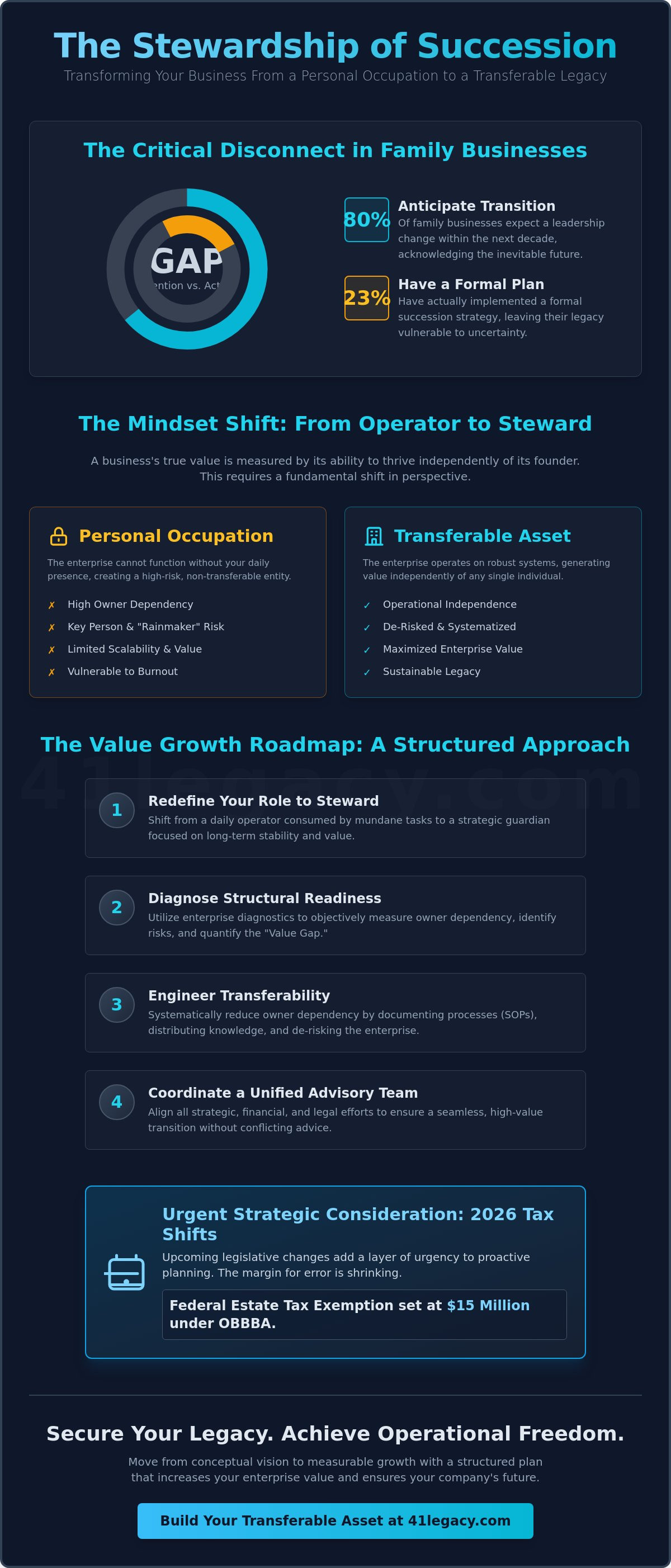
While nearly 80% of family businesses anticipate a leadership transition within the coming decade, a mere 23% have begun the meticulous work of implementing a formal strategy. This profound disconnect leaves the very essence of a lifetime's work vulnerable to the tides of uncertainty. You've likely felt the weight of daily operations resting solely on your shoulders. It's a quiet burden that often leads to burnout. Without a dedicated approach to business succession planning, your company remains a personal occupation rather than a standing monument that can survive without your constant presence.
Mastering this process is an act of stewardship that transforms your enterprise into a high-value, transferable asset. You'll discover how to bridge the "Value Gap" and achieve operational freedom through precise diagnostics and transferability engineering. This article provides a clear roadmap to increase enterprise value while ensuring your company remains a legacy of excellence. We'll examine the latest 2026 tax shifts, including the federal estate tax exemption set at $15 million under the OBBBA, and how structured advisory support can help you secure a dignified, impactful transition.
Key Takeaways
- Redefine your role from a daily operator to a steward of a transferable asset that maintains its essence and value beyond your tenure.
- Identify and mitigate the "Rainmaker Trap" by implementing transferability engineering to reduce owner dependency and increase operational freedom.
- Utilize enterprise diagnostics to measure your structural readiness and bridge the "Value Gap" through proactive business succession planning.
- Coordinate a unified advisory team to ensure all strategic, financial, and legal efforts are aligned toward a seamless and high-value transition.
- Move from conceptual vision to measurable growth by utilizing a structured Value Growth Roadmap and consistent monthly implementation support.
The Essence of Business Succession Planning: More Than a Transaction
Many founders view their departure as a singular, distant event. They see it as a final closing of a chapter. This perspective is fundamentally flawed. True business succession planning isn't a transaction; it's the ultimate act of stewardship. It's the process of refining a living entity so its narrative and impact don't end when the founder steps away. You aren't merely selling a company. You're ensuring the survival of an essence you've spent decades cultivating.
The landscape of 2026 has introduced a new era of strategic necessity. With federal estate tax exemptions set at $15 million under the OBBBA and shifting capital gains rates, the margin for error has vanished. Preserving a legacy in this environment requires more than just good intentions. It requires technical precision and a proactive stance. At 41 Legacy, we believe succession planning should be a continuous growth strategy. It's a method for strengthening the business today to ensure it remains a high-value, transferable asset tomorrow.
There's a vital distinction between owning a job and owning an asset. If the enterprise relies on your daily presence to function, you don't yet own a transferable asset. You own a personal occupation. A true asset possesses its own heartbeat. It generates value, serves clients, and maintains its standards independently of its creator. This independence is the most accurate metric of an organization's health.
Stewardship vs. Ownership
Stewardship is the mindset of a guardian. While ownership focuses on the rights of the individual, stewardship focuses on the responsibility to the entity. You're the curator of a culture and a reputation. This mindset shifts your decision-making from short-term profit to long-term stability. It's about building a foundation that can support the weight of future generations. When you prioritize the company's "soul," you naturally build a more resilient and attractive enterprise.
The Philosophical Shift to Transferability
Transferability is the intersection of creative vision and mechanical reliability. It's a philosophical shift that asks a simple, piercing question: could the business thrive if you disappeared tomorrow? Achieving this requires "Transferability Engineering." It's where the artisan's touch meets the engineer's rigor. By reducing owner dependency, you aren't just preparing for an exit. You're creating a more harmonious, scalable engine that provides operational freedom long before you decide to step down. High transferability is the hallmark of a masterpiece.
The Architecture of Transferability: Reducing Owner Dependency
Excellence is never accidental. It's the result of intentional design, specifically focusing on the decoupling of the enterprise's daily performance from the founder's personal exertion. In the context of business succession planning, this design focuses on transforming a founder-led company into an independent engine of value. Many owners find themselves caught in the 'Rainmaker Trap,' where they remain the singular driver of sales, innovation, and strategic vision. While this involvement feels like leadership, it's actually a structural fragility that caps the business's ultimate worth.
Engineering a business to be 'buyer-ready' is a discipline that should be practiced regardless of your current exit timeline. It requires a shift from personal authority to institutional systems. By creating a repeatable, scalable engine, you ensure the company's "essence" is preserved in its processes rather than its personalities. This transition provides the operational freedom necessary to lead with clarity rather than being consumed by the mundane.
De-risking the Enterprise
Key Person Risk is a silent valuation killer. When institutional knowledge resides exclusively in the mind of the founder, the business becomes a high-risk asset for any future successor. De-risking requires the meticulous distribution of this knowledge across the organization's infrastructure. Standard Operating Procedures (SOPs) function as the blueprints of your masterpiece, ensuring that every task is executed with surgical precision. Owner dependency serves as the primary friction to a successful transfer, acting as a structural barrier that prevents an enterprise from functioning as a truly independent asset.
To begin identifying these vulnerabilities, an owner dependency reduction strategy is essential for uncovering where the founder's shadow still obscures operational efficiency.
Building Strategic Capacity
True stewardship involves the transition from 'doing' to 'orchestrating.' This requires developing strategic capacity within your leadership team so they can handle high-level decision-making without constant oversight. According to a March 2026 iMocha report, only 11% of HR executives feel they have a strong bench to fill leadership roles. This statistic highlights a significant opportunity for value growth. By empowering a 'Second-in-Command' to operate with your level of precision, you're not just delegating tasks; you're building an asset class. Effective business succession planning prioritizes this talent development, ensuring the company's narrative continues with strength and sophistication long after the original author has moved on.
Evaluating Exit Readiness: The Diagnostic Approach
A common hesitation among founders is the belief that their enterprise isn't yet worthy of scrutiny. They wait for a perfect season that rarely arrives, stalling the very progress they desire. This delay is often rooted in a misunderstanding of what evaluation actually entails. In the sophisticated landscape of business succession planning, an assessment isn't a judgment of past performance. It's a meticulous diagnostic of future potential. Waiting until you feel "ready" often means waiting until it's too late to influence the outcome.
Traditional valuations often serve as static portraits. They capture a moment in time without offering a path forward. We view Enterprise Diagnostics as a living blueprint. While a valuation tells you what the business is worth today, a diagnostic reveals what it could be worth if the structural frictions were removed. This distinction is vital for any owner who views their business as a legacy rather than a mere income stream. It's the difference between knowing the price of a masterpiece and understanding how to restore it to its full brilliance.
Enterprise Diagnostics and the Value Gap
The "Value Gap" is the silent delta between your current enterprise value and the financial requirements of your legacy goals. For many, this gap remains unquantified until the moment of transition, leading to a compromise in lifestyle or impact. By utilizing an Exit Readiness Assessment, we uncover the hidden risks that devalue a company in the eyes of a sophisticated successor. These risks often include high customer concentration or undocumented intellectual property. Quantifying these elements allows us to bridge the gap with surgical precision, ensuring the business's performance aligns with your long-term needs.
Market Attractiveness vs. Structural Readiness
Value is the intersection of two distinct forces: market attractiveness and structural readiness. Market factors are external and often volatile, influenced by economic shifts like the 2026 tax changes under the OBBBA. While you cannot control the market, you have absolute authority over your internal readiness. A business that is structurally sound possesses clean financial statements, decentralized leadership, and repeatable systems. This internal strength allows the enterprise to command a premium regardless of external fluctuations. Preparing for the scrutiny of a connoisseur requires a refusal to settle for less than operational perfection. It ensures that when the market is favorable, your asset is positioned to thrive.
Orchestrating the Transition: The Coordinated Advisory Team
A masterpiece requires more than just skilled hands; it requires a conductor. In the sophisticated realm of business succession planning, the owner is often surrounded by brilliant specialists. CPAs, attorneys, and RIAs each bring immense technical expertise to the table. Yet, these professionals frequently operate in isolation, focused on their specific discipline. This "Silo Effect" creates a disjointed strategy where tactical legal advice might inadvertently conflict with tax efficiency or long-term wealth goals. Without a central point of coordination, the founder is left to translate complex jargon and resolve contradictions alone.
To maintain what we call "professional-room altitude," an owner needs a strategic coordinator, or a "Quarterback." This individual doesn't replace your existing advisors. Instead, they ensure the entire team is reading from the same blueprint. A Certified Exit Planning Advisor (CEPA) brings this holistic perspective to the room. They ensure that every legal structure and tax maneuver serves the singular goal of exit readiness and asset transferability. This orchestration prevents the friction that often stalls even the most well-intentioned transitions.
The Quarterback Role in Strategic Planning
Our strategic advisory philosophy centers on this collaborative harmony. We coordinate with your existing trusted advisors to ensure tactical execution remains aligned with your broader vision. By bridging the gap between technical silos, we ensure that legal and tax structures don't just exist; they actively support the ultimate transferability of the asset. This level of coordination is what transforms a collection of disparate services into a unified legacy. It allows the owner to remain a steward of the vision rather than a mediator of technical disputes.
Aligning Personal and Business Goals
Succession is as much a personal evolution as it is a corporate transition. Personal financial planning must run in parallel with business growth to prevent the "Value Gap" from becoming a personal crisis. Beyond the balance sheet, the owner's "third act" requires intentional design. Many founders experience "Owner's Remorse" not because the financial outcome was poor, but because they lacked a clear purpose after the transition. Preparing for the emotional weight of a departure is a critical component of a dignified exit. We help you design a future that is as compelling as the business you've built.
To begin aligning your professional team toward a singular vision of value, we invite you to explore our Strategic Advisory services.
Crafting Your Legacy: The Value Growth Roadmap
Excellence is a cadence, not a single stroke of a pen. Many owners treat business succession planning as a one-time intellectual exercise, resulting in beautiful documents that gather dust on a shelf. To build a legacy that endures, you must move from the quiet halls of strategy to the rigorous arena of implementation. This is the stage where the business is refined, polished, and prepared for its next curator. It's the transition from a vision held in the mind of a founder to a reality embedded in the systems of an enterprise.
A successful transition is the logical conclusion of a well-engineered masterpiece. It requires a commitment to modernization without sacrificing the company's core essence. By following a structured Value Growth Roadmap, you ensure that every operational adjustment serves the dual purpose of increasing current cash flow and long-term transferability. This process ensures the "soul" of the company remains intact even as the mechanics of its leadership evolve.
Implementation and Accountability
Statistics show a stark reality in the professional world. While 85% of family businesses view succession as critical, only 23% are actively implementing a plan as of February 2026. This gap exists because strategy without accountability is merely a wish. Our Monthly Implementation Support provides the steady rhythm necessary to execute complex changes over time. The Roadmap serves as a living document of enterprise evolution, guiding the organization through the meticulous process of reducing owner dependency and increasing enterprise value. Consistent execution is the only way to transform a personal occupation into a standing monument.
The Final Transfer: Internal vs. External
A high-value, transferable asset provides the owner with the ultimate luxury: the luxury of choice. Whether you envision an internal transition to family members, an Employee Ownership Trust (EOT) with its effective 12% capital gains rate, or a third-party sale, your options expand as your dependency decreases. In family dynamics, where only 32% of billion-dollar companies expect a family CEO, having a professionalized, independent structure preserves both the business and the family harmony. Business succession planning isn't just about the exit; it's about creating the strength to choose how you leave.
The journey from founder to steward to successful predecessor is a path of profound respect for what has been built. It ends not with a disappearance, but with a dignified handoff of a thriving, independent entity. Your legacy is defined by the strength of the business you leave behind. By focusing on transferability today, you ensure that your life's work continues to speak for itself long after you've stepped away from the podium.
The Future of Your Masterpiece
We have explored the intricate architecture of transferability and the necessity of reducing owner dependency to preserve the essence of your life's work. You now understand that business succession planning is not a final act of departure; it is the continuous refinement of enterprise value. By quantifying the Value Gap and aligning your advisory team through a coordinated methodology, you transform a personal occupation into a standing monument that thrives independently. This evolution ensures that the standards you've established remain uncompromised through the passage of time.
Led by a Certified Exit Planning Advisor (CEPA), our team provides national reach with the high-altitude strategic depth required to navigate the complexities of the current era. We utilize a proven 'Quarterback' methodology to ensure your CPA, attorney, and wealth advisor move in perfect harmony toward your ultimate legacy goals. Your dedication deserves a transition defined by clarity, precision, and the luxury of choice. Begin your journey toward a transferable legacy with an Exit Readiness Assessment. We look forward to helping you secure a future that honors your past achievements and ensures your company's story continues with strength.
Refining the Legacy: Frequently Asked Questions
What is the difference between exit planning and succession planning?
Exit planning encompasses the entirety of the owner's transition, including personal, financial, and business readiness. Succession planning is a critical subset focused specifically on the transfer of leadership and ownership to the next curator. While exit planning prepares the individual for their "third act," succession ensures the enterprise itself is structurally sound enough to survive the handoff. Both require meticulous orchestration to protect the company's essence.
When is the best time to start business succession planning?
The ideal time to begin is several years before you intend to step away, typically a three to five-year horizon. Proactive business succession planning allows for the gradual decentralization of the founder and the engineering of transferability. Starting early ensures that the transition is a deliberate choice rather than a reaction to external pressures. It provides the necessary runway to refine operations and maximize enterprise value through strategic clarity.
How does owner dependency affect the value of my business?
Owner dependency serves as a significant friction point that directly suppresses your company's valuation multiples. Sophisticated successors view a business that relies on the founder's daily presence as a high-risk asset. By reducing this dependency through transferability engineering, you create a more resilient, scalable engine. A business that functions independently of its creator commands a premium because it represents a repeatable, institutionalized legacy rather than a personal occupation.
What are the most common mistakes in business succession?
The most frequent error is treating the transition as a singular legal event rather than an operational evolution. Many founders focus exclusively on tax structures while neglecting the structural health and leadership pipeline of the company. Another common mistake is failing to quantify the Value Gap early enough to influence the outcome. These oversights often lead to "Owner's Remorse," where the financial or emotional result falls short of the founder's expectations.
Can I still maintain control of my business during the planning process?
You maintain absolute authority throughout the entire process, as the goal is to enhance your options, not limit them. Effective planning actually increases your control by providing operational freedom and reducing the daily burdens of management. By building strategic capacity in your team, you're empowered to lead from a higher altitude. You choose the timing and nature of your departure, ensuring the transition happens on your specific terms.
What is a 'Value Gap' and why does it matter for my exit?
The Value Gap is the difference between the current worth of your enterprise and the net amount required to fund your future legacy. It's a critical metric because it identifies the growth needed to achieve a dignified exit without lifestyle compromise. Understanding this gap allows for the creation of a Value Growth Roadmap. This strategic tool directs your focus toward the specific improvements that will bridge the delta and secure your financial peace.
Do I need a new attorney or CPA to start succession planning?
You don't need to replace your trusted advisors; you need a strategic coordinator to align their efforts. Most CPAs and attorneys are experts in their silos but rarely coordinate with one another on a holistic strategy. Our role is to act as the "Quarterback," ensuring that every professional is working toward a singular vision of readiness. This coordination prevents conflicting advice and ensures that tactical execution supports the company's long-term transferability.
How long does the business succession process typically take?
A comprehensive business succession planning process typically requires twelve to thirty-six months of focused implementation. This timeline allows for the deep work of enterprise diagnostics, leadership development, and the documentation of institutional knowledge. While foundational changes can be identified quickly, the refinement of a transferable asset is a time-intensive act of craftsmanship. A steady, unhurried rhythm ensures that the final transition is seamless and the company's essence remains uncompromised.
Disclaimer
This article is for educational and informational purposes only and does not provide legal, tax, investment, or business brokerage advice. 41 Legacy does not offer M&A brokerage services, legal document drafting, tax preparation, or investment advisory services. Business owners should consult licensed professionals in those disciplines before making decisions related to business transactions, legal matters, tax strategy, or financial planning. All examples are illustrative and may not apply to your specific situation.