
Management Transition Plan for Business Sale: A Guide
A business sale can change who owns the company; it doesn’t automatically change who knows how to run it. If customers rely on you, key decisions still pass through you, or your leadership team isn’t ready to take full responsibility, the handoff needs more than a closing date. A management transition plan for business sale clarifies how leadership, decision-making, and essential knowledge will move to the next owner.
The buyer and seller may have different expectations for post-sale involvement. One may anticipate a quick handoff; the other may expect months of guidance. Planning ahead brings those expectations into the open and helps the business operate with less dependence on its departing owner.
This guide explains what to address before, during, and after an ownership transition: who leads key functions, how to document and transfer critical knowledge, and how to define post-sale support. It also shows how transition planning connects to broader exit objectives and transferability. Keep operational planning distinct from transaction terms, and coordinate those terms with the appropriate professional advisors.
Key Takeaways
- Separate the transfer of ownership from the handoff of leadership, decision-making, and essential knowledge.
- Use a management transition plan for business sale to assign clear owners to key responsibilities and continuity tasks.
- Compare a staged leadership handoff with a planned owner exit or time-limited support to clarify how each affects accountability.
- Build the plan before the sale by identifying dependencies, setting priorities, documenting processes, and rehearsing responsibilities.
- Use enterprise diagnostics and a value growth roadmap to connect transition priorities with broader exit readiness.
Why a Business Sale Needs a Management Transition Plan
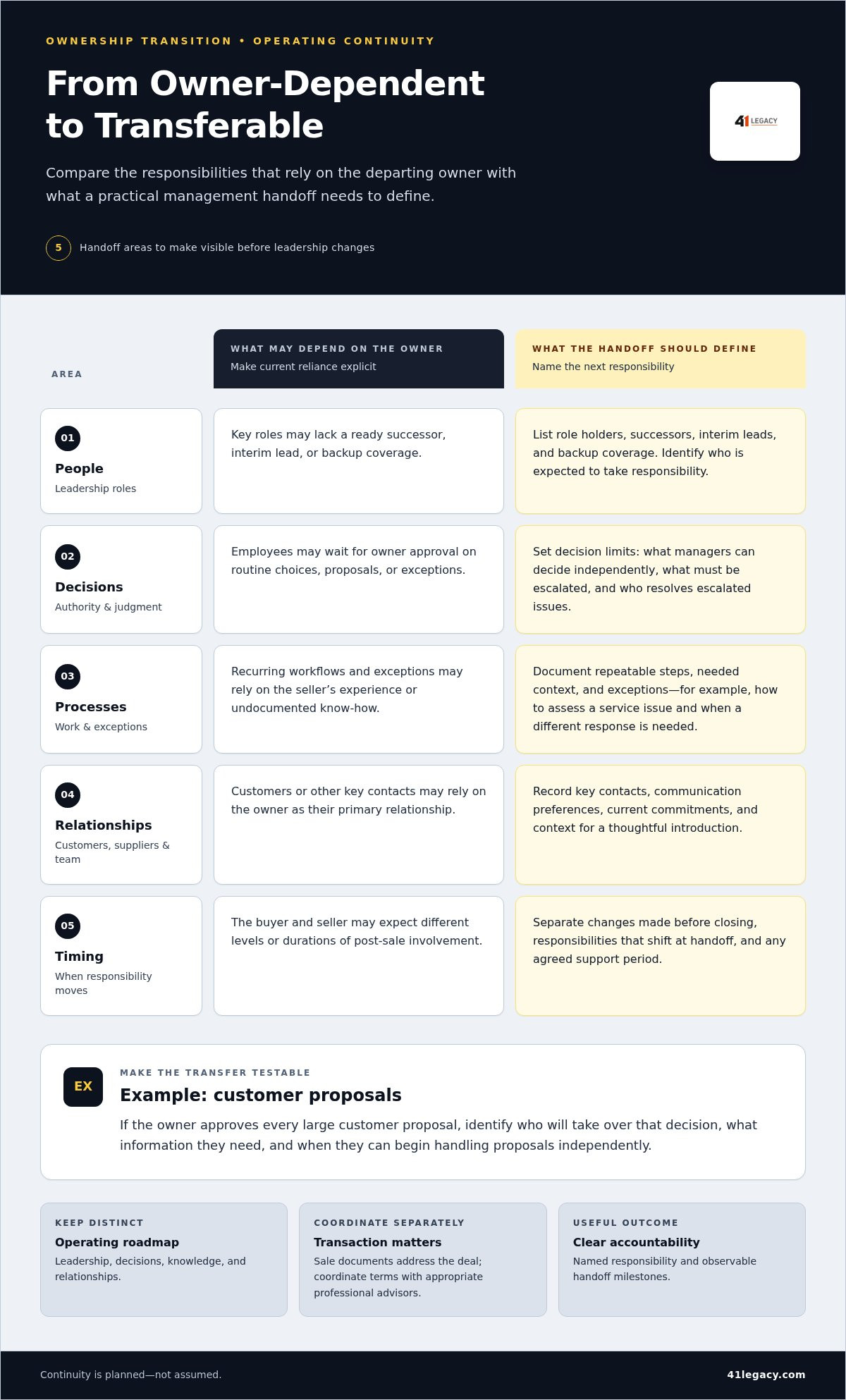
A change in ownership does not automatically transfer the knowledge, relationships, and judgment that keep a business operating. Customers may call the owner first. Employees may wait for the owner’s approval before making routine decisions. A management transition plan for business sale makes these dependencies visible and sets out how leadership and responsibility will move to others.
A management transition plan is an operating roadmap for transferring leadership, decision-making, essential knowledge, and relationships. It is separate from sale documents. Transaction documents address the deal; the transition plan addresses how the business will continue to function as roles change. Keeping those purposes distinct helps owners organize operational priorities and coordinate transaction matters with their professional advisors.
That distinction matters to a prospective buyer assessing whether the company can perform without its current owner at the center of every decision. A business with capable leaders, clear authority, and accessible operating knowledge has a more concrete continuity plan. Planning also helps the seller and incoming owner clarify what support is expected during the handoff, rather than relying on assumptions.
What does a management transition plan cover?
Start with the functions that keep the business steady: leadership roles, decision rights, key customer and supplier relationships, and business-critical knowledge. For each, name who is responsible now, who is expected to take responsibility, and what must be transferred. Distinguish changes made before closing, responsibilities that shift at handoff, and any agreed support period. Broader Succession Planning in Business also considers how leadership continuity is prepared; tailor this operating roadmap to the company’s actual roles and needs.
Make the plan usable. If the owner approves every large customer proposal, for example, identify who will take over that decision, what information they need, and when they can begin handling proposals independently. This turns a general intention to “hand over sales” into a testable transfer of responsibility. Coordinate transaction terms and professional matters with the appropriate advisors.
Why owner dependency makes the handoff harder
Trace where the owner’s involvement is essential: recurring decisions, customer relationships, approvals, and workflows. Ask managers to identify tasks they cannot complete without the owner, then record the steps, context, and judgment those tasks require. For each dependency, note whether the gap is missing documentation, limited authority, lack of experience, or a relationship that has not been transferred. Undocumented knowledge can leave a successor uncertain about priorities or delay routine work when responsibilities shift.
This review can also reveal which roles need development, clearer authority, or backup coverage before the handoff. Reducing owner dependency is part of building a transferable enterprise, not simply preparing for a sale. For a broader view of value growth, explore increasing enterprise value.
What to Include in a Business Sale Management Transition Plan
A useful plan turns broad intentions into named responsibilities and observable handoff milestones. Organize it around five areas: people, decisions, processes, relationships, and timing. For each item, record the current owner, the person expected to assume responsibility, the information or authority they need, and how the handoff will be reviewed. This gives the management transition plan for business sale practical value beyond a collection of notes.
A transition plan links named responsibilities to documented handoff milestones. It should show what will change, who will lead each change, what needs to be in place for work to continue, and how the team will know the transfer is working.
Map leadership roles and decision authority
List key functions such as operations, sales, finance, and customer service, then identify who makes consequential decisions in each. Name the proposed post-handoff lead and note any interim responsibility. Be specific about decision limits: which routine choices can a manager make independently, and which require escalation? Record who can resolve escalated issues so employees aren’t left guessing when the owner steps back. Where authority is changing, communicate the change to the people who rely on those decisions.
Document processes, relationships, and knowledge
Prioritize recurring workflows and exceptions that depend on the seller’s experience. A process note might explain how a service issue is assessed, who must be informed, and what conditions call for a different response. For customer, supplier, and team relationships, record key contacts, communication preferences, current commitments, and context needed for a thoughtful introduction. Documentation supports continuity, but it can’t guarantee how another party will respond.
Process documentation should be clear enough for another person to follow and maintain. A business SOP, or standard operating procedure, records how a repeatable task is performed; context and exceptions matter as much as the steps themselves. The guide to business SOPs and transferability explores how documented processes support a more transferable operation.
- People: List role holders, successors, interim leads, and backup coverage.
- Decisions: Define authority, escalation points, and who can resolve exceptions.
- Processes: Record recurring work, key dependencies, and less common scenarios.
- Relationships: Capture relevant contact history, commitments, and next steps.
- Milestones: Track preparation, handoff, and any agreed follow-up period.
Not every file belongs in a general handoff folder. Separate operating instructions and routine reference materials from confidential or sensitive records. Identify who needs access to each category and how access should be controlled, coordinating document-handling decisions with the appropriate professional advisors. Bank of America’s Creating a Business Transition Plan also emphasizes planning across the transition, rather than treating it as a single event.
Keep the plan current as responsibilities become clearer. A structured approach to enterprise readiness can help owners connect handoff priorities with the broader work of strengthening transferability.
Compare Seller Involvement, Leadership Handoffs, and Consulting Agreements
A management transition plan for business sale should distinguish between transferring a role, stepping away from daily operations, and providing support after the handoff. These approaches can overlap, but they are not interchangeable. Each places responsibility for decisions, knowledge transfer, and continuity in different hands. Choose an approach based on the responsibilities that still depend on the departing owner, rather than assuming the seller will remain available by default.
A planned exit removes the owner from routine operations; a staged handoff transfers leadership over time; consulting support provides defined access to the seller after ownership changes. Compare the models against specific responsibilities that still depend on the departing owner.
- Planned exit from daily operations: The owner prepares leaders to take over before stepping away. The team assumes operating decisions, while documented processes and introductions support continuity. Start early wherever the owner remains the main source of knowledge or authority.
- Staged leadership handoff: Responsibility moves in planned steps. A successor might first lead a function with the owner available for guidance, then take full decision authority once prepared. Specify each transfer so employees know who is accountable at every stage.
- Time-limited seller support: The seller provides specific assistance after the handoff, such as answering questions about an established process or explaining the history of a key relationship. The new leadership team retains decision authority; seller input should not become an informal second chain of command.
How should an owner evaluate post-sale involvement?
Begin with business-critical duties that can’t transfer immediately without preparation. For each one, ask what knowledge is missing, who is being prepared to assume responsibility, and what support would close the gap. Distinguish access to the seller’s experience from authority to direct the company. Match involvement to documented needs, rather than preserving a familiar routine simply because it feels comfortable.
Then consider how the arrangement will be understood by the incoming leadership team and employees. If the seller remains available, define who requests support, which topics are in scope, and who makes the final decision. Clear boundaries help the successor establish credibility while allowing the seller to contribute where their knowledge is useful.
How does a consulting agreement relate to the transition plan?
A consulting agreement is one possible way to formalize defined post-sale responsibilities. The transition plan identifies the operational need; the agreement may set out expectations for scope, duration, availability, reporting, and the objectives of the handoff. It can also establish when the support arrangement is expected to conclude, rather than allowing an open-ended role to develop by habit.
Keep the roles distinct. The strategic plan describes what knowledge or continuity support the business needs. The parties’ professional advisors can address binding agreement language and how terms should be structured. There is no universal arrangement that fits every company. Clarity comes from connecting any proposed support to real responsibilities, clear decision authority, and a defined transition objective.
Build the Transition Plan Before the Sale: A Practical Sequence
Build the plan while there’s room to develop leaders, test responsibilities, and close knowledge gaps. Preparation should begin before a closing date is known, because owner dependency takes time to reduce. Use this sequence as a planning framework, not a guaranteed timeline or promise of a particular transaction outcome. Adjust the work to the company’s needs and revisit priorities as they change.
- Diagnose dependencies. Identify roles, decisions, relationships, and recurring work that still rely on the owner. For each, note what could be disrupted if the owner stepped away tomorrow, and who currently has the knowledge or authority to keep it moving.
- Set priorities. Rank each dependency by its operational importance and readiness for reassignment. Separate tasks that need an immediate backup from longer-term priorities, such as developing a leader who can eventually take responsibility for an entire function.
- Assign owners. Name one person to lead each transition item, along with any supporting roles. “The leadership team” is not a clear assignment. A named owner can coordinate the work, surface obstacles, and keep the handoff from disappearing among daily priorities.
- Document what matters. Create or update practical instructions, decision guides, contact context, and exception-handling notes. Keep materials focused on what the successor needs to perform the work, and distinguish completed documentation from items that still depend on the seller’s explanation.
- Rehearse the handoff. Have the designated leader complete key work while the owner observes rather than intervenes. Test routine decisions as well as less familiar situations. Record where the successor needs more context, authority, practice, or support, then revise the plan accordingly.
- Review readiness. Track each item as not started, in progress, ready to test, or completed. Review both deliverables and capability: a process document may be finished, but the successor should also demonstrate they can use it without relying on the owner.
Identify priorities and test readiness
A dependency review turns a broad concern into manageable work. If a manager can handle standard customer requests but still needs the owner to resolve unusual cases, for example, separate routine authority from exception handling. The immediate priority may be a clear escalation process; longer-term development may involve giving the manager practice with more complex decisions. This distinction helps direct effort where it can strengthen continuity.
Measure progress through evidence, not optimism. Useful indicators include whether each transition item has a named owner, whether essential knowledge materials are complete, and whether designated leaders can perform key tasks without the seller stepping in. These measures help identify remaining gaps; they don’t guarantee readiness or a sale result.
For broader preparation context, see exit planning for business owners. The strategic approach to building a transferable business connects management handoff priorities with a broader transferability strategy.
Align the Management Transition Plan With Exit Readiness
A leadership handoff is one part of exit readiness, not a separate exercise. It should connect to the broader question of whether the business can operate and make decisions without the owner’s daily involvement. Enterprise diagnostics can help surface gaps between current operations and a more transferable business, giving the owner a clearer basis for setting priorities.
A review may show, for example, that a capable manager leads daily operations but lacks authority to resolve customer exceptions, or that core processes exist only in the owner’s experience. These findings point to different readiness needs: clarify decision rights in one case, document and transfer knowledge in another. The purpose is to identify practical improvements, not to promise a particular valuation, buyer response, or sale result.
Connect transition readiness to transferable value
Leadership depth and documented processes help show that important work can continue beyond the founder. A Value Growth Roadmap can sequence these transition improvements alongside other business priorities, so the owner can address the most relevant gaps without treating every issue as equally urgent. For related context on determining enterprise value, consider how operational readiness fits into the broader picture of the company.
The sequence matters. If a manager needs experience before taking on a larger role, leadership development may need to precede a transfer of decision authority. If an essential workflow depends on the owner’s memory, documentation and practice may be an earlier priority. Linking each improvement to a responsible person and a clear next step makes the roadmap more actionable.
Coordinate implementation with the advisory team
Transition work often touches several areas of the business. Strategic coordination can help the owner keep operational priorities visible while working with existing advisors, including a CPA and attorney, on matters within their respective roles. 41 Legacy provides strategic advisory and implementation support to help align the work of the owner’s advisory team.
Monthly implementation support can help maintain accountability for roadmap priorities by reviewing progress, surfacing obstacles, and keeping agreed actions moving. The owner and advisory team can use those reviews to adjust priorities as the business changes, rather than letting the transition plan become a static document. Useful progress measures include whether a successor has assumed a defined responsibility, whether a key process is documented and practiced, and whether unresolved dependencies have an assigned next step.
Consider the plan alongside your broader exit objectives. The strongest priorities are those that improve the company’s ability to function independently while supporting its ongoing needs. A thoughtful readiness process connects diagnostics, roadmap priorities, and coordinated implementation into one strategic view.
Prepare the Business to Thrive Beyond Your Tenure
The next step is to turn transition intent into a readiness priority. Choose one responsibility that still depends on you, identify who could eventually own it, and decide what knowledge or authority they need to take it on. This deliberate step can begin shifting the business from founder-led to genuinely transferable well before a handoff is imminent.
A management transition plan for business sale is most useful when it serves a wider purpose: preparing the enterprise to operate with clarity and strength beyond your tenure. 41 Legacy, founded and led by Chris Giammarco, a Certified Exit Planning Advisor, supports that work through enterprise diagnostics, a Value Growth Roadmap, and monthly implementation support coordinated with your existing professional advisors.
You don’t need every transition question answered before you begin. A clear view of readiness can help you decide where to focus first and how operational priorities fit your broader exit objectives. Assess your business’s exit readiness and take the next step toward building an enterprise prepared for what comes next.
Frequently Asked Questions
When should a business owner start a management transition plan for a sale?
Start when a potential ownership change becomes a serious planning consideration, not after a date is fixed. Early work lets the owner use ordinary operating cycles to test whether another leader can run key meetings, approve routine work, or manage a seasonal workload. If an exit remains several years away, begin with the roles most tied to the owner and revisit the plan as leadership capacity and business priorities evolve.
Does a management transition plan replace a post-sale consulting agreement?
No. The plan helps identify which responsibilities may need continued support and what the incoming leadership team needs to learn. A consulting agreement, if used, can formalize the parties’ expectations for that support. For example, the plan might identify a need to explain a complex customer process, while the agreement addresses the scope and duration of that assistance. The parties’ legal advisors can address binding agreement language.
Can a business sale proceed if the owner is essential to daily operations?
It may still be considered, but the owner’s central role is an operational risk that deserves careful attention. A practical first step is to divide the owner’s work into decisions that can move to existing leaders, knowledge that can be documented, and responsibilities that need a successor or additional capacity. This helps clarify the scale of the transition challenge without assuming a particular sale outcome.
Who should be involved in creating the management transition plan?
The owner should lead the process, with input from managers and employees who understand how work actually gets done. If a successor has been identified, involve them early enough to expose gaps in authority or context. The owner’s existing professional advisors can contribute within their areas of expertise. Keep one person responsible for maintaining the working plan so updates don’t become scattered across separate conversations.
What should a seller document before handing over management responsibilities?
Record the information a successor would struggle to reconstruct: recurring deadlines, approval thresholds, decision history, open commitments, and the reasons behind exceptions to standard practice. For instance, a handoff note about a supplier issue should distinguish a one-time problem from a recurring constraint. Store sensitive records through appropriate access controls, and avoid placing passwords or other credentials in general operating documents.
How can a seller measure whether the management handoff is working?
Compare the successor’s work with the business’s own baseline, rather than relying on a general impression that the transition feels smooth. Track whether assigned duties are completed, whether work is delayed or returned for correction, and how often decisions still escalate to the seller. Review the patterns with the successor: recurring questions may signal a missing instruction, unclear authority, or a need for further practice.
What happens to the transition plan if the sale timeline changes?
Update the plan to reflect the new timing and current operating priorities. A delay may create room to test a successor further, while an accelerated schedule may require narrowing attention to the responsibilities most critical for continuity. Reconfirm who owns each task and whether milestones still make sense. Keep operational planning current, and have professional advisors address any effect on separate transaction documents or agreements.

Article by
Mike Laskowski
Mike Laskowski is a Business Value Growth Strategist who helps business owners uncover the truths that drive their performance, risk, and readiness. Blending forensic interviewing from a 26‑year federal career with Strategic Capacity analysis and CEPA methodology, he works upstream to reduce owner dependency, increase transferability, and strengthen enterprise value. Mike guides founders through clarity, operational evolution, and transition readiness so their companies become transferable, owner‑independent assets that endure beyond the founder.
Disclaimer
This article is for educational and informational purposes only and does not provide legal, tax, investment, or business brokerage advice. 41 Legacy does not offer M&A brokerage services, legal document drafting, tax preparation, or investment advisory services. Business owners should consult licensed professionals in those disciplines before making decisions related to business transactions, legal matters, tax strategy, or financial planning. All examples are illustrative and may not apply to your specific situation.

