
Leaving Money on the Table in a Business Sale? Find the Value Gaps
For owners searching “leaving money on the table business sale,” the concern often starts with a practical question: what could make the business harder to understand or transfer? Value gaps can emerge well before a transaction is planned. Customers may rely on the founder, key decisions may sit with one person, or financial and operating information may not clearly show how the company performs.
A prospective buyer may have questions about how those risks affect continuity and what improvements deserve attention first. A business is easier to assess when it can show how it will continue to perform beyond its founder. Preparation helps make that strength visible through clear responsibilities, repeatable processes, and reliable evidence of performance.
This article explains how owner dependency, concentrated customer relationships, unclear processes, and weak preparation can create avoidable value gaps. You’ll learn how to prioritize steps that strengthen transferability, reduce uncertainty, and support an internal or external transition. With an Exit Readiness Assessment, enterprise diagnostics, and a Value Growth Roadmap, 41 Legacy helps owners build a clearer path toward a business prepared to thrive beyond them.
Key Takeaways
- Identify how sale readiness risks can begin with unresolved weaknesses in operations, customer relationships, or decision-making.
- Trace owner dependency to continuity concerns, then identify responsibilities and relationships that need to rely less on the founder.
- Compare the business’s current evidence with your transition goals to pinpoint unanswered questions and practical next steps.
- Prioritize improvements by their business significance, available evidence, your influence over them, and the effort required to make progress.
- Use an Exit Readiness Assessment and Value Growth Roadmap to turn diagnosed value gaps into sequenced priorities for a more transferable business.
Leaving Money on the Table in a Business Sale: Signs the Value Gap Starts Early
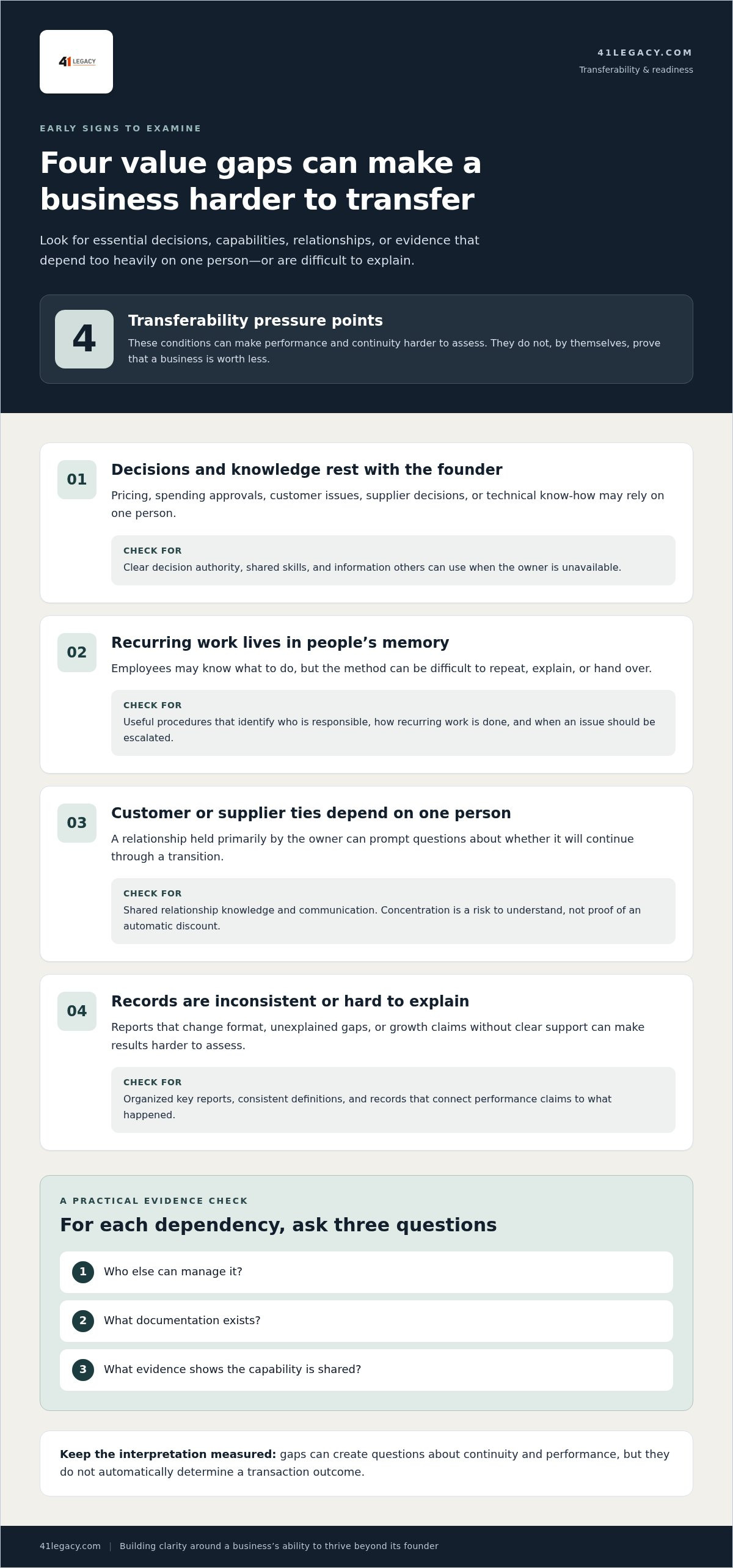
Preparation gaps can appear well before an owner decides to transition. Decisions may depend on the founder’s judgment, processes may exist only in employees’ memory, or records may be inconsistent from one period to the next. These conditions don’t prove that a business is worth less. They can make its performance and ability to continue without the owner harder to assess.
What does leaving money on the table in a business sale mean?
The phrase “leaving money on the table” describes preventable value or deal certainty lost when unresolved weaknesses obscure an enterprise’s strengths. It points to missed preparation opportunities, not a promise that any step will produce a particular price, buyer, or transaction outcome.
Documented performance shows what the business has achieved. Its potential may depend on capabilities that haven’t been made visible or repeatable, such as the owner’s personal customer relationships or knowledge of how to resolve daily problems. When evidence is incomplete, a prospective buyer may have more questions about continuity and the company’s ability to sustain its results. That uncertainty can complicate evaluation, but it doesn’t automatically determine an outcome.
A transferable business makes its performance and essential capabilities clear, reducing visible risk and supporting buyer confidence.
Enterprise value is also distinct from an owner’s personal financial goals and future plans. A business may have operating strengths, but the owner’s desired timing, role after transition, and financial priorities are separate considerations. Clarity on both sides helps owners prepare with purpose. For foundational context on how economic value can be estimated, see Business valuation.
Which early signs suggest a business may be harder to transfer?
Look for places where the business relies on one person rather than a shared, documented capability. If only the owner knows how to approve exceptions, manage a key account, or handle a recurring operational issue, their absence could interrupt decisions or service. Informal processes create a similar challenge: employees may know what to do, but the method may be difficult to repeat or explain.
Concentrated customer or supplier relationships also deserve attention. A relationship held primarily by the owner can raise questions about whether it will continue through a transition. Concentration is a risk to understand, not proof of an automatic discount. Uneven records can add uncertainty when reported results are difficult to reconcile or explain.
Start by listing essential decisions, processes, and relationships that depend on the owner. For each, record who else can manage it, what documentation exists, and what evidence shows the capability is shared. For a deeper discussion of enterprise value, read determining enterprise value.
Why Owner Dependency and Unclear Operations Can Weaken Sale Readiness
A business may produce strong results and still rely heavily on its founder to keep those results going. That reliance can prompt practical questions: Who can make key decisions? Will important customer and supplier relationships continue? Can the team maintain operations if the owner steps away? If the answers are unclear, transition planning becomes more difficult and perceived uncertainty can grow.
How does owner dependency affect a business sale?
Start by identifying where the founder remains the essential link. This may include setting prices, resolving customer issues, approving spending, managing a major supplier, or holding technical knowledge no one else has documented. The issue isn’t simply that the owner is involved. It’s whether the business has the authority, skills, and information to continue when the owner isn’t available.
Delegating decisions with clear boundaries shows who is responsible for routine and exceptional matters. Documented processes help employees carry out recurring work consistently. These steps support continuity, but they don’t guarantee a particular sale price or outcome. They make the company’s operating model easier to understand and assess.
Relationships deserve the same scrutiny as tasks. If a customer works only with the founder or a supplier relies on the owner’s personal judgment, consider how knowledge and communication could be shared. A concentrated relationship isn’t automatically a fatal flaw; its significance depends on context, the strength of the relationship, and evidence that it can endure beyond one person.
Why do systems and reliable records matter to transferability?
Standard operating procedures (SOPs) describe how recurring work is done, who is responsible, and what steps or decisions are involved. A useful procedure doesn’t need to capture every detail. It should give someone qualified enough direction to repeat the work and know when an issue needs to be escalated.
Consistent records help tell the company’s operating story. If reports change format or growth claims can’t be supported by clear evidence, it may be harder to distinguish sustained performance from assumptions or one-time results. Keep key reports organized, use consistent definitions, and connect claims about growth to records that show what happened. Not every inconsistency signals a serious defect, but unexplained gaps invite questions that context and evidence could resolve.
To identify where owner reliance, systems, or reporting need attention, consider a structured review of transferability and risk. 41 Legacy’s strategic advisory approach helps owners organize these questions alongside their existing professional advisors.
How to Assess Value Gaps Before a Business Sale
A useful assessment compares the business as it operates today with the owner’s objectives and preferred transition. It isn’t a prediction of a sale price. It’s a disciplined way to identify what the business can demonstrate, where it relies on informal knowledge, and which questions need answers. For owners concerned about leaving money on the table in a business sale, preparation starts with evidence, not assumptions.
What should an owner review when looking for value gaps?
Review whether a capable leader could explain and manage essential functions without relying on the owner’s memory. Look across financial consistency, customer relationships, operating systems, management capacity, and the company’s ability to pursue its strategic priorities. Record the evidence available and the knowledge that still sits with one person. The aim is to see how well the business’s performance and capabilities can be understood and repeated.
| Area | Current evidence | Unresolved question | Next action |
|---|---|---|---|
| Earnings quality | Consistent reports and supporting records | Can reported performance be clearly explained? | Organize records and flag financial interpretations for the owner’s qualified advisors. |
| Customer concentration | Revenue and relationship information | Are key relationships shared beyond the owner? | Document relationship coverage and continuity questions. |
| Owner reliance | Decision and responsibility assignments | Who can act when the owner is unavailable? | Clarify delegated authority and identify knowledge gaps. |
| Operating systems | Written procedures and repeatable workflows | Can another capable person perform recurring work? | Document essential steps and responsibilities. |
| Strategic capacity | Leadership, time, and resources for priorities | Can the business pursue its plans without depending on the founder? | Identify constraints and assign follow-up. |
How do you distinguish a fixable gap from an unknown?
Classify each issue by the strength of its evidence, its business impact, the owner’s ability to influence it, and the time or coordination needed to address it. A missing report is an information gap, not proof of a specific valuation effect. A concentrated relationship may call for continuity planning, but its significance depends on the facts and context.
Keep observed facts separate from assumptions. Note what is known, what remains unanswered, and who is best positioned to clarify it. Financial or legal interpretations should be flagged for the owner’s qualified advisors, rather than treated as conclusions from a readiness review.
An assessment prioritizes questions and actions; it doesn’t guarantee value or a transaction outcome. A structured review can help owners turn findings into sequenced priorities. Explore 41 Legacy’s strategic advisory to learn how the firm helps strengthen transferability.
What to Improve First to Avoid Leaving Money on the Table
Preparation works best as a focused sequence, not a collection of disconnected projects. The aim is to strengthen the business while it continues to serve customers and meet its commitments. A clear order helps owners address risks that affect continuity or obscure performance before spending time on lower-priority refinements. No single change guarantees a particular buyer response or outcome.
A practical sequence for prioritizing improvements
- Clarify your goals. Define the transition you want, the role you hope to have, and the business conditions that matter to you. These objectives help distinguish essential preparation from work that may not support your plans.
- Identify the gaps. Review where performance is hard to explain, critical work depends on you, or important responsibilities and relationships lack clear ownership. Note what evidence exists and what remains an assumption.
- Prioritize risk. Give early attention to issues that threaten continuity, obscure the company’s operating record, or rely heavily on the owner. Consider each item’s business significance, available evidence, your influence over it, and practical feasibility.
- Assign an owner. Give each priority a responsible person, a defined next action, and evidence that will show progress. For example, a manager might document a recurring workflow while the owner shares a key customer relationship with another team member.
- Review progress. Revisit priorities through an existing management meeting or planning routine. Update the evidence, note obstacles, and adjust the sequence as capacity or business needs change.
This process also builds a clearer operating narrative: what the company does, how essential work gets done, who is accountable, and what supports its performance. Consistent records and measurable responsibilities make that account more specific. They don’t guarantee a particular valuation or outcome, but they can make the business easier to understand.
Prepare without disrupting daily operations
Integrate readiness work into existing routines wherever possible. Sequence initiatives around dependencies: clarify responsibilities before documenting a handoff, for example, or organize reporting definitions before comparing performance. Avoid assigning more work than the team can realistically absorb. Steady progress is more useful than a disconnected initiative that competes with core operations.
Some decisions may require input from the owner’s existing professional advisors. Coordinate with them when a question falls within their expertise, while keeping strategic priorities aligned across the broader plan. Preparation can begin well before a transition is imminent, giving the owner time to build transferability alongside the daily work of running the company.
For structured support in organizing readiness priorities, explore 41 Legacy’s strategic exit-readiness guidance.
How 41 Legacy Helps Owners Build a More Transferable Business
Readiness is a strategic process, not a last-minute checklist. For owners concerned about a business sale, the first step is understanding how the company operates today, what the owner wants from a future transition, and where the two may not yet align. 41 Legacy’s Exit Readiness Assessment provides a structured view of enterprise conditions and the gaps that may affect transferability.
What happens in an exit-readiness process?
The work begins with enterprise diagnostics and goal alignment. Together, these help clarify strengths, constraints, owner dependencies, and unanswered questions. Findings then inform a Value Growth Roadmap, which organizes strategic priorities into a sequence the owner and leadership team can work through.
A roadmap might identify the need to clarify responsibilities, document essential processes, or strengthen the information used to explain business performance. Priorities are tailored to the company’s circumstances and transition objectives. Where a question calls for legal, tax, accounting, or other specialized interpretation, 41 Legacy coordinates with the owner’s existing professional advisors rather than replacing their expertise.
That coordination is part of the strategic quarterback role: helping the owner and their advisors stay aligned around shared business objectives. Monthly implementation support adds structure and accountability as priorities move from plans into practice. It supports progress, but it isn’t transaction representation and cannot promise a particular buyer, price, or outcome.
Why build transferability before choosing a transition?
Stronger systems, clearer responsibilities, and reduced reliance on the owner can support the business across different transition paths. They can also help the enterprise operate with greater continuity if timing or plans change. Preparation is therefore useful even when a sale isn’t imminent or the owner is still considering what comes next.
Transferability is built through deliberate improvements over time. An Exit Readiness Assessment helps establish where the business stands; the Value Growth Roadmap gives the owner a practical sequence for addressing the most relevant gaps. Progress can be reviewed alongside existing management routines and coordinated with the owner’s professional advisors, keeping the work connected to daily operations and long-term objectives.
For owners ready to clarify priorities and strengthen the business beyond its founder, explore 41 Legacy’s strategic advisory approach.
Build a Business Ready for What Comes Next
Value gaps often start before a transition is on the calendar. Owner-dependent decisions, unclear operating practices, and inconsistent records can make a business harder to understand and transfer. Addressing those weaknesses early helps owners build a more resilient enterprise, whether their plans lead to an internal or external transition. No readiness process can guarantee a specific price or outcome.
Start by comparing the company’s current condition with your goals, then focus on improvements that strengthen continuity and make performance easier to explain. 41 Legacy, led by Chris Giammarco, a Certified Exit Planning Advisor (CEPA), brings structure to that work through enterprise diagnostics, a Value Growth Roadmap, and monthly implementation support. As a strategic quarterback, the firm coordinates with your existing professional advisors around shared business objectives.
Explore 41 Legacy’s Exit Readiness Assessment and take the first step toward a more transferable business. With clear priorities and steady progress, you can strengthen an enterprise built to thrive beyond its founder.
Frequently Asked Questions
How can I tell if my business sale could be undervalued?
Look for gaps between the company’s documented performance and the story its records support. Inconsistent financial reports, unexplained changes in results, undocumented processes, or customer relationships held mainly by the owner may make the business harder to assess. These signs don’t establish that a sale will be undervalued. They indicate questions to investigate, evidence to organize, and matters to discuss with qualified professional advisors where financial or other specialized interpretation is needed.
Does owner dependency reduce business value?
Owner dependency can create concern about whether the business will continue to operate effectively without the founder, but it doesn’t automatically reduce value. Consider which decisions, customer relationships, supplier connections, and essential knowledge depend on you. Then identify who could take responsibility and what processes or information would support them. Clear delegated authority and documented ways of working can help demonstrate continuity, though they can’t guarantee a specific price or buyer response.
How far in advance should I prepare my business for sale?
Begin before a sale is imminent, if you can. Preparation often involves clarifying goals, identifying owner-dependent responsibilities, improving records, and making important processes repeatable. These changes take attention and coordination, so starting early gives you more opportunity to sequence the work alongside daily operations. There’s no universal timeline that guarantees readiness. A structured assessment can help identify priorities based on your business’s current condition and desired transition.
What are the most common reasons owners leave money on the table?
Common sources of avoidable value gaps include excessive reliance on the owner, concentrated customer or supplier relationships, informal operating processes, inconsistent records, and growth claims that aren’t supported by clear evidence. These conditions don’t automatically determine a sale outcome. Their significance depends on the business and the available evidence. Assess each issue by its effect on continuity, how clearly it can be explained, and what practical steps could reduce uncertainty.
Can I increase business value without selling immediately?
Yes. Owners can work to strengthen the business as a transferable asset without committing to an immediate sale. Clarifying responsibilities, documenting essential processes, improving management capacity, and building consistent records can support the company’s ability to operate beyond the founder. These efforts may also help the business become more resilient if plans change. They don’t guarantee a higher valuation or a future transaction, but they can improve strategic clarity and readiness.
What is an exit-readiness assessment?
An Exit Readiness Assessment is a structured review of a company’s current enterprise conditions in relation to the owner’s goals and desired transition. At 41 Legacy, enterprise diagnostics help identify strengths, potential value gaps, and questions that may need attention. Findings can inform a Value Growth Roadmap with sequenced priorities. The process supports strategic preparation and coordination with the owner’s existing professional advisors; it doesn’t guarantee a sale outcome or provide a certified business valuation.

Article by
Mike Laskowski
Mike Laskowski is a Business Value Growth Strategist who helps business owners uncover the truths that drive their performance, risk, and readiness. Blending forensic interviewing from a 26‑year federal career with Strategic Capacity analysis and CEPA methodology, he works upstream to reduce owner dependency, increase transferability, and strengthen enterprise value. Mike guides founders through clarity, operational evolution, and transition readiness so their companies become transferable, owner‑independent assets that endure beyond the founder.
Disclaimer
This article is for educational and informational purposes only and does not provide legal, tax, investment, or business brokerage advice. 41 Legacy does not offer M&A brokerage services, legal document drafting, tax preparation, or investment advisory services. Business owners should consult licensed professionals in those disciplines before making decisions related to business transactions, legal matters, tax strategy, or financial planning. All examples are illustrative and may not apply to your specific situation.

