
Transferability & Owner Dependency
Key Drivers of Enterprise Value for a Private Company: A Strategic Guide
What if the very legacy you've spent decades refining is currently nothing more than a high-paying job in disguise? Many business owners believe they're building a lasting monument, only to realize their company's heartbeat is entirely dependent on their own daily presence. We understand the weight of this realization. It's the silent anxiety of knowing that a buyer won't pay for your personal talent, but for the systems you leave behind. Identifying the key drivers of enterprise value for a private company is the first step in transforming a lifestyle business into a sophisticated, transferable asset.
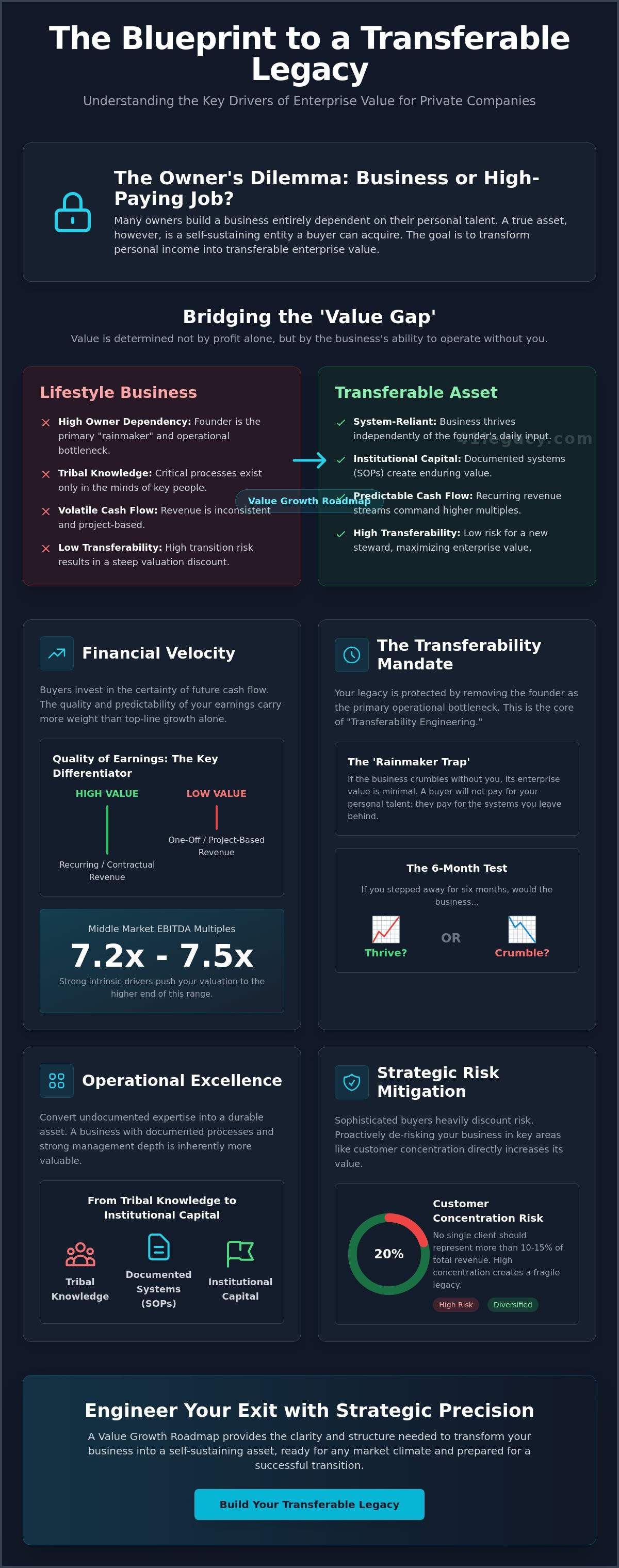
In this guide, we reveal the levers that move a business from a founder-led operation to a self-sustaining entity. You'll discover how to bridge the 'Value Gap' and why current market conditions, where middle market EBITDA multiples average between 7.2x and 7.5x, favor those with surgical precision in their operations. We provide an actionable framework to reduce owner dependency and strengthen your cash flow patterns. This isn't just about a transition; it's about the stewardship of an enterprise that possesses its own enduring essence and value.
Key Takeaways
- Learn to distinguish between your company's market attractiveness and its intrinsic value to ensure the business thrives as a self-sustaining entity.
- Understand why the quality of your earnings and predictable revenue streams are the key drivers of enterprise value for a private company, often carrying more weight than top-line growth alone.
- Identify the 'Rainmaker Trap' and discover how Transferability Engineering protects your legacy by removing the founder as the primary operational bottleneck.
- Explore how converting tribal knowledge into documented systems creates institutional capital that a future steward can manage with precision.
- Gain clarity on calculating your 'Value Gap' to align your current operations with the long-term financial milestones required for a successful transition.
The Essence of Enterprise Value: Beyond the Balance Sheet
Enterprise value is far more than a cold calculation of equity and debt. It represents the collective energy, systems, and potential of a business, distilled into a single, authoritative figure. In technical terms, Enterprise Value is the total worth of a business entity, viewed independently of its capital structure. For the private business owner, this metric serves as a profound scorecard of stewardship. It measures your ability to transform a personal income stream into a high-value, transferable asset that can endure for generations.
When we examine the key drivers of enterprise value for a private company, we must look beyond the immediate balance sheet. We focus on the present value of future, risk-adjusted cash flows. A buyer isn't paying for what you did yesterday. They're paying for the certainty that those results will continue tomorrow without your presence. This requires a shift in perspective. You're no longer just running a company; you're engineering a masterpiece that possesses its own heartbeat.
The Concept of Transferability
Profitability does not always equate to value. A business generating millions in profit might have surprisingly low enterprise value if the founder is the only person capable of closing sales or managing operations. We call this the 'Transferability Test.' If you were to step away for six months, would the business thrive or crumble? Buyers apply a heavy discount to any entity where the transition risk is high. True value lies in the degree to which the business can function as a self-sustaining organism, independent of its creator's daily input. Engineering this independence is what separates a lifestyle business from a legacy asset.
Intrinsic vs. Extrinsic Value Drivers
Value is born at the intersection of internal excellence and external opportunity. Intrinsic drivers are the factors you control, such as management depth and documented processes. Extrinsic drivers involve market conditions, like the current 7.2x to 7.5x EBITDA multiples seen in middle market private equity deals. While you cannot control the economy, you can maximize 'Blue Sky' value by focusing on the key drivers of enterprise value for a private company that reside within your reach. A structured Value Growth Roadmap helps quantify these levers, ensuring your enterprise is prepared for any market climate. By focusing on these internal mechanics, you build a business that remains attractive regardless of external volatility.
Financial Velocity: EBITDA, Margins, and Cash Flow Predictability
Precision is the hallmark of any masterpiece. In the financial architecture of a business, EBITDA serves as the foundational stone. It's the universal language of valuation, allowing buyers and advisors to speak with a shared clarity. When we evaluate the key drivers of enterprise value for a private company, we look past the raw turnover to the velocity and quality of the cash flow. It's here that the true strength of an enterprise is revealed; not just in what it earns, but in how reliably it earns it.
The "Quality of Earnings" is a concept we treat with deep reverence. A business reliant on one-off projects is a collection of transactions; a business built on recurring revenue is a living entity with a heartbeat. Consistent revenue streams are among the most influential key drivers of enterprise value for a private company, as they command significantly higher multiples by reducing buyer anxiety. To showcase true earning power, we normalize financials through "Add-backs," removing one-time expenses or owner-specific costs that won't persist under new stewardship. This process polishes the financials to a high sheen, revealing the underlying Valuation Drivers that attract sophisticated acquirers.
Revenue Quality and Concentration
Exclusivity is often a virtue, but in your customer base, it's a risk. We advise that no single client should represent more than 10% to 15% of your total revenue. High customer concentration creates a fragile legacy, as the loss of one relationship could jeopardize the entire enterprise. Buyers place a premium on subscription models or long-term contractual agreements that provide a clear view of the future. By diversifying your revenue streams, you mitigate the risk profile and ensure the business stands on multiple pillars of support.
Predictability and Forecasting
Trust is built on the bedrock of transparency. Clean, audited-quality financial statements are essential for establishing this trust with potential buyers. Accurate financial forecasting further reduces the "risk discount" applied by lenders and acquirers alike. It demonstrates that the management team has a surgical grip on the company's direction. EBITDA represents the baseline for debt-service capacity in an acquisition. Through our Enterprise Diagnostics, we help owners identify where their financial narrative can be strengthened to better reflect the inherent value they've created.
The Transferability Mandate: Mitigating Owner Dependency
While financial ratios provide the skeleton of a valuation, owner-independence is the soul that gives it life. Many founders fall into the 'Rainmaker Trap,' where they remain the primary engine for sales and strategic relationships. While this may lead to high current income, it devalues the enterprise in the eyes of a potential successor. If the business cannot generate revenue without your direct involvement, it's not an asset; it's a job you happen to own.
One of the most critical key drivers of enterprise value for a private company is the ability for the organization to operate as a self-sustaining entity. Buyers look for 'Owner-Centric' bottlenecks; processes that require the founder's signature, approval, or specific tribal knowledge to proceed. At 41 Legacy, we utilize specialized Enterprise Diagnostics to pinpoint these dependency risks. By identifying where the founder's presence is a prerequisite for performance, we can begin the work of Transferability Engineering. The goal is to ensure the eventual 'Multiple' offered by a buyer reflects the business's strength, not just your personal talent.
Building a Functional Leadership Team
True leadership is not about being the smartest person in the room. It's about building a room that functions without you. Transitioning from a 'hub-and-spoke' management style, where all decisions flow through the founder, to decentralized authority is essential for growth. This often involves empowering a strong 'Number Two' executive who can bridge the gap between vision and execution. In a transition scenario, the retention of this key leadership is paramount. Implementing 'stay-bonuses' or long-term incentive plans ensures that the institutional capital remains intact when the ownership changes. This depth of management increases the 'Strategic Capacity' of the firm, making it more resilient and valuable to a future steward.
The Role of the Owner as Steward
Shifting your focus from 'working in' the business to 'working on' the asset is the ultimate act of craftsmanship. It requires a profound psychological shift. You must move from being the primary actor to being the steward of a legacy. This evolution ensures that the business thrives independently of your personal exertion. Building a transferable asset is a deliberate choice to prioritize long-term health over short-term ego. It's about creating a masterpiece that can endure, reflecting the meticulous nature of the work you've performed over decades. Preparing for a successful internal or external transition starts with the realization that your greatest contribution is a business that no longer needs you.
Operational Excellence: Systems, SOPs, and Management Depth
A business lacking documented systems is a performance without a script; it relies on the fleeting brilliance of individuals rather than the enduring strength of an institution. In the pursuit of perfection, we view Standard Operating Procedures (SOPs) as the 'Owner's Manual' for the next steward. These documents aren't merely lists of tasks. They are the codified essence of your company's success, ensuring that the precision you've cultivated remains untarnished after a transition. By turning tribal knowledge into institutional capital, you create a legacy that is both durable and scalable.
Operational maturity is one of the most vital key drivers of enterprise value for a private company. When a buyer evaluates an acquisition, they look for a plug-and-play model where the gears continue to turn seamlessly from day one. Modern Information Systems (IS) and integrated technology play a curative role here, providing the infrastructure for operational scalability. Through Transferability Engineering, we help owners refine these internal mechanics until the business operates with the rhythmic grace of a well-maintained timepiece. This level of systemic reliability significantly reduces the perceived risk for a successor, directly impacting the final valuation multiple.
Process Documentation and Scalability
Sophisticated buyers pay a premium for 'boring' consistency over 'creative' chaos. While individual flair is admirable, it is difficult to replicate and even harder to scale. Documented workflows ensure that every facet of the business, from lead generation to final delivery, follows a proven path. We focus on identifying the 'Critical Path' processes, those specific actions that drive 80% of the company's value. By refining these workflows, you reduce training costs for a successor and ensure that the quality of the output remains uncompromised. This meticulous attention to detail transforms a collection of activities into a high-performance asset.
Risk Management and Compliance
True stewardship requires a proactive approach to mitigating hidden liabilities. Before a business enters the scrutiny of due diligence, it must be cleansed of potential legal, environmental, or cybersecurity risks. Ironclad contracts with vendors, employees, and customers serve as the protective casing for your enterprise value. We believe that Enterprise Diagnostics are essential for uncovering these vulnerabilities before they can devalue the firm. Addressing these compliance gaps early ensures a smooth transition and reinforces the professional altitude of the organization. To begin fortifying your company's internal systems, consider our specialized Transferability Engineering services to build a more resilient asset.
Engineering Your Exit: The Value Growth Roadmap and Strategic Alignment
Engineering an exit is the final, most complex movement in the symphony of business ownership. It requires a clear understanding of the 'Value Gap', which is the distance between your current enterprise value and the net proceeds required to fund your next chapter. Addressing this gap isn't just about a future sale; it's about refining the key drivers of enterprise value for a private company today. When these drivers are optimized, exit planning simply becomes good business strategy. It ensures the firm is always 'transfer-ready', regardless of whether you intend to transition in two years or twenty.
A successful transition requires a harmonious effort from your entire advisory team. Too often, CPAs, attorneys, and wealth managers operate in isolation, providing fragmented advice that lacks a cohesive center. We serve as the 'Quarterback', coordinating these specialists toward a singular vision of perfection. This alignment ensures that every legal structure and tax strategy serves the ultimate goal of maximizing the asset's value. Our Monthly Implementation Support bridges the divide between high-level strategy and granular execution, ensuring your Value Growth Roadmap remains a living, breathing guide rather than a static document on a shelf.
The Diagnostic First Step
Establishing a baseline is the first act of the master artisan. Through an Exit Readiness Assessment, we identify the 'Low-Hanging Fruit', those immediate operational or financial improvements that can elevate your valuation within the next 12 to 24 months. These quick wins build momentum, allowing us to tackle deeper systemic issues later. Value is built through intentional stewardship, not by accident.
Your Legacy as a Transferable Asset
There is a profound peace of mind that comes from knowing your life's work is built to last. By focusing on the key drivers of enterprise value for a private company, you ensure that your reputation, your employees, and your customers are protected long after you've passed the torch. A transferable asset is the ultimate testament to your dedication. It signifies that you've built something larger than yourself; a legacy that will continue to thrive under new stewardship. Begin your journey toward a transferable legacy with 41 Legacy.
Secure Your Legacy Through Strategic Stewardship
Building a business of enduring worth requires more than just operational success; it demands the intentional creation of a transferable asset. We've examined how financial velocity and documented systems serve as the bedrock of a high-value enterprise. By mitigating owner dependency and aligning your leadership team, you transform your company from a personal income source into a self-sustaining masterpiece. Focusing on the key drivers of enterprise value for a private company ensures that your life's work is resilient, attractive, and ready for its next steward.
At 41 Legacy, we provide the strategic clarity needed to navigate this complex journey. Led by a Certified Exit Planning Advisor (CEPA), our team utilizes a proven 'Quarterback' model to ensure all your professional advisors are moving toward a singular goal. Through a structured Value Growth Roadmap, we deliver measurable results that bridge the gap between your current reality and your ultimate financial aspirations. The path to a successful transition is built on precision and foresight. Schedule your Exit Readiness Assessment today and begin the work of protecting what you've built. Your enterprise deserves a future as enduring as the passion you've invested in it.
Frequently Asked Questions
What is the difference between Enterprise Value and Equity Value?
Enterprise Value represents the total worth of the entire business entity, encompassing both its debt and equity. Equity Value is the specific portion of that total worth that belongs to the shareholders after all debt has been satisfied. One views the business as a whole organism; the other focuses on the owner's remaining stake.
How do I calculate the 'multiple' for my specific industry?
Multiples are derived from analyzing recent comparable transactions within your sector. As of mid-2026, middle market private equity deals have seen average EBITDA multiples ranging between 7.2x and 7.5x. It's important to recognize the size premium; businesses with $10M to $25M in EBITDA often command multiples 1.5x to 2.0x higher than those in the $3M to $5M range.
Can a business be too small to have significant enterprise value?
Value isn't determined by size alone, but by the quality of the systems and the depth of the management team. While larger companies often attract more suitors, a smaller firm with high margins and documented SOPs can still be a highly valuable asset. The key is ensuring the business is a self-sustaining entity rather than a personal income stream.
What is the #1 value driver that buyers look for in a private company?
The most vital factor is the predictability of future, risk-adjusted cash flows. Buyers seek the certainty that the business will continue to flourish long after the founder has departed. Understanding these key drivers of enterprise value for a private company allows you to build a legacy that isn't dependent on your daily involvement.
How long does it typically take to significantly increase enterprise value?
Meaningful value growth usually requires a horizon of two to five years. This timeframe allows for the meticulous implementation of a Value Growth Roadmap and the seasoning of new systems. It takes time to prove to a buyer that your decentralized leadership and recurring revenue streams are durable and reliable.
Does having a lot of cash on the balance sheet increase my enterprise value?
Cash on hand generally does not increase Enterprise Value. Most transactions are performed on a "cash-free, debt-free" basis, meaning the seller typically retains the cash or it's used to adjust the final purchase price. Enterprise Value focuses on the earning power of the operational assets, not the liquid capital currently held in the bank.
What happens to my value if I am the only person who can perform the core service?
If the business relies on your personal talent to function, its enterprise value is significantly diminished. The asset lacks transferability because the "essence" of the service departs with you. Through Transferability Engineering, we help you codify your expertise into systems that others can execute, preserving the value you've created.
How often should I have an Enterprise Diagnostic performed?
We recommend an annual diagnostic to maintain a surgical grip on the health of your asset. Regular assessments allow you to monitor your progress against the key drivers of enterprise value for a private company and adjust your strategy as market conditions evolve. It ensures your business remains in a constant state of transition-readiness.
Disclaimer
This article is for educational and informational purposes only and does not provide legal, tax, investment, or business brokerage advice. 41 Legacy does not offer M&A brokerage services, legal document drafting, tax preparation, or investment advisory services. Business owners should consult licensed professionals in those disciplines before making decisions related to business transactions, legal matters, tax strategy, or financial planning. All examples are illustrative and may not apply to your specific situation.