
Key Drivers of Enterprise Value: Balancing Asset Foundations and Earnings Potential
What if the very assets you have meticulously gathered over decades are actually anchoring your business to the past rather than propelling it into a transferable future? It’s a common frustration for the modern steward to find that while their balance sheet is robust, the market’s perception of its worth remains stagnant. You may feel caught between the rigid calculations of a financial advisor and the sweeping promises of a strategic buyer; this tension often obscures the true key drivers of enterprise value. It’s unsettling to realize that your personal involvement, once the catalyst for growth, might now be the primary obstacle to a premium valuation.
We believe that a business is more than a ledger of equipment and inventory. It’s a living legacy that must be engineered for independence. This article provides the strategic clarity you need to master the levers that transform a collection of assets into a high-value, transferable enterprise. We will explore a clear framework for balancing your foundational strengths with earnings potential, offering actionable steps to increase your valuation multiples. By the end, you’ll understand how to align your advisory team and ensure your firm is prepared to thrive long after your final day at the helm.
Key Takeaways
- Distinguish between the "floor" of asset-based liquidation and the "ceiling" of earnings-based potential to understand how the market perceives your firm's true worth.
- Master the key drivers of enterprise value that allow a business to transcend its physical foundations and command premium multiples through sustainable cash flow.
- Recognize how owner dependency acts as a gravity well, pulling valuations down toward asset floors unless transferability is intentionally engineered into the organization.
- Identify and close the "Value Gap" between your current enterprise worth and the specific financial goals required to secure your lasting legacy.
- Learn how a coordinated advisory approach ensures that your CPA, attorney, and RIA work in harmony to support a successful internal or external transition.
The Fundamental Spectrum: Asset-Based vs. Earnings-Based Valuation
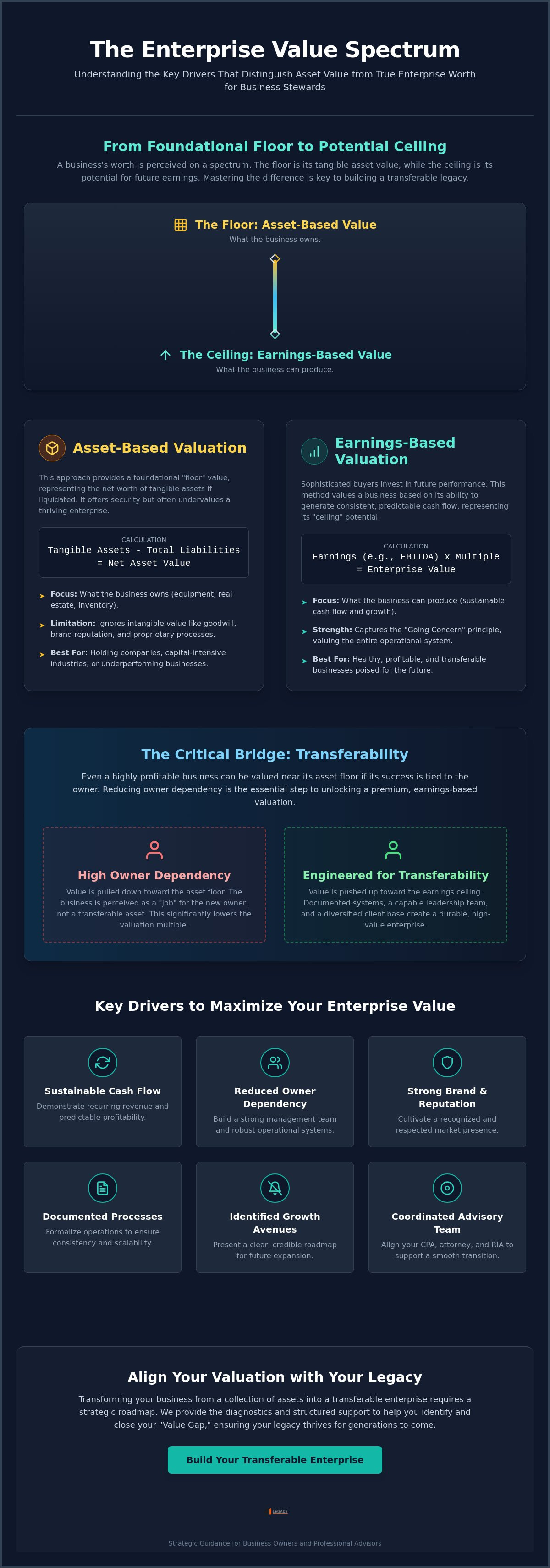
To understand the true worth of a business, one must view it as a spectrum. At one end lies the foundational weight of physical assets; at the other, the ethereal yet potent promise of future cash flows. Most owners view their firms through the lens of what they've built, focusing on the machinery, inventory, and property that fill their balance sheets. While these elements provide a sense of security, they often represent the "floor" of a company’s worth. Before refining your strategy, it’s helpful to define the baseline: What is Enterprise Value? fundamentally? It's the total market value of the business, yet how that value is calculated depends heavily on whether the firm is viewed as a collection of parts or a living, breathing entity.
When we analyze the key drivers of enterprise value, we see that capital-intensive industries, such as manufacturing or distribution, often lean toward asset-heavy frameworks. In these sectors, the sheer replacement cost of specialized equipment acts as a stabilizing force. However, relying solely on an asset-based approach can be a strategic trap. It ignores the "Going Concern" principle, which recognizes that a synchronized, operational business is worth far more than the sum of its liquidated parts. A healthy enterprise doesn't just exist; it performs. It's this performance that shifts the valuation from the floor of the past to the ceiling of the future.
The Asset-Based Floor: Tangible Security
The asset-based approach calculates the Net Asset Value (NAV) by subtracting total liabilities from the fair market value of all tangible assets. This method is essential for holding companies or firms where the primary value is tied to real estate or investment portfolios. It's also the unfortunate reality for underperforming firms that can't generate a return above their liquidation value. The primary limitation here is the absence of "goodwill." An asset-based model fails to capture the brand essence, the proprietary processes, and the historical reputation that you've spent a lifetime cultivating. It treats your legacy as a commodity rather than a unique market force.
The Earnings-Based Ceiling: Monetizing the Future
Sophisticated buyers and strategic investors rarely buy a business for what it owns; they buy it for what it can produce. They view earnings as a proxy for future Return on Investment (ROI). This requires a psychological shift for the owner, moving from a focus on "what we have" to an obsession with "what we can generate." This earnings-based model typically yields the highest key drivers of enterprise value for healthy firms. It transforms the business into a transferable asset, where the value is found in the reliability and growth of future cash flows. By focusing on earnings, you aren't just selling a history; you're offering a future that can thrive independently of your daily presence.
The Mechanics of Tangible Value: When Assets Dictate Worth
While the promise of future growth often captures the imagination, the tangible foundation remains the anchor of any serious valuation. For the business owner acting as a meticulous steward, understanding the physical components of the firm is the first step in protecting its heritage. We must distinguish between three distinct measures of worth: Book Value, Replacement Value, and Net Realizable Value. Book Value is often a mere accounting artifact, reflecting historical costs minus accumulated depreciation. In contrast, Replacement Value considers what it would cost to recreate your infrastructure in the current economy; Net Realizable Value represents the sobering reality of what assets would fetch in an orderly liquidation. These technical distinctions are key drivers of enterprise value because they define the risk profile of the firm's physical core.
Specialized machinery and proprietary technology often harbor the danger of "sunk costs." An investment that felt revolutionary a decade ago may now be an anchor of inefficiency. If a buyer views your technology as outdated, the million-dollar investment on your books might actually necessitate a price reduction to account for future capital expenditures. Similarly, heavy depreciation might provide tax benefits today, but it can mask a decaying technical health that sophisticated observers will quickly identify during a transition. True enterprise health requires a balance between maintaining the physical essence of the firm and ensuring its tools remain sharp and relevant.
Book Value vs. Fair Market Value
A standard balance sheet rarely reflects the true market price of an enterprise because it relies on historical data rather than current utility. Professional advisors move beyond these static numbers by utilizing an Adjusted Net Asset Value during their diagnostics. Adjusted NAV is the recalibration of historical costs to current market realities. This process ensures that every piece of equipment, every square foot of real estate, and every dollar of inventory is valued according to its actual contribution to the firm's future. It's a necessary step for any owner seeking a transparent view of their starting point.
Intangible Assets: The Hidden Value Bridge
The most profound value often resides in what cannot be touched. Customer lists, proprietary workflows, and brand reputation are "off-balance sheet" assets that act as the bridge between a collection of parts and a high-performance organization. Through our Enterprise Diagnostics, we uncover these hidden key drivers of enterprise value that are frequently overlooked by traditional accounting. When these intangible assets are properly documented and transferred, they begin to fuel higher earnings multiples, elevating the business from a simple operation to a premium, transferable asset that can thrive independently of its founder.
The Power of Multiples: Why Earnings-Based Valuations Lead the Market
While assets provide a sturdy foundation, earnings provide the momentum that carries a firm into the future. In the sophisticated world of valuation, EBITDA (Earnings Before Interest, Taxes, Depreciation, and Amortization) serves as the universal language. It allows an advisor to strip away the specificities of a founder’s tax strategy or debt structure to reveal the raw, underlying performance of the firm. This metric is more than a calculation; it is a testament to the business’s ability to generate wealth. When we examine the key drivers of enterprise value, we find that the market’s willingness to pay a premium is directly tied to the clarity and sustainability of these earnings.
A multiple is essentially a multiplier of trust. It represents the buyer’s confidence that the cash flows they see today will not only continue but grow tomorrow. This is where the transition from a collection of assets to a transferable enterprise becomes tangible. By focusing on specific levers like recurring revenue and dominant market share, an owner can expand their multiple, effectively turning every dollar of profit into several more dollars of enterprise worth. It's the difference between selling a past achievement and offering a future opportunity.
EBITDA vs. SDE: Choosing the Correct Metric
The choice between Seller’s Discretionary Earnings (SDE) and EBITDA depends on the scale and structure of the firm. SDE is typically utilized for owner-operated businesses where personal perks and salary are intertwined with the bottom line. Institutional-grade enterprises, however, speak in the language of EBITDA. To present a clear narrative to a successor, one must "normalize" these financials. This involves removing one-time expenses or personal expenditures to show the true, repeatable profitability of the organization. Normalized financials remove the fog of individual ownership, allowing a successor to see the firm’s potential with surgical precision.
The Anatomy of a Multiple
Industry growth rates and market attractiveness set the baseline multiple, but the final figure is a dynamic reflection of risk. Perceived instability or high churn creates a "Risk Discount," pulling the valuation downward regardless of the raw earnings. This explains why two firms with identical profit margins often command vastly different prices. When we evaluate the key drivers of enterprise value, we look for the presence of "gravity"-those risks that threaten to ground a firm’s potential-and work to eliminate them through precise engineering and strategic clarity.
The Transferability Factor: Why Earnings Can Revert to Asset Value
Earnings are the lifeblood of valuation, yet they can be remarkably fragile. If the essence of the firm is locked within the mind of its founder, those earnings aren't a transferable asset; they're a personal service. This fragility is one of the most overlooked key drivers of enterprise value. Without transferability, the premium multiples discussed in previous sections dissolve, leaving only the cold weight of physical assets. A buyer doesn't purchase your past success. They purchase the future reliability of the machine you've built.
Imagine owner-dependency as a gravity well. It pulls the aspirational ceiling of an earnings-based valuation back down toward the floor of the asset-based assessment. If the business can't breathe without its creator, it possesses no independent life. Diversification is the necessary antidote. To secure a premium valuation, an organization must reduce its reliance on singular points of failure, such as:
- Customer Concentration: Ensuring no single client accounts for a disproportionate share of revenue.
- Key Employee Dependency: Distributing specialized knowledge across a resilient team.
- Vendor Reliance: Maintaining a robust supply chain that survives individual disruptions.
Owner Dependency: The Silent Value Killer
In many firms, the hub and spoke model prevails. Every decision, relationship, and technical solution flows through the founder. While this offers control, it creates an insurmountable risk for a successor. If the hub is removed, the spokes collapse. Owner dependency is the primary friction to a successful legacy transition. Quantifying this risk is a sobering exercise. If your departure results in a 30% drop in revenue, your enterprise value is effectively tethered to your physical presence rather than the firm's intrinsic worth.
Building a Transferable Asset
The evolution from operator to steward is the hallmark of a legacy-minded leader. Documented systems and procedures aren't mere administrative tasks; they're the blueprints of a transferable asset. They prove that the excellence of the firm is a deliberate design rather than a series of fortunate accidents. By engineering these key drivers of enterprise value, you ensure the firm's essence is preserved in its processes rather than its personalities. To begin this transformation, a comprehensive Exit Readiness Assessment serves as the essential diagnostic tool. It identifies exactly where the founder's shadow still obscures the firm's independent potential.
Strategic Exit Readiness: Aligning Valuation with Your Legacy
The architecture of a successful exit requires more than a simple spreadsheet. It demands a profound alignment between the firm’s current performance and the owner’s ultimate vision for the future. Many owners encounter the "Value Gap," which is the distance between your current enterprise worth and the specific financial threshold required to fund your next chapter without compromise. Identifying this gap early is one of the most critical key drivers of enterprise value because it transforms a vague desire to transition into a precise, goal-oriented strategy. Without this clarity, an owner risks reaching the end of their career only to find the business cannot support the legacy they intended to leave behind.
Achieving this alignment requires a synchronized effort from your entire advisory team. While a CPA focuses on historical compliance and an attorney mitigates legal risk, 41 Legacy serves as the "Quarterback" of the process. We coordinate these specialists alongside your RIA to ensure every tactical decision supports a unified exit strategy. This collaborative approach prevents conflicting advice and ensures that the technical engineering of the business is always moving toward the same horizon. We don't just provide a perspective; we provide a structural harmony that protects the essence of your life’s work.
The Enterprise Diagnostic Process
A sophisticated exit plan doesn't begin with a transaction. It begins with an initial Enterprise Diagnostic. This process moves beyond surface-level data to uncover the industry-specific key drivers of enterprise value that truly move the needle for your firm. We identify where the organization is strong and where it remains fragile, shifting the conversation from theoretical valuation to a project-based implementation of growth strategies. This diagnostic serves as the foundation for a Value Growth Roadmap, a living document that guides the firm’s evolution toward maximum transferability and health.
Monthly Implementation: Protecting Your Life’s Work
The greatest challenge in building a transferable asset is the friction of daily operations. It’s easy for long-term value growth to be sidelined by immediate fires. Our monthly advisory support provides the necessary accountability to ensure the Value Growth Roadmap remains a priority. We work alongside you to reduce owner dependency and strengthen the firm's independent capacity, ensuring the business thrives long after the transition. This steady, unhurried pace of improvement reflects the meticulous nature of high-end craftsmanship. Secure your legacy by scheduling an initial Enterprise Diagnostic with 41 Legacy.
Engineering Your Lasting Impact
The journey toward a premium valuation is an intentional act of stewardship. By harmonizing your foundational assets with a resilient earnings potential, you transcend the limitations of historical cost. Mastering these key drivers of enterprise value ensures that your firm is no longer a burden of personal effort but a masterpiece of independent performance. It requires the courage to document your systems and the wisdom to reduce owner dependency long before the transition begins. When you focus on transferability, you aren't just preparing for an exit; you're ensuring the vitality of your organization's future.
As a national advisory firm led by a Certified Exit Planning Advisor (CEPA), we specialize in the strategic engineering of business health. Our focus remains steadfast on enterprise value growth and the meticulous protection of your heritage. Your firm is a living legacy that deserves a future as robust as its history. Start Your Exit Readiness Assessment with 41 Legacy to begin the transformation of your enterprise today. You have built something of profound significance; we are here to ensure it endures for generations to come.
Frequently Asked Questions
Is business valuation based on assets or earnings better for my company?
An earnings-based valuation is generally superior for healthy, growing firms because it captures the future momentum of your legacy. While an asset-based approach provides a foundational floor, it rarely accounts for the proprietary excellence and market position you've built. Sophisticated buyers view earnings as the primary indicator of future return on investment, making it the preferred metric for transferable enterprises.
How does owner dependency specifically affect a business valuation?
Owner dependency acts as a gravity well that pulls your valuation multiple downward. If the firm's success is tethered to your personal relationships or daily decisions, a buyer will apply a significant risk discount to the price. Reducing this dependency is one of the most vital key drivers of enterprise value because it proves the firm can thrive as an independent, sustainable entity.
What is the difference between EBITDA and SDE in the context of enterprise value?
EBITDA represents the raw earning power of the enterprise, stripped of personal tax strategies and debt structures. SDE, or Seller’s Discretionary Earnings, is more common for smaller firms and includes the owner's salary and personal benefits. Institutional buyers prefer EBITDA because it reflects the firm's inherent health regardless of who sits in the founder's chair, offering a cleaner view of potential ROI.
Can an enterprise be valued on both assets and earnings simultaneously?
Professional diagnostics often utilize a hybrid approach where assets and earnings are considered in tandem. The asset value serves as the foundational security of the firm, while the earnings-based valuation provides the aspirational ceiling. The gap between these two figures is often categorized as "goodwill," which represents the intangible artistry, brand reputation, and systems that make your business a unique market force.
Why does my CPA’s valuation often differ from an M&A professional’s estimate?
A CPA typically focuses on historical accuracy, tax compliance, and book values based on accounting standards. M&A professionals look toward the future, assessing what a strategic buyer will pay based on current market multiples and qualitative risk profiles. These two perspectives represent different altitudes of analysis; one is a record of the past, while the other is a projection of market-driven worth.
How long does it typically take to increase a business’s valuation multiple?
It typically takes 12 to 24 months of disciplined implementation to see a meaningful shift in your valuation multiple. Buyers require a proven track record of performance under new, owner-independent systems to trust the stability of the firm. This duration allows the key drivers of enterprise value to manifest as verifiable trends rather than temporary improvements, providing the evidence needed for a premium price.
What are the most common risks that devalue a business during an exit transition?
The most damaging risks include high customer concentration and the absence of documented workflows. If a single client represents more than 20% of your revenue, the firm’s stability is perceived as fragile. These vulnerabilities, alongside the potential departure of key employees, signal to a successor that the essence of the business is not yet fully transferable, leading to a lower offer.
Does having documented SOPs actually increase my company’s eventual sale price?
Documented Standard Operating Procedures (SOPs) are the blueprints of a transferable asset. They transform a collection of individual efforts into a repeatable, scalable machine that functions without your direct supervision. By significantly lowering the perceived risk for a successor, these systems directly support a higher valuation multiple and ensure the firm's essence is preserved through the transition.

Article by
Mike Laskowski
Mike Laskowski is a Business Value Growth Strategist who helps business owners uncover the truths that drive their performance, risk, and readiness. Blending forensic interviewing from a 26‑year federal career with Strategic Capacity analysis and CEPA methodology, he works upstream to reduce owner dependency, increase transferability, and strengthen enterprise value. Mike guides founders through clarity, operational evolution, and transition readiness so their companies become transferable, owner‑independent assets that endure beyond the founder.
Disclaimer
This article is for educational and informational purposes only and does not provide legal, tax, investment, or business brokerage advice. 41 Legacy does not offer M&A brokerage services, legal document drafting, tax preparation, or investment advisory services. Business owners should consult licensed professionals in those disciplines before making decisions related to business transactions, legal matters, tax strategy, or financial planning. All examples are illustrative and may not apply to your specific situation.