
Increasing the Transferable Value of a Business: A Strategic Guide for Owners
What if the most sophisticated component of your enterprise is the one you haven't yet engineered: its ability to flourish in your absence? For many dedicated owners, the business is a living reflection of their own craftsmanship. You likely feel the weight of daily operations and the uncertainty of whether the market truly recognizes the soul you've poured into the machine. We understand that your company is more than a balance sheet; it's a heritage waiting to be solidified. It's frustrating to realize that your personal involvement might actually be the primary obstacle to increasing the transferable value of a business.
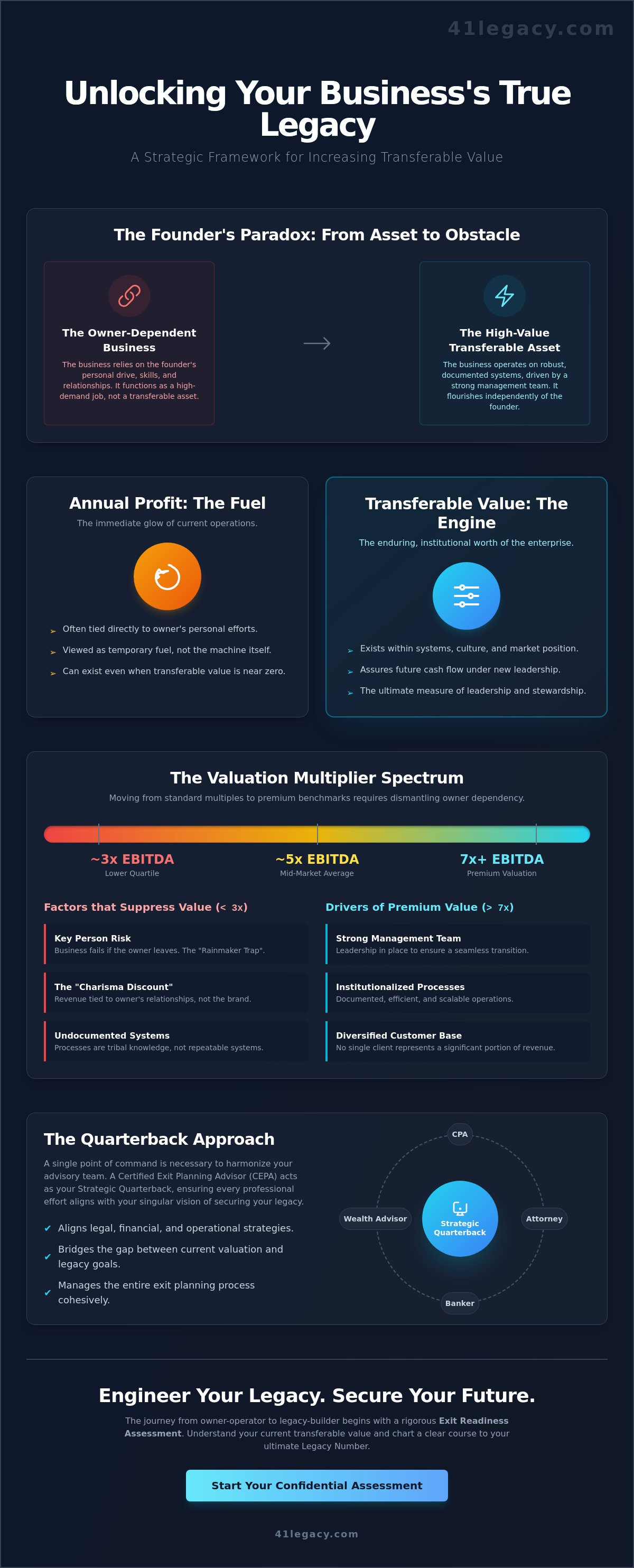
We're here to guide you through an elevated framework designed to transform your operation into a high-value, transferable asset. By the end of this guide, you'll understand how to secure the peace of mind that comes from a documented legacy. We'll examine the strategic shifts required to move beyond standard 3x EBITDA multiples and reach the 7x benchmarks seen in premium 2026 market sectors. This journey begins with an Exit Readiness Assessment, moving toward a future where your business operates with the precision of a masterfully restored engine.
Key Takeaways
- Distinguish between mere annual profit and the enduring institutional value that defines a true marketable asset.
- Recognize how "Key Person Risk" functions as a mechanical flaw; learn to dismantle the "Rainmaker Trap" that limits your enterprise's potential.
- Master the art of increasing the transferable value of a business by implementing uncompromising systems that institutional buyers and private equity groups prioritize.
- Conduct a rigorous Enterprise Diagnostic to bridge the distance between your current valuation and your ultimate Legacy Number.
- Understand the necessity of a Strategic Quarterback to harmonize your advisory team and ensure every professional effort aligns with your singular vision.
Understanding Transferable Value: The Legacy of Independence
Transferable value is the residual essence of an enterprise that remains once the founder exits the daily theatre of operations. It represents the ultimate evolution of a company, moving from a vehicle for personal income to a standalone masterpiece of engineering. While many owners focus on the immediate glow of annual profit, this is merely the current fuel. True institutional value is the engine itself. A Certified Exit Planning Advisor (CEPA) serves as the curatorial expert in this process, quantifying the intangible worth that exists within your systems, culture, and market position. They look beyond the surface to ensure the mechanics of your legacy are sound.
The Distinction Between Profit and Transferable Value
It's a sobering reality that a highly profitable company can possess nearly zero transferable value. If the revenue generation relies solely on your personal relationships or bespoke technical skills, a buyer sees a liability rather than an asset. This phenomenon is known as the "Charisma Discount." When the owner is the primary value driver, the Business valuation can plummet because the risk of failure post-acquisition is too high. Most mid-market businesses trade between 3x and 7x EBITDA; however, those plagued by owner-dependency often struggle to reach even the lower end of that spectrum. Transferable value is the assurance of future cash flow under new leadership. By focusing on increasing the transferable value of a business, you ensure that the craftsmanship you've applied to your work survives your tenure.
Why Transferability is the True Measure of Stewardship
At 41 Legacy, we view a business as a curated asset rather than a mere cash engine. Moving from a "job owner" mindset to a "legacy builder" perspective requires a profound shift in focus. You aren't just managing an operation; you're preserving a soul. Stewardship implies an ethical obligation to your employees and stakeholders to build a sustainable entity that doesn't collapse when you depart. It's about building an uncompromising foundation that honors the history of the brand while preparing it for future evolution. Our Strategic Advisory services help you transition from the daily grind to a high-level vision. increasing the transferable value of a business is the ultimate litmus test of your leadership. It proves that you've built something larger than yourself, a legacy that will endure for decades to come.
Reducing Owner Dependency: Breaking the Rainmaker Trap
The paradox of the founder is a delicate tension. In the early years of an enterprise, your personal drive and charisma are the very spark plugs that ignite growth. You are the master craftsman, the visionary, and the primary engine of progress. However, as the business matures toward a transition, this same strength transforms into a significant liability. When the enterprise cannot function without your presence, it ceases to be a transferable asset and becomes a highly demanding job. For a buyer, "Key Person Risk" is a mechanical flaw that necessitates a lower purchase price; it signals that the engine might seize the moment you hand over the keys. Accomplishing the goal of increasing the transferable value of a business requires you to dismantle this "Rainmaker Trap" and engineer your own obsolescence.
The psychological shift required here is profound. You must move from being the indispensable driver to the architect of a self-sustaining system. This transition often begins with a rigorous Exit Readiness Assessment to identify exactly where your personal involvement creates a bottleneck. By quantifying these dependencies, we can begin the meticulous work of decoupling your identity from the company's daily performance.
The Risk of the Charismatic Founder
Personal brand dependency creates a "valuation ceiling" that sophisticated buyers simply won't cross. If your clients are loyal to you rather than your brand, the risk of attrition post-sale is too high for a premium multiple. Buyers look for stability in the Drivers of Transferable Business Value, prioritizing companies where the sales process is institutionalized. When you lead every sales meeting, you inadvertently tell the market that the company's revenue is fragile. Transitioning that loyalty requires a bespoke approach to client management, ensuring that the excellence they expect is delivered by the organization, not just the individual.
Systematising Knowledge and Relationships
Transforming tacit knowledge into institutional intelligence is an uncompromising requirement for a high-value exit. Most founders carry the blueprints for their success in their heads; this is "knowledge leakage" that devalues the enterprise. You must build a buffer between yourself and the company's critical functions. This involves documenting every meticulous process with the precision of a technical manual. It's not merely about creating a handbook; it's about building an ecosystem where the soul of the business is preserved in its systems. Owner Dependency Reduction is the highest ROI activity you can undertake because it directly expands the pool of potential buyers. If you're ready to see how your business performs under scrutiny, consider beginning with our Enterprise Diagnostics to uncover your hidden value drivers.
Strengthening Value Drivers: The Engineering of Transferability
Designing an enterprise for transition demands the same meticulous reverence as restoring a legendary grand tourer. It's a journey from the friction of founder-led chaos toward the fluidity of uncompromising precision. Private equity groups and institutional buyers aren't merely seeking current earnings; they're acquiring the reliability of the mechanism that generates them. This pursuit is the essence of increasing the transferable value of a business. By refining specific value drivers, you transform a standard operation into a bespoke asset that commands a premium in any market environment. You're no longer just selling a company; you're offering a masterfully engineered legacy.
Building a Next-Level Management Team
A business tethered to the founder's daily presence is an engine with a restricted rev limit. You must elevate your team from tactical executioners to strategic stewards who embody the company's core philosophy. Preserving the heritage of the brand requires incentivizing this talent to remain post-transfer through sophisticated stay-bonuses or performance-based equity arrangements. This ensures the intellectual capital remains within the walls of the institution. A professional management team increases a buyer's confidence in future performance by proving the company’s brilliance is a function of its structure rather than its creator. When the leadership layer is robust, the perceived risk of the acquisition drops, allowing for the premium multiples your hard work deserves.
Scalable Systems and Standard Operating Procedures (SOPs)
Documented systems are the technical blueprints of your legacy; they represent the actual product a buyer intends to own. Standard Operating Procedures (SOPs) act as the manual that ensures the "soul" of the operation remains consistent under new ownership. Through Enterprise Diagnostics, we identify the mechanical inefficiencies that prevent your business from running like a well-tuned machine. We focus on Strategic Capacity Evaluation to ensure the entity can scale without your direct oversight. Our approach to Transferability Engineering focuses on turning "how we do things" into a repeatable, high-performance sequence.
In the current 2026 landscape, the market's preference for predictability is undeniable. Software sectors, driven by recurring revenue models, enjoy multiples of 11.41x EV/Revenue, while transactional models in consumer electronics lag at 0.91x. This gap underscores why increasing the transferable value of a business through meticulous system engineering is a non-negotiable step for the serious connoisseur of commerce. Buyers prize the "boring" consistency of a well-documented process over the "exciting" volatility of founder-led heroics. By implementing these uncompromising standards, you ensure that your business is prepared for its next evolution, regardless of who is behind the wheel.
Identifying the Value Gap: From Current Worth to Strategic Potential
The Value Gap represents more than a simple financial discrepancy; it's the distance between your current trajectory and your ultimate Legacy Number. This number is the precise amount of after-tax capital required to fund your next chapter with uncompromising grace. For many owners, the realization that 90% of their total net worth is locked within the illiquid machinery of their business is a moment of profound clarity. This concentration of wealth is a significant risk, especially if the business's current worth falls short of the target needed to sustain your lifestyle. Bridging this chasm is the central objective of increasing the transferable value of a business.
We approach this gap with the same surgical precision used to assess a vintage chassis before restoration. It's not enough to hope for a high valuation; you must engineer it. By utilizing a Value Growth Roadmap, we prioritize high-impact improvements that move the needle on both profitability and structural integrity. This roadmap serves as your strategic compass, ensuring that every hour of implementation support is dedicated to the most vital components of your enterprise.
Enterprise Diagnostics: The Strategic Baseline
Establishing a baseline requires an objective, high-resolution view of your company’s internal health. Enterprise Diagnostics act as the strategic scan that uncovers hidden vulnerabilities before they become deal-breakers. In the current 2026 market, buyers are increasingly meticulous during due diligence, often identifying "red flags" such as customer concentration or undocumented tribal knowledge that can derail a transaction. Our diagnostic process creates a clear, uncompromising view of reality. It allows us to see the business as a sophisticated buyer would, identifying where the mechanics of the operation require refinement to meet the standards of a premium asset.
Bridging the Gap to Your Number
Closing the Value Gap involves a dual-track strategy: expanding the earnings base while simultaneously engineering a higher valuation multiple. While most mid-market businesses trade between 3x and 7x EBITDA, reaching the upper echelon of that range requires Transferability Engineering. You don't just want a bigger business; you want a better one. This means focusing on systemic efficiency so that every dollar of profit is worth more to a potential successor. If you're ready to uncover the true potential of your enterprise, determine your current exit readiness with our diagnostic tools. By focusing on increasing the transferable value of a business today, you ensure your eventual exit is a masterpiece of timing and value.
The Quarterback Approach: Aligning Your Advisory Team for Success
The final evolution of an enterprise is not achieved in isolation. It requires the harmonious coordination of diverse disciplines, much like the assembly of a bespoke engine where every tolerance must be perfect. Too often, business owners receive disjointed advice from siloed professionals. A CPA may focus exclusively on tax mitigation, while an attorney prioritizes risk avoidance, and a financial planner looks only at post-exit liquidity. Without a central vision, these efforts can inadvertently work against each other, stalling the momentum of increasing the transferable value of a business. When advisors pull in different directions, the structural integrity of the exit plan begins to fray.
We believe the owner needs a "Quarterback" to harmonize these distinct voices. This role ensures that every legal, tax, and operational decision aligns with a singular, uncompromising goal: protecting and growing the value of your life's work. At 41 Legacy, our mission is to serve as the guardian of this process, ensuring the soul of your enterprise is preserved through a coordinated strategic effort. We don't replace your trusted advisors; we provide the alignment they need to perform at their highest level.
Coordinating the Professional Advisory Team
We act as the central point of alignment for your existing team of experts. It's vital that tax planning doesn't devalue the enterprise by aggressively reducing the reported earnings that buyers use to calculate valuation multiples. Through our Strategic Advisory services, we maintain the steady, unhurried rhythm of your transition plan. We provide the technical precision required to ensure that your legal structures and financial reporting are not just compliant, but optimized for a high-value transfer. This collaborative model prevents the friction that often occurs when professional silos operate without a shared blueprint, allowing you to focus on the artistry of your leadership.
The Value Growth Roadmap
A vision without execution is merely a dream. Our Value Growth Roadmap transforms theoretical strategy into a structured process of monthly implementation and accountability. We move beyond the high-level concept of increasing the transferable value of a business to the meticulous execution of specific value-building tasks. Each month, we focus on mechanical refinements, from tightening operational systems to enhancing management capacity. This disciplined approach ensures that when the time comes to step away, your business is a high-performance asset ready for its next curator. Begin your journey toward a transferable legacy today.
The Final Stage of Professional Craftsmanship
Your business is a masterpiece of your own creation; yet its ultimate value lies in its ability to flourish in your absence. We've explored how dismantling the Rainmaker Trap and engineering uncompromising systems transforms a personal operation into a high-value asset. By identifying your Value Gap and aligning your advisory team, you move beyond the daily theater of operations toward a documented legacy. This transition is the preservation of the soul you've built into your company.
Increasing the transferable value of a business requires the steady, unhurried hand of a master. Our team provides national strategic advisory expertise led by Certified Exit Planning Advisor (CEPA) leadership. Through our proprietary Enterprise Diagnostics process, we establish a strategic baseline to ensure your company meets the highest standards of the 2026 market. Secure your legacy and grow your enterprise value with 41 Legacy. The road ahead is one of evolution and refinement. We're ready to help you cross the finish line with the same precision you applied to building your brand from day one.
Frequently Asked Questions
How do I calculate the transferable value of my business?
Calculate this by applying a market multiple to your EBITDA and then meticulously deducting for owner-specific dependencies. According to industry standards in early 2026, mid-market businesses trade between 3x and 7x. The transferable portion is the amount a buyer pays for the institutional engine, excluding your personal charisma and relationships. It's the value that remains when you are no longer there to drive the machine.
Can a business be transferable if the owner is still active in sales?
A business remains technically transferable while you lead sales, but it will suffer a significant valuation ceiling. Buyers view owner-led sales as a mechanical flaw that creates "Key Person Risk." To preserve the soul of the enterprise, you must transition these relationships to a bespoke sales system. This ensures the revenue engine continues to rev without your constant hand on the throttle.
What are the most common risks that devalue a business during an exit?
Customer concentration and undocumented tribal knowledge are the primary risks that erode value. If a single client represents more than 15% of your revenue, buyers perceive a fragile foundation. Lack of uncompromising documentation also creates friction during due diligence. Addressing these risks is a vital component of increasing the transferable value of a business and securing a premium multiple.
How long does it typically take to increase a company's transferable value?
Significant evolution typically requires a multi-year horizon, often spanning 24 to 36 months. This timeline allows for the meticulous implementation of a Value Growth Roadmap and the testing of new management structures. It's an unhurried process of refinement. Rushing this transformation often leads to structural weaknesses that sophisticated buyers will quickly identify during their rigorous assessment of your enterprise.
What is the difference between enterprise value and transferable value?
Enterprise value represents the total economic worth of the entity, while transferable value is the portion that persists after your departure. Many founders confuse personal income with institutional worth. If the business's success is tethered to your daily craftsmanship, the enterprise value may be high, but the transferable value remains disappointingly low. Transferability is the true measure of your stewardship.
Why is owner dependency considered a risk by potential buyers?
Buyers view owner dependency as a point of failure in the mechanical integrity of the company. If you are the "Rainmaker," the revenue is perceived as a temporary gift rather than a permanent asset. Institutional buyers prioritize predictability. They seek a self-sustaining machine that operates with uncompromising precision, ensuring their investment isn't lost when the founder finally exits the theatre of operations.
Do I need a Certified Exit Planning Advisor (CEPA) if I already have a CPA?
A CEPA provides the strategic alignment that a traditional CPA often lacks. While your CPA manages the precision of historical tax records, a CEPA acts as the Quarterback for your entire legacy. They focus on increasing the transferable value of a business by harmonizing legal, financial, and operational disciplines. This ensures every professional effort contributes to a singular, high-value exit goal.
How do SOPs specifically impact the sale multiple of a business?
Standard Operating Procedures function as the technical manual for your enterprise, directly pushing your valuation toward the higher 7x EBITDA benchmarks. Buyers pay a premium for "turnkey" operations where the craftsmanship is documented and repeatable. Without these blueprints, the business is viewed as a collection of chaotic tasks. Meticulous SOPs provide the assurance of future performance that institutional investors demand.

Article by
Mike Laskowski
Mike Laskowski is a Business Value Growth Strategist who helps business owners uncover the truths that drive their performance, risk, and readiness. Blending forensic interviewing from a 26‑year federal career with Strategic Capacity analysis and CEPA methodology, he works upstream to reduce owner dependency, increase transferability, and strengthen enterprise value. Mike guides founders through clarity, operational evolution, and transition readiness so their companies become transferable, owner‑independent assets that endure beyond the founder.
Disclaimer
This article is for educational and informational purposes only and does not provide legal, tax, investment, or business brokerage advice. 41 Legacy does not offer M&A brokerage services, legal document drafting, tax preparation, or investment advisory services. Business owners should consult licensed professionals in those disciplines before making decisions related to business transactions, legal matters, tax strategy, or financial planning. All examples are illustrative and may not apply to your specific situation.