
Improving Profit Margins Before Selling: Engineering a Transferable Legacy
What if the true value of your life’s work isn’t found in your top-line revenue, but in the structural integrity that remains when you finally step away from the helm? Many dedicated founders spend decades perfecting their craft only to realize that their financial success is tethered to their daily presence. This reality creates a daunting value gap between the current worth of the enterprise and the resources required for a meaningful next chapter. You likely understand that improving profit margins before selling is a fundamental requirement for a successful exit, yet this pursuit involves far more than simple cost-cutting or aggressive sales targets.
True profitability is the ultimate proof of a business's mechanical health. We believe that a company should be a masterpiece of engineering, capable of sustaining its excellence without the constant intervention of its creator. We’ll show you how to meticulously refine your margins to bridge the value gap and transform your business into a high-value, transferable asset. We’ll examine how a value growth roadmap and enterprise diagnostics provide the strategic clarity needed to build a legacy that thrives independently of your daily oversight.
Key Takeaways
- Understand how consistent margins act as a powerful multiplier by reducing perceived risk for future stewards of your business.
- Prioritize improving profit margins before selling by identifying and sealing operational leaks, such as scope creep and excessive customer concentration.
- Reposition your pricing as a strategic expression of market authority to protect your enterprise from the erosion of commoditization.
- Architect a transferable legacy by reducing owner dependency, ensuring the business maintains its financial performance without your constant oversight.
- Implement a formal Value Growth Roadmap to bridge the value gap through a disciplined, multi-year process of refinement and enterprise diagnostics.
The Multiplier Effect: Why Profit Margins Define Enterprise Value
A business is a living entity with a story to tell, and its financial statements are the transcript of its health. When we evaluate enterprise value, we often look at EBITDA as the foundational metric. However, the true power of an organization lies in how that earnings figure is derived. High profit margins aren't just numbers on a spreadsheet; they're evidence of a business's structural integrity and its ability to thrive without the founder's constant intervention. This is why improving profit margins before selling is the most critical lever a steward can pull to secure their legacy.
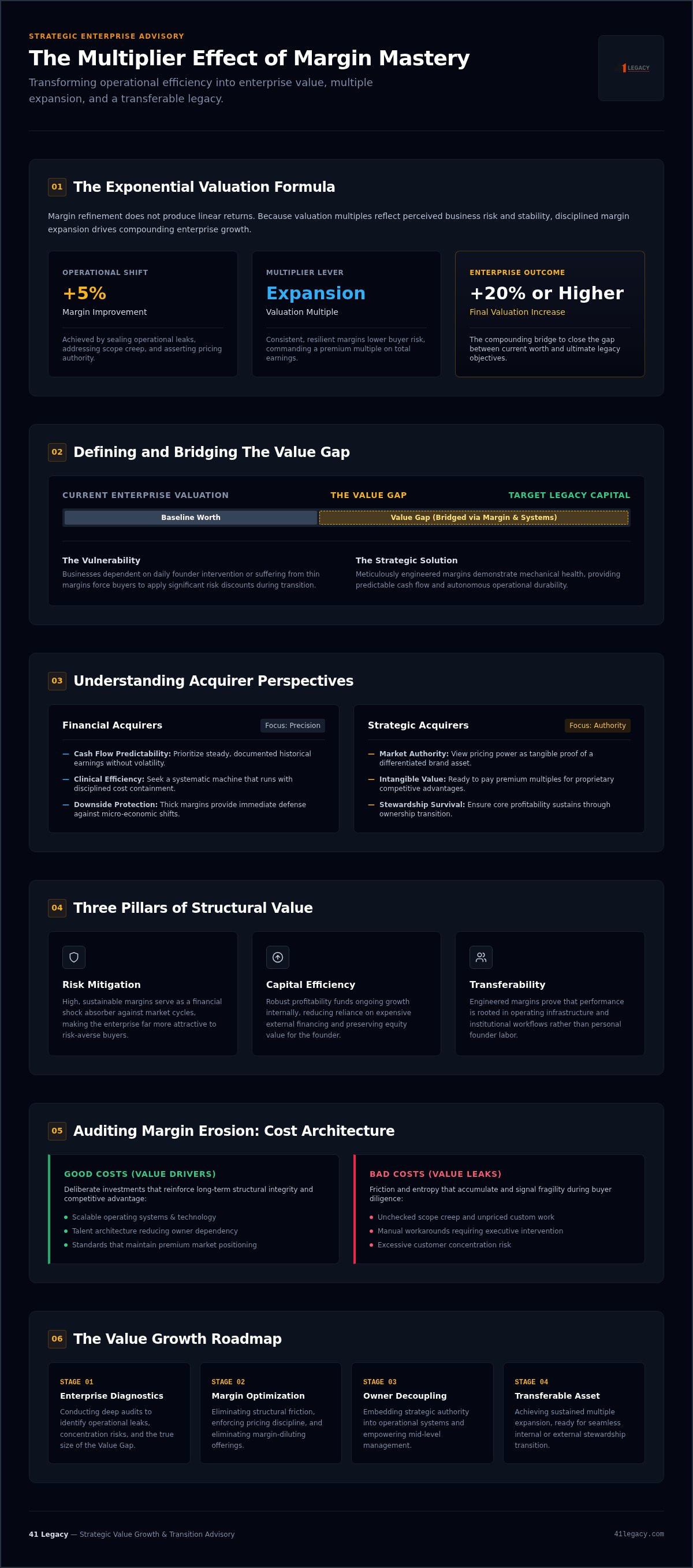
In the context of an exit, the relationship between profitability and value is governed by the valuation multiple. Buyers view margin consistency as a direct proxy for business risk. A company with erratic or thin margins feels fragile, suggesting that any minor market shift could jeopardize its survival. Conversely, thick and stable margins signal a resilient asset that commands a higher multiple. This leads to the concept of multiple expansion, where refining your operations doesn't just increase your earnings; it increases the price a buyer is willing to pay for every dollar of those earnings. We define the Value Gap as the difference between your business's current valuation and the capital required to achieve your ultimate legacy goals.
Understanding the Buyer's Lens on Profitability
Different buyers view your margin profile through different lenses. Financial buyers prioritize cash flow predictability and operational precision. They want to see a machine that functions with clinical efficiency. Strategic buyers look for something deeper. They see your margins as an expression of your brand's market authority and the essence of your competitive advantage. To these guardians, a business that maintains premium pricing proves it possesses an intangible value that's worth a significant premium. They seek to ensure the business's essence is profitable enough to survive the transition and flourish under new stewardship. Sustainable, engineered margins are always more valuable than a temporary spike in profits, as they demonstrate the long-term viability of the enterprise.
The Mathematical Reality of Value Growth
The impact of margin refinement is rarely linear. It's exponential. When you focus on improving profit margins before selling, you're engaging in a form of financial craftsmanship. A modest 5% increase in margin doesn't just add 5% to your bottom line; because of multiple expansion, that efficiency can lead to a 20% or higher increase in the final valuation. Consider these key factors:
- Risk Mitigation: High margins provide a buffer against economic volatility, making the business more attractive to risk-averse buyers.
- Capital Efficiency: Profitable businesses require less external funding to grow, preserving more value for the owner.
- Transferability: Robust margins often indicate that the business's success is built into its systems rather than the owner's personal effort.
By applying precision to your cost structures and pricing strategies, you create a compounding effect on your final valuation. This intersection of engineering and financial performance is where true enterprise value is forged. For a deeper look at how these metrics coalesce, you may find value in our resource on Determining Enterprise Value.
Auditing the Essence: Identifying Margin Erosion and Value Leaks
To the master artisan, a flaw in the foundation is more than a technicality; it's a threat to the entire structure. Improving profit margins before selling requires a curatorial eye that looks beyond the obvious line items on a profit and loss statement. We must distinguish between "Good Costs," which are the deliberate investments that fuel sustainable growth and technical excellence, and "Bad Costs," which represent the friction and entropy that naturally accumulate in an aging enterprise. A sophisticated acquirer doesn't just buy your revenue; they buy your efficiency. Redundant processes or manual workarounds that require your constant oversight are signals of a fragile asset that will be discounted during a transition. Every hour spent managing a bottleneck is an hour of value lost to the ether.
The Hidden Cost of Customer Concentration
There's a seductive danger in the high-margin client who provides a significant portion of your revenue. While the numbers look favorable on paper, a single source of truth is a high-risk asset. If one customer represents a disproportionate share of your earnings, your enterprise multiple is under siege. Diversification is a form of protection, ensuring the business's essence can survive the departure of any single relationship. We help owners evaluate customer quality through the lens of long-term transferability, ensuring that the revenue you build today remains a secure foundation for the next steward. Protecting the multiple means ensuring no single entity holds the keys to your financial health or your legacy.
Operational Friction as a Margin Killer
Operational friction is the silent erosion of your life's work. When a business lacks Standard Operating Procedures, it relies on the tribal knowledge of the founder or a few key individuals. This lack of a blueprint creates hidden labor costs as teams reinvent the wheel with every task, leading to scope creep that quietly eats away at your bottom line. Identifying these leaks is the most direct path to improving profit margins before selling because it cleanses the operation of waste before a buyer ever looks at the books. Our "Quarterback" approach identifies these bottlenecks, allowing you to refine the workflow until only the value-added essence remains. This isn't just about cutting expenses; it's about engineering a machine that runs with the precision of a fine timepiece. Understanding these leaks is the first step in our Enterprise Diagnostics process, where we map out a path to peak performance and lasting impact.
The Art of Pricing and Strategic Capacity
Pricing serves as a definitive declaration of your company's worth and its unique position in the market. It's an expression of what we call sophisticated passion; a commitment to excellence that refuses to be reduced to a mere commodity. When a business falls into the "Commodity Trap," it signals to potential acquirers that its services are easily replicated and its margins are vulnerable to the slightest competitive pressure. To a sophisticated buyer, pricing power is a primary indicator of brand strength and market authority. By improving profit margins before selling through strategic pricing, you demonstrate that your business possesses an essence that customers are willing to pay a premium to preserve.
Transparency and consistency in your pricing models are equally vital. During due diligence, a buyer will meticulously scrutinize how you arrive at your numbers. If your pricing appears arbitrary or varies wildly between clients without a clear logic, it creates a sense of financial instability. We emphasize that clear, documented pricing structures build a bridge of trust. They show that the business's profitability is engineered and repeatable, rather than the result of lucky breaks or founder-led negotiations that can't be easily transferred to a new steward.
Engineering Pricing Power
Moving away from "cost-plus" models is a fundamental step in capturing the true value of your work. Value-based pricing allows you to align your fees with the impact you deliver rather than the hours you record. This shift often reveals unexploited pricing power, a characteristic that buyers find incredibly attractive. They'll often pay a higher multiple for a business where they see immediate room for growth through pricing optimization. By leveraging specialized expertise and exclusivity, you can maintain premium margins that reflect the rare intersection of artistry and technical precision within your organization.
Capacity as a Lever for Profitability
Profitability isn't just about what you charge; it's about how effectively you use your team's energy. A Strategic Capacity Evaluation helps determine if your organization is "over-built" with expensive talent performing low-margin tasks or "under-utilized" in areas that could drive significant growth. Aligning your talent development with your most profitable service lines ensures that every hour of labor contributes to the enterprise's long-term health. This focus on high-margin activities is a core component of How to Increase Enterprise Value. When you refine your capacity, you ensure the business is lean, focused, and ready for a successful transition to its next chapter.
Reducing Owner Dependency to Protect Future Earnings
The "Rainmaker Trap" is a seductive illusion that many founders mistake for success. You may drive sales through sheer force of will, but founder-led revenue often masks unsustainable margins that a buyer will immediately identify as a significant risk. If your company's performance relies on your 60-hour work week, you haven't built a transferable asset; you've built a high-performance cage. A sophisticated acquirer will discount the value of margins that disappear the moment you walk out the door. Improving profit margins before selling requires you to decouple the business's success from your personal labor, ensuring the enterprise's heartbeat continues without your presence.
Transitioning from a "Founder-Centric" model to an "Enterprise-Centric" model is a philosophical evolution. It requires the discipline to move from the center of every decision to the architect of the systems that make those decisions possible. This is the essence of stewardship. When the business thrives independently of its creator, it achieves its highest form of enterprise value. We believe that a business should be a masterpiece of engineering, capable of sustaining its brilliance through the hands of others. This shift is the core of our Value Growth Roadmap, which transforms your daily effort into a durable, transferable legacy.
Transferability Engineering
We view the refinement of your business as a form of transferability engineering. This involves building systems that capture your "Master Artisan" knowledge, ensuring the next generation of leadership can maintain your standards of excellence. It requires a psychological shift. You must move from being the "Hero" of the story to the "Steward" of the asset. Reducing owner dependency is the most profitable investment you can make because it directly impacts the multiple a buyer is willing to pay. A business that runs itself is a rare and precious object in the eyes of a connoisseur of industry.
The Coordinated Advisory Team
Achieving this level of independence isn't a solitary pursuit. 41 Legacy acts as the "Quarterback" for your transition, ensuring your CPA and attorney align with your owner-dependency goals. We work to remove you from the "Critical Path" of daily operations, allowing the business to function as a self-sustaining masterpiece. This structured approach is led by a Certified Exit Planning Advisor who understands the delicate balance between technical precision and artistic legacy. By aligning your entire advisory team, we ensure that every strategic lever pulled is designed to increase the health and transferability of your life's work.
If you are ready to see how your business performs without your constant intervention, our Owner Dependency Reduction diagnostic can provide the strategic clarity you need to move forward.
Engineering Your Legacy: The Value Growth Roadmap
The final chapter of your business ownership shouldn't be a frantic race to a transaction; it should be a deliberate, masterfully executed transition. This process begins with an Enterprise Diagnostic, a rigorous evaluation designed to identify the Value Gap between your current net worth and the capital required for your next act. By improving profit margins before selling, you're not just adjusting numbers on a ledger. You're refining the very essence of your life's work. This transition typically requires a 12 to 36 month timeline, allowing for the deep, structural changes that transform a founder-dependent company into a high-value, transferable asset.
The Diagnostic Process
Our Exit Readiness Assessment serves as the technical blueprint for your transition. It reveals the current health of your margins and identifies the low-hanging fruit where immediate growth can be captured. We look past the surface to evaluate the Market Attractiveness of your firm, ensuring that every operational lever we pull enhances the business's appeal to sophisticated buyers. This level of technical precision is what separates a mere service provider from a true guardian of your legacy. We focus on several critical areas during this evaluation:
- Margin Integrity: We identify areas where operational friction or scope creep is eroding your bottom line.
- Growth Potential: We map out specific paths to increase enterprise value through refined pricing and capacity.
- Risk Mitigation: We strengthen the internal systems that ensure the business thrives independently of your daily presence.
Executing the Roadmap
A roadmap is only as valuable as the discipline used to execute it. Maintaining a professional-room altitude during this phase is essential, as it allows you to stay focused on strategic growth while we handle the intricacies of implementation. We provide the monthly implementation support and accountability needed to bridge the gap between your current reality and your ultimate goals. This structured advisory ensures that the roadmap isn't just a document, but a living process of refinement. You're the steward of a lasting, profitable impact, and our role is to ensure that impact is preserved for the next generation. Begin your journey toward a transferable legacy at 41legacy.com/home.
The Stewardship of Lasting Impact
Your business is far more than a collection of assets; it's a living testament to your dedication and vision. By focusing on improving profit margins before selling, you aren't merely adjusting a financial metric. You're refining the structural integrity of your life's work. We've examined how reducing owner dependency and sealing operational leaks transforms a founder-centric company into a high-value, transferable masterpiece. This meticulous engineering ensures that the essence of your organization remains vibrant long after you've stepped away from the helm.
Navigating this transition requires the calm authority of specialists who respect the heritage you've built. Led by a Certified Exit Planning Advisor (CEPA), we utilize a structured Value Growth Roadmap to bridge the gap between your current worth and your legacy goals. We serve as the quarterback for your professional team, ensuring your CPA and attorney are aligned with a singular vision of perfection. You've spent decades building your enterprise. Now, let's ensure it thrives independently. Secure Your Legacy with an Exit Readiness Assessment and take the first step toward a successful, engineered transition.
Frequently Asked Questions
How long does it typically take to see a significant improvement in profit margins?
Meaningful refinement usually requires a window of 12 to 36 months to manifest fully on your financial statements. This duration allows for the deep, structural changes necessary to ensure improvements are sustainable rather than temporary spikes. We focus on engineering durable efficiency through our Value Growth Roadmap. By starting early, you provide potential buyers with a multi-year history of performance, which significantly enhances the enterprise multiple.
Can I improve my margins without laying off long-term employees?
Improving profit margins before selling is often achieved through operational precision rather than headcount reduction. We prioritize Strategic Capacity Evaluation to ensure your existing talent is focused on high-margin activities. Often, friction arises from redundant processes or scope creep rather than overstaffing. By refining your workflow and reclaiming lost time, you can elevate profitability while preserving the institutional knowledge held by your dedicated team.
What is the 'Value Gap' and how do I know if I have one?
The Value Gap is the difference between the current enterprise value of your business and the capital you need to achieve your post-transition legacy goals. Most owners discover this gap through our Enterprise Diagnostics. If your net worth is heavily concentrated in your company and its current market price doesn't support your desired lifestyle, a gap exists. Identifying this early allows us to engineer a path toward bridging it.
Why does a buyer care about owner dependency if the profits are high?
High profits are secondary to the risk of those profits disappearing once you depart. A buyer views owner dependency as a structural flaw that threatens the future of the asset. If the company's success is tied to your personal relationships or technical skill, it isn't truly transferable. Reducing this dependency ensures the business thrives as an independent entity, which protects the buyer's investment and justifies a premium valuation multiple.
Should I focus on increasing sales or decreasing costs first?
We recommend focusing on margin integrity and cost efficiency before pursuing aggressive sales growth. Improving profit margins before selling on a flawed foundation only amplifies existing inefficiencies. By identifying and sealing value leaks first, every new dollar of sales becomes more profitable. This disciplined approach ensures that your growth is sustainable and that the business's essence is refined to its highest state of performance before you go to market.
How does an Exit Readiness Assessment differ from a standard business valuation?
A standard valuation provides a snapshot of what your business is worth today, but an Exit Readiness Assessment evaluates your company's potential. Our diagnostic explores the qualitative factors that drive value, such as owner dependency and operational friction. While a valuation tells you the price, our assessment provides the technical blueprint needed to improve that price. It's the difference between a simple appraisal and a master artisan's structural survey.
Will improving my margins now increase my tax liability significantly?
Higher profitability naturally impacts taxable income, but the strategic goal is the long-term growth of your enterprise value. We don't provide tax advice, as our focus remains on the structural health of your business. However, as your quarterback, we coordinate closely with your CPA to ensure that your margin refinement strategy is executed with awareness of your overall financial picture. This alignment ensures no detail is overlooked in your stewardship.
How can a strategic advisor help me if I already have a CPA?
A strategic advisor fills the role of a quarterback, coordinating the efforts of your entire professional team. While your CPA manages historical reporting and tax compliance, we focus on the future transferability and engineering of the asset. We provide the monthly implementation support needed to execute your Value Growth Roadmap. This collaborative approach ensures that your financial, legal, and operational goals are unified toward a singular, uncompromising vision of excellence.

Article by
Mike Laskowski
Mike Laskowski is a Business Value Growth Strategist who helps business owners uncover the truths that drive their performance, risk, and readiness. Blending forensic interviewing from a 26‑year federal career with Strategic Capacity analysis and CEPA methodology, he works upstream to reduce owner dependency, increase transferability, and strengthen enterprise value. Mike guides founders through clarity, operational evolution, and transition readiness so their companies become transferable, owner‑independent assets that endure beyond the founder.
Disclaimer
This article is for educational and informational purposes only and does not provide legal, tax, investment, or business brokerage advice. 41 Legacy does not offer M&A brokerage services, legal document drafting, tax preparation, or investment advisory services. Business owners should consult licensed professionals in those disciplines before making decisions related to business transactions, legal matters, tax strategy, or financial planning. All examples are illustrative and may not apply to your specific situation.

