
Transferability & Owner Dependency
Improving Business Processes for Scalability: Engineering a Transferable Legacy
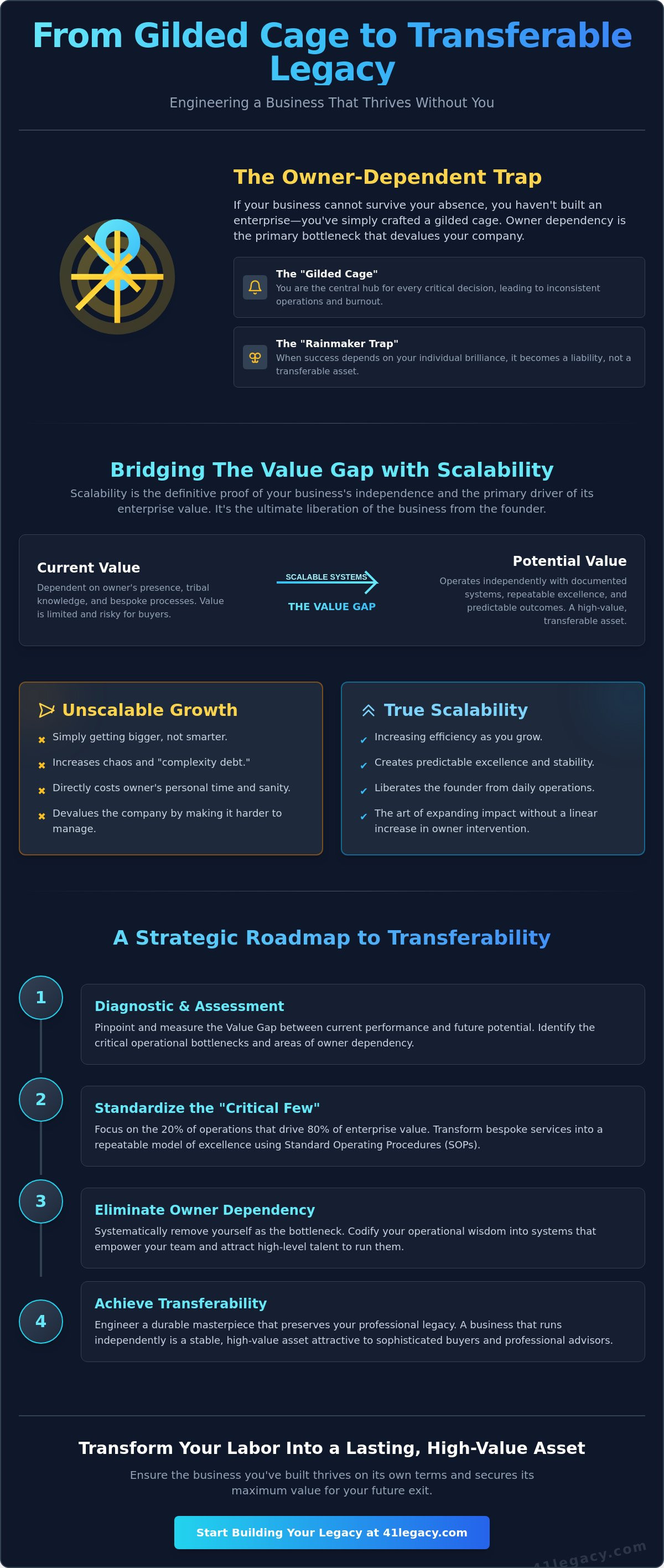
If your business cannot survive your absence, you haven't built an enterprise; you've simply crafted a gilded cage. For many founders, the transition from a hands-on artisan to a strategic steward feels like a loss of control, yet it's the only path toward true permanence. You likely feel the friction as volume increases, watching operations become inconsistent because you remain the primary bottleneck for every critical decision. Improving business processes for scalability is more than an operational necessity. It's a meticulous act of engineering a transferable legacy that preserves its value long after you step away from the helm.
You deserve a company that operates with the same precision and harmony as a restored masterpiece. We'll show you how to transform owner-dependent routines into a scalable, high-value asset built for a successful eventual exit. This guide explores the transition from chaotic growth to predictable excellence, ensuring your business runs independently while attracting high-level talent. By focusing on transferability and strategic clarity, you can turn your daily labor into a lasting, high-value asset that thrives on its own terms.
Key Takeaways
- Understand how scalability serves as the definitive proof of your business's independence and its most significant driver of enterprise value.
- Discover the discipline of operational standardization, transforming bespoke service into a repeatable model of excellence that functions without your constant oversight.
- Learn why eliminating the "Rainmaker Trap" is essential for improving business processes for scalability and securing the interest of professional advisors.
- Identify the strategic phases of a value growth roadmap, starting with a diagnostic to pinpoint and close the gap between current performance and future potential.
- Explore how structured advisory support aligns your entire professional team to engineer a transferable asset that preserves your professional legacy.
Defining Scalability as the Foundation of Enterprise Value
True enterprise value isn't found in the tireless hustle of a founder; it resides in the structural integrity of the organization itself. Many owners mistake a rising revenue line for a healthy business, yet they remain trapped in the gears of daily operations. Scalability is the capacity for an enterprise to expand its impact and revenue without a linear increase in owner intervention. It's the ultimate liberation of the business from the founder’s daily presence. Within the framework of 41 Legacy, we view scalability as the primary driver for closing the Value Gap. This gap represents the distance between what your business is worth today and what it could be worth if it functioned as a high-performance, transferable asset.
During due diligence, sophisticated buyers and investors prioritize scalable processes over historical revenue. They aren't just buying your past successes; they're purchasing the certainty of future performance. Improving business processes for scalability ensures that the excellence you've cultivated isn't a fluke of your personal talent but a repeatable outcome of your design. When a business is built on your individual brilliance, it's a liability. When it's built on engineered systems, it becomes a legacy. Professional advisors look for this structural maturity as the first sign of a high-value enterprise.
The Distinction Between Growth and Scalability
Growth is simply the act of getting bigger, often at the cost of your personal time and sanity. Scalability is the art of increasing operational efficiency so that every new client doesn't require a new layer of chaos. Unscalable growth creates complexity debt, a hidden tax that devalues your company by making it harder to manage as it expands. You must shift your philosophy from being a tireless operator to being a meticulous steward of a transferable asset. This evolution requires a commitment to precision that mirrors the restoration of a classic vehicle; every component must work in harmony to ensure the soul of the machine survives the transition.
The Impact of Systems on Transferability
A business that relies on tribal knowledge is impossible to sell at a premium. If the "how" of your operations exists only in the minds of a few veterans, the risk for a buyer is far too high. Documented systems serve as the instruction manual for a new owner, providing the clarity they need to maintain momentum from day one. Standardized processes reduce the perceived risk for M&A professionals, signaling that the business is a stable, professional entity. By improving business processes for scalability, you provide the evidence that your enterprise is a durable masterpiece rather than a fragile, owner-dependent routine.
The Architecture of Scale: Standardization as a Meticulous Craft
Standardization represents the intentional design of repeatable excellence across every department. It's the silent engine that powers a high-performance enterprise. While many founders fear that systems will stifle their bespoke craftsmanship, the opposite is true. Standardized precision in operations is what creates the space for artistry in service. Documentation serves as the soul of a scalable enterprise, capturing the nuance and wisdom that otherwise evaporates when a founder leaves the room. Precision is not optional. Without this record, your business's identity is fragile, tethered entirely to your personal presence.
Strategic owners focus their energy on the "Critical Few" processes. You don't need to document every minor task to the same level of granularity. Instead, you must identify the 20% of operations that drive 80% of your enterprise value. By prioritizing these core functions, you ensure that the most vital parts of your legacy are protected and transferable. Improving business processes for scalability starts with this diagnostic mindset, treating your operations like a complex engine where every component must be tuned for maximum output and reliability.
The Role of Standard Operating Procedures (SOPs)
SOPs shouldn't be viewed as static lists or bureaucratic burdens. Instead, they are the codified wisdom of your organization. Building a Transferable Business: The Role of SOPs involves moving beyond manuals that gather dust on a shelf. Modern scalability requires living, breathing digital workflows that guide your team through complex tasks with surgical precision. These systems ensure that quality remains uncompromising, regardless of who is performing the task. This structural clarity reduces the friction of growth and builds immense confidence in future successors or professional advisors evaluating your firm.
Systematizing the Client Experience
A brand's heritage must survive even when the founder isn't present to defend it. Systematizing the client experience involves Building Scalable Operations that use technology to automate low-value, repetitive tasks. This automation doesn't replace the human element; it preserves your capacity for high-touch, meaningful relationships. Feedback loops are the final piece of this architecture, allowing you to refine your processes based on real-world performance. Improving business processes for scalability is an iterative journey toward perfection. If you're ready to evaluate your current framework, an Enterprise Diagnostic can reveal exactly where your systems need reinforcement.
The Rainmaker Trap: Why Owner Dependency is the Enemy of Scale
The Rainmaker Trap is a seductive snare. It often begins as a source of pride, where the founder's charisma and expertise drive every sale and solve every crisis. However, this individual brilliance is precisely what limits the enterprise's future. When you are the primary driver of sales, strategy, and operations, you haven't built a company; you've built a personal pedestal. A business that cannot function without its owner is a job, not an asset. Professional advisors, such as CPAs and attorneys, recognize owner dependency as a primary "Value Killer." They know that if you walk away, the soul of the business walks with you.
Improving business processes for scalability requires a fundamental shift in how you view your role. You must move from being the engine of the business to being its architect. This involves more than just offloading chores; it requires delegating authority. When you empower others to make decisions based on established systems, you create a resilient leadership team capable of carrying your vision forward. By focusing on improving business processes for scalability, you mitigate the risk that your enterprise will collapse the moment you step back.
Identifying Owner-Dependent Bottlenecks
The most effective way to diagnose this issue is through the "Vacation Test." If your business cannot thrive for 30 days without your direct input, you are the primary bottleneck. Mapping your decision-making flows often reveals that you are an unnecessary gatekeeper for routine choices. This constant need for your approval doesn't just slow down operations; it creates a glass ceiling for talented employees. High-level talent will not stay in an environment where their growth is stifled by a founder who refuses to let go of the reins.
Engineering Transferability Through Delegation
To build a transferable asset, you must transition from "doing" to "quarterbacking" your professional advisory team. This means setting the strategic direction and then stepping back to allow mid-level management to own the results. By providing clear KPIs and defined process ownership, you give your team the tools to succeed independently. This is where you Create Scalable SOPs that act as the guardrails for your staff. Reducing "Key Person Risk" is the most significant step toward attracting a successor. If you're ready to begin this evolution, our Owner Dependency Reduction strategies provide the roadmap for a clean transition.
A Strategic Roadmap for Process Improvement and Operational Excellence
Improving business processes for scalability isn't a project you finish in a weekend. It's a disciplined evolution that requires a structured, phased approach rather than a collection of quick fixes. To begin this journey, you must first understand your starting point. An initial Enterprise Diagnostic serves as the foundation, allowing us to identify the "Value Gap" between your current operations and a truly transferable asset. By aligning these process improvements with your long-term exit goals, you ensure every operational change serves the ultimate purpose of increasing enterprise value. Monthly implementation support ensures these strategic plans don't become shelf-ware; they become the heartbeat of your organization.
Phase 1: Diagnostic and Discovery
A thorough assessment of your current operational health is the first step toward permanence. We look for "Red Flags" that decrease market attractiveness, such as high customer concentration or a lack of documented workflows. Identifying these risks early allows us to address them before they compromise a future transition. By setting a baseline valuation today, you can measure your growth not just in revenue, but in the tangible increase of your company's worth as a standalone entity.
Phase 2: The Value Growth Roadmap
Once the diagnostic is complete, we prioritize process improvements that offer the highest ROI on enterprise value. This isn't about changing everything at once. Instead, we develop a timeline for Transferability Engineering that typically spans 12 to 36 months. During this period, we coordinate with your existing team of professional advisors, including your CPA and attorney. This ensures that every operational shift aligns with your broader tax and legal structures, creating a seamless path toward your eventual exit.
Phase 3: Implementation and Accountability
Strategic plans often fail because they lack a "Quarterback" to keep the team focused on the roadmap. Our advisory model provides the necessary oversight to ensure that systems are implemented and iterated as the business reaches new milestones of scale. We measure progress through Value Drivers; specific metrics that prove the business is becoming more efficient and less dependent on your personal input. If you're ready to identify the hidden obstacles in your operations, our Enterprise Diagnostic provides the clarity needed to begin your transformation.
41 Legacy: Strengthening Transferability Through Strategic Process Alignment
At 41 Legacy, we serve as the guardian of your business's future value, ensuring that the soul of your enterprise survives the eventual transition. We hold a profound reverence for the legacy you've built through decades of dedicated craft and uncompromising standards. Our role is to ensure that this masterpiece isn't lost to the friction of a poorly planned exit. Improving business processes for scalability is the mechanical foundation upon which this preservation is built. We believe a business should be built to last, but it must also be built to leave.
We operate using a "Quarterback" model, aligning your existing professional team toward a single, unified exit goal. This collective includes your CPA, attorney, and other key advisors who must work in harmony to protect your interests. Without this central coordination, strategic advice often becomes fragmented or contradictory. By providing high-level strategic guidance, we ensure that every operational adjustment increases your enterprise value while respecting the complex legal and tax frameworks surrounding your business. It's about creating a narrative of excellence that professional advisors and potential successors can recognize instantly.
The Exit Readiness Assessment
The first step toward true scalability is understanding exactly where your business stands today. Learn more about our Exit Readiness Assessment, which serves as the definitive diagnostic for your firm's structural health. This process goes far beyond generic business consulting; it's a specialized discipline rooted in the principles of Certified Exit Planning (CEPA). We move past surface-level symptoms to address the core mechanics of your organization. By improving business processes for scalability at this foundational level, we reveal the precise adjustments needed to make your business a high-value, transferable asset.
Protecting Your Life’s Work
The ultimate goal of our partnership is to ensure your business can thrive independently of your daily presence. This isn't just about efficiency. It's about the profound peace of mind that comes from knowing your asset is "Exit Ready" at any time, regardless of when you choose to step away. Whether you transition in three years or thirteen, your enterprise should be a finished work of art, capable of performing without your constant intervention. Improving business processes for scalability is the final act of stewardship, transforming your life’s work into a lasting, transferable legacy. Schedule your Enterprise Diagnostic with 41 Legacy today.
Engineering the Future of Your Enterprise
The evolution from a founder-led operation to a self-sustaining enterprise is the ultimate act of stewardship. You've recognized how owner dependency chokes potential and how meticulous standardization preserves the soul of your work. Improving business processes for scalability is the discipline that transforms daily effort into a durable masterpiece. It's the essential difference between a business that fades with its founder and one that thrives as a transferable legacy for future generations. Precision in your operations today ensures the permanence of your vision tomorrow.
True readiness requires more than intent; it demands a structured, diagnostic approach. Our team utilizes Certified Exit Planning Advisor (CEPA) expertise to help you identify the Value Gap and bridge it through a comprehensive Value Growth Roadmap. By starting with thorough Enterprise Diagnostics, we ensure every operational gear is tuned for maximum transferability and long-term health. Begin your journey toward a transferable legacy with an Exit Readiness Assessment. You've spent years building your heritage with uncompromising care. Now, let's ensure it's engineered to endure.
Frequently Asked Questions
What is the difference between growth and scalability in a business?
Growth is simply an increase in top-line revenue, while scalability is the ability to handle that increased volume without a linear rise in costs or owner effort. Many businesses grow themselves into bankruptcy by adding complexity they can't manage. Scalability focuses on improving business processes for scalability to ensure that every new dollar of revenue is more profitable than the last. It's about building a machine that runs faster without breaking.
How do I know if my business is too dependent on me?
You can determine your level of dependency by applying the "Vacation Test": could you leave for 30 days without your phone ringing? If your presence is required for routine decisions or sales closures, your business is a job rather than an asset. Professional advisors look for this dependency as a primary risk factor. High dependency usually results in a lower valuation because the business cannot demonstrate it'll survive a transition.
How long does it take to implement scalable business processes?
Engineering a truly transferable asset typically requires a phased approach over 12 to 36 months. This timeline allows for the deep work of documenting systems, training leadership, and testing the business's independence. It isn't a quick fix but a meticulous restoration of your operational framework. The duration depends on your current level of documentation and the complexity of your team's decision-making hierarchy and overall operational maturity.
Why do professional advisors like CPAs care about my business processes?
CPAs and other professional advisors care about your processes because they directly impact the risk profile and valuation of the enterprise. Clean, documented systems make financial audits smoother and demonstrate that revenue is repeatable rather than accidental. When processes are standardized, it's easier to verify the health of the company. This structural clarity gives advisors the confidence to support your long-term exit strategy and value growth goals.
Can a service-based business really be scaled and standardized?
Service-based businesses can absolutely be standardized by focusing on the delivery process rather than the individual talent. While the final output might be bespoke, the steps to reach that output should be uniform. Standardizing the client journey ensures a consistent experience that doesn't rely on your personal touch. This allows you to scale the brand's reputation instead of just your individual hours, making the firm much more attractive to successors.
What is an Exit Readiness Assessment and why do I need one now?
An Exit Readiness Assessment is a comprehensive diagnostic that evaluates your business's structural health and market attractiveness. You need one now to identify the "Value Gap" while you still have the time to close it. This assessment provides a baseline for your Value Growth Roadmap. It ensures that when you're ready to step away, the business is prepared to thrive without you, protecting your life's work from avoidable risks.
How do documented SOPs actually increase my company’s sale price?
Documented SOPs increase your company's value by reducing the perceived risk for a successor. They act as an instruction manual, proving that the business's success is a result of engineered systems rather than tribal knowledge. Buyers pay a premium for certainty. When you demonstrate that improving business processes for scalability is a core part of your culture, you're selling a predictable future rather than a chaotic and owner-dependent past.
What role does a "Quarterback" advisor play in the scaling process?
A "Quarterback" advisor coordinates your entire professional team, including your attorney, CPA, and financial planners, toward a singular goal. This role ensures that strategic advice isn't siloed or contradictory. By maintaining a high-level view of your roadmap, the Quarterback keeps everyone focused on increasing transferability. This structured support prevents strategic plans from stalling and ensures consistent progress toward a successful transition that preserves your professional legacy.
Disclaimer
This article is for educational and informational purposes only and does not provide legal, tax, investment, or business brokerage advice. 41 Legacy does not offer M&A brokerage services, legal document drafting, tax preparation, or investment advisory services. Business owners should consult licensed professionals in those disciplines before making decisions related to business transactions, legal matters, tax strategy, or financial planning. All examples are illustrative and may not apply to your specific situation.