
Transferability & Owner Dependency
Identifying Business Value Drivers: Engineering the Transferable Asset
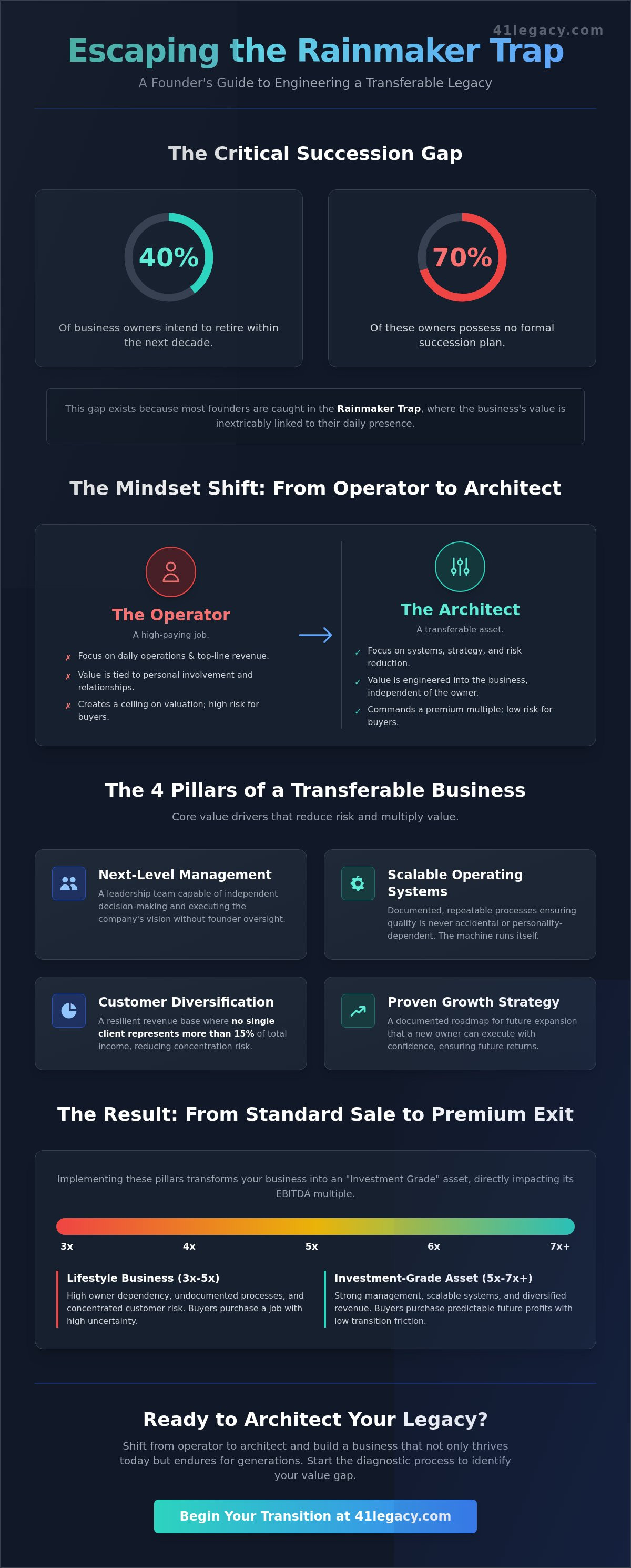
Recent data from May 2026 reveals that while 40% of business owners intend to retire within the next decade, a staggering 70% possess no formal succession plan. This gap exists because most founders remain caught in the Rainmaker Trap. In this state, the enterprise's soul is inextricably linked to the owner's daily presence. True legacy isn't found in a spreadsheet; it's engineered through the deliberate process of identifying business value drivers that function independently of the founder. You've likely felt the weight of knowing your company's performance relies on your personal involvement, creating a ceiling on what a buyer is willing to pay.
We believe your business is more than a source of income; it's a masterpiece of your own creation. To ensure this work survives your departure, you must shift from being the operator to the architect of a transferable asset. You'll discover how to meticulously engineer the internal factors that transform a dependent operation into a high-value legacy. We'll examine the strategic roadmap required to reduce risk, lower owner dependency, and bridge the distance between your current enterprise value and your desired exit objectives.
Key Takeaways
- Shift your focus from vanity metrics like top-line revenue to the internal risk-reduction factors that actually command a premium valuation multiple.
- Master the meticulous process of identifying business value drivers to engineer an organization that thrives independently of your daily oversight.
- Uncover the hidden vulnerabilities within the "Rainmaker Trap" and learn how to sever the invisible threads that tie the enterprise’s survival to the founder.
- Utilize enterprise diagnostics to calculate your specific value gap and prioritize the high-impact structural changes needed for a successful transition.
- Establish a structured implementation roadmap that coordinates your advisory team toward the singular goal of preserving your professional legacy.
Beyond the Balance Sheet: Defining True Enterprise Value Drivers
Profitability is a baseline; transferability is the prize. When identifying business value drivers, we must look past the surface of the general ledger to the structural integrity beneath. A business that generates $5 million in revenue but requires the owner's 80-hour work week is not an asset; it's a high-paying job. True value drivers are the internal characteristics that increase a company’s multiple by reducing risk and ensuring long-term sustainability. They are the difference between a machine that runs because of you and a machine that runs for you.
Understanding What is Business Value requires a shift in perspective from the economic to the operational. Revenue alone is a vanity metric in the context of an exit because it fails to account for the cost of replacement. If a buyer cannot replicate your results without your specific personality or relationships, the value evaporates the moment you hand over the keys. Building a transferable asset means creating a soul for the enterprise that exists independently of its founder.
A value driver is a lever that increases the probability of a successful future transfer.
The Interplay of Financial and Operational Drivers
Operational excellence acts as a force multiplier for your financial results. While a standard 3x to 5x EBITDA multiple is common for businesses under $1 million in earnings, those with documented, repeatable systems often command the higher end of that range. Moving from a lifestyle business to an enterprise-level asset requires treating your internal processes with the same reverence a master craftsman gives to his tools. Intangible assets, such as brand reputation and proprietary workflows, provide the sustainability buyers crave. They don't just want your past profits; they want the certainty of future ones.
The Buyer’s Lens: Identifying Risk vs. Opportunity
Sophisticated buyers don't just buy profits; they buy the absence of risk. They seek "Investment Grade" private companies that offer predictable outcomes and seamless transitions. Red flags, such as high customer concentration or a lack of middle management, act as immediate devaluations regardless of your current margin. Identifying business value drivers through the buyer's lens reveals that predictability is the ultimate premium. When you reduce the friction of transition, you increase the certainty of the legacy you've built. This meticulous approach to risk reduction is what separates a common sale from an extraordinary exit.
The Pillars of Transferability: Core Value Drivers Every Owner Must Master
A business is a complex mechanism. Like a vintage engine, its beauty lies in the harmony of its components. Identifying business value drivers requires us to look at the structural pillars that support the entire enterprise. These aren't just checkboxes; they're the foundational elements that ensure the business can survive the transition from one steward to the next. Without these pillars, the enterprise remains fragile, dependent on the individual rather than the institution.
Success in this arena demands more than just a profitable year. It requires a commitment to building a self-sustaining entity. Buyers in the 2026 market, where global M&A activity exceeded $1.2 trillion in Q1 alone, are increasingly discerning. They seek assets that demonstrate resilience through diversified revenue and institutionalized knowledge. To command a premium multiple, which typically ranges from 3x to 7x EBITDA for mid-market firms, you must master the specific pillars of transferability that mitigate risk and promise future growth.
- Next-Level Management: A leadership team capable of independent decision-making and vision execution.
- Scalable Operating Systems: Codified processes that ensure quality is never accidental or personality-dependent.
- Customer Diversification: A revenue base where no single client represents more than 15% of total income.
- Proven Growth Strategy: A documented roadmap for future expansion that a buyer can execute with confidence.
Next-Level Management and Culture
The transition from a founder-led company to a management-led enterprise is a profound evolution. Many owners struggle to distinguish between "doers" who follow instructions and "strategic leaders" who own outcomes. A buyer pays for the team that stays, not the founder who leaves. When you invest in owner dependency reduction, you're essentially installing a new navigational system. This depth of leadership directly impacts the transferability multiple, as it removes the single greatest point of failure: the owner's daily involvement.
Scalable Systems and Meticulous SOPs
Precision is the hallmark of a high-value asset. Every critical process, from lead generation to final delivery, must be meticulously documented in Standard Operating Procedures (SOPs). This codification ensures that "the way we do things here" is a repeatable science rather than a localized art form. Technology and integrated information services act as force multipliers, embedding your expertise into the software and workflows of the company. Documented processes build buyer confidence by proving that the company's soul is preserved within its systems, not just its people. This meticulous attention to detail transforms a chaotic operation into an investment-grade asset.
The Owner Dependency Trap: Reducing Risk to Multiply Multiple
The most beautiful machine is one that operates with silent, autonomous precision. For many founders, however, the enterprise is held together by invisible threads of personal involvement and specialized knowledge. Identifying business value drivers requires a cold, objective assessment of how much the company relies on your presence to function. If you're the primary "Rainmaker," responsible for closing every major deal or maintaining every key relationship, you haven't built an asset. You've built a cage. A buyer will view this dependency as a catastrophic risk, knowing that the moment you depart, the revenue likely follows.
Owner-dependency reduction is the ultimate act of business stewardship. It's the process of transferring the "soul" of the company from the individual to the institution. A simple but profound diagnostic is the "Vacation Test." If you cannot leave your business for 30 days without a single phone call, your enterprise is not yet transferable. Data from May 2026 indicates that 70% of small business owners have no formal succession plan, often because they haven't yet engineered themselves out of the daily workflow. By identifying business value drivers that exist outside of your personal efforts, you begin the work of building a truly independent asset.
Strategic Capacity and Delegation
Building a self-sustaining enterprise requires evaluating the "Strategic Capacity" of your leadership team. You must move from an owner-led model, where every decision filters through you, to a management-led operation. This transition involves reducing the "Knowledge Gap" through meticulous documentation and cross-training. When your team has the authority and the information to execute the vision independently, the business gains a level of resilience that commands a premium. It's about ensuring the craftsmanship of the organization isn't limited to a single set of hands.
Engineering the Founder’s Exit
Engineering your exit is as much a psychological shift as it is an operational one. You must transition from the role of "Operator" to that of "Asset Manager." Start by identifying the specific tasks only you currently perform and systematically delegating them to your team. This isn't just about clearing your desk; it's about preparing the business for a life beyond your tenure. By meticulously severing the threads of dependency, you ensure that the legacy you've built continues to thrive long after your final day. This commitment to owner dependency reduction is what transforms a successful career into a lasting legacy.
The Diagnostic Framework: Identifying Your Specific Value Gap
Engineering a legacy requires more than intuition; it demands a surgical level of assessment. Identifying business value drivers is a hollow exercise without a framework to measure their current performance against their potential. This is where we move from theory to the drafting table. Through a process of Enterprise Diagnostics, we uncover the specific structural weaknesses that suppress your current multiple. It's about seeing the enterprise not as it appears, but as it operates under the stress of a potential transition.
The "Value Gap" represents the distance between your current market valuation and the net proceeds required to fund your next chapter. For many, this gap is the result of unaddressed risks or underperforming drivers. If your goal is to transition your wealth into a $15 million estate tax-exempt legacy, as per the 2026 federal guidelines, but your current enterprise value sits at $8 million, you have a $7 million gap to engineer. Identifying these drivers allows us to create a targeted Value Growth Roadmap, ensuring every hour of implementation support is spent on the levers that move the needle most. Learn more about our Enterprise Diagnostics.
Quantitative vs. Qualitative Assessment
True clarity comes from a dual-lens approach. We use quantitative data to benchmark your performance against industry standards, such as the median public SaaS EV/Revenue multiple of 3.3x recorded in March 2026. However, numbers only tell half the story. Qualitative assessments, including interviews with key staff, reveal the operational friction that data often hides. This combination allows us to identify where your transferability multiple is being held back by culture or process inefficiencies. It's the difference between looking at a car's exterior and inspecting the timing of its valves.
Prioritizing Drivers for Maximum Impact
You cannot solve every problem simultaneously. We apply a meticulous 80/20 strategy to value growth, focusing on the 20% of drivers that will generate 80% of your valuation increase. This involves distinguishing between "low-hanging fruit," such as cleaning up financial reporting, and long-term structural changes like building a middle-management layer. We align this prioritization with your specific exit timeline to ensure the business is investment grade exactly when you're ready to step away. To begin closing your specific gap, you can request a Strategic Capacity Evaluation to see where your team stands today.
Strategic Stewardship: Implementing a Roadmap for Lasting Legacy
The final stage of engineering a transferable asset is not found in a document, but in the disciplined execution of a vision. While identifying business value drivers provides the necessary blueprint, strategic stewardship ensures the structure is built to withstand the pressures of a transition. Most owners possess a team of capable advisors, yet these professionals often operate in isolation. Your CPA focuses on the historical record, your attorney on immediate risk mitigation, and your wealth advisor on the personal future. Without a central coordinator, these efforts remain disjointed, leaving the owner to bridge the gaps alone. We believe the owner's role is to be the visionary, not the project manager of their own exit.
Building a business that is "ready to be sold" is fundamentally different from merely putting a company "for sale." Readiness implies a state of operational grace where every system is polished and every risk is accounted for. In a market where 55% of sponsor-backed businesses have been held for five years or more, the pressure for private equity to find high-quality, resilient assets is immense. By maintaining a state of constant readiness, you ensure that you are never forced to accept a suboptimal offer. Discover our Strategic Advisory services to learn how we guide this meticulous preparation.
Aligning the Professional Advisory Team
The "Quarterback" role is essential for breaking down the silos between financial, legal, and operational planning. We coordinate your existing professionals to ensure that every move aligns with the singular goal of transferability engineering. This approach prevents the friction that occurs when a tax strategy conflicts with an operational growth plan. Our coordinated advisory ensures the enterprise’s soul is protected from every angle, allowing you to focus on high-level stewardship rather than administrative minutiae. It's about harmonizing disparate expertise into a singular, uncompromising strategy for the health of the enterprise.
The Continuous Evolution of Value
Value growth is a discipline, not a one-time event. Your Value Growth Roadmap must remain a living document, evolving alongside market shifts such as the 26% year-over-year increase in global M&A activity recorded in Q1 2026. Identifying business value drivers is a recurring necessity as your company scales and the competitive landscape shifts. Through monthly implementation support, we provide the bridge between strategic identification and real-world results. This commitment to continuous refinement ensures that the legacy you've built doesn't just survive the transition of ownership, but flourishes under new stewardship for decades to come.
The Architecture of a Lasting Legacy
The evolution of your business from a personal endeavor into a transferable asset is the ultimate expression of professional stewardship. By identifying business value drivers and meticulously reducing owner dependency, you transform a fragile operation into an investment-grade masterpiece. This transition requires more than a casual glance at the balance sheet; it demands a surgical commitment to structural excellence and the deliberate elimination of the Rainmaker Trap.
We're dedicated to helping you navigate this evolution with the precision of a master craftsman. Led by a Certified Exit Planning Advisor (CEPA), our team provides the strategic clarity needed to bridge the value gap through a structured Value Growth Roadmap. You've spent years building your enterprise. Now, it's time to ensure its soul survives the transition and continues to flourish under new stewardship.
Begin your journey with an Exit Readiness Assessment to uncover the hidden potential within your organization and secure the future of your professional legacy. Your greatest work deserves a finish that reflects its true worth.
Frequently Asked Questions
What is a business value driver?
A business value driver is a structural lever that increases the probability of a successful future transfer by mitigating risk. While financial metrics track past performance, these drivers ensure future sustainability. They are the gears that allow the machine to run with precision, independent of the founder's daily efforts. Identifying business value drivers is the first step in moving from a lifestyle business to an investment-grade asset.
How do I identify the value drivers in my specific industry?
Identifying business value drivers in your industry requires benchmarking against current market data, such as the 3.3x EV/Revenue median for SaaS firms in March 2026. You must look for the "intangible assets" that buyers in your specific niche prize most, whether that's recurring revenue models or proprietary technology. Enterprise diagnostics provide the surgical clarity needed to see how your specific operations compare to top-quartile performers in your sector.
Does EBITDA alone determine the value of my business?
EBITDA provides the base, but your multiple determines the final valuation. For small businesses with under $1 million in earnings, multiples typically range from 3x to 5x. The higher end of that range is reserved for companies with strong internal systems and management depth. A business with $1 million in EBITDA and poor systems is worth significantly less than one with the same earnings but high transferability.
How can I reduce owner dependency without losing revenue?
Reducing owner dependency involves transferring your strategic capacity to a management team through meticulous documentation. Start by identifying the specific tasks only you perform and creating SOPs that allow others to execute them with the same craftsmanship. This institutionalization of knowledge prevents revenue loss by ensuring quality remains consistent. It transforms the company from an owner-led operation into a management-led enterprise that thrives on its own.
What is the "Value Gap" in exit planning?
The Value Gap is the financial distance between your current enterprise value and the net proceeds required for your desired lifestyle or legacy goals. If your transition requires $15 million to fund your next chapter but your business is worth $8 million, you have a $7 million gap. Closing this gap requires a structured roadmap focused on increasing your multiple through targeted operational improvements and risk reduction over several years.
Why do I need a coordinated advisory team to increase business value?
Coordinated advisory prevents the friction that occurs when financial, legal, and operational goals aren't aligned. Your CPA and attorney often work in silos, but a "Quarterback" ensures their advice supports the singular objective of transferability engineering. This alignment is critical because 70% of business owners lack a formal succession plan. A unified team ensures your legacy is protected from every angle during the transition.
Can a business have a high revenue but a low EBITDA multiple?
Yes, high revenue often masks structural fragility that leads to a low multiple. If a single client represents more than 15% of your income, or if the owner is the primary salesperson, a buyer will heavily discount the business. These red flags signal high risk, regardless of the top-line figures. True value is found in the resilience of the revenue stream, not just its current size or growth rate.
How long does it typically take to improve a company’s value drivers?
Engineering a significant increase in value typically requires a 12 to 36-month implementation period. This timeline is necessary to document systems, train management, and prove that the business can maintain its performance without the founder. Value growth is a discipline of continuous evolution rather than a one-time event. Starting this process early ensures the asset is investment grade exactly when you are ready to step away.
Disclaimer
This article is for educational and informational purposes only and does not provide legal, tax, investment, or business brokerage advice. 41 Legacy does not offer M&A brokerage services, legal document drafting, tax preparation, or investment advisory services. Business owners should consult licensed professionals in those disciplines before making decisions related to business transactions, legal matters, tax strategy, or financial planning. All examples are illustrative and may not apply to your specific situation.