
How to Transition Leadership to a Family Member: A Strategic Stewardship Guide
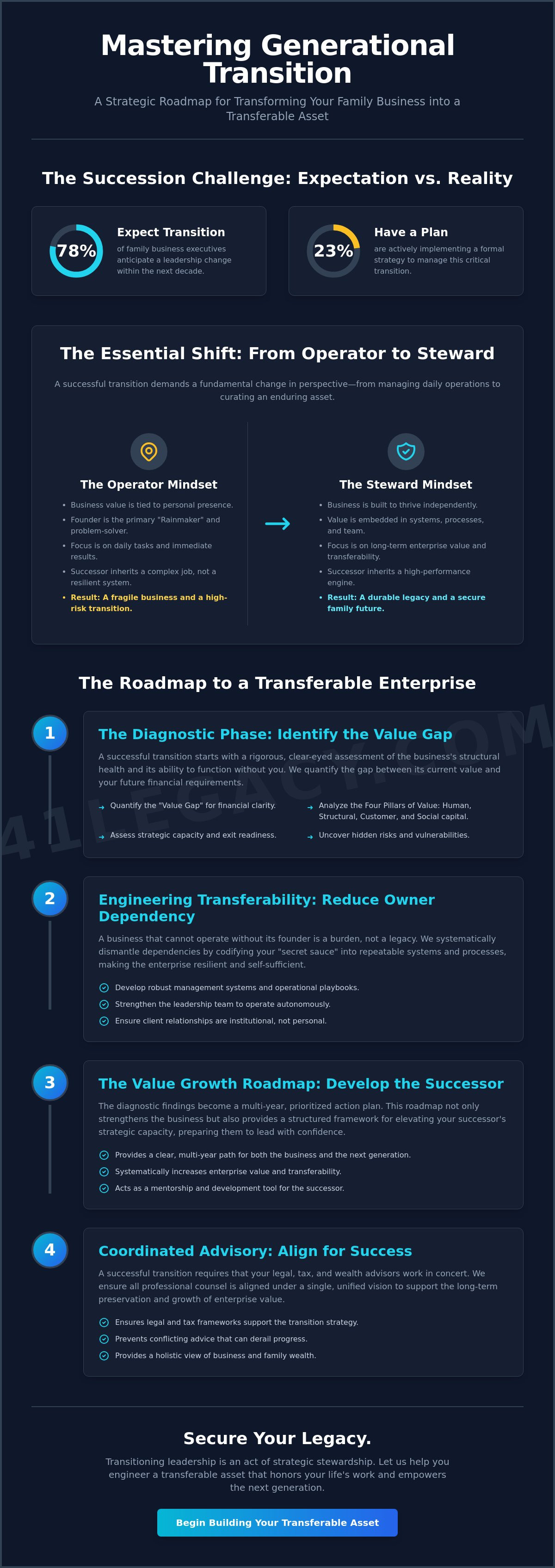
While 78% of family business executives expect a leadership transition within the next decade, a mere 23% are actually implementing a strategy to handle it. You've spent a lifetime refining the essence of your enterprise, yet the weight of daily operations often rests solely on your shoulders. It's natural to worry that your departure might cause the very foundation you built to crumble. Understanding how to transition leadership to a family member requires more than just naming a successor. It demands a fundamental shift from being an operator to becoming a curator of a transferable asset.
We believe your business is a work of art that deserves to endure. You can master the art of generational transition by transforming your company into a resilient entity that thrives beyond your tenure. This guide provides a clear roadmap to reduce owner dependency and preserve your family legacy through precise strategic planning. We'll examine the technical engineering of transferability, the role of Enterprise Diagnostics in valuing your life's work, and the steps required to elevate your successor's strategic capacity for the long term.
Key Takeaways
- Shift your perspective from a transactional exit to an act of strategic stewardship, ensuring the essence of the enterprise remains intact for the next generation.
- Utilize Enterprise Diagnostics to quantify the "Value Gap," ensuring the business’s current valuation aligns with your future financial requirements.
- Learn how to transition leadership to a family member by engineering transferability and systematically reducing the organization's dependency on the founder.
- Establish a structured, multi-year Value Growth Roadmap to provide the successor with the strategic capacity needed to lead the business independently.
- Coordinate your professional advisors under a unified vision to ensure that legal and tax frameworks support the long-term preservation of enterprise value.
Leadership Succession as an Act of Strategic Stewardship
Leadership succession is far more than a change in personnel. It's the intentional transfer of authority, vision, and operational essence to a chosen successor. While many view an exit as a mere transaction, a generational shift is a profound act of stewardship. You aren't just exiting a company; you're preserving a legacy. The business owner acts as a temporary guardian of a permanent asset, ensuring it remains vibrant for the next generation. This mindset is critical when considering how to transition leadership to a family member, as it shifts the focus from your departure to the enterprise's endurance.
Many founders fall into the "Rainmaker Trap," where they remain the primary driver of growth and client relationships. This creates a fragile structure. If the enterprise relies on your personal charisma to generate revenue, its value is tied to your presence. True stewardship requires dismantling this dependency. A business that cannot breathe without its founder isn't a gift; it's a burden for the successor. By engineering the business to operate independently, you protect the enterprise value and the family's future security.
The Philosophy of the Transferable Asset
A business must be "built to sell" even if you never intend to list it on the open market. This discipline forces you to stop working in the daily mechanics and start working on the strategic value of the entity. When you evaluate how to transition leadership to a family member, you must view the company through the lens of an outside investor. Transferability is the ability of an enterprise to thrive under new leadership without loss of momentum. By treating the transition with the same rigor as an external sale, you ensure the family member inherits a high-performance engine rather than a complex restoration project.
Protecting the Essence of the Legacy
Your "secret sauce" shouldn't be a mystery. Codifying your unique approach into repeatable systems allows the essence of your work to persist. This technical precision, combined with a firm commitment to core values, maintains harmony during the hand-off. Managing the emotional weight of a multi-generational heritage requires grace. It's about honoring the history while providing the successor the freedom to navigate the future. When values are clearly defined, they act as a compass, ensuring the business remains true to its origins even as it evolves under new stewardship.
The Diagnostic Phase: Identifying the Value Gap
A successful transition begins with a cold, clear-eyed look at the current state of the enterprise. Before you announce a change in command, a formal Enterprise Diagnostic is essential. This process goes beyond the surface-level metrics of a standard audit. It's a rigorous examination of the organization's structural health and its ability to function without your direct intervention. When you're exploring how to transition leadership to a family member, you must first quantify the Value Gap. This is the difference between the current valuation of the business and the financial requirements of your next chapter. Ignoring this gap is a risk to the legacy you've spent decades building.
A sophisticated buyer doesn't just look at profit; they look at risk. You must evaluate your business through that same lens to find hidden vulnerabilities. Is your revenue tied to a few key clients? Is the knowledge of your "secret sauce" locked in your head? These are the cracks in the foundation that devalue the asset. Assessing the Strategic Capacity of the business determines if the entity can handle the weight of a leadership change. A comprehensive Enterprise Diagnostic serves as the baseline for this transformation, uncovering the precise areas where the business needs reinforcement.
Quantifying Enterprise Value
Standard tax valuations are often insufficient for transition planning because they focus on historical data rather than future potential. To understand the true worth of your life's work, we examine the Four Pillars of value: Human, Structural, Customer, and Social capital. These pillars represent the intangible essence of the company. Human capital measures the talent of your team, while Structural capital evaluates your systems and processes. By identifying these strengths and weaknesses, you gain a clear picture of the organization's exit readiness. This technical precision ensures the successor inherits a resilient, high-value asset.
The Value Growth Roadmap
The diagnostic findings are the raw materials for your Value Growth Roadmap. This document is a prioritized list of strategic improvements designed to maximize transferability. It's not enough to simply hand over the keys. You must set specific benchmarks for the successor to achieve before the full transfer occurs. This roadmap provides the tactical clarity needed when deciding exactly how to transition leadership to a family member without losing enterprise value. This period of growth aligns your personal financial goals with the company's trajectory. It ensures the business is not just surviving but thriving as a transferable asset that can support both your retirement and the successor's future.
Engineering Transferability: Reducing Owner Dependency
Owner dependency is the silent architect of failure in family-owned firms. While many advisors focus on the individual readiness of the successor, they often ignore the structural readiness of the enterprise itself. If the business relies on your daily intuition to function, it isn't a transferable asset. It's a job you've created for yourself. When you analyze how to transition leadership to a family member, you must first engineer the organization to breathe on its own. Transferability Engineering is the process of decoupling the founder's identity from the company's operations, ensuring the machine continues to hum even when the master artisan steps away.
This shift requires a deliberate move from a founder-centric model to a process-driven architecture. Without this, the successor is set up for exhaustion rather than excellence. By building a robust Management Tier, you provide the necessary scaffolding to support the new leader. This tier acts as a buffer, maintaining stability and institutional memory during the delicate period of hand-off. It allows the successor to focus on high-level strategy rather than being consumed by the granular details that once required your personal touch.
Systematizing the Craft
Tribal knowledge is a liability. When the "secret sauce" exists only as an unwritten instinct, it cannot be passed down with precision. Documenting your methodologies through Standard Operating Procedures (SOPs) transforms personal talent into institutionalized excellence. This documentation ensures the brand's quality remains uncompromised by the change in leadership. SOPs are not just instructions, but the blueprints of the legacy. They provide the successor with a proven manual for success, reducing the uncertainty that often leads to family conflict during the transition.
Empowering the Management Team
A family successor shouldn't stand alone. Selecting and developing non-family key employees is a vital step in reducing Key Person Risk. These professionals bridge the gap between generations, providing technical expertise and operational continuity. Incentivizing this talent to stay through the transition period protects the enterprise value from the "brain drain" that often plagues firms during a change in command. By empowering these specialists, you ensure the business thrives as a collective effort. It's about building a team of dedicated specialists united by a singular, uncompromising vision of perfection, which is the ultimate goal when learning how to transition leadership to a family member successfully.
Implementing the Transition Implementation Support
Implementation is the bridge between a strategic vision and a lasting reality. It's a marathon, not a sprint. While many founders attempt a rapid exit, a deliberate window of three to five years is the gold standard for success. This timeframe aligns with current trends, as 42% of family business executives anticipate a transition within this exact period. A hurried departure risks the structural integrity of the enterprise, whereas a measured cadence allows for the technical engineering of transferability to take root. We utilize a "Quarterback" approach to coordinate the efforts of CPAs, attorneys, and family members, ensuring every professional contributor is aligned with the singular goal of preserving enterprise value.
Success in this phase requires a steady, unhurried rhythm of execution. When you're mastering how to transition leadership to a family member, you must also manage the transition of delicate external relationships. Lenders, vendors, and top-tier clients often view the founder as the guarantor of the brand's essence. Transferring these loyalties to the successor is a surgical process that requires time and intentionality. By establishing a monthly implementation rhythm, we ensure that the strategic roadmap remains a living document rather than a neglected file, preventing the "planning fatigue" that often stalls generational shifts.
The Phased Hand-Over
A structured hand-over follows a logical, three-step progression that builds the successor's strategic capacity. Initially, the successor enters the organization as a learner, absorbing the institutional memory and operational nuances. In the second phase, they assume responsibility for a specific department, proving their ability to manage people and outcomes. Finally, they step into the lead strategic role, directing the future of the enterprise. Defining clear "sunset" dates for the founder's involvement is essential to mitigate the "Founder’s Shadow," allowing the new leader to establish their own authority while the founder transitions into a purely advisory capacity.
Accountability and Progress Tracking
Precision in execution is maintained through constant accountability. Monthly implementation support provides the scaffolding needed to measure progress against the established Value Growth Roadmap. We utilize specific Key Performance Indicators (KPIs) to track the successor’s impact on the organization's transferability and overall health. This data-driven approach ensures that the transition is based on merit and performance rather than emotional assumptions. To ensure your enterprise is prepared for this rigorous journey, Learn more about our Value Growth Roadmap and how it serves as the blueprint for your legacy's endurance.
If you're ready to begin the process of securing your business's future, our team is here to provide the Strategic Advisory necessary for a seamless transition.
The Coordinated Advisory Team: Aligning for Success
A generational transition is a masterpiece of complex engineering. It requires the synchronization of disparate professional disciplines into a single, cohesive movement. While your CPA focuses on the technicalities of tax compliance and your attorney manages the intricacies of legal liability, they often operate in silos. This fragmentation is where enterprise value is frequently lost. To truly understand how to transition leadership to a family member, you must introduce a "Quarterback" to the advisory room. This role, often filled by a Certified Exit Planning Advisor (CEPA), ensures that every tactical decision supports the overarching goal of transferability and long-term growth.
This coordination is especially vital in light of recent regulatory shifts that have reshaped the landscape of estate planning. The "One Big Beautiful Bill Act" (OBBBA) of 2025 has established a permanent federal estate tax exemption of $15 million per individual for 2026. While this provides a more stable foundation for planning, the 2024 Supreme Court ruling in Connelly v. United States has fundamentally changed how life insurance proceeds are valued within a business. Without a coordinated advisory team to navigate these nuances, the transition of ownership could trigger unintended tax liabilities that erode the very legacy you've spent a lifetime building. Finalizing the journey requires a seamless shift from leadership hand-off to the eventual transfer of equity, ensuring the successor is prepared for both the authority and the responsibility of ownership.
Aligning Professional Disciplines
There's often a natural tension between tax-minimization and value-maximization. A CPA might suggest aggressive write-offs to reduce current tax exposure; however, these same actions can artificially depress the company's valuation in the eyes of future stakeholders. We ensure the Value Growth Roadmap serves as the guiding document for all advisors, aligning the estate plan with the business transition plan. This alignment prevents the "Succession Paradox," where the acknowledged importance of a plan is undermined by a lack of tactical execution. By harmonizing these efforts, we protect the structural integrity of the enterprise during its most vulnerable phase.
Securing the Future Legacy
A successful transition is the ultimate transformation of a family’s wealth into a lasting impact. It's the moment where the business ceases to be a founder’s project and becomes a multi-generational institution. By engineering a transferable asset today, you set the stage for the next century of influence. This is the essence of stewardship; building something that doesn't just survive your tenure but thrives because of the foundation you laid. To begin this journey with precision and clarity, Begin your Enterprise Diagnostic with 41 Legacy and discover the true potential of your life's work.
The Enduring Legacy of Strategic Stewardship
The preservation of an enterprise's essence requires more than a simple hand-off. It demands the meticulous engineering of a legacy that can stand alone. You've discovered that true enterprise value is rooted in transferability, where institutionalized systems and an empowered management tier replace the founder's daily intuition. By identifying the Value Gap and adhering to a structured roadmap, you ensure the transition is a transformation of wealth rather than a loss of momentum. This curatorial approach protects the harmony of the family while securing the health of the business.
Deciding how to transition leadership to a family member is the most significant strategic endeavor of your career. It's a process that benefits from national expertise in Enterprise Diagnostics and a specialized focus on reducing owner dependency. Led by a Certified Exit Planning Advisor (CEPA), our team acts as the guardian of your history, helping you refine your business into a permanent asset. Secure your legacy with a professional Exit Readiness Assessment. Your life's work is a masterpiece. We're here to ensure it continues to thrive for generations to come.
Frequently Asked Questions
How long does a leadership transition to a family member typically take?
A measured transition typically requires a three to five-year window to ensure the structural integrity of the enterprise remains intact. This timeframe allows for the gradual transfer of authority and the successful implementation of a Value Growth Roadmap. Attempting to accelerate this process often results in operational friction and a significant degradation of enterprise value.
What is the "Rainmaker Trap" in family business succession?
The "Rainmaker Trap" occurs when the founder remains the primary architect of sales and the sole guardian of key client relationships. If the entity's revenue depends on your personal charisma, the business lacks true transferability. Reducing this dependency is a core requirement when learning how to transition leadership to a family member successfully, as it ensures the business can breathe without its founder.
Should I give or sell the business to my family member?
The decision to gift or sell interests depends on your personal financial requirements and the successor's need for professional accountability. With the federal gift tax exemption established at $15 million per individual for 2026, gifting is a powerful tool for many families. However, a structured sale can provide you with necessary liquidity while ensuring the successor has a tangible stake in the company's future performance.
What happens if the family successor is not ready to lead?
If a successor lacks the necessary strategic capacity, we implement a targeted development plan within the Value Growth Roadmap. This process uses objective benchmarks to measure their growth in leadership and operational management. If the gap remains too wide, appointing a professional non-family manager to bridge the generational divide may be the most prudent path to preserving the family legacy.
How do I determine the fair market value of my family business for a transition?
Determining value requires a deep examination of the "Four Pillars" of capital: Human, Structural, Customer, and Social. We use Enterprise Diagnostics to look beyond standard accounting metrics, identifying the intangible assets that a sophisticated buyer would value. This technical precision ensures the transition is based on the actual health of the organization rather than a subjective estimation.
What is the role of a "Quarterback" in the exit planning process?
The "Quarterback" is a strategic advisor who ensures your CPA, attorney, and wealth manager are all working toward a unified vision. Without this coordination, tax-minimization strategies might accidentally conflict with your long-term value growth goals. This role maintains the "professional-room altitude" needed to align these disparate disciplines into a singular, cohesive movement toward a successful transition.
How can I reduce my business’s dependency on me before I retire?
Reducing dependency involves institutionalizing your "secret sauce" through Transferability Engineering. This process requires creating documented Standard Operating Procedures (SOPs) and developing a robust management tier capable of leading without your daily oversight. It's about transforming the business from a founder-led firm into a resilient, transferable asset that thrives independently of your personal involvement.
What is an Exit Readiness Assessment and why do I need one?
An Exit Readiness Assessment is a diagnostic tool that identifies the structural risks and value gaps within your enterprise. It provides a baseline of your current state, allowing us to build a roadmap that strengthens the business's health. You need this assessment to understand how to transition leadership to a family member without compromising the financial security you've spent a lifetime building.

Article by
Mike Laskowski
Mike Laskowski is a Business Value Growth Strategist who helps business owners uncover the truths that drive their performance, risk, and readiness. Blending forensic interviewing from a 26‑year federal career with Strategic Capacity analysis and CEPA methodology, he works upstream to reduce owner dependency, increase transferability, and strengthen enterprise value. Mike guides founders through clarity, operational evolution, and transition readiness so their companies become transferable, owner‑independent assets that endure beyond the founder.
Disclaimer
This article is for educational and informational purposes only and does not provide legal, tax, investment, or business brokerage advice. 41 Legacy does not offer M&A brokerage services, legal document drafting, tax preparation, or investment advisory services. Business owners should consult licensed professionals in those disciplines before making decisions related to business transactions, legal matters, tax strategy, or financial planning. All examples are illustrative and may not apply to your specific situation.