
Your business is more than a sequence of transactions; it is a living testament to your vision and a vessel for your legacy. However, many owners discover too late that they've built a masterpiece that cannot survive their absence. Learning how to sell a small business is not merely about finding a buyer. It's about engineering an entity that thrives independently of its creator. We understand the weight of this transition and the quiet anxiety that stems from high owner-dependency and uncertain enterprise value.
You likely feel a profound responsibility to ensure your work endures while securing the value you've spent years cultivating. We promise to show you how to transform your operation from a founder-centric model into a high-value, transferable asset ready for a sophisticated exit. This guide provides a strategic roadmap to reduce your daily operational burden, align your advisory team, and increase the enterprise value of your stewardship. We'll explore the essential steps to diagnose your current readiness and implement the structural refinements necessary for a successful transition.
Key Takeaways
- Shift your perspective from a one-time transaction to a state of perpetual exit readiness, ensuring your business remains a high-value asset at any moment.
- Learn how to sell a small business by engineering transferability into your operations, successfully reducing owner-dependency through enhanced strategic capacity.
- Identify and bridge the "Value Gap" by utilizing enterprise diagnostics to eliminate common value killers like customer concentration and disorganized financials.
- Follow a structured Value Growth Roadmap that coordinates your entire advisory team under a single vision to preserve your legacy and maximize enterprise value.
Beyond the Transaction: Shifting from "Selling" to "Exit Readiness"
A sale is not a goal to be pursued; it's the natural consequence of a well-engineered enterprise. For many owners, the business is a living testament to their skill, sacrifice, and vision. However, the true mark of a master artisan is the ability to create a work that stands independently of its creator. Understanding how to sell a small business begins with a fundamental shift in perspective. We must move away from the idea of a "transaction" and toward a state of constant Exit Readiness.
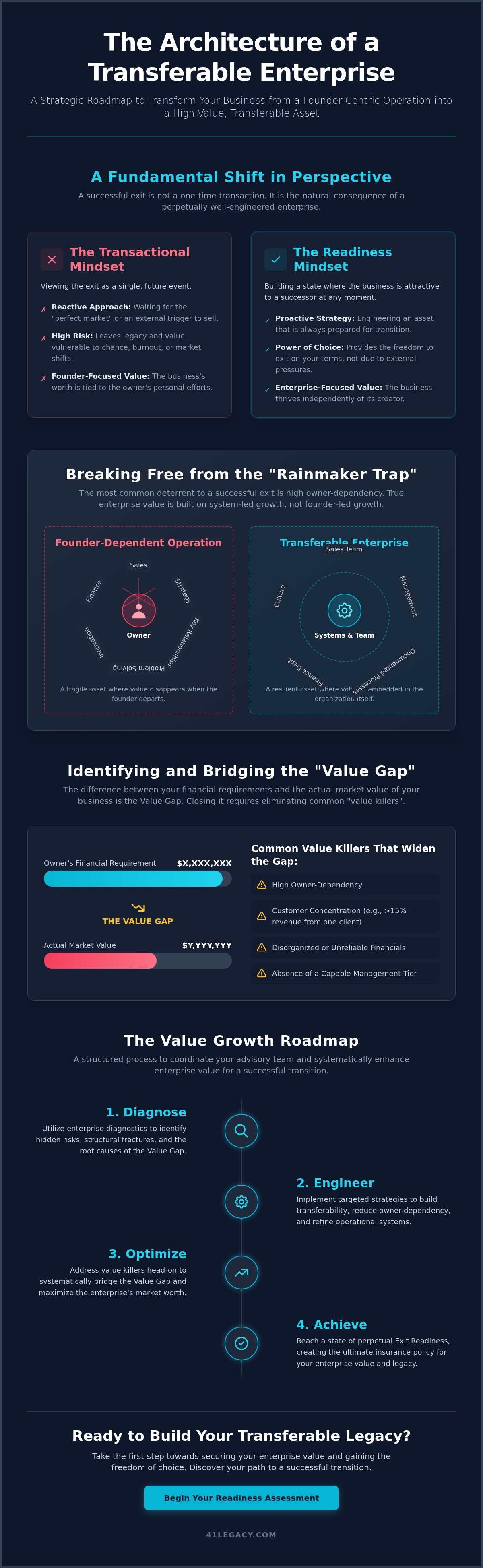
Exit Readiness is the condition where your business is attractive to a buyer at any moment. It signifies that the enterprise is healthy, organized, and capable of thriving without your daily presence. When growth is founder-led, the business is caught in the "Rainmaker Trap." This creates a fragile entity where the value is tied strictly to your personal efforts. By contrast, true Enterprise Value is built on system-led growth. As a steward of your legacy, your role is to refine these systems until the business becomes a high-value, transferable asset.
While a Business Broker may eventually facilitate the introduction to a buyer, the strategic work of preparation happens years earlier. This preparation involves deep Transferability Engineering to ensure the essence of the business remains intact during a transition. It turns the organization into something a successor can confidently lead, preserving the impact you've spent a lifetime building.
The Distinction Between Price and Transferable Value
There's a vital difference between what a business earns and what it's worth to a successor. A high-revenue company can still have zero transferable value if all the critical knowledge and relationships reside in the founder's head. This creates a "Value Gap," which is the distance between your financial requirements for the future and the actual market value of the asset. To bridge this, we focus on three pillars: personal readiness, financial integrity, and business autonomy. Without these, the price you envision may never materialize in reality.
Why Readiness Trumps Market Timing
Owners often wait for the "perfect market" to consider a transition. This is a reactive strategy that leaves your legacy to chance. Readiness is proactive. It provides you with the power of choice, allowing you to exit on your own terms rather than being forced by external circumstances or burnout. Whether you seek an internal succession or an external sale, Exit Readiness serves as the ultimate insurance policy for your enterprise value. It ensures that the asset is always prepared for the progression of time.
The Architecture of Transferability: What Buyers Actually Pay For
A sophisticated buyer is not merely purchasing a ledger of past successes; they are acquiring the certainty of future performance. When you explore how to sell a small business, you must view the enterprise as an architectural masterpiece. The value doesn't reside in the founder's charisma but in the structural integrity of the asset. This essence is composed of three distinct elements: refined systems, a resilient culture, and predictable, repeatable results. A business that breathes on its own is a living entity, capable of sustaining its impact long after the creator has stepped away.
Strategic Capacity is the silent engine of this value. It represents the organization's ability to absorb growth and navigate challenges without the founder's constant touch. Buyers are connoisseurs of stability. They seek an asset where the strategic capacity is high, meaning the business can scale with ease. To reveal the true health of this engine, we utilize Enterprise Diagnostics. This process identifies the hidden risks and structural fractures that devalue a company, allowing for precise engineering before the transition begins. It's a vital step in ensuring the legacy you've built remains untarnished by the friction of change.
Reducing Owner Dependency
The "Rainmaker Trap" is the most common deterrent to a successful exit. If you are the primary source of sales, strategy, and problem-solving, your business is effectively a founder-dependent operation. This dependency creates a fragile asset that loses its essence the moment you depart. Breaking free from this trap is a critical step in learning how to sell a small business for its true enterprise value. You must shift authority from yourself to a capable management tier. This transition requires a deliberate, surgical approach to delegating decision-making power, ensuring the business remains vibrant under new stewardship.
The Role of Systems and SOPs
Standard Operating Procedures (SOPs) are the blueprints of a high-value asset. They are the technical specifications that ensure excellence is not an accident but a standard. Well-documented systems mitigate the risk of talent turnover during a sale. They provide the new owner with a manual for success, reducing the friction of the transition. When your processes are polished to a high sheen, they protect the legacy you've built. We recommend starting with an Exit Readiness Assessment to determine which systems require the most immediate attention to secure your future.
Identifying the Value Gap: Why Most Small Businesses Fail to Sell
The transition from founder to legacy is often complicated by a silent obstacle: the Value Gap. This is the distance between the current market value of your enterprise and the financial proceeds required to fund your next chapter. Discovering that a life's work falls short of this mark can be a heavy emotional burden. It feels like finding a structural flaw in a cherished heirloom. Most owners don't realize that learning how to sell a small business involves identifying these fractures long before a buyer ever looks at the books. Without a proactive approach, this gap remains an invisible barrier to a successful exit.
Several "Value Killers" frequently widen this gap. High customer concentration, where a single client represents a significant portion of revenue, creates a fragile foundation that buyers find unacceptable. Messy or opaque financials suggest a lack of precision that devalues the entire operation. Stagnant growth and technical debt also act as anchors. We bridge this divide through a Value Growth Roadmap, a strategic document designed to systematically increase the worth of the asset while reducing the risks that cause transitions to fail.
The Four Pillars of Value Growth
To elevate an enterprise to its highest potential, we focus on four essential pillars. Human Capital measures the strength and autonomy of your leadership team. Structural Capital involves your proprietary systems and technology, often referred to as IS Services, which ensure the business operates with mechanical excellence. Customer Capital focuses on the diversity and loyalty of your client base, ensuring the revenue stream is a broad river rather than a single thread. Finally, Social Capital represents your brand reputation and the internal culture that keeps the entity vibrant. Together, these pillars form the bedrock of a transferable asset.
De-risking the Enterprise
De-risking is the process of removing the obstacles that cause buyers to walk away during due diligence. Common financial risks, such as inconsistent cash flows or unrecognized liabilities, can destroy a deal in its final stages. Our Strategic Advisory services help you pre-emptively solve these issues, ensuring the business is polished to a high sheen. We define the Value Gap as the primary obstacle to a successful legacy. By addressing these risks today, you ensure the transition is a celebration of your work rather than a compromise of your vision. It's about protecting the essence of what you've built for the generations to follow.
The Strategic Roadmap: Steps to Optimize Your Enterprise for Sale
The journey toward a successful legacy is not a frantic sprint executed in the months preceding a departure. It is a deliberate, multi-year progression that transforms the business from a founder-centric operation into a high-performance asset. While common advice often suggests beginning your preparations a mere six months before an exit, true value growth requires a horizon of three to five years. This extended timeline allows for the deep structural refinements necessary to secure the enterprise's future. Understanding how to sell a small business with precision means embracing a roadmap that prioritizes long-term health over short-term maneuvers.
Central to this process is the "Quarterbacking" of your professional advisory team. Your CPA, attorney, and wealth manager each possess immense technical skill, yet they often operate in silos. A strategic advisor ensures these specialists are united by a singular, uncompromising vision of your legacy. We also utilize Pro Forma statements during this period. These documents are not mere projections; they are the technical blueprints that demonstrate the business's future potential to a successor once owner-dependency has been surgically removed. To maintain this momentum, Monthly Implementation Support provides the steady, unhurried guidance required to ensure every strategic objective is polished to a high sheen.
Phase 1: The Diagnostic and Discovery
The first phase involves a profound deep-dive into the current essence of the organization. Through Enterprise Diagnostics, we establish a baseline valuation and clearly define the Value Gap. This is a period of intense discovery, where we align your personal aspirations with the business's actual capabilities. It is the moment we identify the fractures in the foundation, ensuring that the path forward is built on clarity rather than assumption.
Phase 2: Implementation and Growth
Once the diagnostic is complete, we move into the active execution of your Value Growth Roadmap. This phase is dedicated to Transferability Engineering, where we meticulously document processes and strengthen the management tier. Regular Strategic Advisory sessions ensure that the reduction of owner-dependency remains the central focus. This disciplined approach ensures the business becomes a living entity that can thrive independently, preserving your impact for generations to come. To begin this transformation, we invite you to explore our Strategic Capacity Evaluation to identify the untapped potential within your enterprise.
Coordinating the Legacy: The Role of a Strategic Advisor
The final movement of a masterpiece requires a conductor to ensure every note resonates with perfect clarity. In the complex landscape of transition, a Certified Exit Planning Advisor (CEPA) serves as this essential conductor, or "quarterback," for your professional team. While your CPA, attorney, and wealth manager possess immense technical skill, they often operate in isolated silos. This fragmentation can lead to misaligned goals and structural friction. We provide the strategic oversight necessary to unite these specialists under a single, uncompromising vision of your legacy.
Our role at 41 Legacy is to act as the guardian of your business's essence. We ensure that the transition does not merely move an asset from one hand to another but preserves the soul of the organization you've spent a lifetime building. This collaborative effort is the true secret to how to sell a small business while preserving its impact. By aligning tax strategy, legal protection, and personal wealth goals, we create a harmonious progression that protects both your financial future and your professional history.
The Advisor vs. The Broker
There's a profound distinction between a transactional broker and a strategic value advisor. A broker focuses on the short-term event of a transaction, often prioritizing the deal over the long-term health of the enterprise. In contrast, exit planning is a disciplined, long-term endeavor. We focus on Transferability Engineering and value growth years before a transition occurs. This proactive coordination prevents "deal fatigue," a common exhaustion that sets in when uncoordinated teams struggle with due diligence. We ensure your wealth is protected through a process that is as meticulous as the craftsmanship that built the business itself.
Securing Your Life’s Work
True stewardship means building a transferable asset that can thrive independently of its creator. It's about ensuring your work continues to breathe and grow under new leadership. The first step in this journey is not a search for a buyer, but an internal diagnostic. We invite you to begin this process with an Exit Readiness Assessment. This evaluation provides the clarity needed to identify your Value Gap and begin the work of refinement. Learning how to sell a small business is, ultimately, a journey of preparation. We invite you to schedule a consultation today to discover the true potential of your enterprise and secure the legacy you deserve.
Securing the Future of Your Masterpiece
Your business is the culmination of a life's work, a living entity that deserves to endure. We've explored the necessity of shifting from a transactional mindset to a state of constant exit readiness. By reducing owner-dependency and bridging the value gap, you transform a founder-led operation into a high-value, transferable asset. This process is not a short-term event but a deliberate engineering of excellence that preserves your essence for the next generation.
Determining how to sell a small business is ultimately an act of stewardship, ensuring the enterprise remains vibrant under new leadership. Our team provides the Certified Exit Planning Advisor (CEPA) leadership required to navigate this sophisticated transition. We utilize a structured Value Growth Roadmap and provide the expert "quarterbacking" your existing advisory team needs to remain aligned under one vision.
Begin your journey toward a transferable legacy with 41 Legacy. Your work is a masterpiece; its transition should be handled with the same precision and reverence you used to build it.
Frequently Asked Questions
What is the difference between selling a business and exit planning?
Selling a business is a singular transaction, while exit planning is a comprehensive strategy to engineer a transferable asset. Exit planning focuses on the long-term health and autonomy of the enterprise, ensuring it can thrive independently of its creator. This preparation ensures that when the time comes to transition, the legacy is preserved and the enterprise value is maximized through intentional design.
How long does it typically take to prepare a small business for sale?
A sophisticated transition usually requires a horizon of three to five years to achieve peak transferability. This timeline allows for the surgical reduction of owner-dependency and the implementation of a structured Value Growth Roadmap. Short-term preparations often fail to address the deep structural fractures that devalue an enterprise, leading to compromised results during a transition.
Why is owner-dependency considered a major risk for buyers?
High owner-dependency signals a fragile entity that may collapse once the founder departs. Buyers seek the certainty of future cash flows, which requires a business to breathe independently of its creator. When you explore how to sell a small business, reducing this dependency is the most critical step in protecting the asset's transferable value and ensuring its continued survival.
What are the most common "Value Killers" in a small business?
The most pervasive value killers include high customer concentration, opaque financial records, and a lack of documented processes. These fractures create perceived risk, leading sophisticated buyers to discount the enterprise value significantly. Identifying these issues through Enterprise Diagnostics allows you to repair the foundation and polish the asset to a high sheen before the transition begins.
Can I sell my business if I don't have documented SOPs?
You can transition a business without documented procedures, but you'll likely sacrifice a significant portion of its potential value. Standard Operating Procedures act as the blueprints of a high-performance asset, providing a manual for future success. Without them, a successor inherits chaos rather than a living entity, making the transition far more difficult and much less lucrative for the founder.
How does a Strategic Advisor coordinate with my existing CPA and Attorney?
A Strategic Advisor acts as a conductor, ensuring your legal, tax, and financial experts are united by a singular, uncompromising vision. This "quarterbacking" prevents professional silos from creating conflicting strategies that could jeopardize a deal. We align these specialists to protect the essence of your work, ensuring the transition is a harmonious progression rather than a series of disconnected events.
What is a "Value Gap" and how do I calculate mine?
The Value Gap is the distance between the current market value of your business and the proceeds required to fund your desired future. It's calculated by comparing an Exit Readiness Assessment to your personal and financial goals. Understanding how to sell a small business requires bridging this gap through a disciplined roadmap of value growth and risk reduction.
Is an Exit Readiness Assessment necessary if I don't plan to sell for 5 years?
An assessment is most effective when conducted years before a planned transition, as it provides the necessary lead time for refinement. It serves as a diagnostic tool to identify structural weaknesses early, allowing for precise Transferability Engineering. Waiting until you're ready to depart leaves no room for the meticulous improvements that maximize enterprise value and secure your professional legacy.
Disclaimer
This article is for educational and informational purposes only and does not provide legal, tax, investment, or business brokerage advice. 41 Legacy does not offer M&A brokerage services, legal document drafting, tax preparation, or investment advisory services. Business owners should consult licensed professionals in those disciplines before making decisions related to business transactions, legal matters, tax strategy, or financial planning. All examples are illustrative and may not apply to your specific situation.