How to Reduce Owner Dependency: Engineering a Transferable Legacy
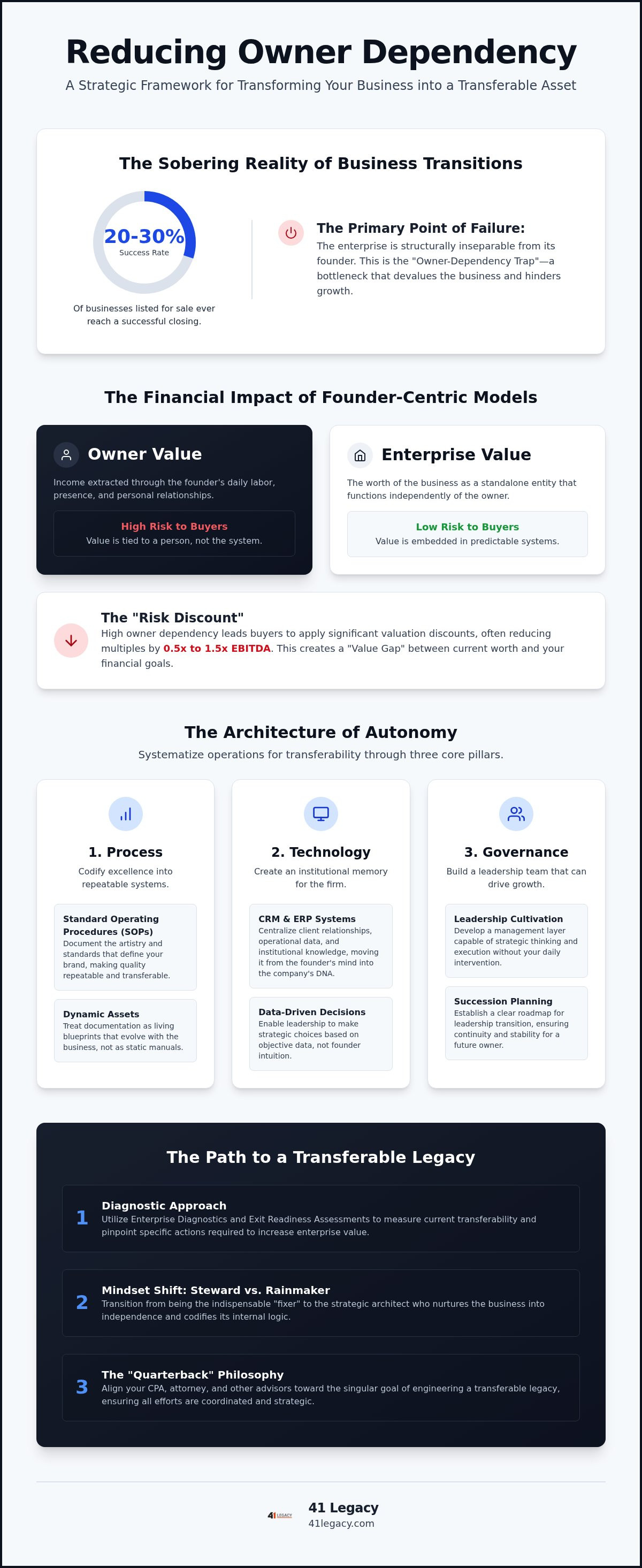
Only 20% to 30% of businesses placed on the market ever reach a successful closing. This sobering reality often stems from a single, structural flaw: the enterprise is inseparable from its architect. You've poured years into perfecting your craft and building a reputation, yet you've likely realized that your presence has become the very bottleneck hindering your growth. Learning how to reduce owner dependency isn't merely about reclaiming your time; it's a deliberate act of stewardship that transforms a personal vocation into a high-value, transferable asset.
We understand the weight of decision fatigue and the quiet anxiety of knowing your legacy might currently be unsellable. This article provides the strategic framework for evolving from a founder-led operation into a truly autonomous enterprise. We'll explore how to bridge the value gap through structured diagnostics and transferability engineering. By the end, you'll have the clarity needed to grow your enterprise value and ensure your business thrives long after you've stepped back from the daily rhythm of operations.
Key Takeaways
- Identify the structural "points of failure" where your presence as a founder creates a bottleneck that devalues the enterprise.
- Implement the three core pillars of systematization—Process, Technology, and Governance—to ensure your business functions with surgical precision in your absence.
- Discover the strategic framework for how to reduce owner dependency by cultivating a leadership team capable of driving growth without your daily intervention.
- Utilize Enterprise Diagnostics and Exit Readiness Assessments to measure your current transferability and pinpoint the specific actions needed to grow enterprise value.
- Understand the "Quarterback" philosophy for aligning your CPA, attorney, and other advisors toward the singular goal of engineering a transferable legacy.
The Owner-Dependency Trap: Why Your Presence Devalues Your Enterprise
Owner dependency is the degree to which your company's heartbeat is tied to your personal pulse. It's found in the sales calls you still lead, the vendor relationships you personally manage, and the operational fires only you can extinguish. While your dedication built the foundation, this reliance is a structural flaw. To build a lasting legacy, you must understand how to reduce owner dependency by shifting your role from the primary engine of the business to its strategic architect.
Many founders fall into the "Rainmaker Trap." In this scenario, you are the most effective salesperson and the keeper of the brand’s most critical relationships. While this feels like strength, it's a profound liability. A potential buyer doesn't want to purchase your personal charisma; they want to purchase a predictable revenue machine. If the revenue stops when you walk out the door, the business is effectively worthless to an outsider. You aren't building an asset; you're simply working a high-stakes job.
The transition toward freedom requires a clear distinction between "Owner Value" and "Enterprise Value." Owner Value is the income you extract through your daily labor. Enterprise Value, however, is the worth of the business as a standalone entity. Transforming your company involves moving from a state of constant tactical intervention to one of high-level governance. You must stop being the hero of the story and start being the author of the system.
The Financial Impact of the Founder-Centric Model
Sophisticated buyers prioritize stability and predictability above all else. If a business relies on your intuition rather than documented systems, it's considered a high-risk investment. Buyers apply significant "risk discounts" to these companies, often reducing valuation multiples by 0.5x to 1.5x EBITDA. This creates a "Value Gap," which is the distance between what your business is worth today and the financial target required for your next chapter. Transferability directly dictates the multiple a buyer is willing to pay.
The Steward vs. The Rainmaker
A Rainmaker hoards knowledge, making themselves indispensable to every transaction. A Steward views the business as a living entity that must be nurtured into independence. This shift is often emotional. It requires letting go of the ego-driven need to be the "fixer" to preserve the company's essence. Professional Succession planning is the hallmark of a steward. It ensures that the company’s internal logic is codified into its operations. Gaining clarity through Determining Enterprise Value is the first step in moving from rainmaker to guardian.
The Architecture of Autonomy: Systematizing Operations for Transferability
Systems are the silent guardians of a company's excellence. They act as the blueprints that allow an enterprise to function with surgical precision long after the architect has left the drafting table. Without these structures, a business relies entirely on the founder's daily intervention. This reliance creates "trapped value," which is knowledge that exists only in the mind of the leader and cannot be transferred to a successor or buyer. Mastering how to reduce owner dependency requires a rigorous commitment to the three core pillars of systematization: Process, Technology, and Governance.
Building the Blueprint: The Role of SOPs
Standard Operating Procedures are not mere administrative chores; they are the foundation of a transferable legacy. They serve to codify the specific artistry and mechanical standards that define your brand. When quality is documented, it becomes repeatable. This ensures that the craftsmanship you've cultivated remains uncompromised by your absence. These should be treated as dynamic assets that evolve with the business, rather than stagnant manuals. Understanding What is an SOP in Business? is essential for any steward looking to build an asset that thrives independently. Using a structured Succession Planning Toolkit can help bridge the gap between founder intuition and institutionalized process.
Leveraging Technology as a Transferability Engine
Technology serves as the institutional memory of the modern firm. CRM and ERP systems do more than track data; they house the vital history of client interactions and operational sequences that once lived only in your memory. By implementing automated workflows, you reduce the friction of daily tasks and ensure that the company’s inner essence is preserved digitally. This technological layer is a critical component of how to reduce owner dependency, as it shifts the burden of memory from the individual to the infrastructure. This engine must always serve the overarching strategy, allowing the team to execute with precision while you focus on high-level governance.
Refining these operational layers is a meticulous process. It requires a dedicated focus on Transferability Engineering to ensure every gear in the machine turns without your hand on the lever. By transforming undocumented wisdom into visible systems, you secure the future of the enterprise and its impact.
Cultivating Strategic Capacity: Building a Leadership Team That Leads
The true measure of an enterprise's maturity is the strength of its leadership core. While systems provide the blueprint, it is the people who breathe life into the machine. A business is only as transferable as the team remaining to steward it. To understand how to reduce owner dependency, one must cultivate what we call Strategic Capacity. This is the collective ability of your team to not only maintain the current rhythm but to orchestrate growth in your absence. By empowering your specialists to execute a Value Growth Roadmap, you shift from a solo performance to a symphony of coordinated excellence. The leadership team assumes the role of the on-field quarterback, coordinating the intricacies of daily operations while aligning with the strategic vision. This orchestration allows you to step into a role of pure governance, focusing on the long-term health of the enterprise rather than the minutiae of the day.
From Tactical Management to Strategic Leadership
There is a profound distinction between those who follow procedures and those who refine them. Tactical managers keep the lights on; strategic leaders identify new avenues for efficiency and impact. Nurturing these Value Drivers within your staff is a fundamental act of legacy preservation. When a successor or buyer evaluates your company, they aren't looking at your individual brilliance. A buyer is purchasing the future cash flows generated by the team's competence, not the owner's effort. Securing your legacy means transforming your role from the primary actor to the director of a self-sustaining production. This transition requires a Strategic Capacity Evaluation to identify where your team is strong and where they require further mentorship.
Decentralizing Customer and Vendor Relationships
Key Person Dependency is a silent erosion of value. If your name is the only one that carries weight with your most vital clients or suppliers, the business remains fragile. You must intentionally transition these relationships to your leadership team. This process involves introducing your specialists as the primary points of contact long before an exit is on the horizon. Building a brand that commands respect independent of your personal presence is a vital component of how to reduce owner dependency. This decentralization ensures that the company's essence remains intact, regardless of who sits in the founder's chair. It is an investment in the permanence of the institution you have built. By stepping back, you allow the enterprise to stand on its own merit.
The Diagnostic Approach: Measuring and Mitigating Owner Reliance
Transformation begins with an uncompromising look at the current state of the enterprise. You can't mitigate what you haven't measured; the diagnostic phase is where we identify the specific points of failure that tether the business to your personal presence. By utilizing structured Enterprise Diagnostics, we reveal the hidden risks that devalue your legacy. This process isn't just about identifying problems; it's about uncovering the path to true autonomy. Understanding how to reduce owner dependency requires a surgical analysis of every operational gear to see where the founder's hand is still required.
The Exit Readiness Assessment: A Mirror for the Owner
This assessment serves as a reflective surface, showing the business as it truly is rather than how you hope it to be. First, we quantify the Value Gap, the distance between your current valuation and the financial objective required for your next chapter. We then score the enterprise on the "4 Cs": Capital, Capability, Customer, and Culture. This scoring reveals the specific tasks that only you can perform, highlighting the areas where transferability is weakest. This clarity is the first step in learning How to Increase Enterprise Value through intentional, data-driven structural changes.
Creating the Value Growth Roadmap
Once the diagnostics are complete, we engineer a Value Growth Roadmap. This plan prioritizes dependency reduction tasks based on their potential return on investment and risk mitigation. We establish Transferability Milestones to track progress over a 12 to 24 month period, ensuring the transition is credible to future stewards or buyers. During this phase, we act as the "Quarterback," aligning your CPA, attorney, and other advisors to ensure every strategic move supports the goal of transferability. Our monthly implementation support provides the necessary accountability to keep the process moving forward, ensuring that the burden of change doesn't stall your daily operations.
Securing the future of your enterprise requires more than just a vision; it requires a documented path. You can begin this process today by engaging with our Exit Readiness Assessment to discover the true potential of your transferable legacy.
Securing the Future: How 41 Legacy Orchestrates Your Value Growth
Building a business that can thrive without its founder is the ultimate expression of stewardship. At 41 Legacy, we serve as the strategic architect for your company’s next chapter, ensuring that your life's work is preserved as a high-value, transferable asset. Our mission is to move you from the exhaustion of daily operational fires to a position of strategic clarity. By focusing on how to reduce owner dependency, we help you engineer an enterprise that commands respect in the marketplace and provides lasting security for your stakeholders.
Central to our approach is the "Quarterback" philosophy. We recognize that your CPA, attorney, and wealth advisors are essential specialists, yet their efforts often remain siloed. We bridge these gaps, aligning every professional advisor toward the singular goal of transferability. This orchestration ensures that the technical precision of your financial and legal structures mirrors the mechanical excellence of your operations. We don't just provide a plan; we lead the execution, ensuring every strategic move strengthens the foundation of your legacy.
The 41 Legacy Process: From Diagnostics to Implementation
Our commitment to excellence extends beyond the initial assessment. While many consultants provide manuals that sit on a shelf, our process is defined by active, monthly implementation support. This structured guidance ensures that your Value Growth Roadmap remains a living document. We provide the necessary accountability to ensure that transferability engineering becomes a natural part of your business rhythm. This level of dedication offers you peace of mind, knowing a team of specialists is united by a singular vision of perfection. Understanding The Certified Exit Planning Advisor Difference reveals the depth of expertise required to navigate these complex transitions with surgical precision.
Your Legacy, Refined and Protected
Approaching your business with the mindset of a master craftsman requires a refusal to settle for anything less than perfection. Building for transferability isn't merely a financial strategy; it is the ultimate act of respect for your employees, customers, and the history you've created. It ensures that the company’s essence remains protected, even as the leadership transitions. When you master how to reduce owner dependency, you are no longer just owning a job; you are governing a masterpiece that can stand the test of time. It's time to step away from the bottleneck and into the role of a visionary guardian. We invite you to Begin your Enterprise Diagnostic today and start the journey of refining your transferable legacy.
Architecting the Permanence of Your Life’s Work
The transition from a founder-led operation to an autonomous enterprise is a deliberate act of stewardship. It requires a shift in perspective, moving from the role of a tactical rainmaker to that of a strategic guardian. By codifying your expertise into resilient systems and empowering a leadership team with strategic capacity, you've discovered how to reduce owner dependency. This transformation ensures that the essence of your business remains intact, regardless of your daily presence. It's the difference between owning a demanding job and governing a high-value, transferable asset.
At 41 Legacy, our CEPA-led advisory team provides the technical precision and national expertise required to navigate this evolution. We utilize proprietary Enterprise Diagnostics and a structured Value Growth Roadmap to align your CPA and attorney toward the goal of transferability. This coordinated effort protects the enterprise value you've spent years cultivating. Your dedication has built a remarkable foundation; it's now time to engineer its lasting impact.
Take the first step toward operational freedom and strategic clarity today. Secure Your Legacy with an Exit Readiness Assessment. We look forward to helping you refine your masterpiece for its next chapter.
Frequently Asked Questions
What is owner dependency and why does it matter?
Owner dependency is the degree to which a company relies on the founder for operations, sales, or critical decision-making. It matters because it directly impacts the transferability of the enterprise. If the business cannot function without your constant oversight, it's essentially a high-paying job rather than a sellable asset. Reducing this reliance is the only way to ensure your legacy survives a transition and commands a premium valuation from sophisticated buyers.
How does owner dependency affect my business valuation?
High levels of dependency introduce significant risk, leading buyers to apply substantial "risk discounts" to your valuation. Verified data indicates that systematized businesses can command multiples 0.5x to 1.5x EBITDA higher than owner-dependent counterparts. For a business with $1 million in EBITDA, this gap represents a significant reduction in enterprise value. Mastering how to reduce owner dependency is therefore a critical financial imperative for any founder seeking to maximize their transferable legacy.
How can I tell if my business is too dependent on me?
The most effective test is the "vacation test." If the business experiences operational friction, declining sales, or a backlog of decisions when you step away for two weeks, dependency is high. Other indicators include being the primary point of contact for top clients or holding undocumented knowledge essential for daily production. Identifying these bottlenecks through Enterprise Diagnostics is the first step toward engineering a truly autonomous and transferable legacy that thrives independently.
How long does it take to reduce owner dependency?
Effectively decoupling a founder from daily operations typically requires 18 to 24 months of focused implementation. This timeline allows for the codification of processes, the implementation of technology, and the mentoring of a leadership team. It's a meticulous process. It shouldn't be rushed if the goal is to present a credible, self-sustaining asset to potential successors or high-value buyers who prioritize stability and predictable future cash flows.
Can a business be 100% independent of its owner?
While an owner may always retain a high-level governance role, the operational machine can and should be 100% independent. This means the business generates revenue, serves customers, and manages its team without the founder’s tactical intervention. Achieving this level of autonomy transforms the business into a passive investment or a legacy asset. It allows the owner to focus on long-term strategy while the company’s inner essence thrives through its own documented systems and leadership.
What are the first steps to take to reduce my daily involvement?
The journey begins with a comprehensive Exit Readiness Assessment to identify your current "points of failure." Once these are identified, you must prioritize the documentation of your most frequent decisions into Standard Operating Procedures. This allows your team to handle routine tasks with precision. Learning how to reduce owner dependency starts with delegating authority, not just tasks, and moving from a "doing" mindset to a "governing" mindset through structured advisory support and monthly implementation.
Do I need to hire a new CEO to reduce owner dependency?
Not necessarily. In many cases, reducing dependency involves elevating existing "Value Drivers" within your staff to leadership roles. By providing these individuals with a clear Value Growth Roadmap and the authority to execute it, you build strategic capacity from within. Hiring an outside executive is an option. However, the primary goal is to ensure the business logic is institutionalized so the company no longer relies on any single individual’s personal intuition or daily effort.
What is the "Value Gap" in exit planning?
The Value Gap is the difference between the current value of your business and the net amount you need to fund your next chapter. This gap is often widened by owner dependency, which suppresses the multiple a buyer is willing to pay. Closing this gap requires a combination of increasing cash flow and improving transferability. Identifying this gap early allows a Certified Exit Planning Advisor to align your professional advisory team toward a successful transition.
Article by
Mike Laskowski
Mike Laskowski is a Business Value Growth Strategist who helps business owners uncover the truths that drive their performance, risk, and readiness. Blending forensic interviewing from a 26‑year federal career with Strategic Capacity analysis and CEPA methodology, he works upstream to reduce owner dependency, increase transferability, and strengthen enterprise value. Mike guides founders through clarity, operational evolution, and transition readiness so their companies become transferable, owner‑independent assets that endure beyond the founder.
Disclaimer
This article is for educational and informational purposes only and does not provide legal, tax, investment, or business brokerage advice. 41 Legacy does not offer M&A brokerage services, legal document drafting, tax preparation, or investment advisory services. Business owners should consult licensed professionals in those disciplines before making decisions related to business transactions, legal matters, tax strategy, or financial planning. All examples are illustrative and may not apply to your specific situation.