
Transferability & Owner Dependency
How to Reduce Owner Dependency: Engineering a Transferable Enterprise
Owner dependency is not a management failure; it is an architectural flaw that devalues the enterprise essence you have worked to build. When you are the primary decision-maker for every detail, you aren't just running a company; you are trapped within its mechanics. Many owners find that despite high revenues, their enterprise value remains stagnant because the business cannot breathe without them. If you've ever wondered how to reduce owner dependency to reclaim your life, you're recognizing the need for a more sophisticated, transferable structure.
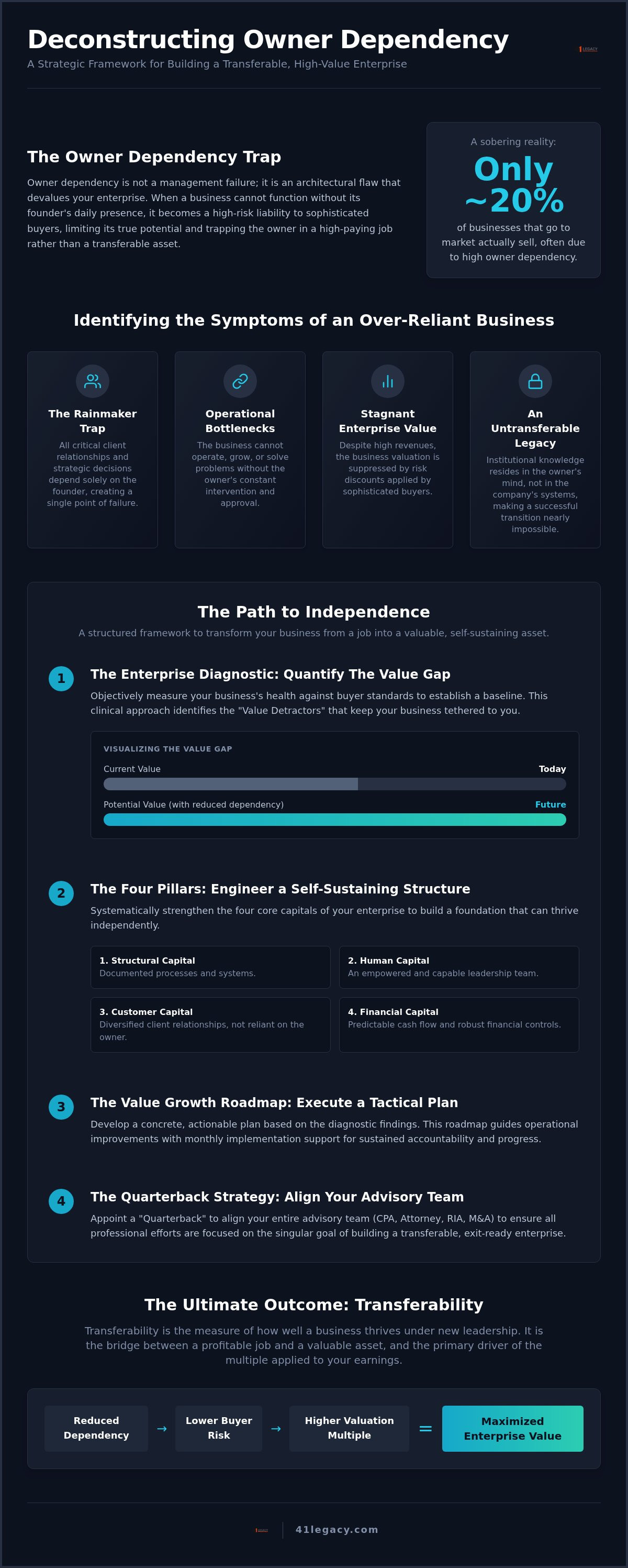
You've likely felt the exhaustion of being the sole engine of growth, fearing that the entire legacy would collapse during a simple vacation. It's a valid concern, especially since only about 20% of businesses that go to market actually sell. We'll provide a strategic framework to decouple your identity from your operations, transforming your work into a high-value asset that appeals to sophisticated buyers. This guide previews the essential role of enterprise diagnostics and value growth roadmaps in engineering a self-sustaining organization. We'll move beyond theory to provide the tactical clarity needed to build a business that thrives independently.
Key Takeaways
- Understand why a business that relies on the founder's daily presence is considered a liability by sophisticated buyers and how to transform it into a transferable asset.
- Learn how to use enterprise diagnostics and the Exit Readiness Assessment to quantify the "Value Gap" between your current and potential enterprise value.
- Discover the strategic framework for how to reduce owner dependency by strengthening structural capital through documented processes and empowering human capital.
- Explore the Value Growth Roadmap as a tactical plan for operational improvement, supported by monthly implementation for sustained accountability.
- Identify the importance of the "Quarterback" role in aligning your advisory team to ensure all professional efforts focus on transferability and long-term health.
The Invisible Ceiling: Why Owner Dependency Devalues Your Life’s Work
Owner dependency represents the invisible tether between a founder’s identity and the firm’s survival. It's the degree to which an enterprise relies on its creator for daily operational breath. While your expertise built the foundation, that same mastery often becomes an architectural flaw. In knowledge-intensive firms, a sophisticated buyer views a founder’s brilliance as a significant liability. They don't see a thriving business; they see a "Rainmaker Trap" where every critical outcome passes through a single person. To scale or exit, you must understand how to reduce owner dependency to liberate the business from its creator.
This requires a profound philosophical shift. You aren't just an operator; you are a steward of a legacy. Transitioning from a job you do to an asset you own is the hallmark of professional maturity. Learning how to reduce owner dependency is not just a tactical choice; it's a strategic imperative for any owner seeking a meaningful exit. Without this shift, the business remains a high-paying role rather than a transferable entity. It's a ceiling that prevents the organization from ever reaching its true potential.
The Fragility of the Founder-Centric Model
Centralized decision-making creates dangerous operational "single points of failure." When every strategic choice and client relationship rests on your shoulders, the enterprise is fragile. This structure takes a heavy emotional toll, leading to burnout as owners realize they cannot step away without the gears grinding to a halt. Sophisticated buyers apply steep discounts to these businesses because the "secret sauce" lives in the owner's mind, not in the company's systems. Effective succession planning addresses these risks by distributing authority across a capable team. Without documented processes, the institutional knowledge vanishes the moment you walk out the door, making the business nearly impossible to transition successfully.
Transferability as the Ultimate Value Multiplier
Transferability is the measure of how well a business thrives under new leadership. It's the primary driver of the "multiple" applied to your earnings. When a business operates independently, it becomes a predictable engine of value rather than a reflection of one person’s effort. Transferability is the bridge between a profitable job and a valuable asset. By focusing on building a transferable enterprise, you ensure your life's work survives your departure. Reducing dependency directly increases the valuation multiple because it lowers the buyer's perceived risk, transforming a precarious income stream into a durable, high-value asset.
The Enterprise Diagnostic: Quantifying the Cost of Your Presence
Engineering a legacy requires more than intuition; it demands clinical precision. The first step in understanding how to reduce owner dependency is an Exit Readiness Assessment. This tool serves as a diagnostic mirror, reflecting the current health of your enterprise against the standards of a sophisticated buyer. Without this baseline, you're navigating without a map. A formal valuation acts as the bedrock for this process, establishing a factual starting point from which all strategic growth is measured. It's impossible to build a bridge to your future without first knowing the exact coordinates of your present location.
Every business possesses two distinct numbers: what it's worth today and what it could be worth if it were structurally sound. The distance between these two figures is the "Value Gap." Enterprise Diagnostics reveal the specific "Value Detractors" that keep your business tethered to your daily effort. These detractors aren't just minor inefficiencies; they're structural leaks that drain potential enterprise value. For example, a customer base that only trusts the founder represents a massive risk to any successor. Identifying these flaws allows you to move from mere maintenance to purposeful engineering.
Identifying the Value Gap
Sophisticated valuations look beyond the balance sheet to assess operational maturity. If your financial performance is strong but your processes are undocumented, a buyer sees a high-risk asset. This "risk discount" can significantly erode your final payout, as the buyer must price in the uncertainty of your departure. You must use data to prove the business can survive without your daily input. By analyzing the correlation between your physical absence and organizational performance, you can pinpoint exactly where the infrastructure needs reinforcement. This data-driven approach transforms subjective fears into objective, solvable engineering problems.
Strategic Capacity Evaluation
True transferability requires a team that owns outcomes rather than just executing tasks. A Strategic Capacity Evaluation examines your leadership’s ability to function under pressure without your direct supervision. This process also identifies "Key Person" risks that may exist beyond the founder, such as a lead engineer or sales director who holds exclusive relationships. You must map out every critical function that currently requires your signature or approval. Once these bottlenecks are visible, you can begin engineering a more resilient structure that thrives on collective competence rather than individual heroics. This evaluation ensures the enterprise is a living entity, capable of growth regardless of who sits in the corner office.
Engineering Independence: Four Pillars of a Self-Sustaining Business
A business that cannot outlast its creator is a fragile monument. To secure your legacy, we must strengthen the four pillars of intangible capital: Structural, Human, Customer, and Social. These elements form the framework of a self-sustaining enterprise. When we discuss how to reduce owner dependency, we are really discussing the intentional redistribution of these capitals from the founder to the organization itself. This transformation ensures that the company’s value is inherent in its systems rather than its personalities. It's the difference between owning a job and curating an enduring asset.
Systematizing the Essence of the Enterprise
Most firms operate on "tribal knowledge," where critical insights are trapped in the minds of a few veterans. This creates a dangerous bottleneck that limits growth. We believe that true independence begins with Structural Capital. You must move toward documented processes that capture the unique essence of your work. Understanding what is sop in business serves as the foundation for this effort. These Standard Operating Procedures (SOPs) are not merely bureaucratic lists; they are the architectural blueprints for your success. By creating a comprehensive "Playbook," you allow the business to scale and perform with precision without your constant oversight.
Transitioning High-Value Relationships
Customer Capital is often the most difficult pillar to detach from the founder. Buyers are inherently risk-averse; they fear customer concentration where the primary revenue drivers are tied specifically to your personal reputation. We utilize a disciplined three-step process to transition these high-value relationships. First, we introduce the team as the primary point of contact. Next, we allow the team to lead while the owner shadows. Finally, the owner retreats to a purely strategic role. This ensures the brand stands independent of any one individual. A business that belongs to its clients, rather than just its founder, is an asset of rare and immense value.
Human and Social Capitals complete this structure. Human Capital involves empowering a leadership team to own strategic outcomes, not just task completion. Social Capital is the culture of accountability you build within the walls of your firm. Cultivating a culture of strategic clarity is how to reduce owner dependency at its most profound level. It requires a team that doesn't just follow orders but understands the "why" behind every decision. When these four pillars are aligned, the enterprise achieves a state of operational grace. It becomes a living entity, capable of thriving across generations. This is the ultimate goal of Transferability Engineering: a business that carries your signature but no longer requires your hands.
The Value Growth Roadmap: A Structured Path to Strategic Oversight
The Value Growth Roadmap is the definitive tactical plan for operational improvement, serving as the bridge between current fragility and future independence. It transforms the owner’s role from a General Manager, entangled in the daily friction of production, to a Board Chairman who provides high-level strategic oversight. Understanding how to reduce owner dependency requires this fundamental mental evolution. You aren't just stepping away; you are elevating your perspective to protect the long-term health of the enterprise. To verify progress, we utilize stress-test absences. These intentional departures, ranging from two weeks to a full month, reveal exactly where the architectural integrity of the business remains dependent on your presence. If the gears continue to turn without your intervention, the transformation is taking root.
Building a Leadership Team for the Future
Scaling beyond your own capacity requires hiring for strategic capacity rather than mere technical skill. You need leaders who can navigate complexity and own outcomes, not just employees who execute tasks under your watchful eye. Implementing incentive structures that align your team with enterprise value ensures that everyone is invested in the company’s success, not just their individual roles. The ideal transition occurs when the founder evolves from the primary engine of production into the strategic guardian of the firm's vision and value. This shift creates a resilient organization capable of thriving in any environment, independent of any single person's effort.
Implementation and Accountability
Most owners fail to reduce dependency because the gravitational pull of daily operations is too strong. Without external implementation support, strategic goals are often sacrificed for the sake of the immediate crisis. Monthly advisory serves as the vital mechanism for keeping the roadmap on track, providing the necessary distance to view the business objectively. We track specific Dependency Metrics as part of your monthly reporting, ensuring that every operational shift moves the needle toward transferability. These metrics might include the percentage of sales closed without founder involvement or the number of operational decisions made by the leadership team. Learning how to reduce owner dependency is a marathon of discipline, not a sprint of effort. If you're ready to begin this transformation, you can develop your Value Growth Roadmap to secure your professional legacy.
The Quarterback Strategy: Aligning Your Advisory Team for Exit Readiness
Your current advisors are essential guardians of your wealth and legal standing, but they often lack the specific training required for transferability engineering. A CPA ensures your tax compliance, while an attorney protects you from liability. However, these specialists rarely look at the operational architecture to understand how to reduce owner dependency. This gap creates a fragmented strategy where legal and financial decisions aren't aligned with the ultimate goal of enterprise independence. Without a central vision, your advisory team operates in silos, leaving the heavy lifting of operational transition solely on your shoulders. Strategic clarity requires a different perspective, one that views the business as a whole rather than a collection of separate departments.
We act as the "Quarterback" for your professional advisory team, ensuring that every specialist is moving in the same direction. This role is about more than just communication; it's about strategic alignment. When financial, legal, and operational planning are unified, the burden on the owner is significantly reduced. A unified front ensures that a tax strategy doesn't inadvertently hinder a future transition or that a legal structure doesn't complicate operational scaling. By breaking down these silos, we transform your advisors into a cohesive unit focused on a single outcome: a transferable asset. This coordination is the final piece of the puzzle in learning how to reduce owner dependency and reclaim your personal freedom.
Coordinating the Advisory Team
Succession planning is often treated as a series of isolated events, yet it's truly a continuous process of alignment. Every advisor you employ should be working toward the same goal of building a transferable asset. When silos are broken down, the owner's burden during the transition process is dramatically lightened. You no longer need to be the translator between your attorney and your CPA. Instead, a unified strategy ensures that every legal document and tax filing supports the long-term health and transferability of the enterprise. This collective focus preserves the essence of your work while preparing the organization for a future that doesn't require your constant presence.
Preparing for the Ultimate Transition
Readiness is the only way to protect the value of your life's work. It's a proactive stance that ensures your legacy is preserved regardless of when or why you choose to step away. Exit Readiness Assessments serve as the master plan, aligning legal and tax decisions with the operational reality of your business. There's a profound peace of mind that comes from knowing your business thrives in your absence. This state of operational grace is the ultimate reward for your stewardship. 41 Legacy stands as your strategic partner in this pursuit, providing the precision and oversight needed to bridge the gap between where you are and where you wish to be. Begin your journey toward a transferable asset with 41 Legacy.
Securing Your Legacy Through Strategic Independence
Building a business that thrives in your absence is the ultimate expression of stewardship. It requires moving beyond the friction of daily operations to focus on transferability and long-term enterprise value. You've discovered that this transformation begins with an honest diagnostic to bridge the Value Gap and continues through the disciplined implementation of a Value Growth Roadmap. By mastering how to reduce owner dependency, you transform your life's work from a personal role into a sophisticated, transferable asset that appeals to the most discerning buyers.
At 41 Legacy, we specialize in this architectural evolution. Led by a Certified Exit Planning Advisor (CEPA), our team acts as the strategic "Quarterback" for your advisory group, ensuring every decision strengthens your company’s foundation. We focus on engineering lasting value rather than simple transaction brokerage. Your legacy deserves a structure as resilient as the vision that created it. It's time to move from the center of the machine to the head of the table. Schedule Your Exit Readiness Assessment with 41 Legacy. Your future of operational freedom and strategic clarity is within reach.
Frequently Asked Questions
What is the first step in reducing owner dependency?
The first step is undergoing a formal Enterprise Diagnostic or Exit Readiness Assessment to establish a factual baseline. This diagnostic allows you to identify specific value detractors and quantify the distance between your current state and your potential enterprise value. By establishing these coordinates, you move from subjective management to purposeful engineering. It's the essential foundation for any owner seeking strategic clarity and a truly transferable legacy.
How long does it typically take to make a business owner-independent?
Transforming a business into an owner-independent asset typically requires significant preparation, often taking 6 to 12 months to address operational and financial dependencies. While the initial diagnostic happens quickly, the implementation of a Value Growth Roadmap requires disciplined, monthly effort. This steady pace ensures that structural changes are deeply integrated into the company’s culture. Rushing this process risks the architectural integrity of the enterprise.
Will reducing my involvement in the business decrease its quality?
Reducing your involvement should actually enhance quality by replacing individual intuition with documented Standard Operating Procedures. When the "essence" of your process is captured in structural capital, excellence becomes a repeatable outcome rather than a lucky occurrence. This transition ensures that the brand’s reputation is upheld by the system, not just the founder. It liberates you while protecting the meticulous standards you’ve established.
How do I know if my business is currently too dependent on me?
You can determine your level of dependency by conducting a "stress-test" absence or analyzing your daily decision volume. If the enterprise requires your approval for routine tasks or if operations halt during a two-week vacation, the business is too dependent on you. Identifying these bottlenecks is the first phase of learning how to reduce owner dependency. High dependency suggests you own a job rather than a transferable asset.
Can a small business really run without the owner present?
A small business can certainly operate without the owner present if it is built on the four pillars of intangible capital. Transferability engineering is not reserved for large corporations; it's an architectural standard for any enterprise seeking to be a high-value asset. By empowering a leadership team and systematizing operations, even a boutique firm can thrive independently. This independence is what makes the business attractive to sophisticated buyers.
What is the difference between an exit plan and reducing owner dependency?
An exit plan focuses on the final transition of ownership, while reducing owner dependency is a value-growth strategy that makes that exit possible. Dependency reduction is the operational work of building a transferable asset that can survive the founder’s departure. While an exit plan outlines the "when" and "how" of a sale, reducing dependency ensures there is a valuable, self-sustaining entity to sell.
How does owner dependency affect my company's valuation?
Owner dependency acts as a significant risk discount in professional valuations, often leading to lower earnings multiples. Sophisticated buyers are risk-averse and will discount businesses where the revenue is tied specifically to the founder's personal effort. Learning how to reduce owner dependency is the most effective way to increase your company's valuation multiple. It transforms a precarious income stream into a durable, high-value enterprise.
Do I need to hire a new CEO to reduce my dependency?
You don't necessarily need to hire a new CEO; often, the solution lies in empowering your existing leadership team. The goal is to move from a founder-centric model to a leader-led organization where outcomes are owned by the team. This might involve refining incentive structures or clarifying strategic roles. It's about building the strategic capacity of the entire organization rather than simply finding a single replacement.
Disclaimer
This article is for educational and informational purposes only and does not provide legal, tax, investment, or business brokerage advice. 41 Legacy does not offer M&A brokerage services, legal document drafting, tax preparation, or investment advisory services. Business owners should consult licensed professionals in those disciplines before making decisions related to business transactions, legal matters, tax strategy, or financial planning. All examples are illustrative and may not apply to your specific situation.