
How to Reduce Owner Dependency: Engineering a Transferable Business Asset
What if the very engine of your success is the same force devaluing your legacy? For many founders, the business is a masterpiece that requires their constant touch to remain vibrant; however, understanding how to reduce owner dependency is the only way to ensure your work becomes a lasting monument rather than a temporary achievement. Without this shift, the enterprise remains tethered to your presence, losing its essence the moment you step away from the daily operations.
You likely agree that true success isn't just building a company, but building one that thrives independently of its creator. We promise to provide the strategic framework for evolving from an indispensable founder to a steward of a high-value, transferable enterprise. This guide explores the principles of transferability engineering and explains how to reduce owner dependency through structured diagnostics and leadership development. By learning how to reduce owner dependency, you'll gain the strategic clarity needed to prepare for an eventual exit while finally securing the personal freedom you've earned.
Key Takeaways
- Recognize how the "Rainmaker Trap" devalues your legacy by making the survival of the enterprise contingent on your daily presence.
- Discover how to reduce owner dependency through Transferability Engineering, treating your internal systems as a blueprint for an independent and valuable asset.
- Evaluate your team’s Strategic Capacity to distinguish between hiring task-oriented helpers and developing leaders who can steer the company without you.
- Implement a structured roadmap that begins with an Enterprise Diagnostic to pinpoint operational friction and codify your unique business processes.
- Understand why a professional Exit Readiness Assessment is the essential diagnostic tool for securing personal freedom and long-term market attractiveness.
The Rainmaker Trap: Why Being Indispensable Devalues Your Legacy
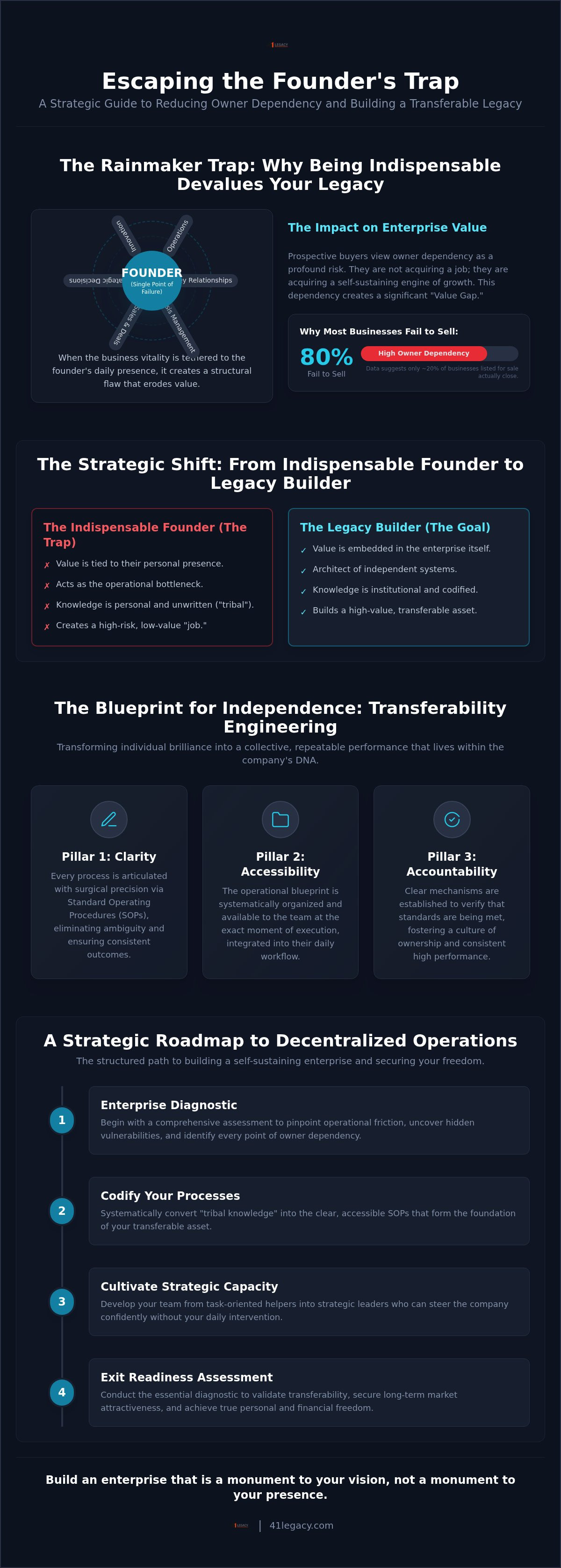
Owner dependency is the structural flaw that occurs when a business's vitality is tethered to the founder's daily presence. It's a silent erosion of what should be a lasting monument. While your talent built the foundation, that same talent often creates the Rainmaker Trap. This is the moment where your unique ability to close deals or resolve crises becomes the very thing that prevents the business from thriving without you. When a founder is the primary relationship holder, the enterprise isn't a transferable asset. It's a personalized service. This distinction is critical for those seeking to understand how to reduce owner dependency and elevate their company to a higher tier of market attractiveness.
Prospective buyers view this dependency as a profound risk. If the essence of the business walks out the door with the owner, the value of the remaining shell drops. This creates a Value Gap. It's the difference between the price a business could command as a self-sustaining entity and its current price, weighted down by founder reliance. Data from the Exit Planning Institute suggests that only about 20% of businesses listed for sale actually close. A primary driver of this failure is the inability to prove the business can survive without the founder. Buyers aren't looking to purchase a job; they're looking for an engine of growth that operates independently of its creator.
The Psychology of the Indispensable Founder
Founders often fall into a subtle ego trap. They subconsciously relish being the hero who saves the day, yet this instinct creates a Bottleneck Effect. Every strategic decision must pass through a single point of failure. Building a legacy requires a deliberate shift in identity. You must transition from being a job creator to a legacy builder. You're an architect creating a structure that must stand long after you've departed. If you're always the smartest person in the room, the room can't grow beyond your own limitations. True stewards recognize that their greatest contribution is the creation of a culture that functions without their direct intervention.
Measuring the Impact on Enterprise Value
External buyers don't just buy cash flow. They buy the certainty that the cash flow will continue. Owner reliance increases perceived risk, which leads to lower valuation multiples. At 41 Legacy, we use Enterprise Diagnostics to uncover these hidden vulnerabilities. These assessments reveal exactly where the owner's shadow is too long, obscuring the team's ability to perform. Learning how to reduce owner dependency through these diagnostics is what separates a stagnant company from a high-value asset. Transferability is the ultimate metric of a successful business. A business that operates independently holds its value in any market, providing the steward with genuine peace of mind and strategic clarity.
Transferability Engineering: The Architecture of an Independent Enterprise
Systematization is an act of high-order craftsmanship. It's the deliberate process of building a machine that operates with rhythmic precision even when the master artisan isn't present. Most founders rely on "tribal knowledge," which is the unwritten wisdom stored in their own minds or within a small circle of veteran employees. This creates a fragile structure that cannot scale or survive a transition. To evolve, you must institutionalize this excellence through transferability engineering. This is the core of how to reduce owner dependency: turning individual brilliance into a collective, repeatable performance that lives within the company's DNA.
SOPs as the Foundation of Value
Standard Operating Procedures are far more than administrative checklists. They are the tactical how to increase enterprise value by proving that your results are not accidental but engineered. Standard Operating Procedures are the Blueprints for a Transferable Legacy. To build a high-value asset, your documentation must rest on three essential pillars:
- Clarity: Every step must be articulated with surgical precision to eliminate ambiguity and ensure a consistent outcome.
- Accessibility: The blueprint must be available to the team at the exact moment of execution, integrated into their daily flow.
- Accountability: There must be a clear mechanism to verify that the standard is being met and refined over time.
When these pillars are in place, the business begins to breathe on its own. You're no longer just documenting tasks; you're engineering a scalable workflow that attracts premium buyers who value stability. This clarity provides the foundation for an eventual exit, ensuring the essence of your work is preserved.
Decentralizing Customer and Vendor Relationships
A significant risk to any legacy is the concentration of social capital in a single individual. If your customers only buy because they know you personally, your enterprise value is inherently limited by your own bandwidth. You must transfer these relationships to the broader team to prevent "Key Man" dependencies. This transition requires moving from founder-led sales to a systematized revenue engine where the brand, not the person, carries the weight of trust. By introducing your team as the primary guardians of the client experience, you ensure the business remains a living entity that thrives through its collective reputation. If you're ready to evaluate your current organizational structure, a Strategic Capacity Evaluation can reveal exactly where these dependencies reside and how to resolve them.
Leadership vs. Management: Cultivating Strategic Capacity
Management is the orchestration of the present, but leadership is the guardianship of the future. While systematization provides the structural blueprints, the human element determines the ultimate resilience of the asset. Many founders mistake a group of efficient "helpers" for a leadership team. Helpers are capable individuals who execute tasks with precision, yet they remain tethered to the owner's instruction. To understand how to reduce owner dependency, one must cultivate strategic capacity: the collective ability of a team to lead, decide, and innovate without the founder's intervention.
Empowerment is not merely the delegation of tasks; it's the transfer of the burden of decision-making. When a team operates under a culture of accountability, they take ownership of the outcomes rather than just the activities. This shift is essential for mastering how to reduce owner dependency and building a transferable enterprise. Succession planning should not be viewed as an end-of-career event but as a continuous refinement of the organization's leadership depth. By developing leaders who can navigate complexity independently, you're not just filling seats. You're increasing the market attractiveness of your legacy.
The Strategic Capacity Evaluation
A rigorous assessment of your team's current capabilities is the first step toward decentralization. We utilize a Strategic Capacity Evaluation to determine if your leadership has the bandwidth to execute a Value Growth Roadmap. This process identifies talent gaps that might threaten long-term transferability. Investing in talent development is a direct investment in enterprise value. A business with a deep, capable bench is a far lower risk for a potential successor than one where all strategic intelligence resides in a single office.
The Role of the 'Quarterback' in Team Development
Cultivating this capacity requires a coordinated effort between the owner and their professional advisors. We act as the "quarterback" for this transition, ensuring that leadership strategies align with your ultimate exit goals. This involves close coordination with your CPAs and attorneys to ensure that incentive structures are both tax-efficient and legally sound. We maintain a "professional-room altitude," providing the calm and authoritative guidance needed to navigate the emotional weight of leadership transitions. This structured advisory support ensures that the transition from founder-led to team-driven is seamless, preserving the essence of the business while engineering its independence.
A Strategic Roadmap to Decentralized Operations
Engineering a transferable asset is a disciplined progression. It's a series of calculated maneuvers designed to separate the creator's identity from the enterprise's function. Understanding how to reduce owner dependency requires a phased approach that moves from diagnostic clarity to operational autonomy. This roadmap ensures that every system is polished to a high sheen, reflecting the meticulous nature of the work itself. We don't just build businesses; we architect independent entities capable of thriving across generations.
Phase 1 begins with an Enterprise Diagnostic. This process identifies exactly where the founder is most "stuck" in the daily gears. It reveals the invisible threads that tie the business's survival to your constant pulse. Once these friction points are mapped, we move to Phase 2: Process Documentation. This is the codification of your "secret sauce." We transform tribal knowledge into a permanent institutional record, ensuring the brand's essence is preserved and repeatable by others.
Phase 3 involves purposeful delegation and rigorous testing. You must create intentional distance to find the structural cracks that only emerge when you step away. Finally, Phase 4 focuses on optimization. Here, refinement is driven by performance metrics rather than founder intuition. This shift from gut feeling to data-driven oversight is the hallmark of a mature, transferable enterprise. It's the moment when the business stops being a reflection of your labor and starts being a testament to your design.
Testing the Systems: The 'Vacation Test'
Short, deliberate absences serve as essential stress tests for your independent operational capacity. These periods of separation expose the "Single Points of Failure" that often remain hidden under the guise of founder efficiency. When a workflow stalls in your absence, it provides the precise feedback needed to refine your what is sop in business framework. These tests aren't failures; they're the diagnostic data points required to build a resilient, self-sustaining monument. By identifying these gaps early, you ensure the blueprint is robust enough for a future transition.
Implementing Technology and Tracking Metrics
Information Systems provide the curatorial oversight necessary for decentralized operations. By developing a "Value Dashboard," you can monitor the KPIs that matter most to potential buyers, such as recurring revenue and customer acquisition costs. This technological layer allows you to maintain strategic clarity without descending into micromanagement. It bridges the gap between your high-level vision and the team's granular execution. If you're ready to begin this evolution, our Value Growth Roadmap provides the structured support needed to engineer true independence.
The Exit Readiness Assessment: Your Diagnostic for True Freedom
Readiness is not merely a state of preparation for a transaction; it's a profound declaration of operational excellence. For many founders, the concept of an exit feels distant or even premature. However, a professional exit readiness assessment serves as the essential diagnostic for understanding the current health of your enterprise. It identifies the invisible anchors that prevent your business from reaching its full potential. By uncovering these friction points, you gain the strategic clarity required to master how to reduce owner dependency and transform your daily labor into a transferable asset.
Our approach at 41 Legacy goes beyond simple diagnostics. We provide Monthly Implementation Support to ensure that the findings of your assessment are translated into tangible results. A roadmap is only as valuable as the discipline used to follow it. We act as the "Quarterback" for your existing team of advisors, including your CPA, attorney, and wealth manager. This coordination ensures that every technical adjustment, from tax structures to legal protections, is aligned with the singular goal of building a business that can thrive independently of its creator. The result is an enterprise that is always ready for a transition, whether internal or external, providing you with the ultimate form of strategic freedom.
The Coordinated Advisory Advantage
Your existing advisors are masters of their specific disciplines, yet they often operate in silos. Without a strategic lead to align their efforts toward transferability, critical opportunities for value growth can be missed. We provide the "professional-room altitude" necessary to harmonize these diverse perspectives. Every decision made today must be viewed through the lens of increasing the enterprise value of tomorrow. This structured oversight provides a sense of peace that only comes from knowing your legacy is being handled with the precision it deserves. You are no longer managing a series of disconnected tasks; you are overseeing a unified strategy for long-term impact.
Building Your Legacy as a Master Craftsman
The transition from an indispensable founder to a steward of an enduring entity is the final act of a master craftsman. You've spent years refining your trade and building a foundation of excellence. Now, the ultimate test of that work is its ability to stand on its own. A business that no longer requires your presence is not a sign of your obsolescence; it's the highest proof of your leadership. It's a living monument that reflects your values while offering you the personal freedom you've earned. If you're ready to evolve from the "Rainmaker" to the architect of a self-sustaining enterprise, Begin your journey to a transferable legacy with 41 Legacy. We'll help you engineer an asset that carries your essence forward into the future.
Architecting a Future Beyond the Founder
Transitioning from an indispensable founder to a steward of a high-value enterprise is the ultimate achievement in business ownership. We've explored how transferability engineering and the development of strategic capacity within your leadership team create a foundation that survives beyond your daily presence. By mastering how to reduce owner dependency, you aren't just gaining personal freedom; you're significantly increasing the market attractiveness and long-term resilience of your life's work. It's the essential shift from owning a job to presiding over a lasting legacy.
This transformation requires a disciplined, structured approach. Led by a Certified Exit Planning Advisor (CEPA), 41 Legacy utilizes a comprehensive Enterprise Diagnostics process and monthly implementation support to ensure your roadmap remains on course. We provide the professional accountability needed to turn strategic clarity into a tangible, transferable asset. Your business is a masterpiece. It deserves a future that honors its past while thriving in its independence.
Secure your business legacy with an Exit Readiness Assessment from 41 Legacy
Frequently Asked Questions
What is owner dependency and why does it matter for my business valuation?
Owner dependency measures the extent to which an enterprise's vitality is anchored to the founder's presence. It is a primary driver of risk in any valuation. Buyers apply a significant discount to owner-dependent firms because the future cash flow is viewed as fragile. By understanding how to reduce owner dependency, you mitigate this risk, allowing your business to command a premium multiple at the higher end of the industry range.
How can I tell if my business is too dependent on me?
The most definitive diagnostic is the "Vacation Test." If the enterprise stalls or customer satisfaction declines during your absence, dependency is critical. You should also evaluate your daily decision volume. If your team cannot resolve tactical issues without your final approval, you've created a bottleneck. This lack of strategic capacity indicates that the business is a personalized service rather than a transferable asset that can thrive independently.
Will reducing my involvement lead to a decrease in service quality?
Decentralization actually elevates quality by replacing individual intuition with institutionalized excellence. When you codify your standards into precise blueprints, you ensure a consistent, premium experience for every client. Systematization removes the variability of human error and allows your team to execute with the same technical precision you once provided. This shift preserves the brand's essence while enabling the business to scale without compromising its foundational standards.
How long does it typically take to significantly reduce owner dependency?
Engineering true independence is a deliberate process that typically spans 12 to 24 months. This timeframe is necessary to document complex workflows, cultivate leadership talent, and stress-test the new systems through periods of founder absence. It's a meticulous evolution of the company's DNA. Using a structured Value Growth Roadmap ensures that each phase of transferability engineering is executed with the required depth and maintains long-term accountability for the founder.
What are the first steps to documenting processes if I've never done it before?
Begin by identifying the "critical path" workflows that directly impact your enterprise value.
- Capture processes using video tools to preserve the nuances of your work.
- Draft Standard Operating Procedures based on these recordings.
- Test the blueprints by having a team member execute the task independently.
Can a business really run entirely without the founder's input?
A sophisticated enterprise can indeed operate without the founder's tactical input. The objective is to make your daily involvement optional, allowing you to serve as a high-level steward rather than a technician. While you may still provide strategic vision, the operational engine should generate predictable results independently. This level of autonomy is the hallmark of a truly transferable asset and the ultimate goal of any dedicated legacy builder.
How does reducing owner dependency improve my options for an exit?
Independence creates a broader spectrum of transition opportunities. A self-sustaining business is highly attractive to external buyers, private equity, and internal management buyouts because it represents a lower risk. When you master how to reduce owner dependency, you gain the leverage to exit on your own terms. It ensures that the enterprise value is preserved during the transition, providing you with both strategic clarity and the personal freedom you've earned.
What role does a Certified Exit Planning Advisor (CEPA) play in this process?
A Certified Exit Planning Advisor serves as the "quarterback" for your entire advisory team. They align the efforts of your CPA, attorney, and wealth manager to ensure every operational change supports your ultimate legacy goals. Through structured Enterprise Diagnostics, they provide the technical precision needed to engineer a transferable asset. This coordinated oversight ensures that your business is built to last while maximizing its value for a future internal or external transition.

Article by
Mike Laskowski
Mike Laskowski is a Business Value Growth Strategist who helps business owners uncover the truths that drive their performance, risk, and readiness. Blending forensic interviewing from a 26‑year federal career with Strategic Capacity analysis and CEPA methodology, he works upstream to reduce owner dependency, increase transferability, and strengthen enterprise value. Mike guides founders through clarity, operational evolution, and transition readiness so their companies become transferable, owner‑independent assets that endure beyond the founder.
Disclaimer
This article is for educational and informational purposes only and does not provide legal, tax, investment, or business brokerage advice. 41 Legacy does not offer M&A brokerage services, legal document drafting, tax preparation, or investment advisory services. Business owners should consult licensed professionals in those disciplines before making decisions related to business transactions, legal matters, tax strategy, or financial planning. All examples are illustrative and may not apply to your specific situation.